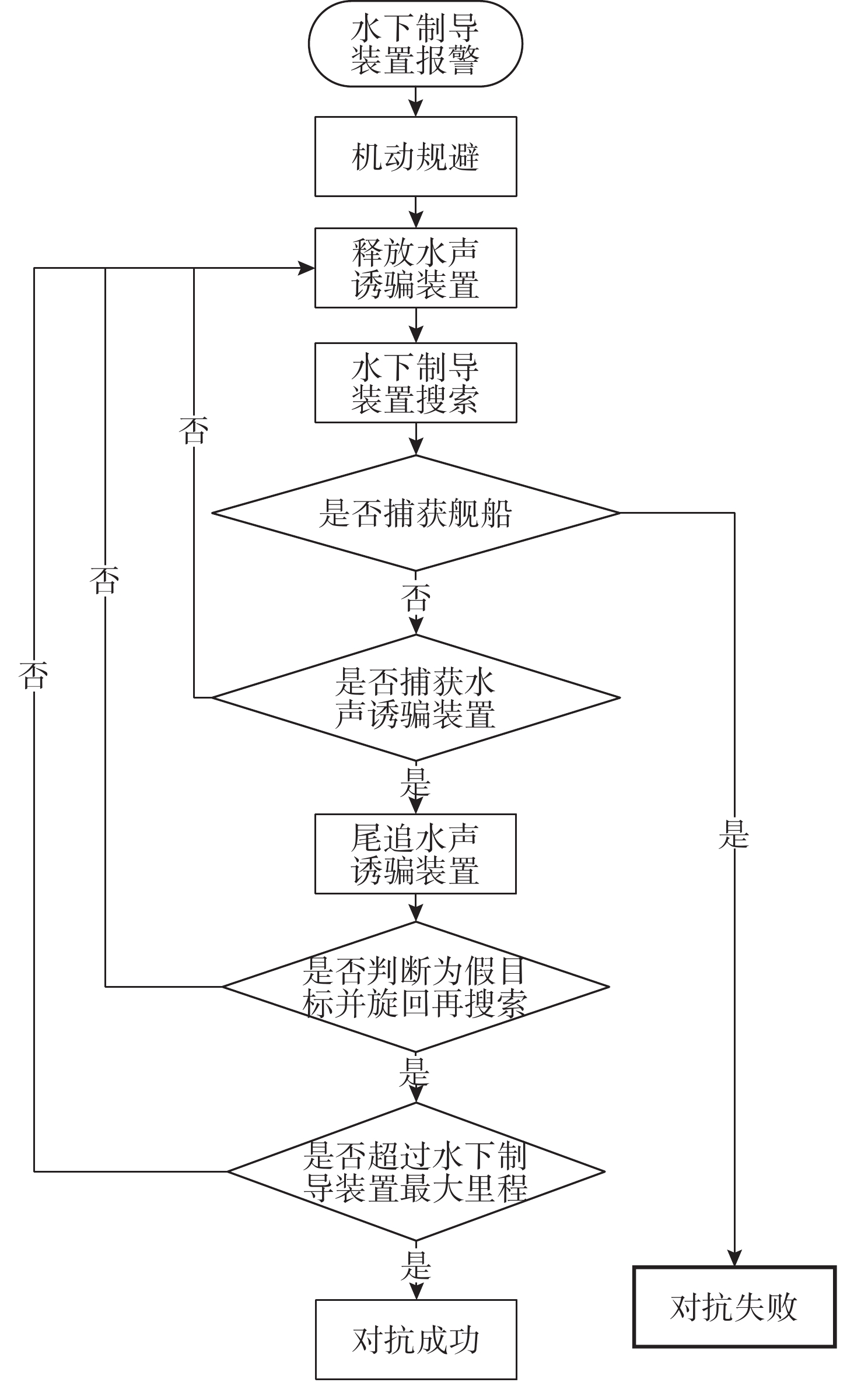


Optimization of Cooperative Countermeasure Strategy for Underwater Acoustic Deception Devices Based on Adaptive Mutation PSO
-
摘要: 针对水面舰船防御水下制导装置时, 多枚水声诱骗装置协同对抗体系研究不足, 且传统穷举法存在效率低、可移植性差的问题, 文中引入粒子群优化算法对对抗模型进行优化, 并通过添加自适应惯性权重与多半径变异机制改进该算法; 同时, 构建以防御成功率、最小交战距离及舰船存活时间为核心指标的多目标优化函数, 优化舰船规避航向以及2枚助飞式水声诱骗装置的发射距离与角度。仿真结果表明, 所提改进算法相较传统算法具备更高效率、更快收敛速度与更优适应度, 同时揭示了不同舷角态势下最优对抗策略的差异性及其战术价值, 为水下制导装置防御策略制定提供重要参考。Abstract: To address the insufficient research on the cooperative combat system of multiple underwater acoustic deception devices when surface ships defend against underwater guidance devices, as well as the problems of low efficiency and poor portability of traditional exhaustive methods, this paper introduced the particle swarm optimization(PSO) algorithm to optimize the countermeasure model and improved the algorithm by introducing an adaptive inertia weight and a multi-radius mutation mechanism. Meanwhile, the paper established a multi-objective optimization function with core indicators including defense success rate, minimum engagement distance, and ship survival time to optimize the ship’s evasive course, as well as the launch distance and angle of two flying-aided underwater acoustic deception devices. Simulation results show that the proposed improved algorithm has higher efficiency, faster convergence speed, and better fitness compared with traditional algorithms. It also reveals the differences in optimal countermeasure strategies under different bearing angle situations and their tactical values, providing an important reference for the formulation of defense strategies against underwater guidance devices.
-
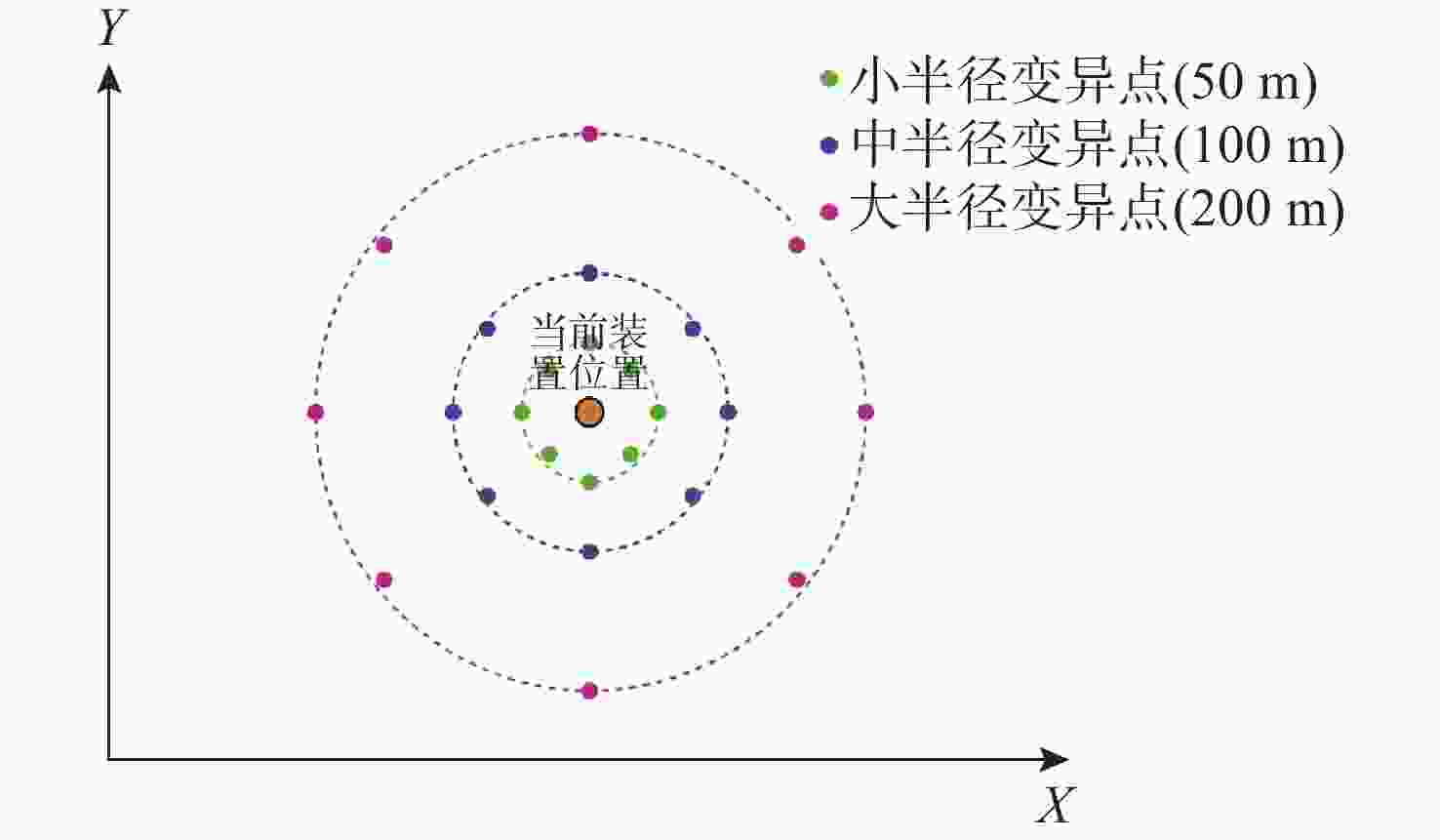
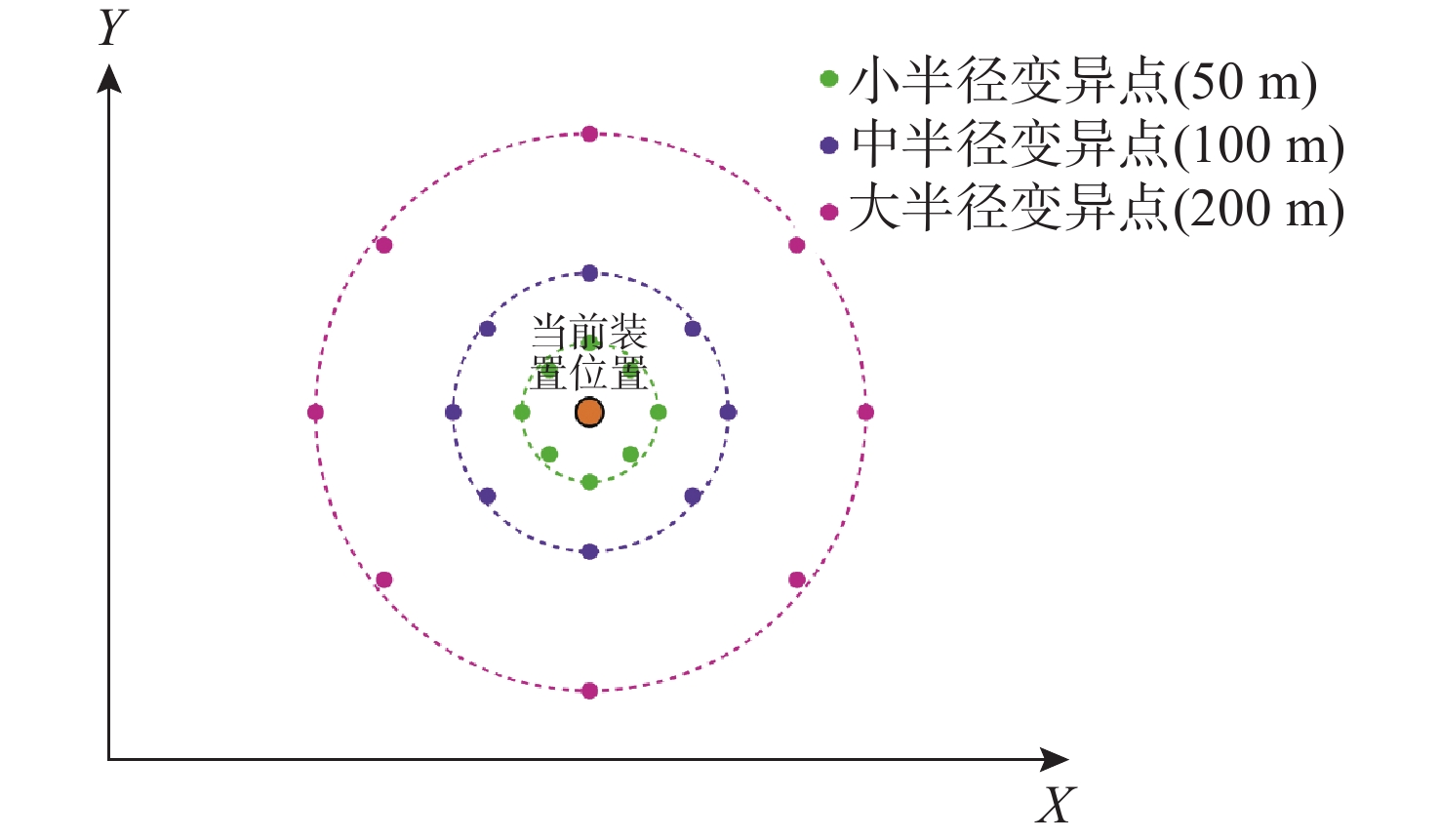
图 3 水声诱骗装置参数多半径变异示意图
Figure 3. Schematic diagram of multi-radius parameter variation of underwater acoustic deception device
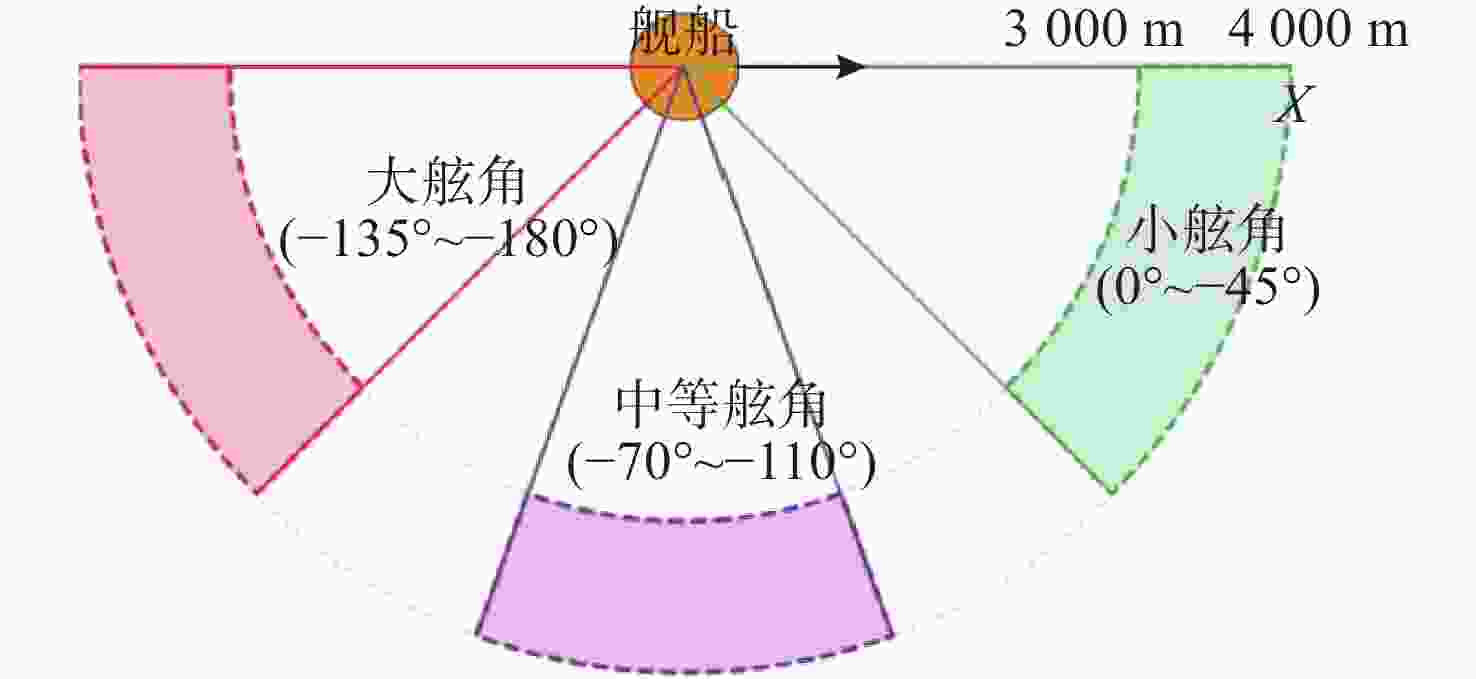
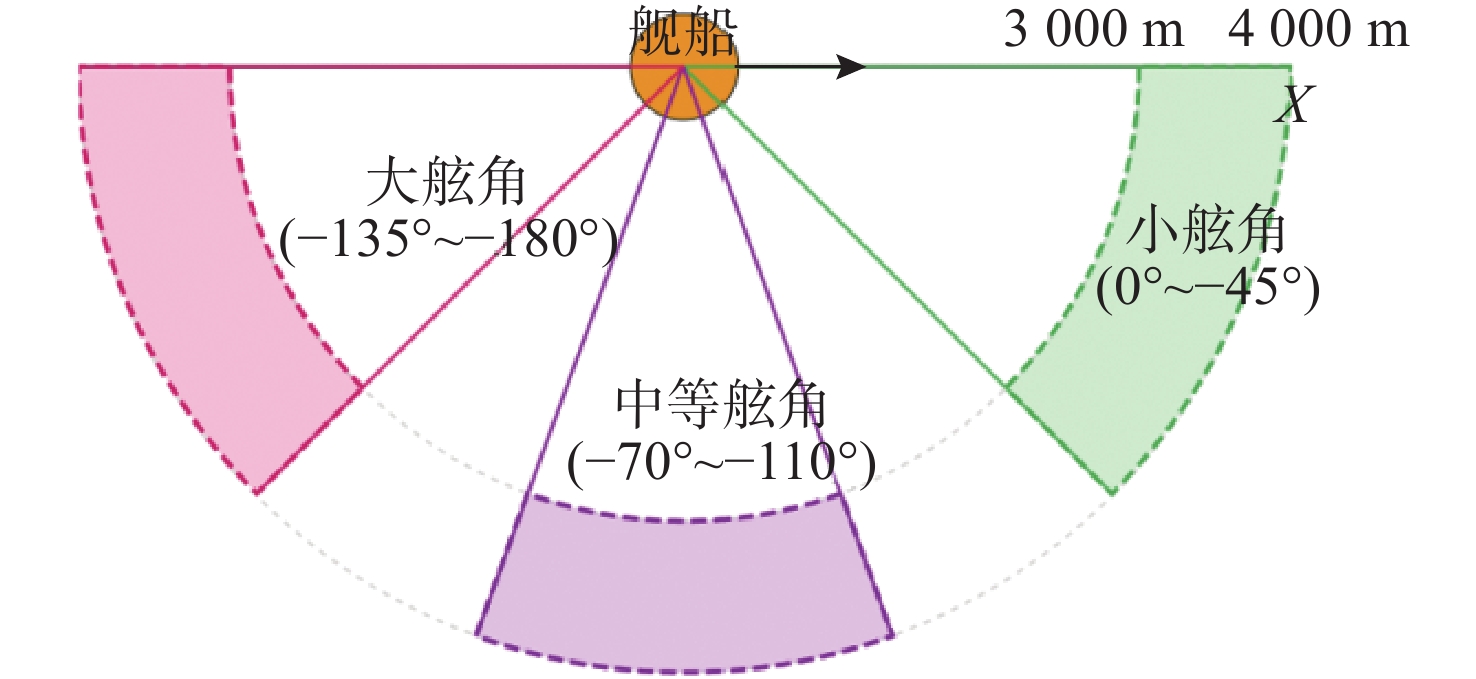
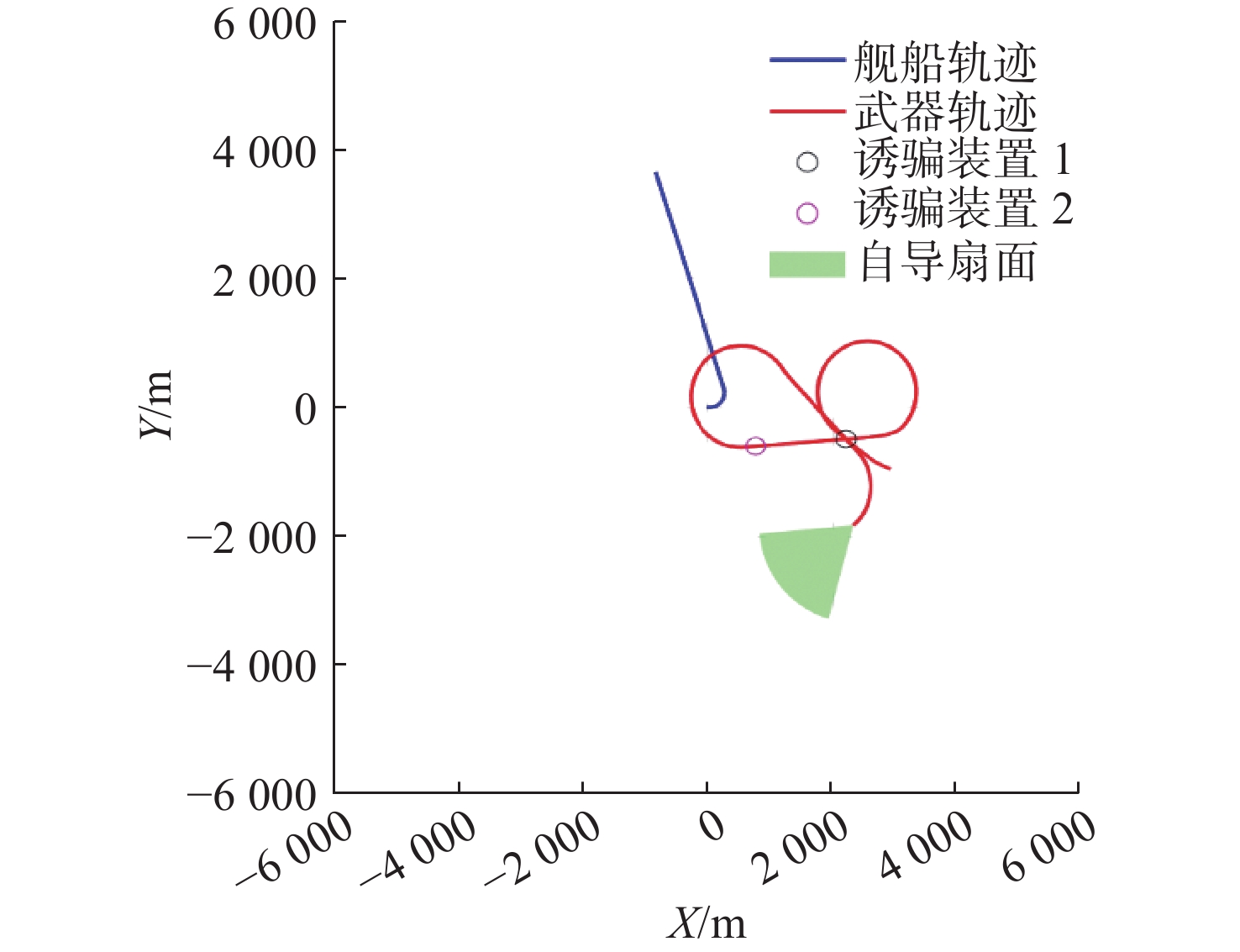
图 4 水下制导装置来袭舷角划分示意图
Figure 4. Schematic diagram of incoming bearing angle division for underwater guidance devices
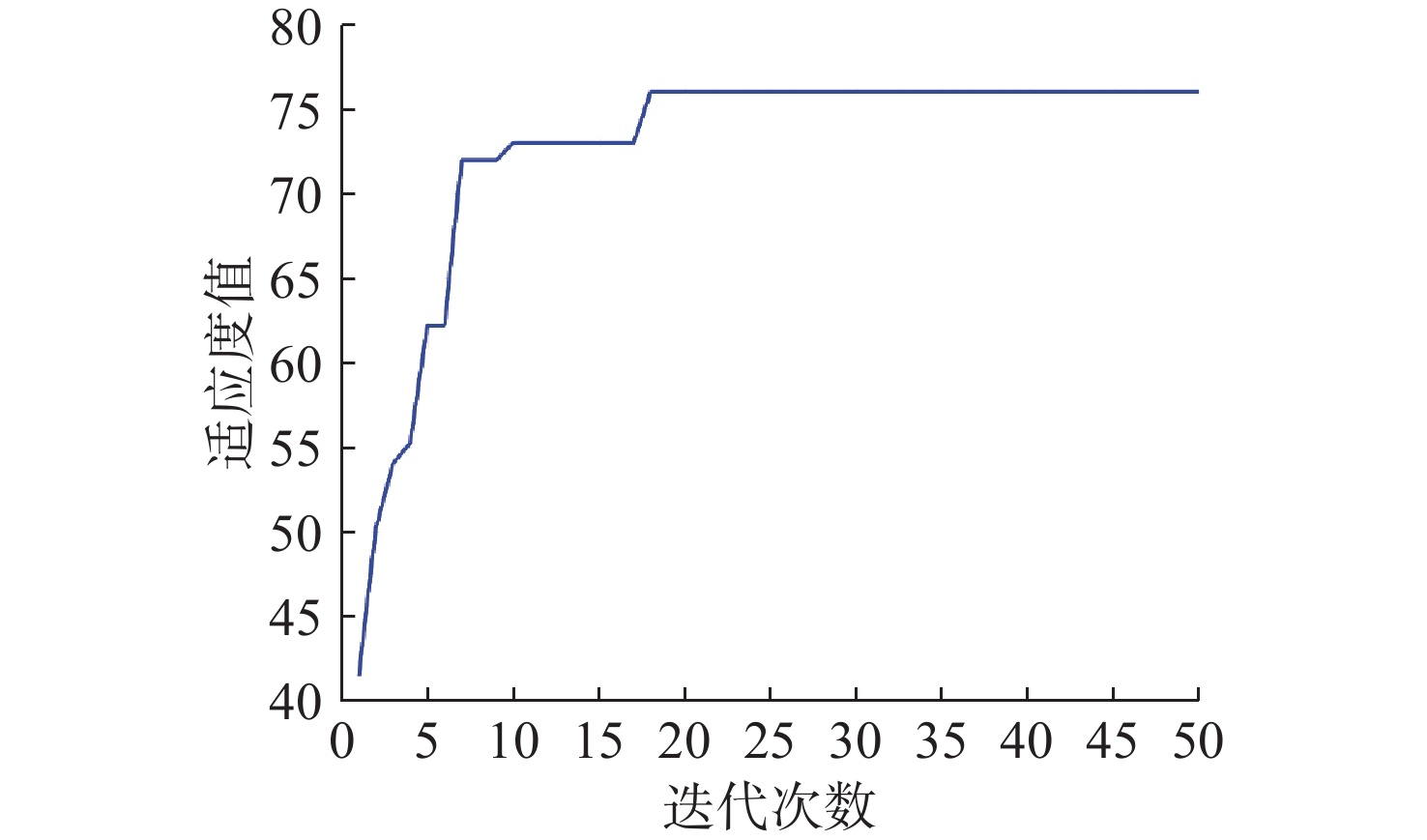
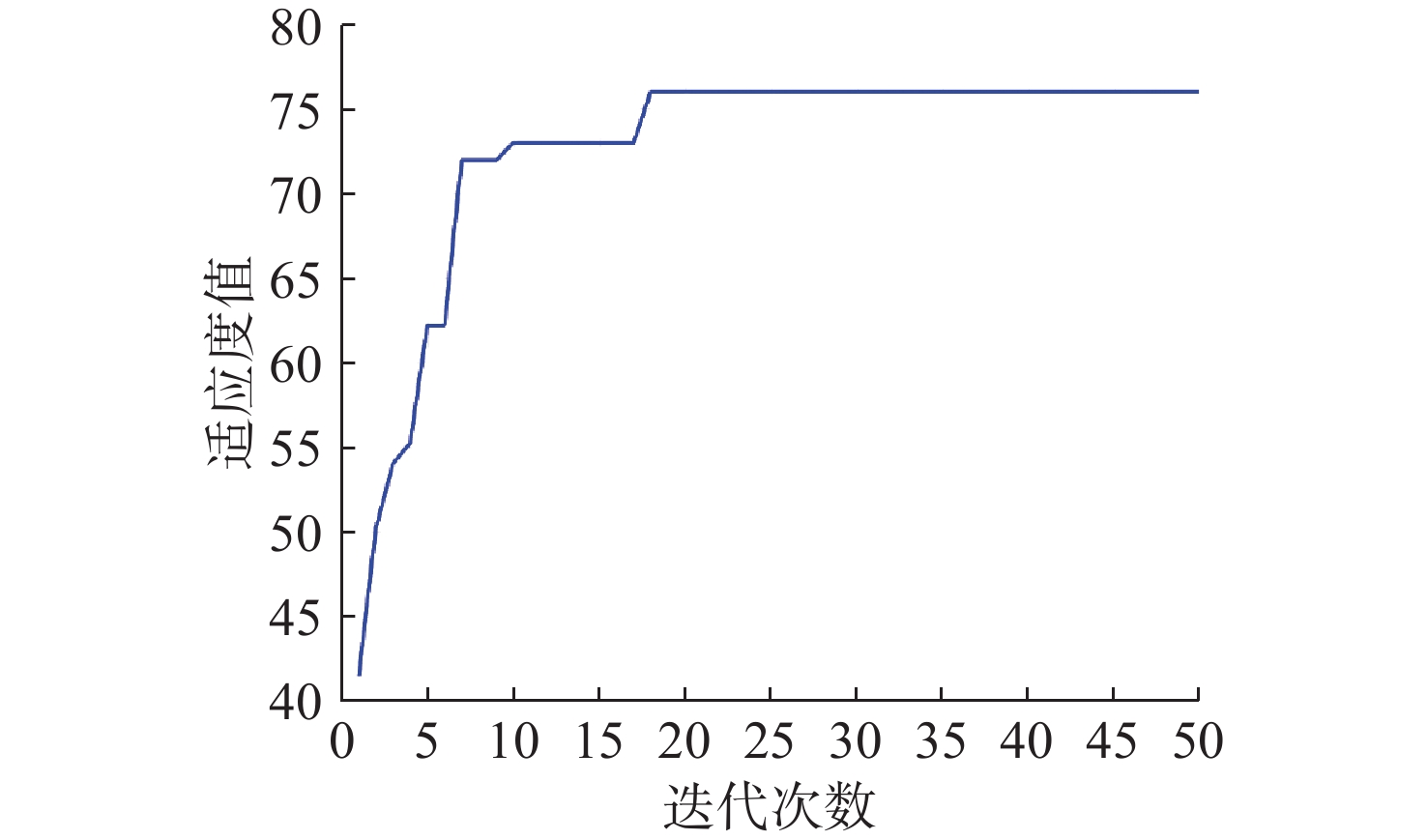
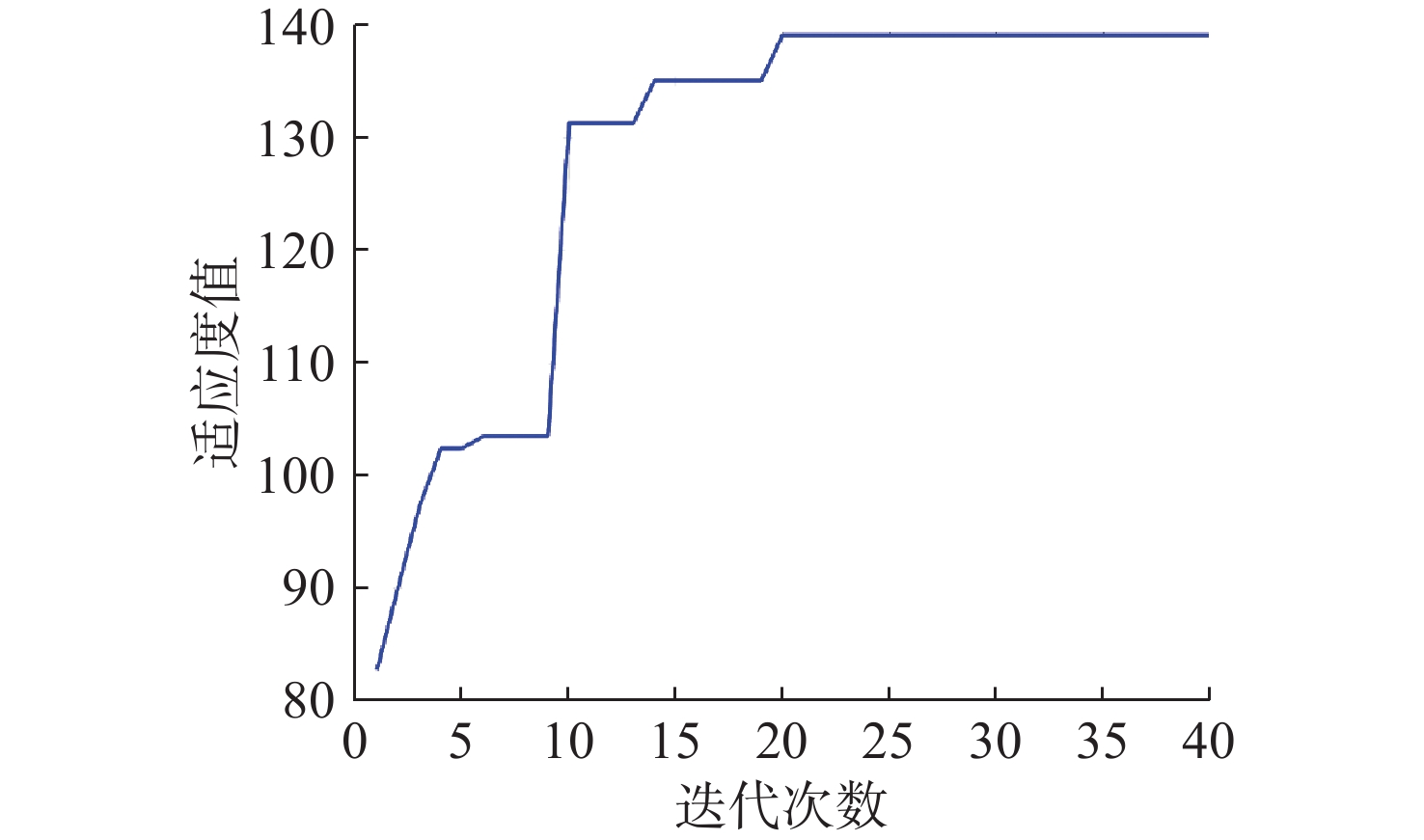
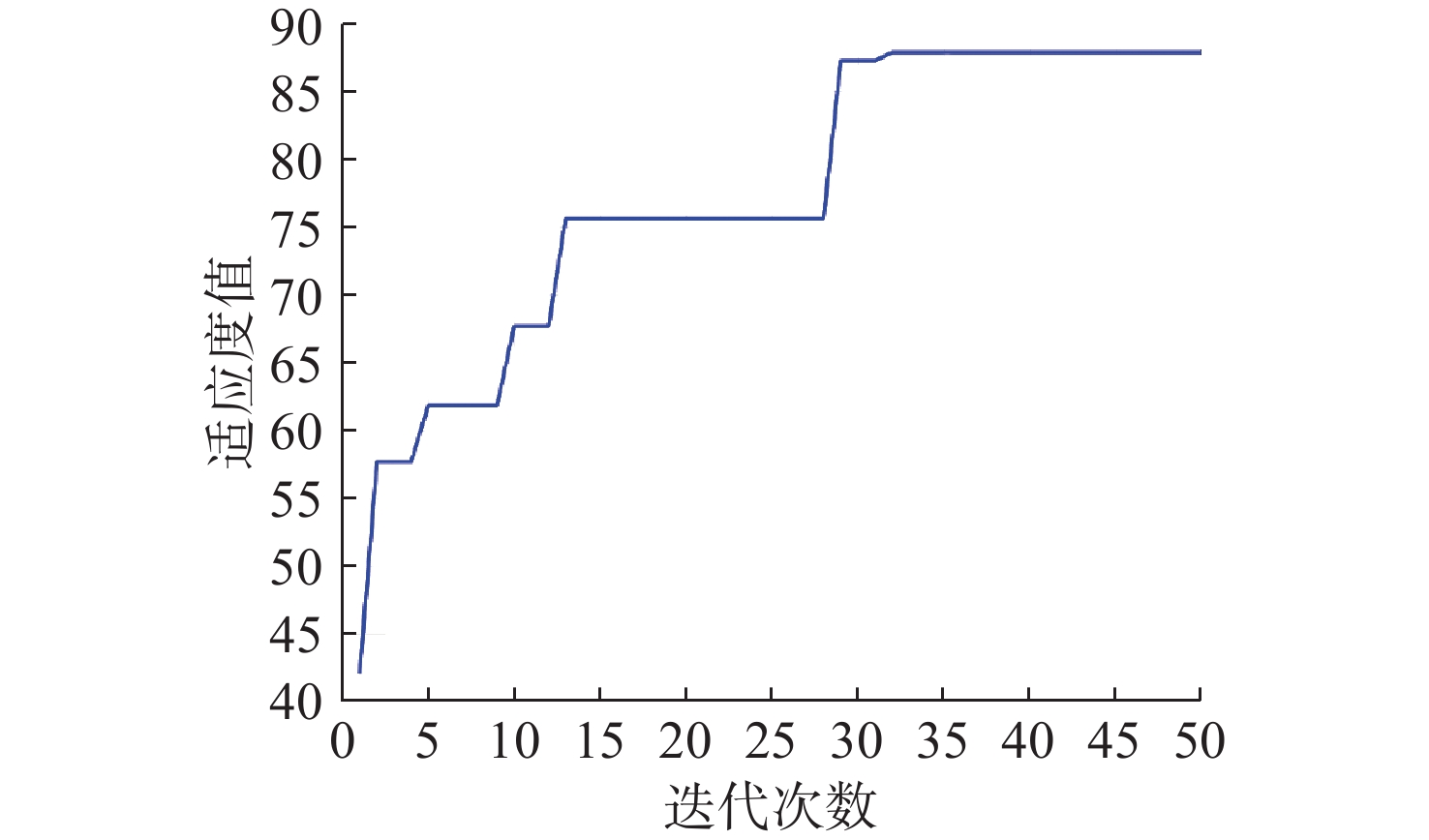
图 6 大舷角态势下粒子群优化算法迭代曲线
Figure 6. Iterative curve of particle swarm optimization algorithm under large bearing angle situation
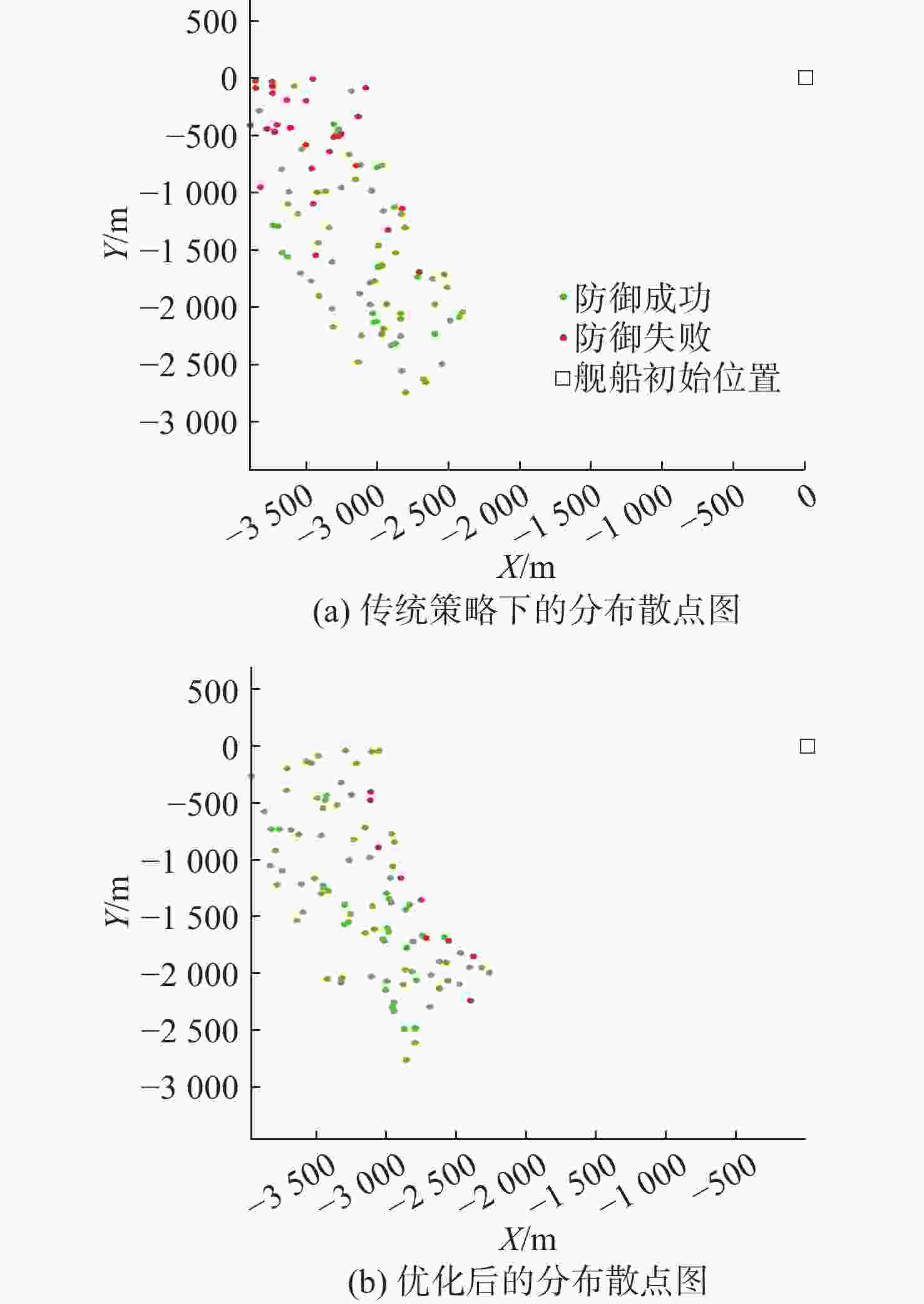
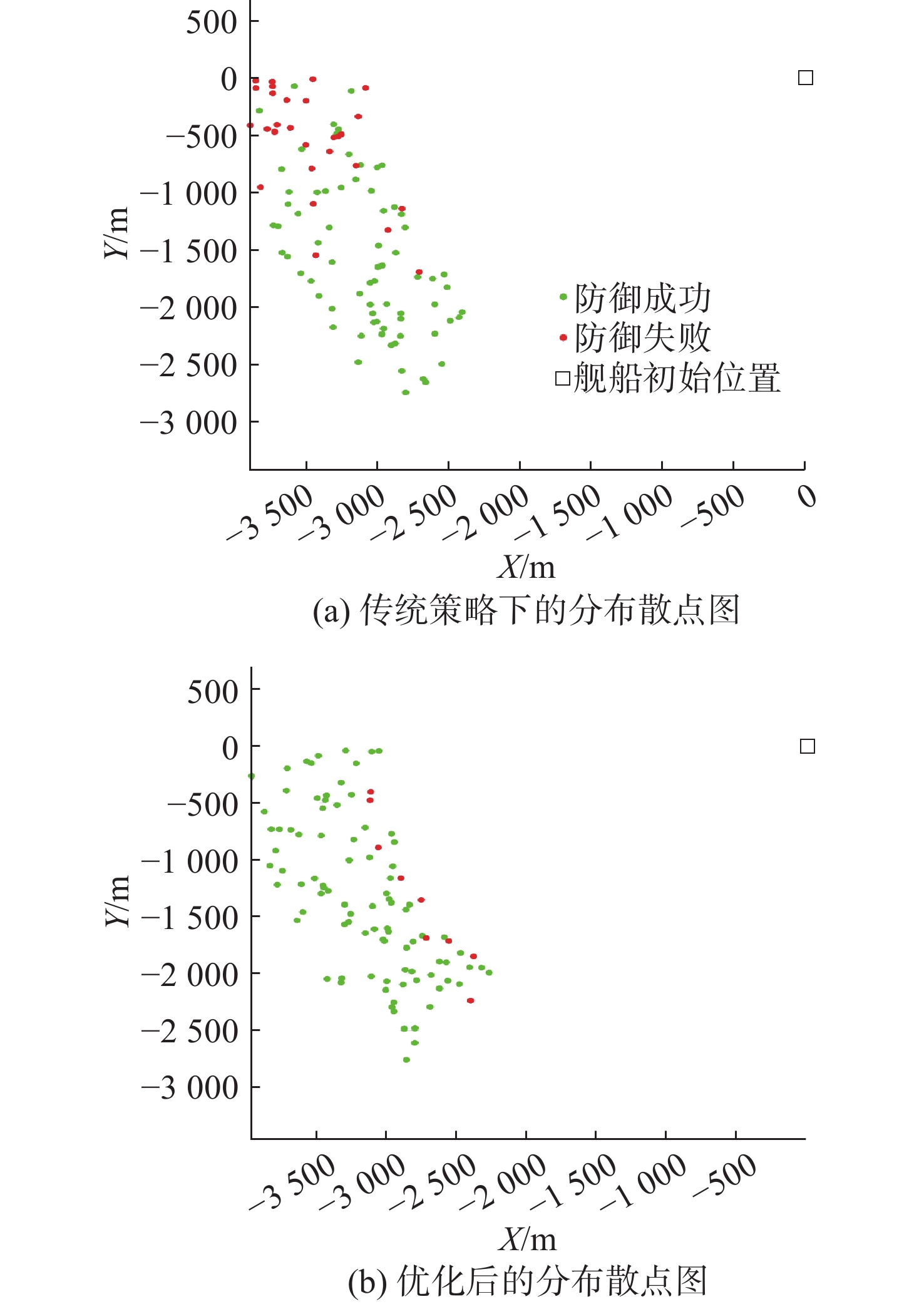
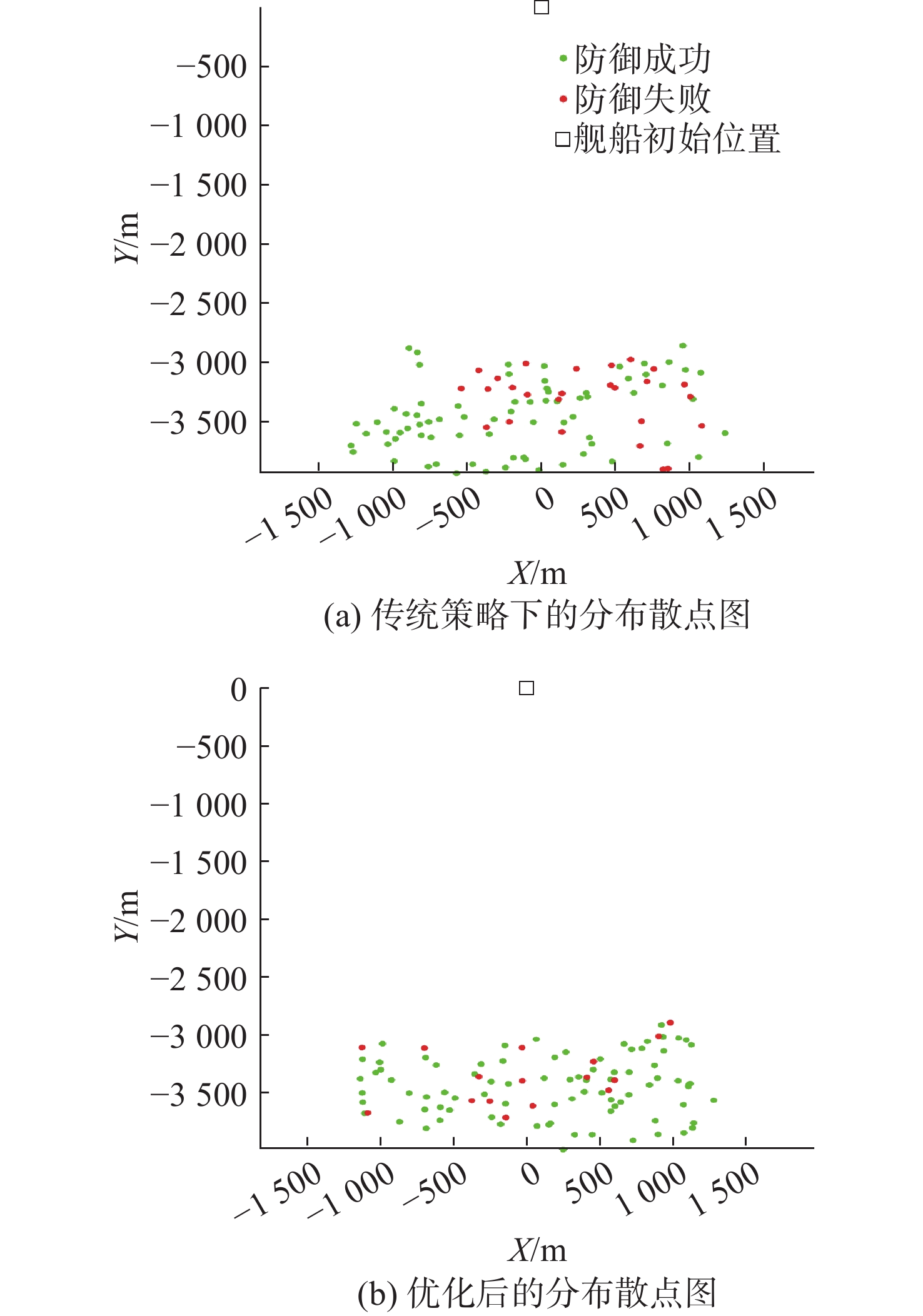
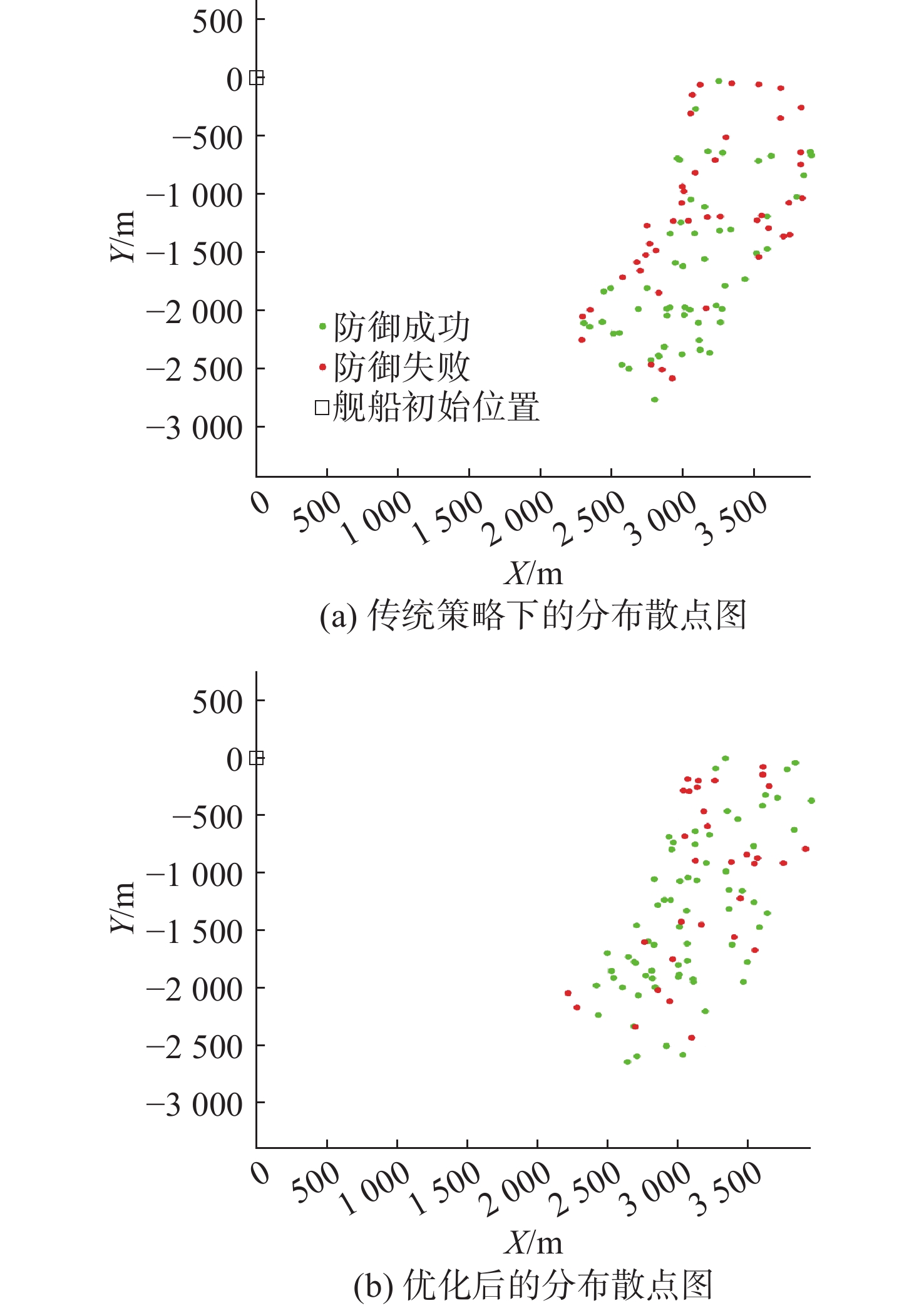
图 7 大舷角态势下100次蒙特卡洛验证结果图
Figure 7. Results of 100 times Monte Carlo verifications under large bearing angle situation
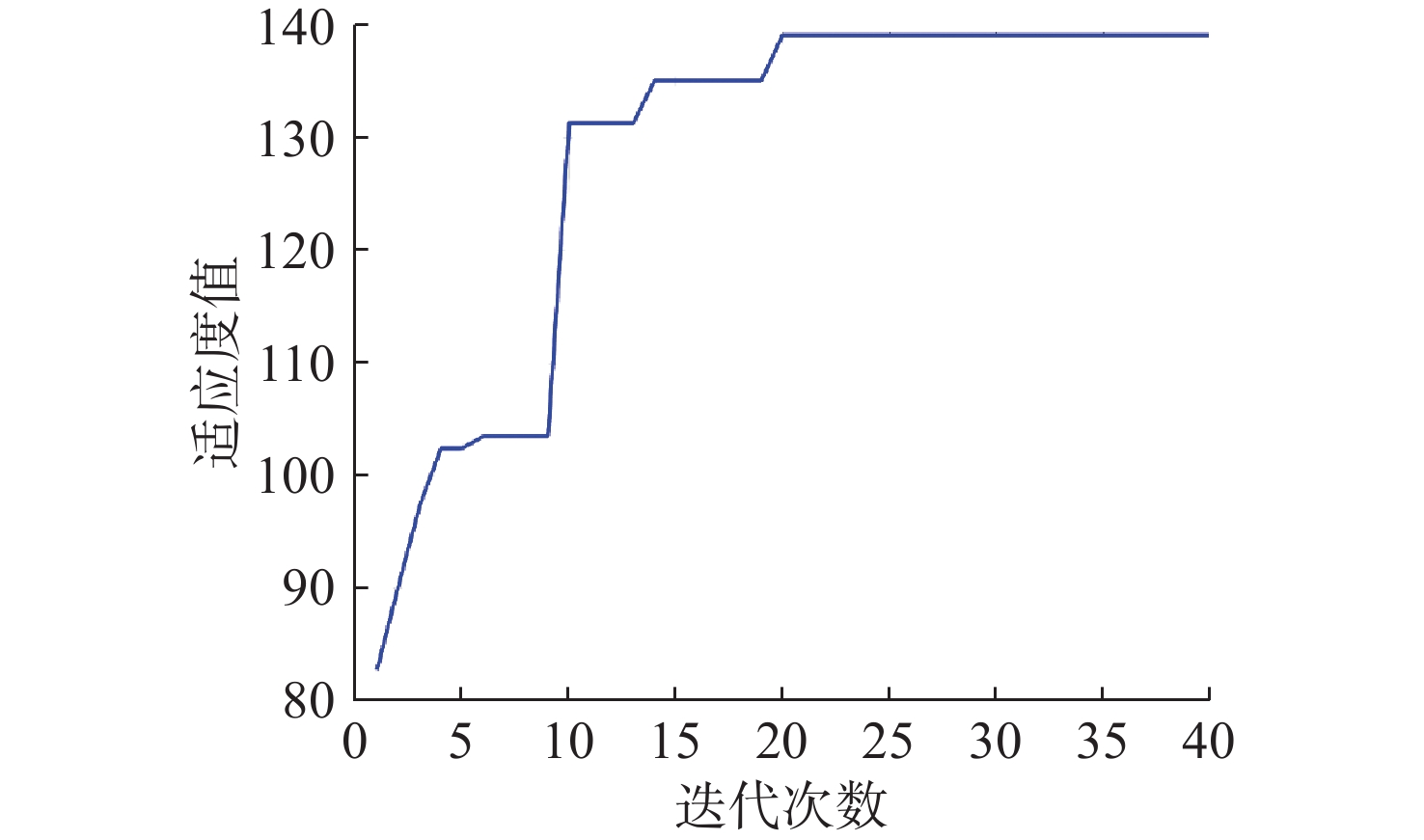
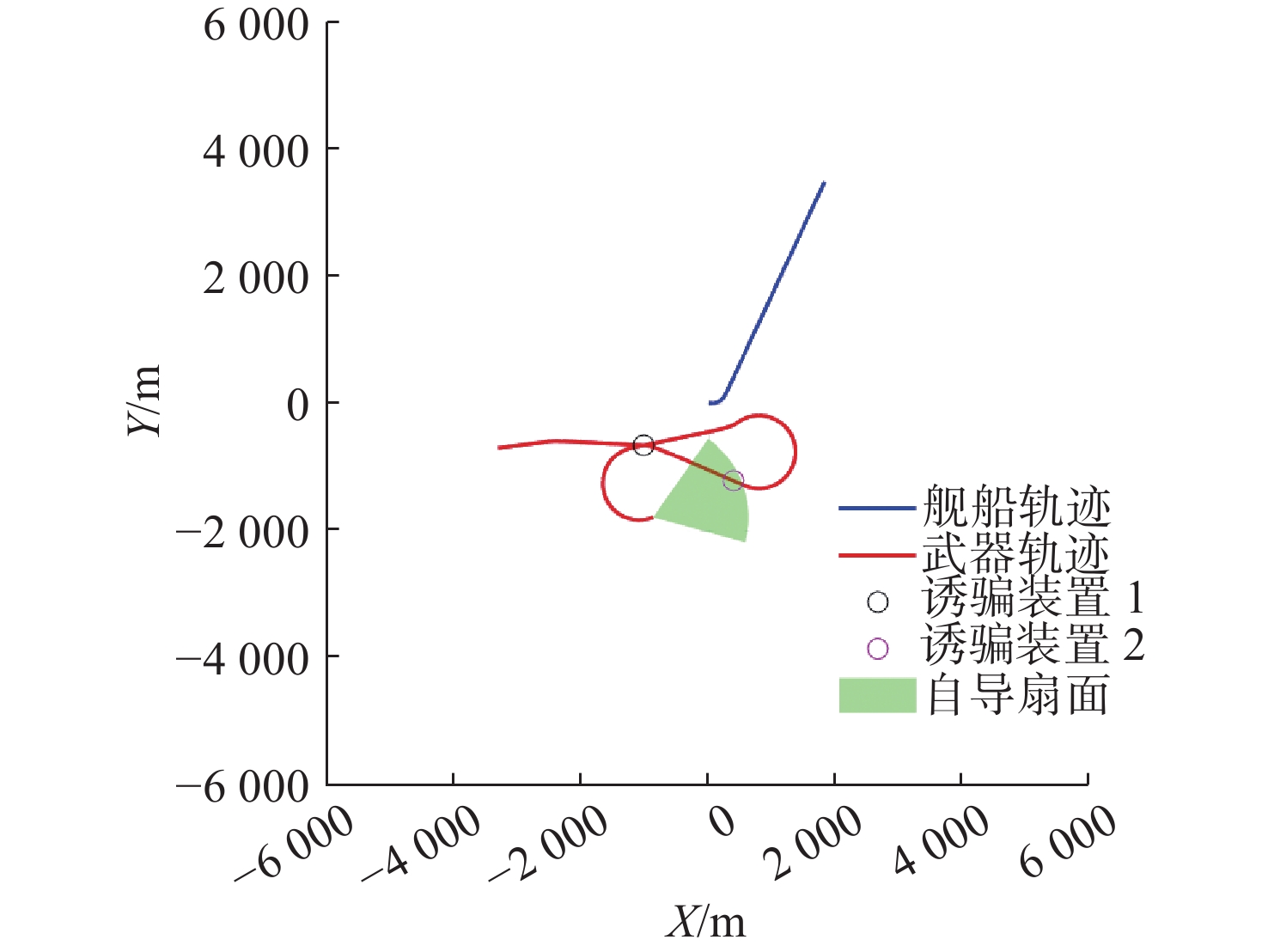
图 9 中等舷角态势下粒子群优化算法迭代曲线
Figure 9. Iteration curve of particle swarm optimization algorithm under medium bearing angle situation
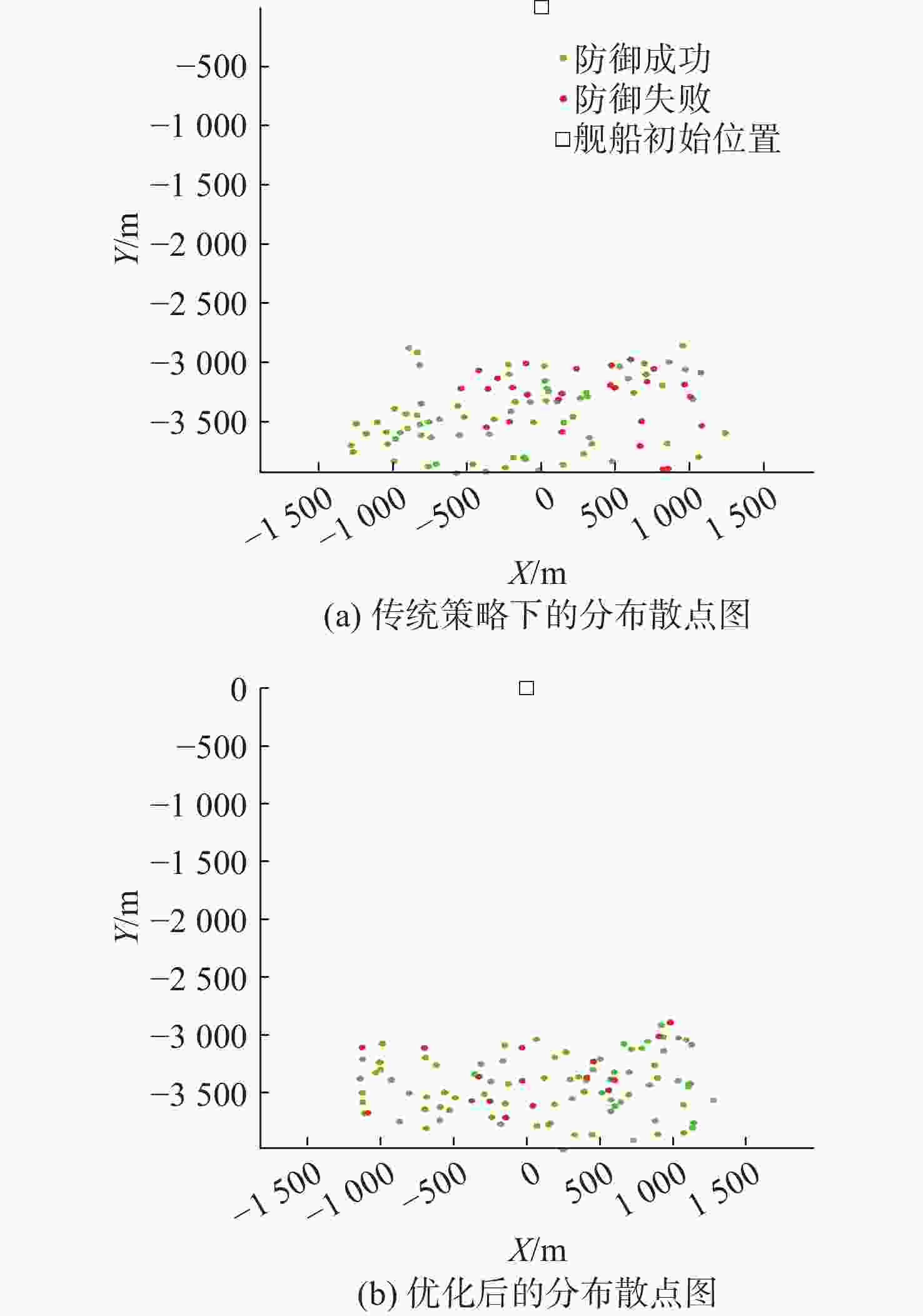
图 10 中等舷角态势下100次蒙特卡洛验证结果图
Figure 10. Results of 100 times Monte Carlo verifications under medium bearing angle situation
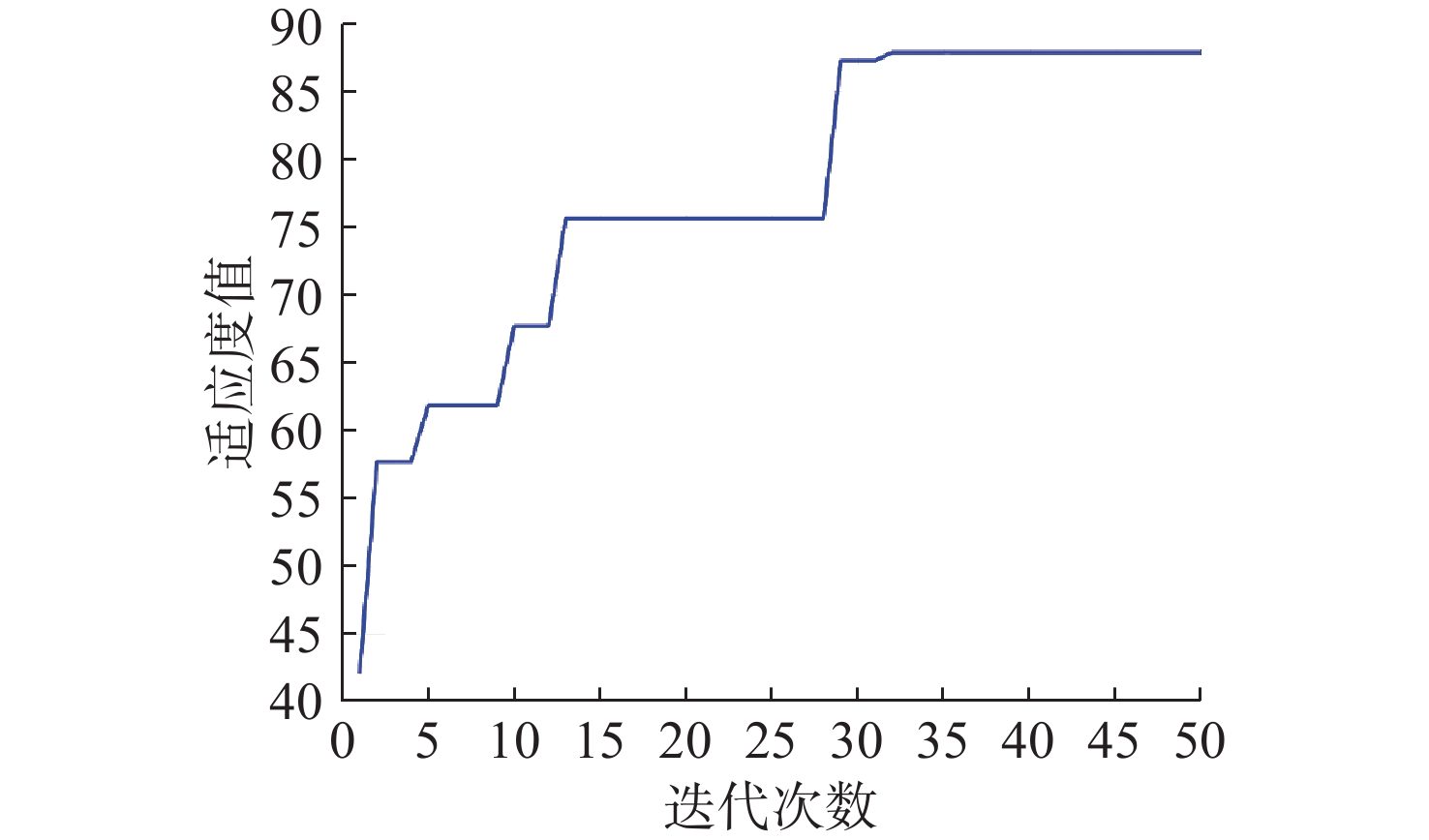
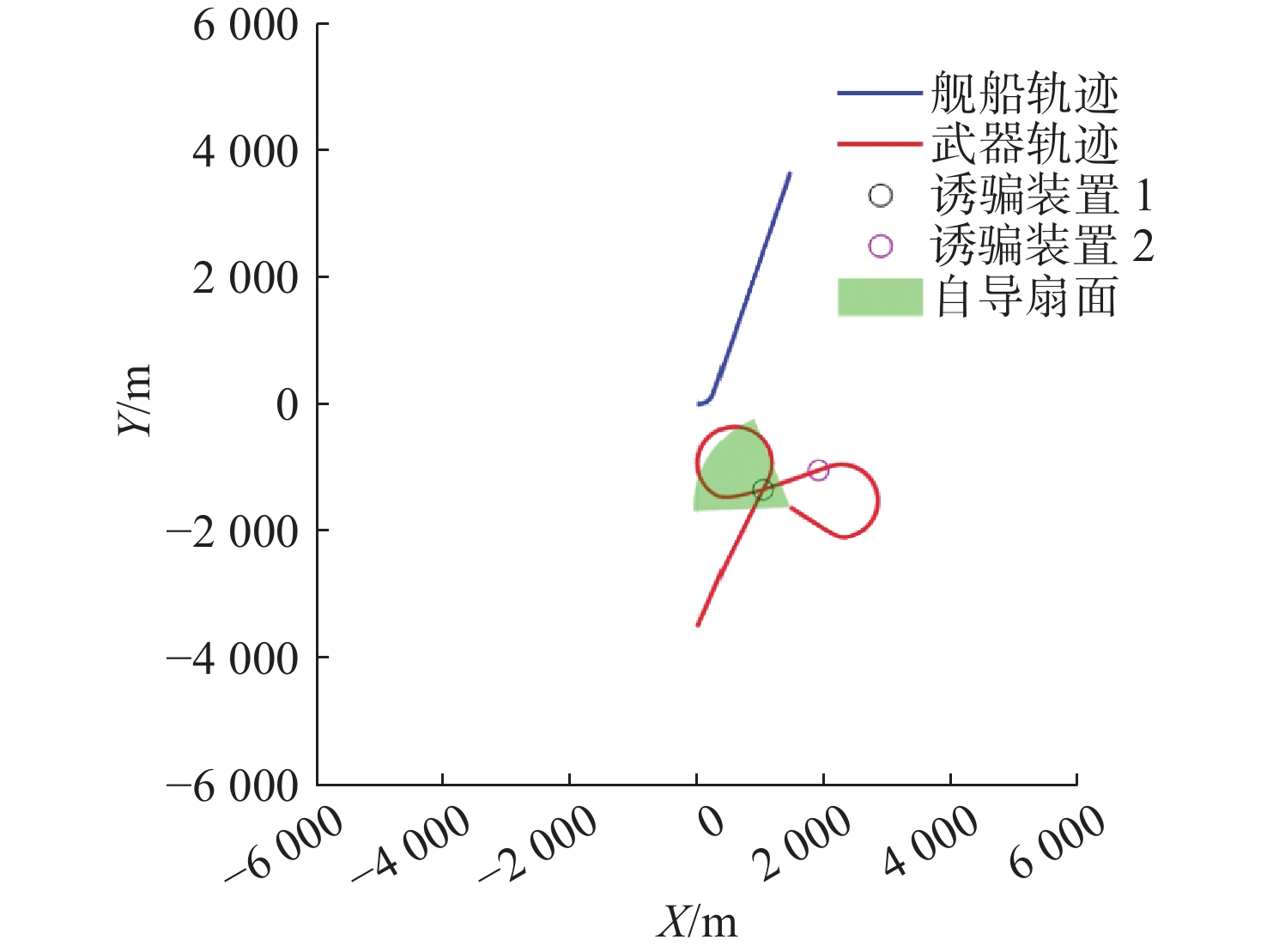
图 12 小舷角态势下粒子群优化算法迭代曲线
Figure 12. Iterative curve of particle swarm optimization algorithm under small bearing angle situation
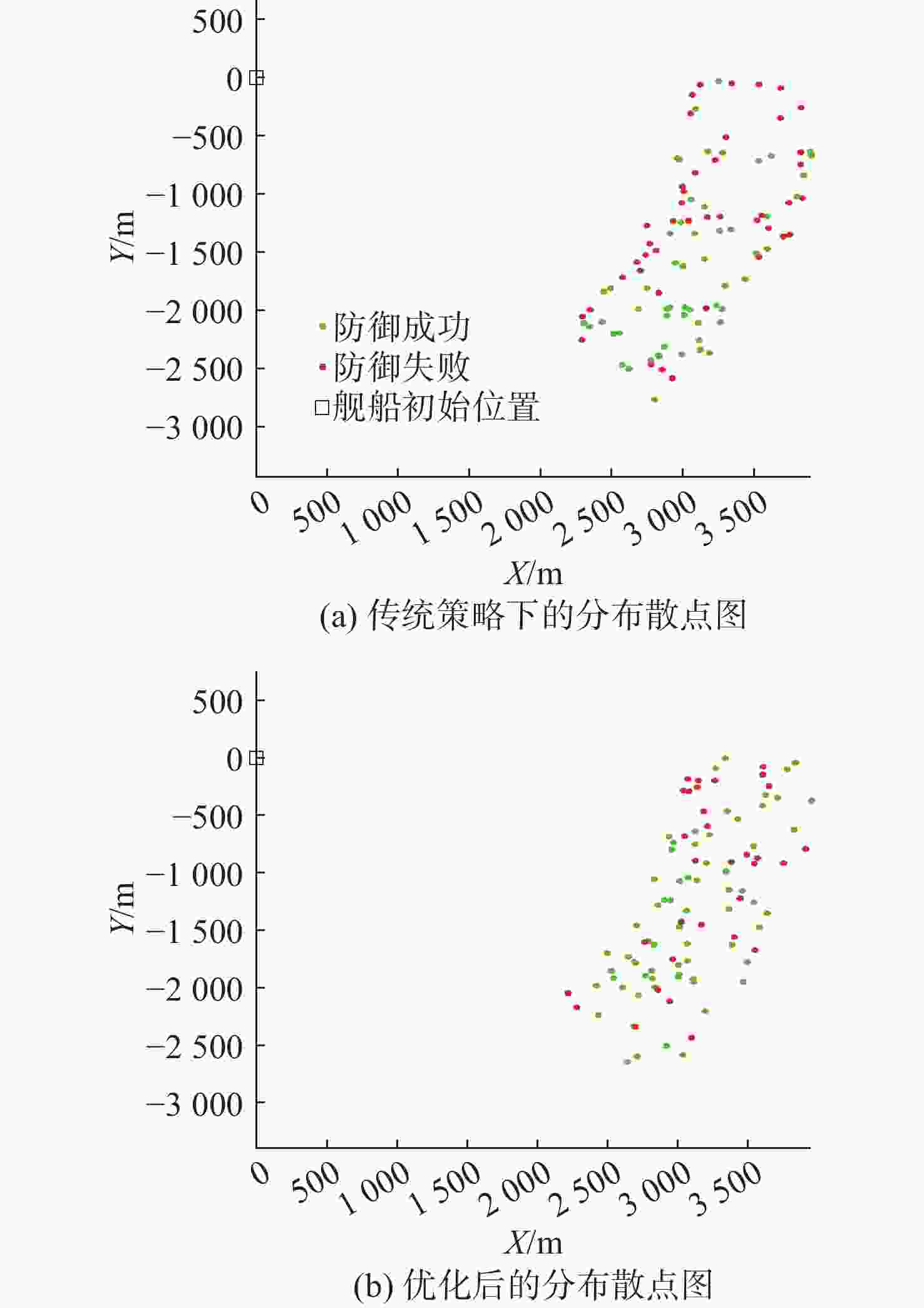
图 13 小舷角态势下100次蒙特卡洛验证结果图
Figure 13. Results of 100 times Monte Carlo verifications under small bearing angle situation
表 1 对抗策略优化参数及范围
Table 1. Optimization parameters and for ranges countermeasure strategy
优化对象 优化参数 参数范围 舰船 舰船规避航向/(°) (0, 180) 诱骗装置1 第1枚诱骗装置发射距离/m (600, 2 000) 诱骗装置1 第1枚诱骗装置发射舷角/(°) (0, 180) 诱骗装置2 第2枚诱骗装置发射距离/m (600, 2 000) 诱骗装置2 第2枚诱骗装置发射舷角/(°) (0, 180)  下载: 导出CSV
表 2 大舷角态势优化前后策略参数
Table 2. Strategy parameters before and after optimization under large bearing angel situation
策略参数 数值 优化前 优化后 舰船规避航向/(°) 97.22 64.84 第1枚诱骗装置释放距离/m 1 919.1 1 211.6 第1枚诱骗装置释放方位/(°) −163 −147 第2枚诱骗装置释放距离/m 1 517.9 1 276.7 第2枚诱骗装置释放方位/(°) −153 −72
下载: 导出CSV
表 3 中等舷角态势优化前后策略参数
Table 3. Strategy parameters before and after optimization under medium bearing angle situation
策略参数 数值 优化前 优化后 舰艇规避航向/(°) 95.2 70.8 第1枚诱骗装置释放距离/m 1 998.4 1 687.1 第1枚诱骗装置释放方位/(°) −85.6 −53.1 第2枚诱骗装置释放距离/m 1 494.9 2 157.6 第2枚诱骗装置释放方位/(°) −75.7 −28.9
下载: 导出CSV
表 4 小舷角态势优化前后策略参数
Table 4. Strategy parameters before and after optimization under small bearing angle situation
策略参数 优化前 优化后 舰船规避航向/(°) 117.74 123.71 第1枚诱骗装置释放距离/m 1 936.3 1 636.2 第1枚诱骗装置释放方位/(°) −18.8 −36.2 第2枚诱骗装置释放距离/m 1 436.7 1 429.2 第2枚诱骗装置释放方位/(°) −8.6 −5.5
下载: 导出CSV
-
[1] 徐宁来, 张群飞, 王汝夯. 基于灰色决策理论的声诱饵作战效能评估[J]. 计算机仿真, 2010, 27(2): 5-9. doi: 10.3969/j.issn.1006-9348.2010.02.002XU N L, ZHANG Q F, WANG R H. Combat effectiveness evaluation of acoustic decoys based on grey decision theory[J]. Computer Simulation, 2010, 27(2): 5-9. doi: 10.3969/j.issn.1006-9348.2010.02.002 [2] 贾跃, 赵学涛, 林贤杰, 等. 基于BP神经网络的鱼雷作战效能模糊综合评估模型及其仿真[J]. 兵工学报, 2009, 30(9): 1232-1235. doi: 10.3321/j.issn:1000-1093.2009.09.016JIA Y, ZHAO X T, LIN X J, et al. Fuzzy comprehensive evaluation model of torpedo combat effectiveness based on BP neural network and its simulation[J]. Acta Ordnance Engineering, 2009, 30(9): 1232-1235. doi: 10.3321/j.issn:1000-1093.2009.09.016 [3] 彭会斌. 基于遗传算法的潜艇组合使用声诱饵防御鱼雷技术研究[J]. 指挥控制与仿真, 2018, 40(1): 52-55. doi: 10.3969/j.issn.1673-3819.2018.01.010PENG H B. Research on the technology of submarine combined use of acoustic decoys for torpedo defense based on genetic algorithm[J]. Command Control and Simulation, 2018, 40(1): 52-55. doi: 10.3969/j.issn.1673-3819.2018.01.010 [4] 曾艳阳, 康凤举, 杨惠珍, 等. 基于粒子群的反鱼雷算法设计与仿真[J]. 系统仿真学报, 2012, 24(9): 2023-2026. doi: 10.16182/j.cnki.joss.2012.09.019ZENG Y Y, KANG F J, YANG H Z. et al. Against torpedo based on particle swarm algorithm design and simulation[J]. Journal of System Simulation, 2012, 24(9): 2023-2026. doi: 10.16182/j.cnki.joss.2012.09.019 [5] 侯文姝, 陆铭华. 基于粒子群算法的潜艇声诱饵防御声自导鱼雷研究[J]. 舰船科学技术, 2022, 44(18): 185-189. doi: 10.3404/j.issn.1672-7649.2022.18.039HOU W S, LU M H. Research on submarine acoustic decoy defense against acoustic homing torpedo based on particle swarm optimization[J]. Ship Science and Technology, 2022, 44(18): 185-189. doi: 10.3404/j.issn.1672-7649.2022.18.039 [6] 沈治河, 刘峰. 水面舰艇水声对抗系统对抗声自导鱼雷仿真分析及评估[J]. 军事运筹与系统工程, 2017, 31(1): 5-9. doi: 10.3969/j.issn.1672-8211.2017.01.001SHEN Z H, LIU F. Simulation analysis and evaluation of countermeasures acoustic homing torpedo for underwater acoustic countermeasures system of surface ships[J]. Military Operations Research and Systems Engineering, 2017, 31(1): 5-9. doi: 10.3969/j.issn.1672-8211.2017.01.001 [7] 付留芳, 周明, 许林周, 等. 潜艇旋回机动规避对声自导鱼雷发现概率的影响分析[J]. 舰船电子工程, 2022, 42(11): 118-122. doi: 10.3969/j.issn.1672-9730.2022.11.026FU L F, ZHOU M, XU L Z, et al. Analysis of the influence of submarine turning maneuver avoidance on detection probability of acoustic homing torpedo[J]. Ship Electronics Engineering, 2022, 42(11): 118-122. doi: 10.3969/j.issn.1672-9730.2022.11.026 [8] 李明辉. 基于蒙特卡洛法的水下对抗效能推演评估研究[D]. 武汉: 中国舰船研究院, 2014. [9] 侯文姝, 陆铭华. 潜艇声诱饵防御声自导鱼雷改进PSO算法[J]. 水下无人系统学报, 2023, 31(3): 436-441.HOU W S, LU M H. Improved PSO algorithm for submarine acoustic decoy defense against acoustic homing torpedo[J]. Journal of Unmanned Undersea Systems, 2019, 31(3): 436-441. [10] 曲泓玥. 基于被动声纳实景仿真的水声对抗性能优化[D]. 哈尔滨: 哈尔滨工程大学, 2020. [11] 张净宇, 王靖, 吴志雄, 等. 一种改进遗传算子的遗传算法组卷策略[J]. 智能计算机与应用, 2023, 13(5): 40-45. doi: 10.3969/j.issn.2095-2163.2023.05.007ZHANG J Y, WANG J, WU Z X, et al. A grouping strategy for genetic algorithm based on improved genetic operators[J]. Intelligent Computer and Applications, 2023, 13(5): 40-45. doi: 10.3969/j.issn.2095-2163.2023.05.007 -

 下载:
下载:

 点击查看大图
计量
- 文章访问数: 798
- HTML全文浏览量: 351
- PDF下载量: 145
- 被引次数: 0