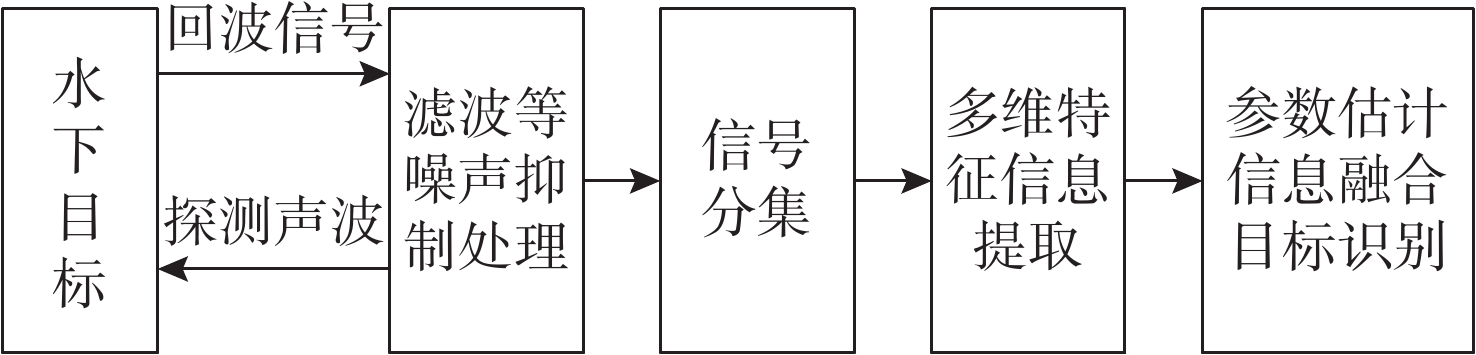


Space-Time Frequency Feature Fusion Recognition Method for Underwater Targets Based on Meta-Learning
-
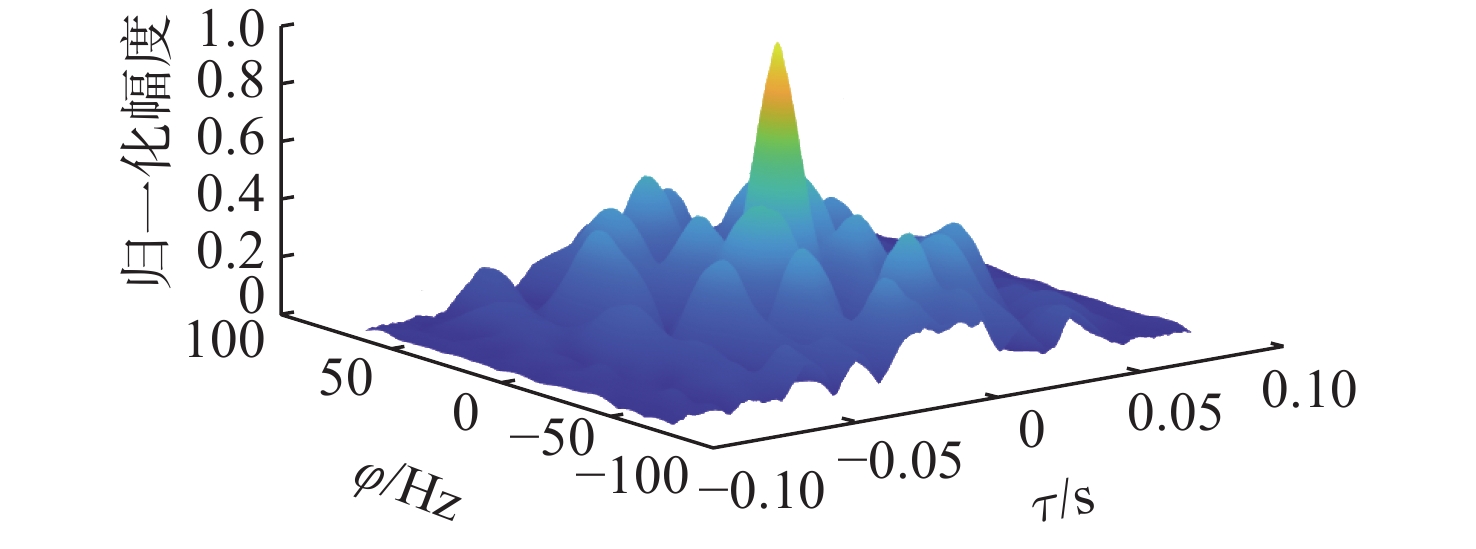
摘要: 针对主动声呐目标识别中舷角适应性较差、新型干扰对抗能力弱的问题, 文中从波动方程理论出发, 阐述了主动声呐感知目标信息的物理机理; 基于广义多重信号分类(MUSIC)空间谱估计, 结合距离维信息提出了一种获取水下目标伪三维空间特征的新方法, 有效提升了空间特征对不同舷角的适应能力; 研究了增强伪魏格纳-维尔分布(PWVD)时频谱特征的方法, 以及基于时频二维相关的运动目标多普勒频移分布特征提取技术, 通过2种算法在舷角特性下的互补优势, 进一步提高了目标识别的舷角适应性。为解决水下目标样本稀缺且分布不平衡的问题, 引入元学习思想, 构建了一种融合空间域、时频域及多普勒域多维特征的数据级融合目标识别网络, 利用仿真和试验数据对该网络进行了训练和测试。测试结果表明, 空时频融合特征显著增强了目标识别的舷角适应性和抗干扰能力, 为智能化水下目标识别技术的发展提供了新思路。
-
关键词:
- 水下目标 /
- 主动声呐; 目标识别 /
- 空时频融合 /
- 多维特征提取 /
- 元学习
Abstract: To improve poor relative bearing adaptability and weak resistance to new types of interference in active sonar target recognition, this paper elaborated on the physical mechanism of active sonar target information perception from wave equation theory. Based on generalized multiple signal classification (MUSIC) spatial spectrum estimation, a novel method was proposed for acquiring the pseudo three-dimensional spatial feature of underwater targets by incorporating distance information, thereby effectively enhancing the adaptability of spatial features across different relative bearings. Additionally, research was conducted on methods to enhance pseudo Wigner-Ville distribution (PWVD) time frequency features and Doppler frequency shift distribution feature extraction of moving targets based on the two-dimensional correlation of time frequency. By leveraging the complementary advantages of both algorithms, the relative bearing adaptability for target recognition was further improved. To address the challenge of scarce and imbalanced underwater target sample distribution, the concept of meta-learning was integrated to construct a data-level fusion target recognition network that incorporated spatial, time-frequency, and Doppler domain features. The network was trained and tested using simulation and experimental data. The results demonstrate that the space-time frequency fusion features significantly improve the relative bearing adaptability and anti-interference capability for target recognition, providing a novel approach for the development of intelligent underwater target recognition technology. -
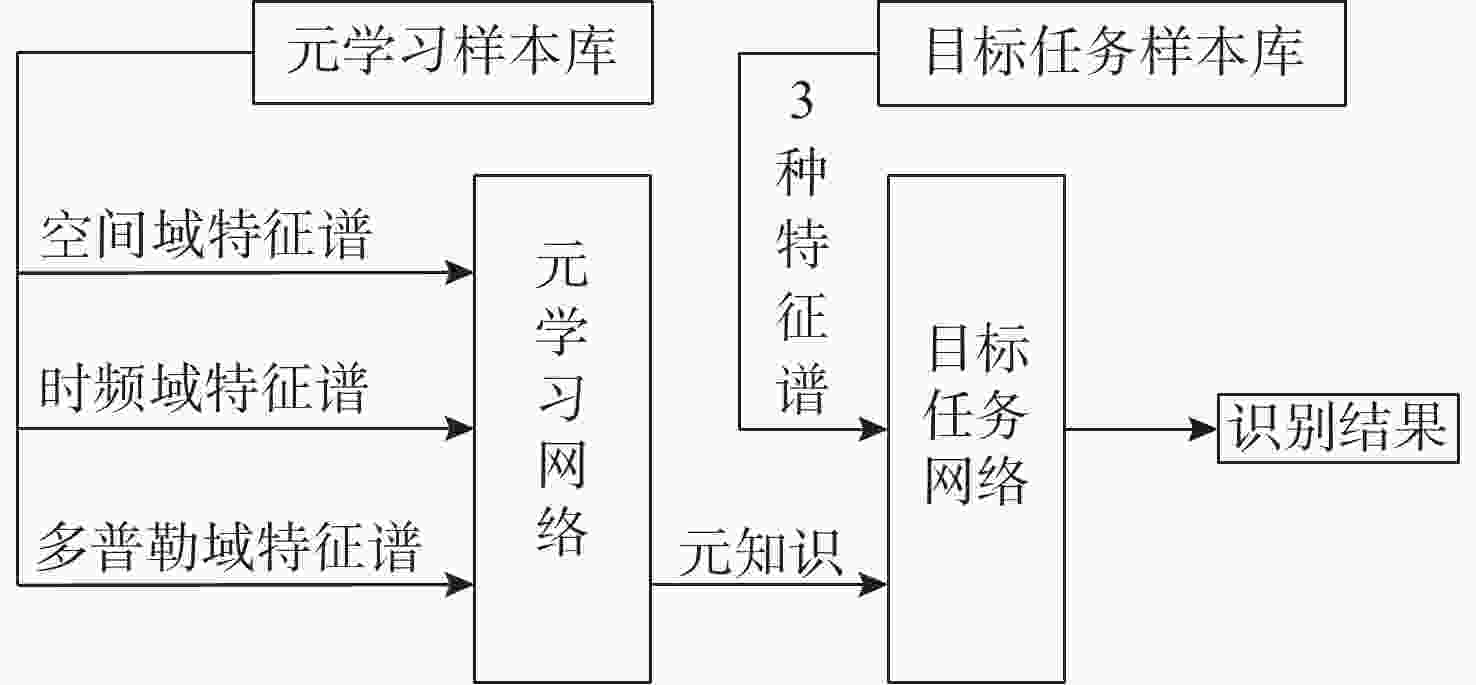
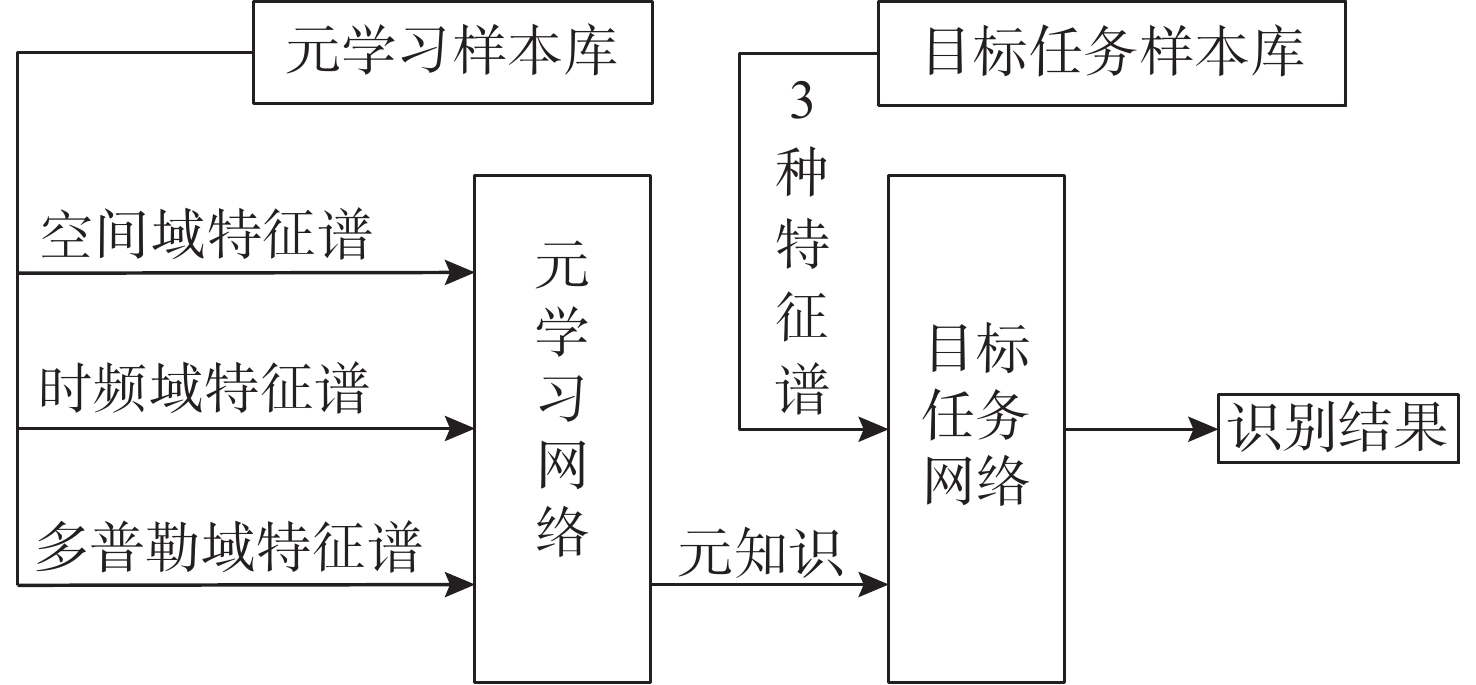
图 12 基于元学习的多维特征融合目标识别网络框架
Figure 12. Network framework for multi-dimensional feature fusion target recognition based on meta-learning
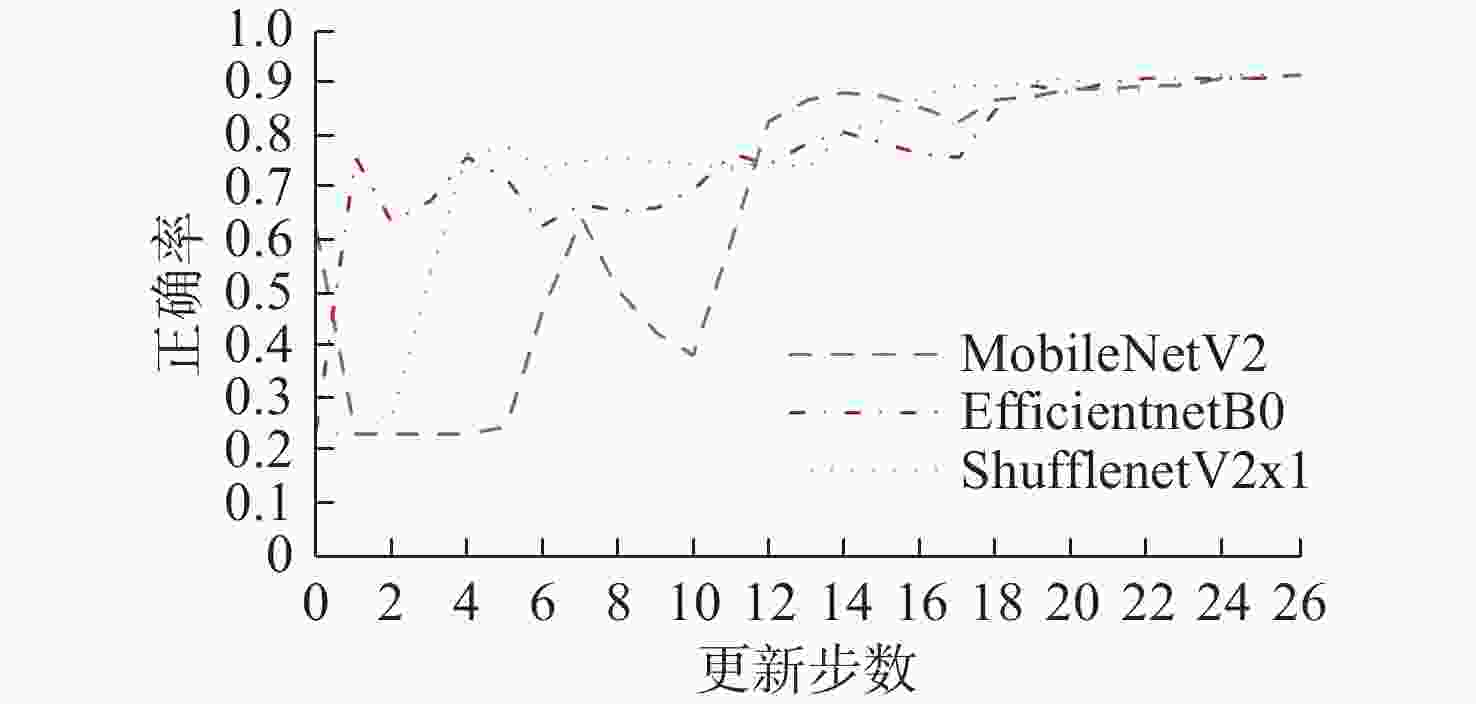
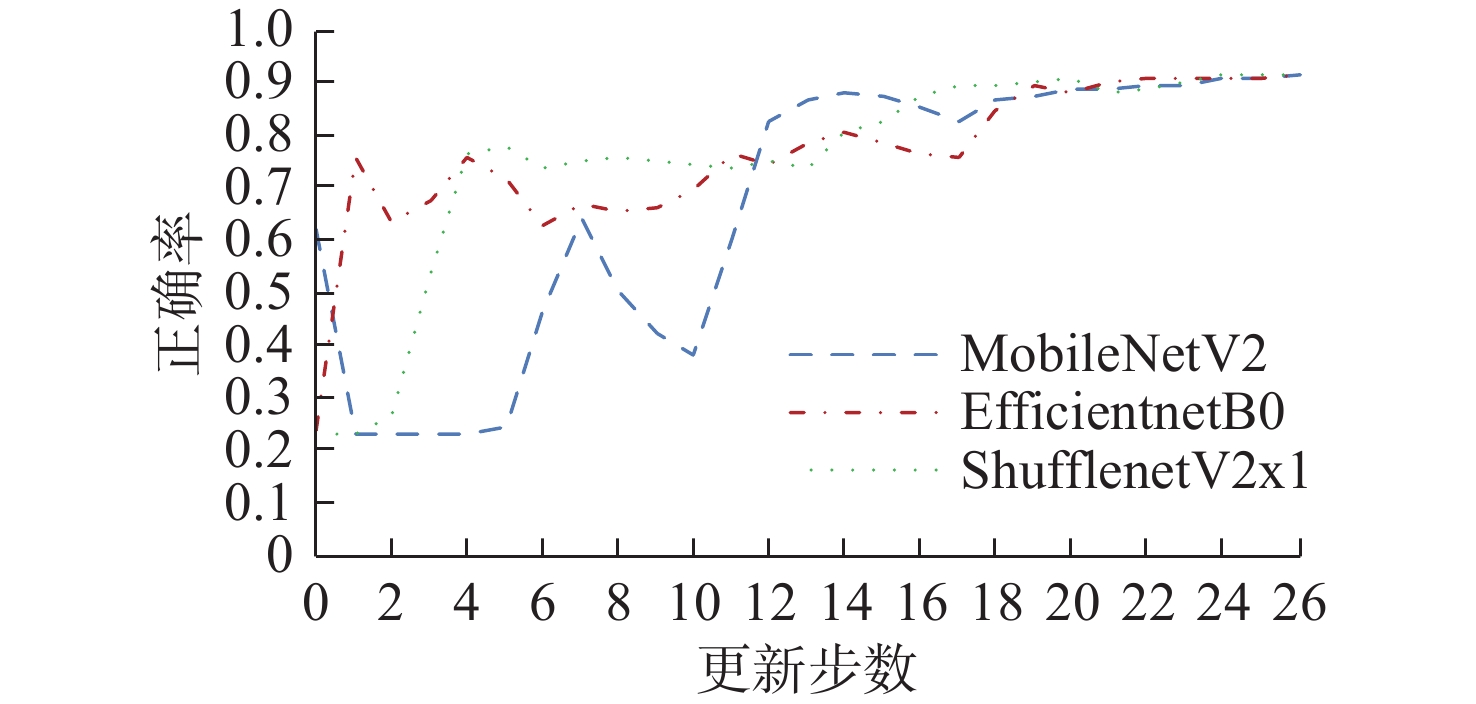
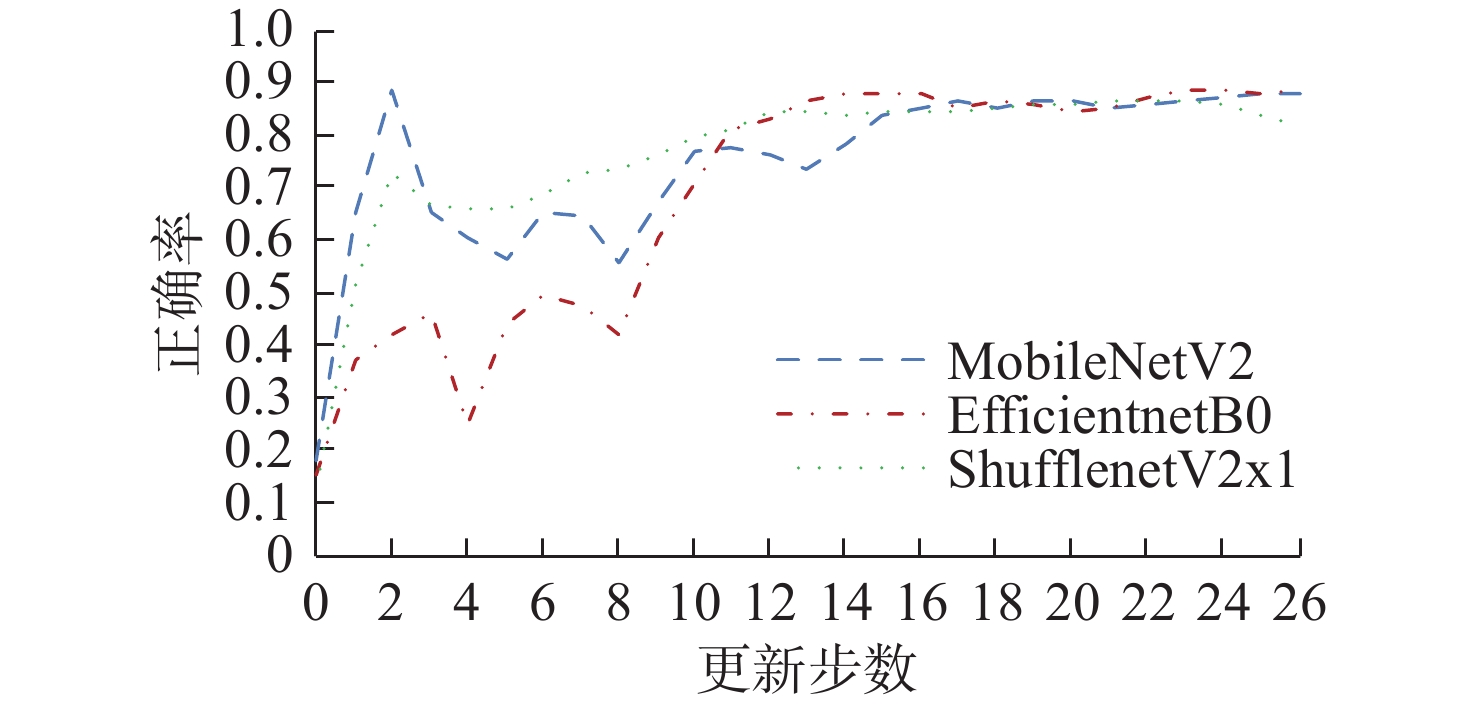
图 13 目标任务网络空间域特征验证曲线
Figure 13. Validation curves of spatial domain features for the target task network
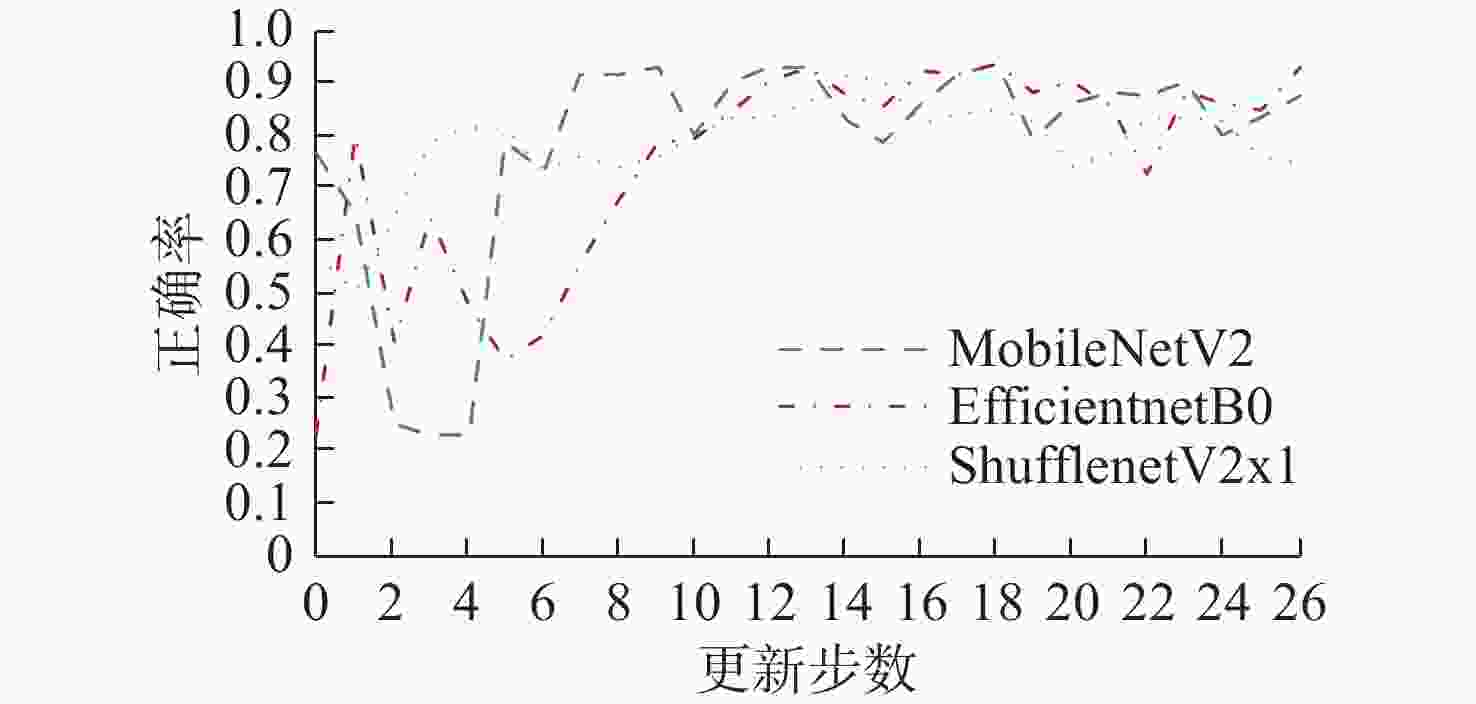
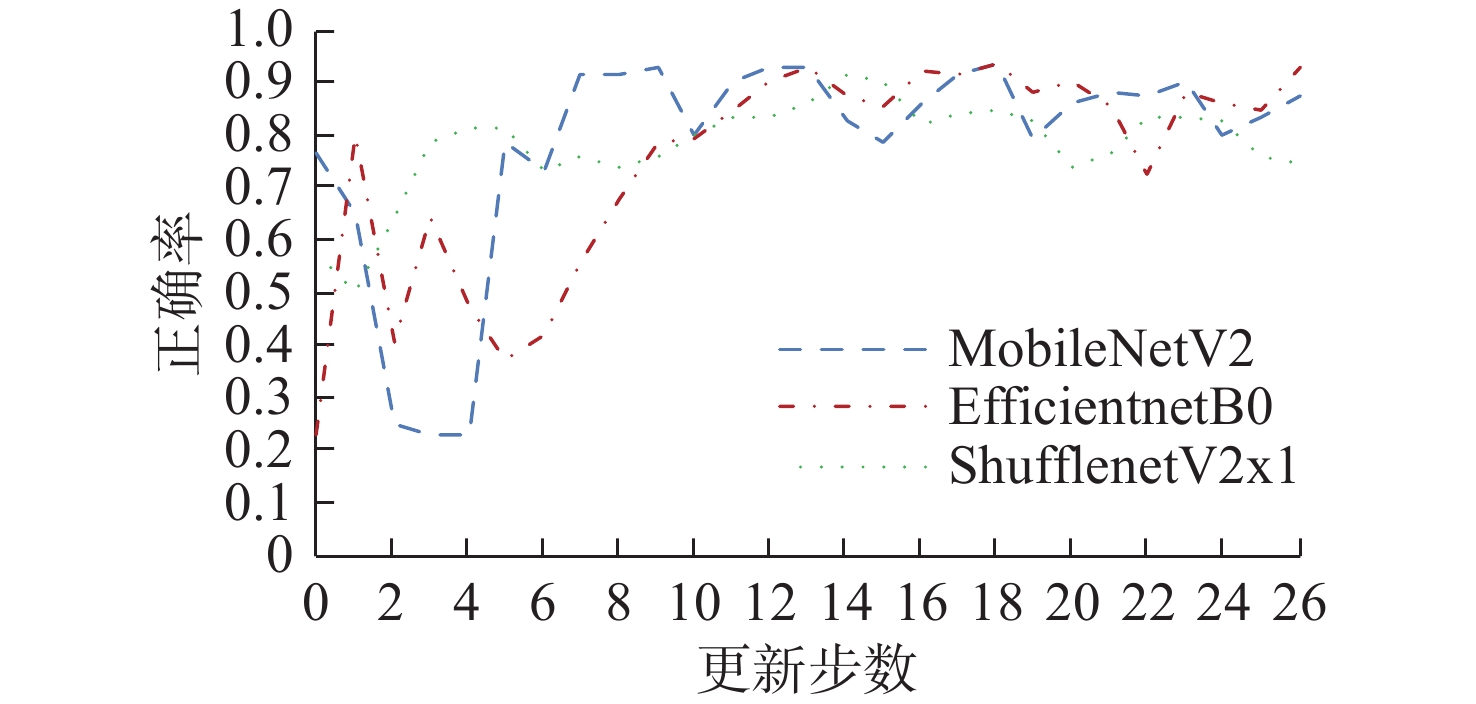
图 14 目标任务网络时频域特征验证曲线
Figure 14. Validation curves of time-frequency domain features for the target task network
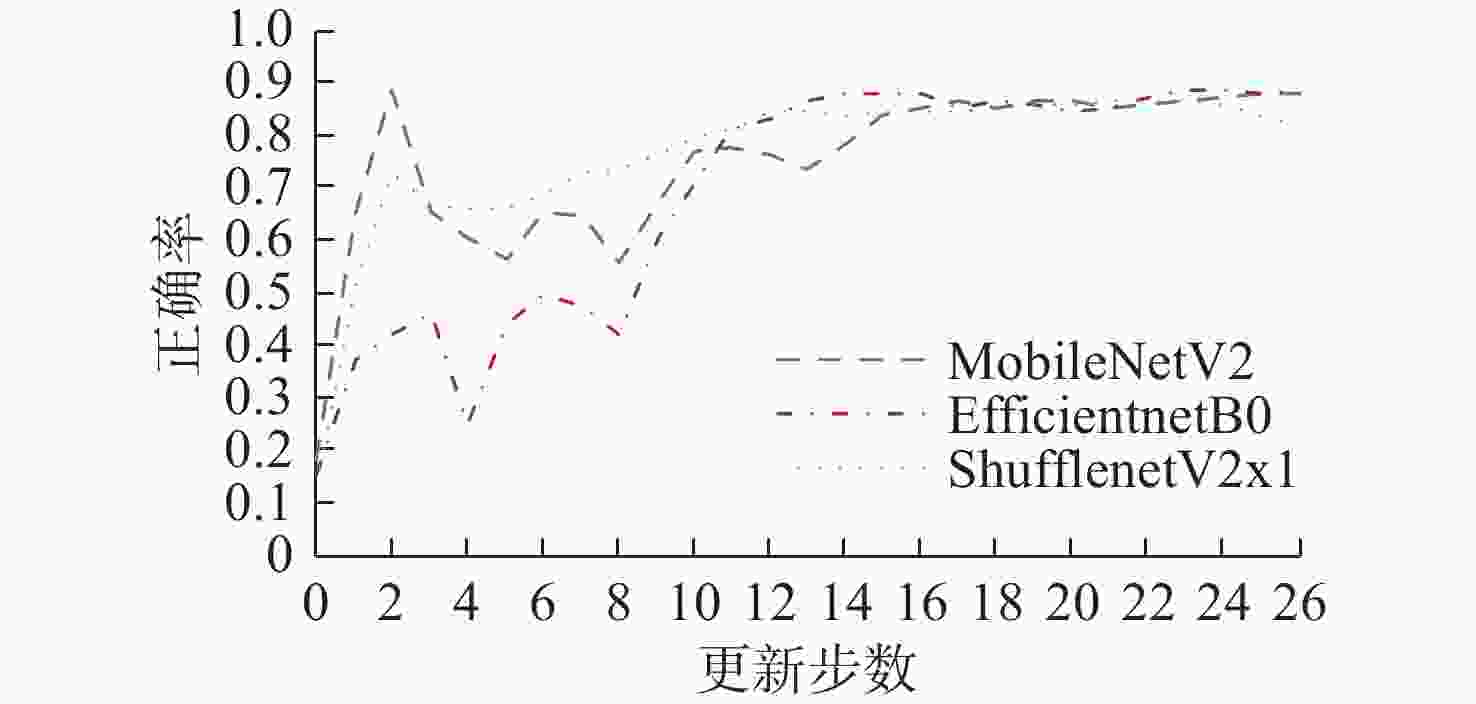
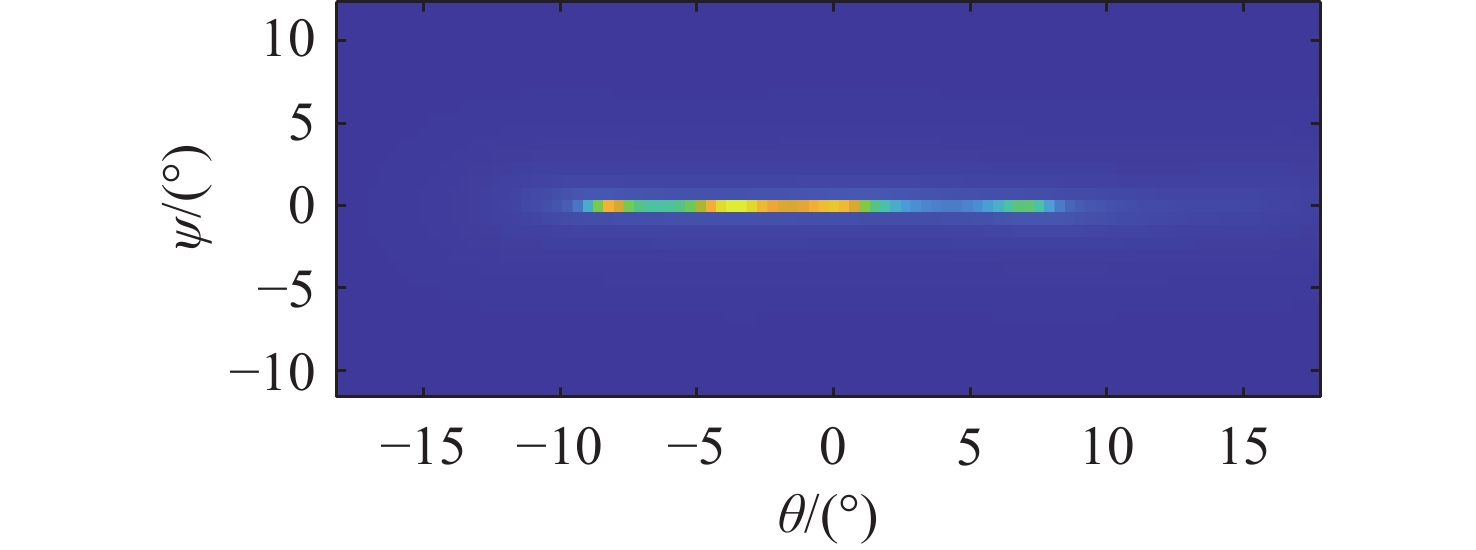
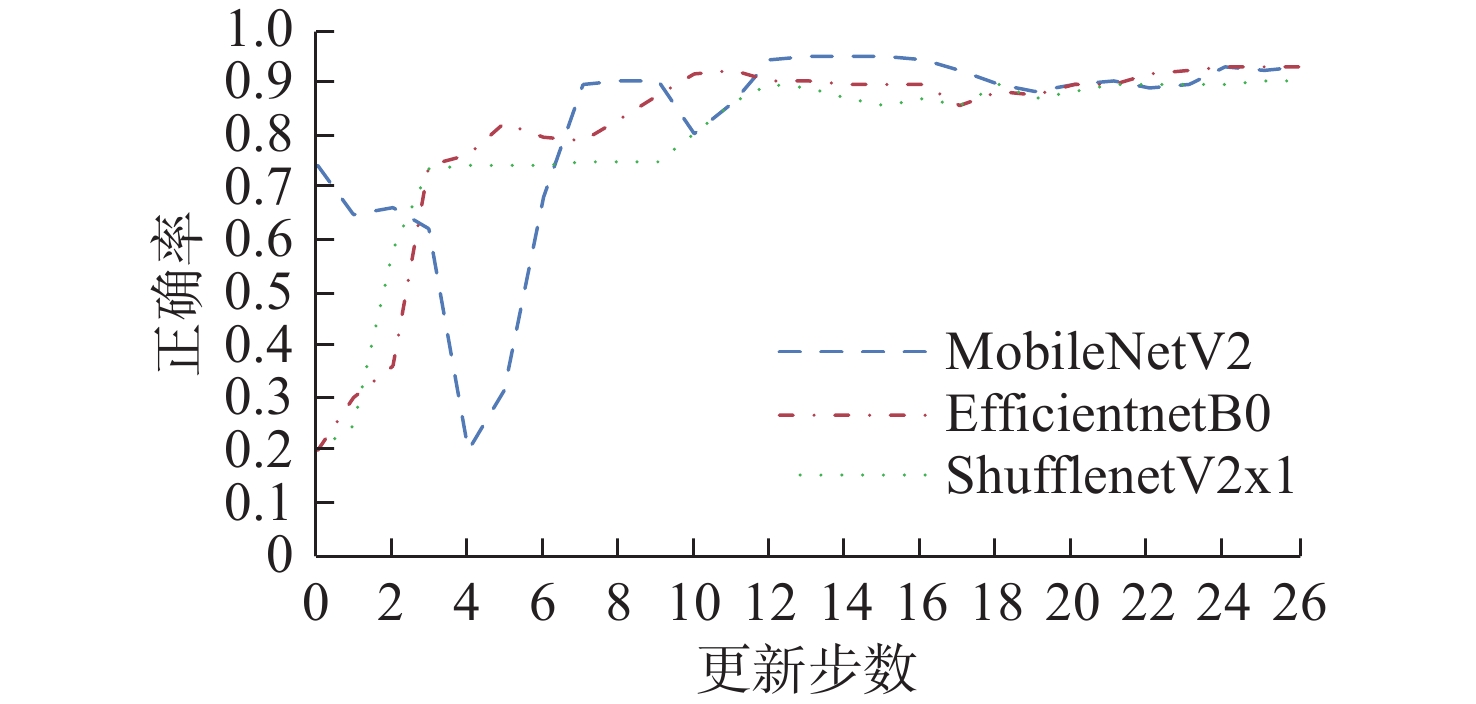
图 15 目标任务网络多普勒域特征验证曲线
Figure 15. Validation curves of Doppler domain features for the target task network
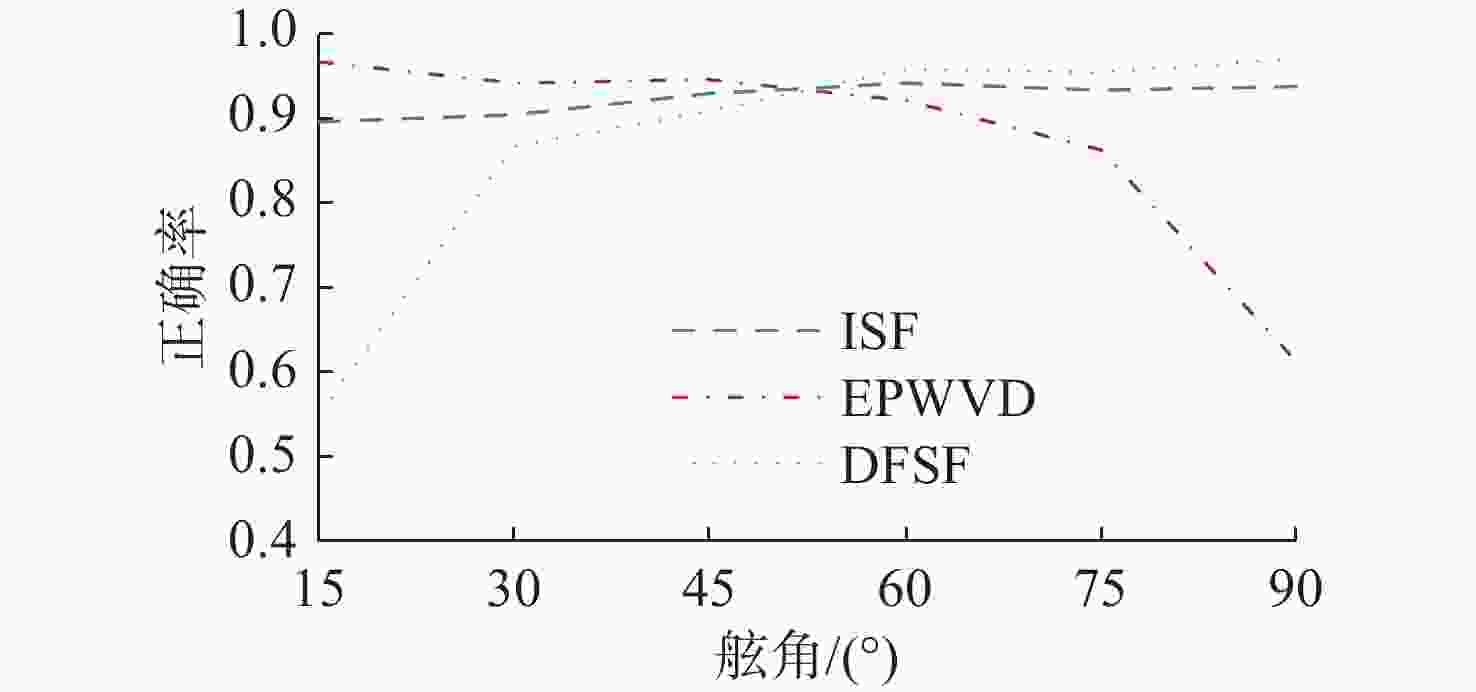
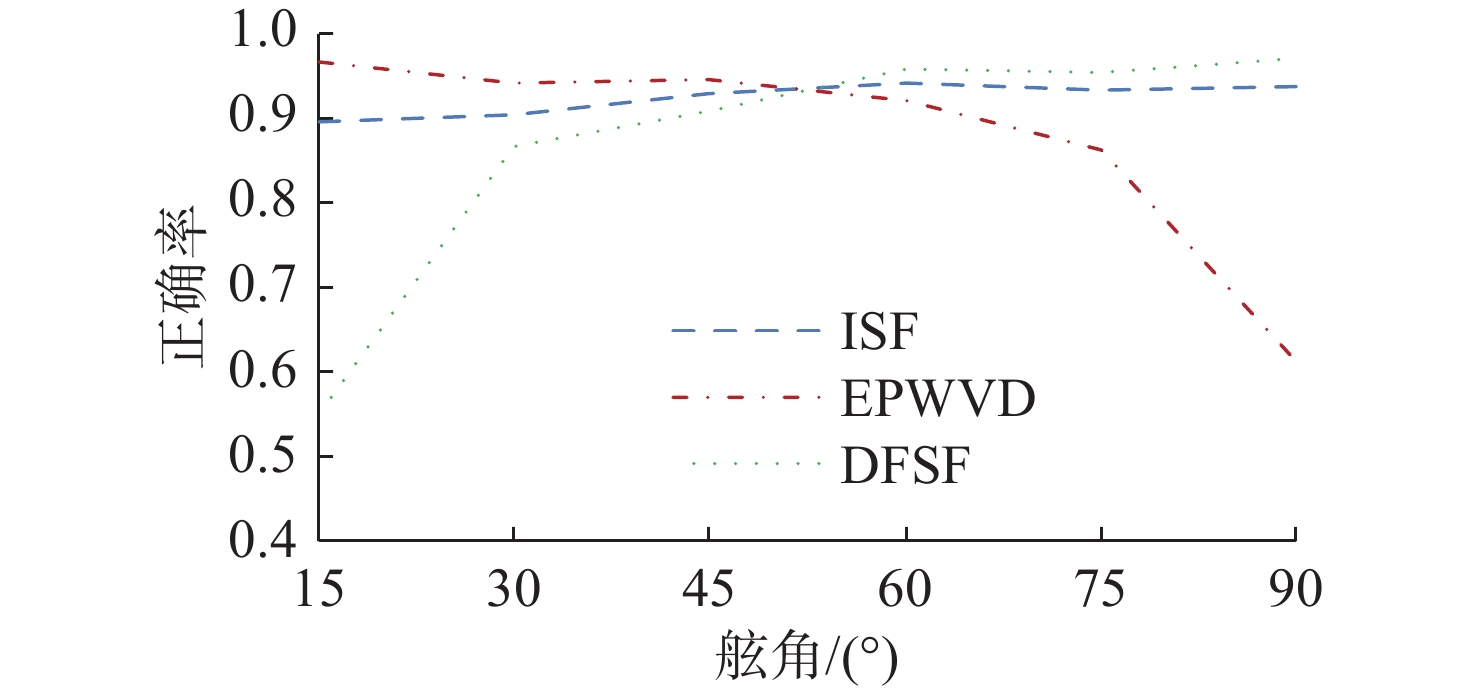
图 16 测试正确率与水平舷角的关系
Figure 16. The correlation between test accuracy and the horizontal bearing-angle
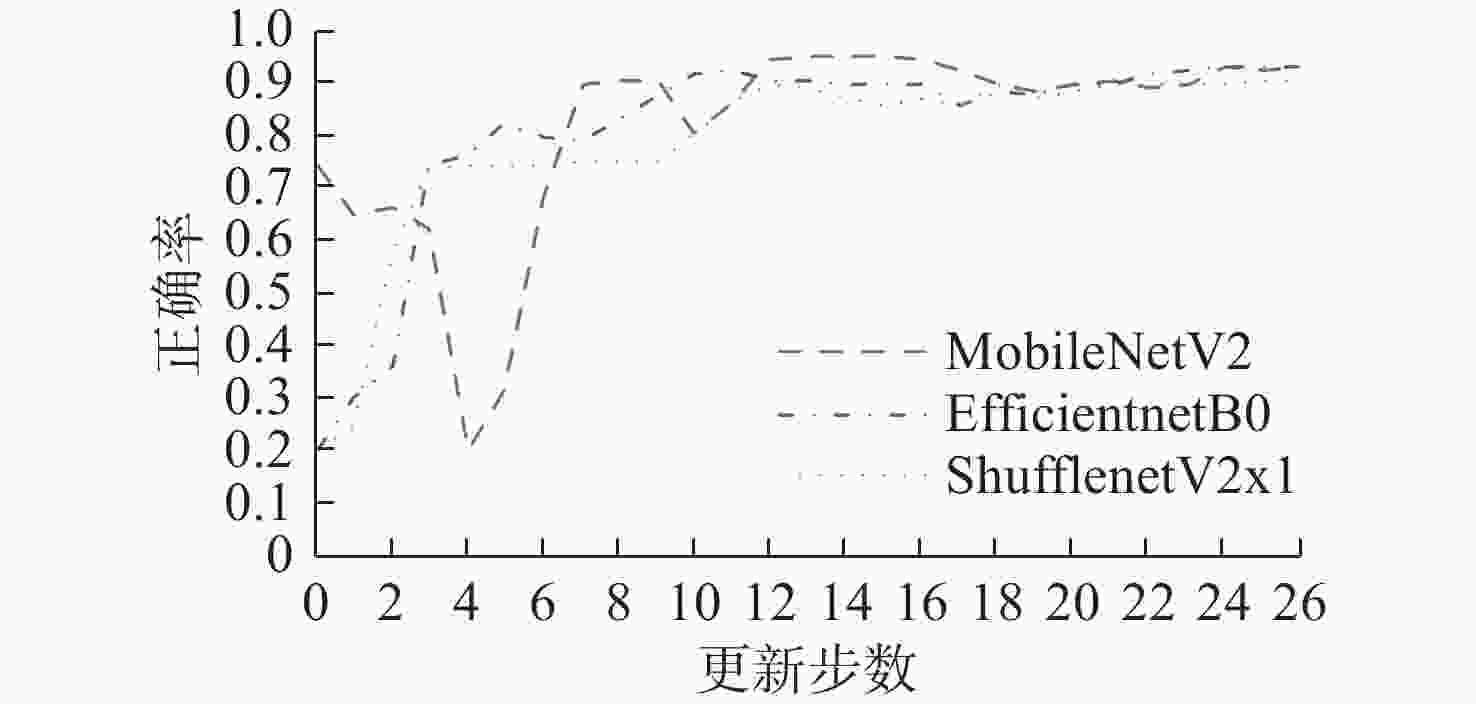
图 17 目标任务网络特征融合验证曲线
Figure 17. Validation curves of feature fusion for the target task network
表 1 目标任务样本库构成
Table 1. Composition of the target task sample library
类型 原始样
本/个配置3
样本/个配置4
样本/个总计/个 训练集 110 150 0 260 验证集 110 0 150 260 测试集 260 0 0 260  下载: 导出CSV
表 2 单一特征推理测试正确率
Table 2. Accuracy of single-feature inference test
模型 空间域
正确率/%时频域
正确率/%多普勒域
正确率/%MobileNetV2 92.3 88.8 88.5 EfficientNetB0 91.5 86.5 87.7 ShuffleNetV2x1 89.6 80.4 83.8
下载: 导出CSV
表 3 网络参数及特征融合测试正确率
Table 3. Network parameters and accuracy of feature fusion test
模型 参数量 FLOPs 正确率/% MobileNetV2 3.51×10⁶ 327.55×10⁶ 94.2 EfficientNetB0 5.29×10⁶ 412.83×10⁶ 93.8 ShuffleNetV2 1.26×10⁶ 146.00×10⁶ 92.3
下载: 导出CSV
-
[1] YU L, CHENG Y M, LI S, et al. Tracking and length estimation of underwater acoustic target[J]. Electronics Letters, 2017, 53(17): 1224-1226. doi: 10.1049/el.2017.1793 [2] WANG Z, WU J, WANG H, et al. A torpedo target recognition method based on the correlation between echo broadening and apparent angle[J]. Applied Sciences, 2022, 12(23): 1-5. [3] XU Y, YUAN B C, ZHANG H G. An improved algorithm of underwater target feature abstracting based on target azimuth tendency[J]. Applied Mechanics & Materials, 2012, 155-156: 1164-1169. [4] XIA Z, LI X K, MENG X X. High resolution time-delay estimation of underwater target geometric scattering[J]. Applied Acoustics, 2016, 114: 111-117. doi: 10.1016/j.apacoust.2016.07.016 [5] LI X K, XU T Y, CHEN B S. Atomic decomposition of geometric acoustic scattering from underwater target[J]. Applied Acoustics, 2018, 140: 205-213. doi: 10.1016/j.apacoust.2018.05.028 [6] RUI L, JUN Y A, GANG C. Target geometric configuration estimation based on acoustic scattering spatiotemporal characteristics[C]//2019 IEEE International Conference on Signal, Information and Data Processing(ICSIDP). Chongqing, China: IEEE, 2019: 1-4. [7] LIU X C, YANG Y C, YANG X F, et al. Zero-shot learning-based recognition of highlight images of echoes of active sonar[J]. Electronics, 2024, 13(457): 1-16. [8] ZHAO S, LI L R, ZHANG X H, et al. Simulation of backscatter signal of submarine target based on spatial distribution characteristics of target intensity[C]//2021 OES China Ocean Acoustics(COA). Harbin, China: IEEE, 2021: 234-239. [9] OU H H , AU W W L , SYRMOS V L. Underwater ordnance classification using time-frequency signatures of backscattering signals[C]//OCEANS 2010 MTS/IEEE SEATTLE. Washington, USA: IEEE, 2010: 1-8. [10] KUBICEK B, SEN GUPTA A, KIRSTEINS I. Feature extraction and classification of simulated monostatic acoustic echoes from spherical targets of various materials using convolutional neural networks[J]. Journal of Marine Science and Engineering, 2023, 11(3): 571. doi: 10.3390/jmse11030571 [11] GERG I D, MONGA V. Structural prior driven regularized deep learning for sonar image classification[J]. IEEE Trans Geosci Remote Sensing, 2022, 60: 1-16. [12] WANG Q C, DU S P, WANG F Y, et al. Underwater target recognition method based on multi-domain active sonar echo images[C]//2021 IEEE International Conference on Signal Processing, Communications and Computing (ICSPCC). Xi’an, China: IEEE, 2021: 1-5. [13] CHEN V C. Advances in applications of radar micro-Doppler signatures[C]//2014 IEEE Conference on Antenna Measurements & Applications(CAMA). Antibes Juan-les-Pins, France: IEEE, 2014: 1-4. [14] JIANG W, LIU Y, WEI Q, et al. A high-resolution radar automatic target recognition method for small UAVs based on multi-feature fusion[C]//2022 IEEE 25th International Conference on Computer Supported Cooperative Work in Design(CSCWD). Hangzhou, China: IEEE, 2022: 775-779. [15] WANG J, GUO J Y, SHAO X, et al. Road targets recognition based on deep learning and micro-Doppler features[C]//2018 International Conference on Sensor Networks and Signal Processing(SNSP). Xi’an, China: IEEE, 2018: 271-276. [16] LENOACH J, LEXA M, CORALUPPI S. Feature-aided tracking techniques for active sonar applications[C]//2021 IEEE 24th International Conference on Information Fusion(FUSION). Sun City, South Africa: IEEE, 2021: 1-7. [17] LI W J, YI W, THE K C, et al. Adaptive multiframe detection algorithm with range-doppler-azimuth measurements[J]. IEEE Transactions on Geoscience and Remote Sensing, 2022, 60: 1-16. [18] WU Y, LUO M, LI S. Measurement and extraction of micro-Doppler feature of underwater rotating target echo[C]//OCEANS 2022. Chennai, India: IEEE, 2022: 1-5. [19] ZENG Z, GU D, SUN J. SAR few-shot recognition based on inner-loop update optimization of meta-learning[C]//2023 8th Asia-Pacific Conference on Synthetic Aperture Radar(APSAR). Bali, Indonesia: IEEE, 2023: 1-5. [20] VETTORUZZ0 A, BOUGUELIA M R, VANSCHOREN J, et al. Advances and challenges in meta-learning: A technical review[J]. IEEE Transactions on Pattern Analysis and Machine Intelligence, 2024, 46(7): 4763-4779. doi: 10.1109/TPAMI.2024.3357847 [21] 孙超. 水下多传感器阵列信号处理[M]. 西安: 西北工业大学出版社, 2007: 22-23. [22] 王永良, 陈辉, 彭应宁, 等. 空间谱估计理论与算法[M]. 北京: 清华大学出版社, 2004: 328-330. [23] 刘晓春, 杨云川, 杨向锋, 等. 基于水下运动目标亮点图像模型的数据增强[J]. 西北工业大学学报, 2023, 39(1): 1-16.LIU X C, YANG Y C, YANG X F, et al. Data augmentation based on highlight image models of underwater maneuvering target[J]. Journal of Northwestern Polytechnical University, 2023, 39(1): 1-16. [24] 张贤达, 保铮. 非平稳信号分析处理[M]. 北京: 国防工业出版社, 1998: 35-68. [25] 朱埜. 主动声纳检测信息原理[M]. 北京: 科学出版社, 2014: 53-54. [26] PAVEL B, JAN N, VAN R, et al. Meta-learning applications to automated machine learning and data mining second edition[M]. Berlin: Springer-Verlag, 2022. -

 下载:
下载:

 点击查看大图
计量
- 文章访问数: 1020
- HTML全文浏览量: 523
- PDF下载量: 170
- 被引次数: 0