

A Three-Dimensional Dynamic Recovery Path Planning Method for Mother–Child AUVs in Complex Ocean Current Environments
-
摘要: 自动回收是母子自主水下航行器(AUV)协同作业中的典型任务, 针对复杂洋流环境下母AUV持续运动导致回收点动态变化, 以及子AUV返航路径受三维地形、洋流扰动和机动约束的共同影响的问题, 提出一种母子AUV三维动态回收方法。该方法面向深海复杂地形区域的中远距离动态返航回收任务, 构建了包含高斯峰谷地形和混合洋流的水下规划环境。在路径生成阶段, 采用快速行进树算法(FMT*)生成全局可行粗路径, 并利用粒子群算法(PSO)对路径进行局部优化。在动态回收阶段, 提出基于二分法的母子AUV动态会合机制, 实现子AUV任务执行段与动态回收段的路径规划。在路径跟踪验证阶段, 将该路径规划方法与PID控制融合, 应用于REMUS100型AUV运动数学模型, 以验证子AUV依靠自身运动控制完成路径跟踪和动态返航的可行性。30次独立仿真结果表明, 在母AUV匀速和正弦变速航行工况下, 所提方法的回收成功率分别达到93%和87%, 与对比算法相比, 所提方法在路径可行性、推进代价和动态回收稳定性方面表现出较好的综合性能。Abstract: Autonomous recovery is a key task in cooperative operations of mother–child autonomous underwater vehicles (AUVs). To address the dynamically changing recovery point caused by the continuous motion of the mother AUV in complex ocean currents, together with the effects of three-dimensional terrain, current disturbances, and maneuverability constraints on the return path of the child AUV, a three-dimensional dynamic recovery method is proposed. The method is intended for medium- and long-range recovery missions in deep-sea regions with complex terrain. A Fast Marching Tree (FMT*) algorithm is used to generate a globally feasible coarse path, which is locally optimized by particle swarm optimization (PSO). A bisection-based dynamic rendezvous mechanism is then developed to plan the task and recovery segments of the child AUV. The trackability of the planned path is verified using PID control based on a REMUS 100 motion model. Results from 30 independent simulations show that the recovery success rates reach 93% and 87% under constant-speed and sinusoidally varying-speed conditions of the mother AUV, respectively. Compared with the benchmark algorithms, the proposed method shows better overall performance in path feasibility, propulsion cost, and dynamic recovery stability.
-
Key words:
- path planning /
- dynamic recovery /
- mother–child AUV /
- mixed currents
-
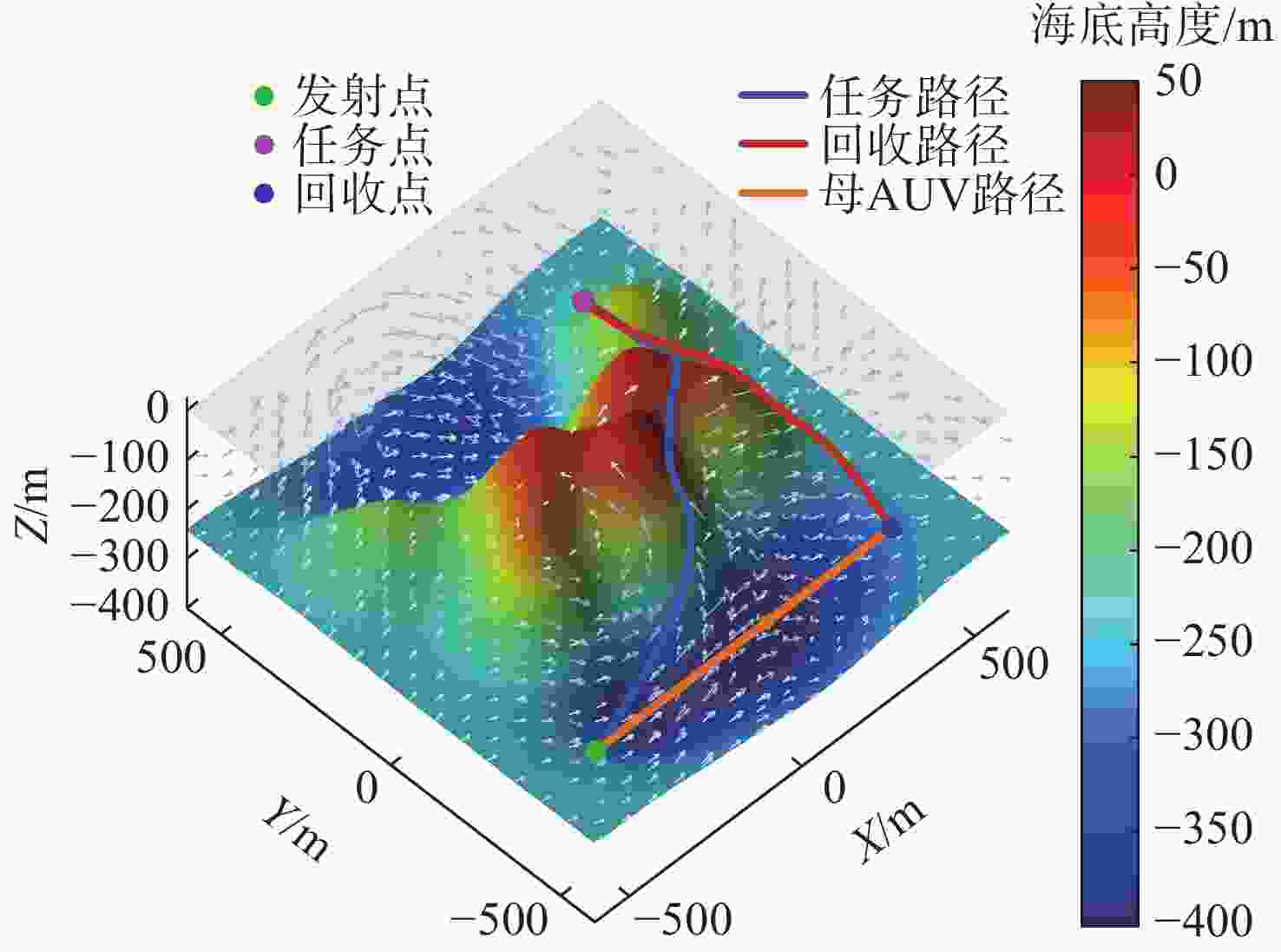
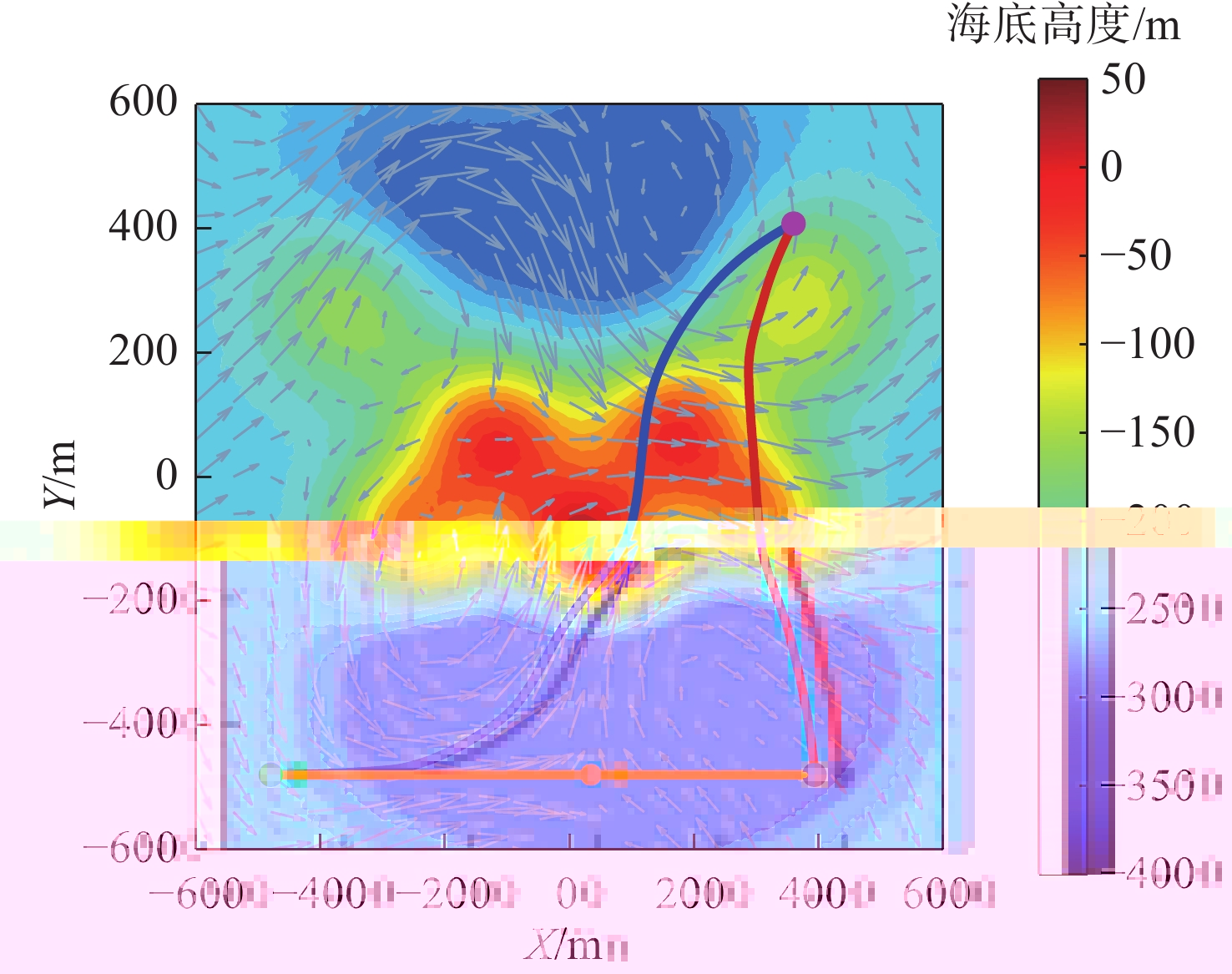
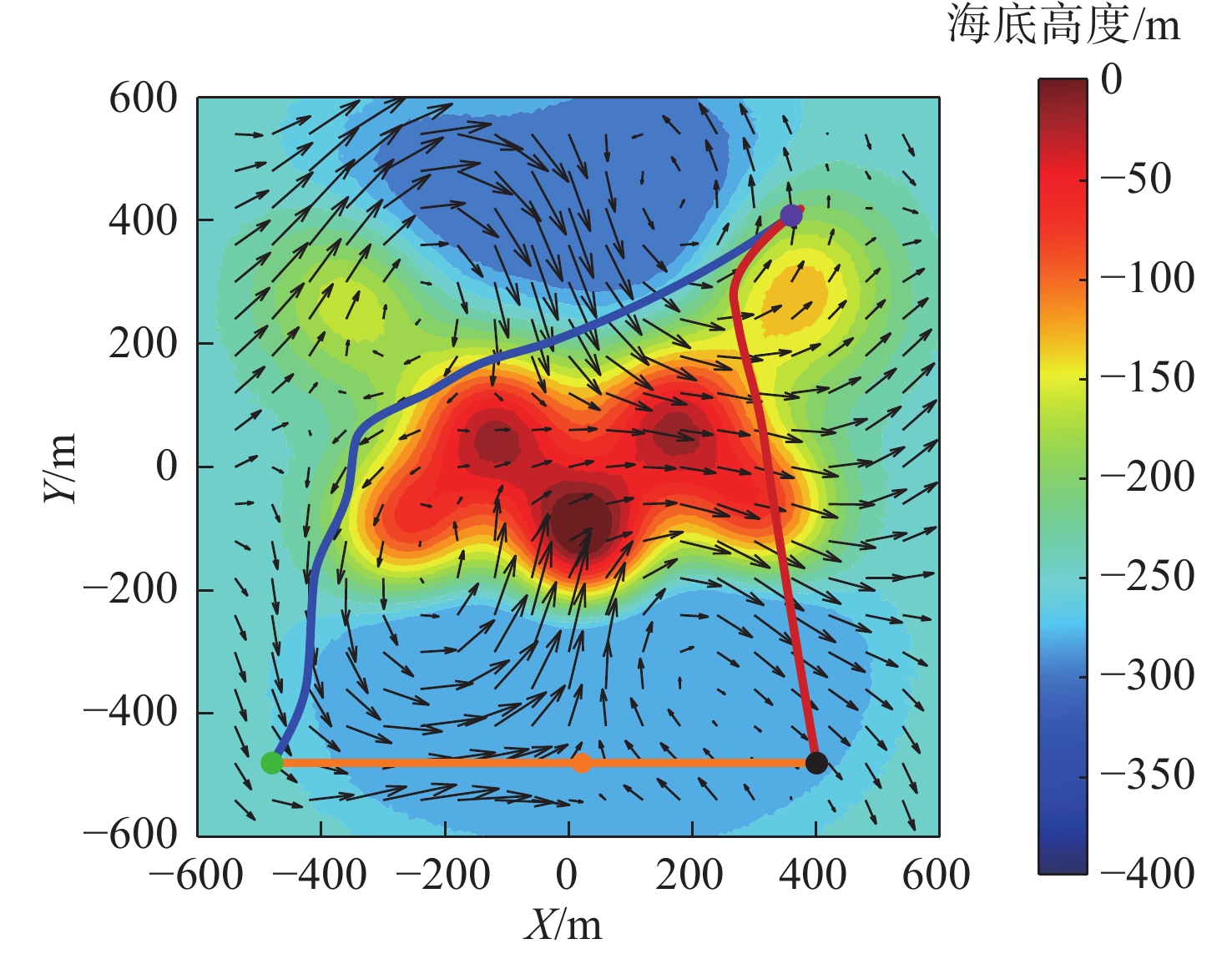
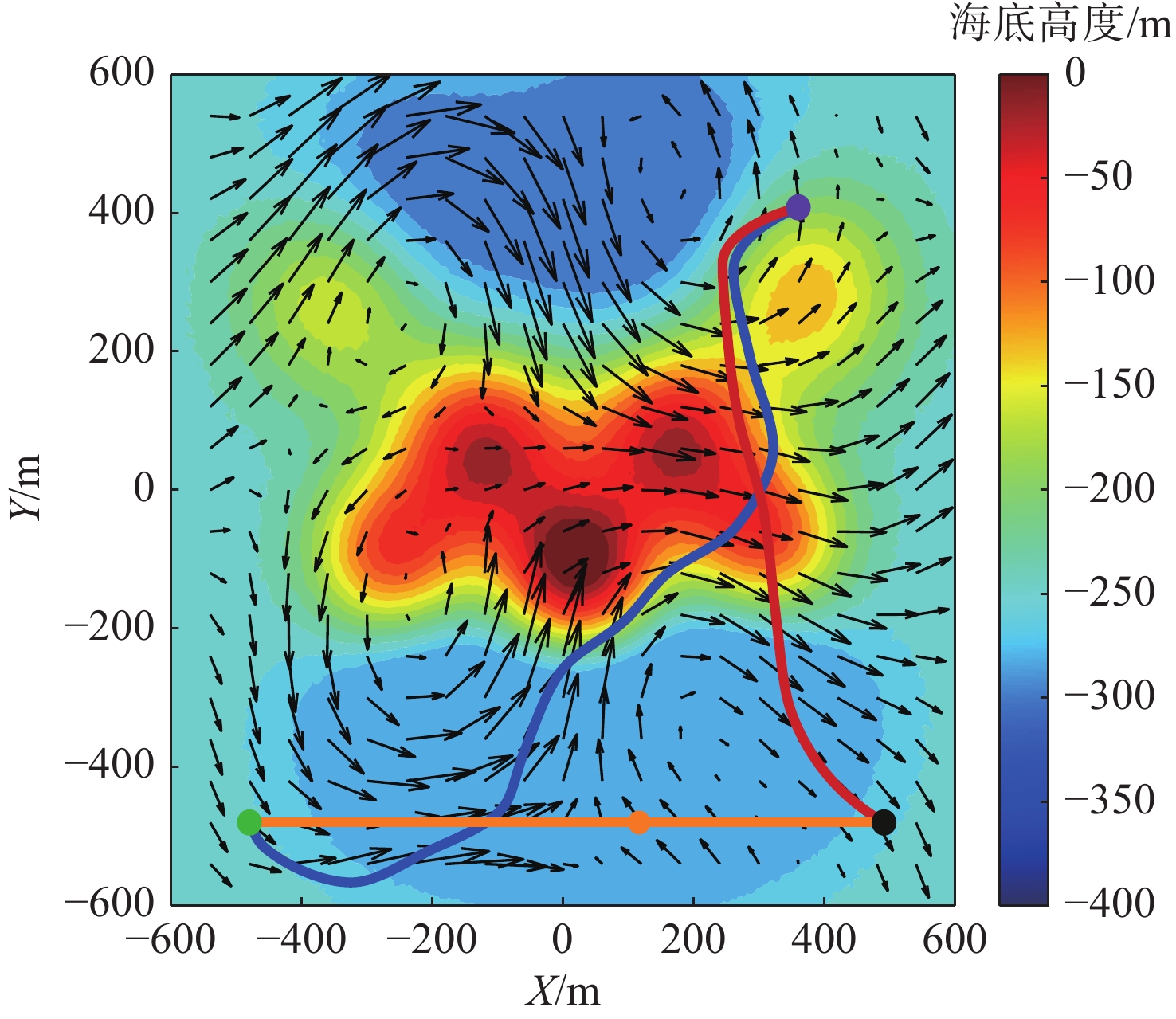
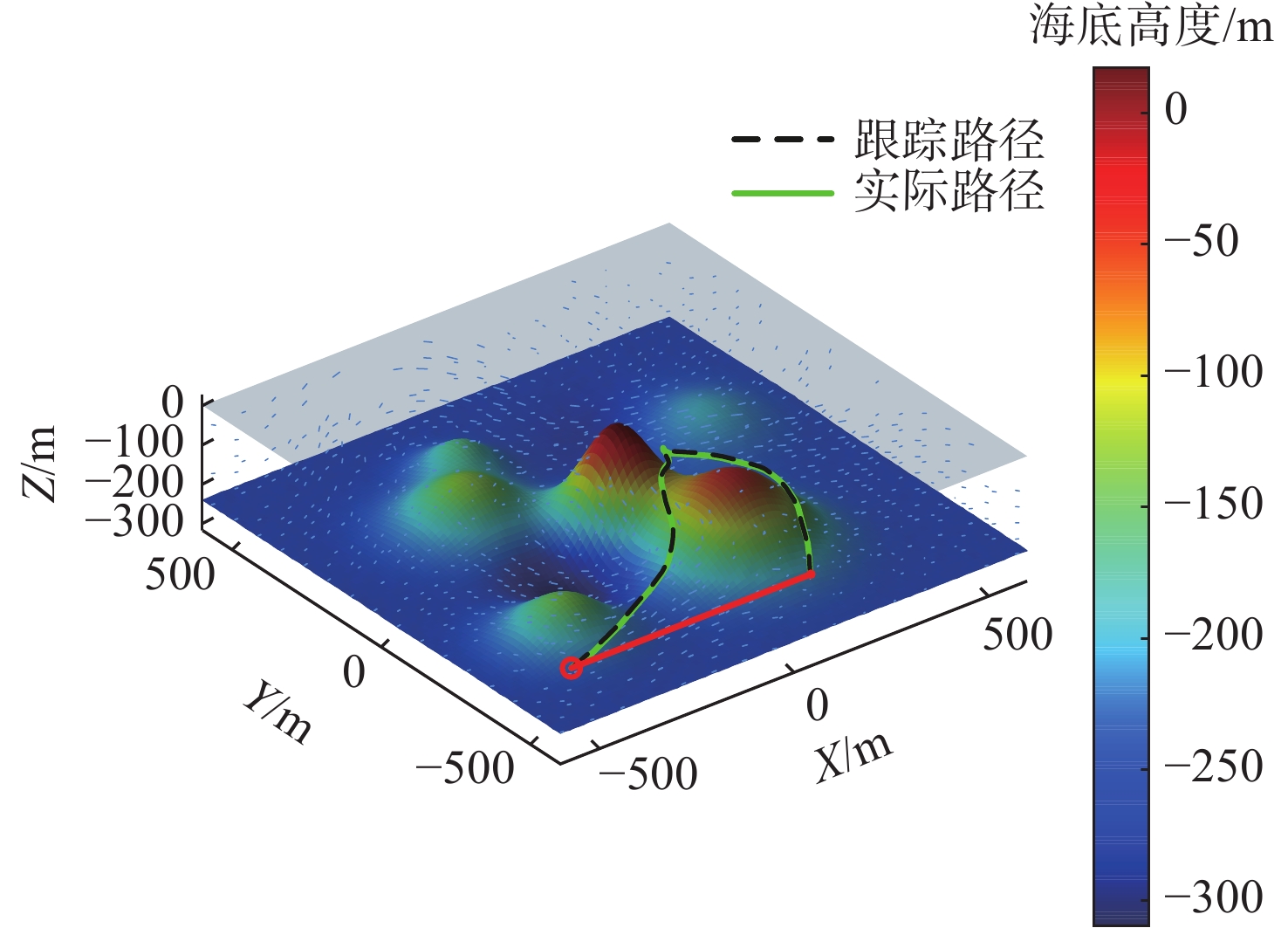
图 8 变速条件下母子AUV路径规划示意图
Figure 8. Schematic diagram of path planning for mother–child AUVs under variable-speed conditions
表 1 不同权重组合下路径规划结果对比
Table 1. Comparison of path planning results under different weight combinations
权重比 归一化
路径长度归一化
平滑性归一化
推进代价6∶2∶2 0.842±0.018 0.286±0.021 0.315±0.019 5∶2∶3 0.856±0.016 0.263±0.018 0.281±0.016 4∶3∶3 0.873±0.019 0.238±0.016 0.274±0.017 3∶4∶3 0.895±0.022 0.211±0.014 0.238±0.018 3∶3∶4 0.883± 0.020 0.229± 0.015 0.251± 0.015 注: 权重比按“路径长度∶路径平滑性∶推进代价”顺序; 各指标均为归一化值, 结果为 20 次独立运行的均值±标准差。  下载: 导出CSV
表 2 仿真参数设置
Table 2. Simulation parameters
类别 参数 数值 环境参数 水下空间范围/m $ \begin{aligned} & x,y\in [-600,600], \\& {\textit{z}}\in [-1 200,0]\end{aligned} $ 洋流速度上限/(m·s−1) 1.8 固定洋流分量/(m·s−1) [0.2,0,0] 航行器参数 母AUV速度/(m·s−1) 0.55 子AUV速度/(m·s−1) 1.5 子AUV最大俯仰角/(°) 25 子AUV最大回转角/(°) 60 子AUV最小转弯半径/m 8 权重与惩罚 $ {w}_{d} $ 3 $ {w}_{\psi } $ 2 $ {w}_{\theta } $ 2 $ {w}_{P} $ 3 $ {w}_{l} $ 5 $ {w}_{s} $ 2 $ {w}_{p} $ 3 $ {J}_{\text{con}} $ 8 000
下载: 导出CSV
表 3 匀速条件下不同算法结果对比
Table 3. Comparison of different algorithms under constant-speed conditions
算法 总路径
长度/m累计推
进代价平均转
角/(°)平均俯
仰角/(°)回收成
功率/%PSO 1693 ±2814551 ±2431.29±0.12 11.99±0.58 63 RRT* 1663 ±3114051 ±1931.56±0.15 15.32±0.73 73 FMT* 1721 ±2314906 ±3512.37±0.17 15.27±0.81 47 文中方法 1648 ±1913954 ±2130.84±0.07 11.31±0.51 93
下载: 导出CSV
表 4 母AUV变速条件下不同算法结果对比
Table 4. Comparison of different algorithms under the variable-speed mother AUV condition
算法 总路径
长度/m累计推
进代价平均
转角/(°)平均俯
仰角/(°)回收成
功率/%PSO 1892±35 14903 ±2101.62±0.13 11.94±0.42 63 RRT* 2013±49 16529 ±3461.76±0.17 12.62±0.55 70 FMT* 2105 ±4115379 ±2952.95±0.19 12.91±0.53 47 文中方法 1911±21 14810 ±1831.76±0.08 11.89±0.27 87
下载: 导出CSV
-
[1] 高永宁, 周欢思. 水下航行器布放与回收现状及关键技术综述[J]. 数字海洋与水下攻防, 2025, 8(4): 437-444. doi: 10.19838/j.issn.2096-5753.2025.04.007GAO Y N, ZHOU H S. Review of current status and key technologies of underwater vehicle launch and recovery[J]. Digital Ocean & Underwater Warfare, 2025, 8(4): 437-444. doi: 10.19838/j.issn.2096-5753.2025.04.007 [2] 时常鸣, 刘开周, 赵洋, 等. 面向AUV水下移动对接的实时路径规划方法[J]. 舰船科学技术, 2020, 42(5): 148-152. doi: 10.3404/j.issn.1672-7649.2020.05.028SHI C M, LIU K Z, ZHAO Y, et al. Research on real-time path planning for AUV underwater mobile docking[J]. Ship Science and Technology, 2020, 42(5): 148-152. doi: 10.3404/j.issn.1672-7649.2020.05.028 [3] 曹亚浩, 吕云飞, 陈源宝, 等. 基于改进粒子群算法的UUV集群回收任务规划[J]. 舰船科学技术, 2025, 47(23): 92-97. doi: 10.3404/j.issn.1672-7649.2025.23.014CAO Y H, LV Y F, CHEN Y B, et al. UUV swarm recovery task planning based on improved particle swarm optimization algorithm[J]. Ship Science and Technology, 2025, 47(23): 92-97. doi: 10.3404/j.issn.1672-7649.2025.23.014 [4] 赵鹏程, 宋保维, 毛昭勇, 等. 基于改进的复合自适应遗传算法的UUV水下回收路径规划[J]. 兵工学报, 2022, 43(10): 2598-2608. doi: 10.12382/bgxb.2021.0474ZHAO P C, SONG B W, MAO Z Y, et al. Path planning for UUV underwater recovery based on improved composite adaptive genetic algorithm[J]. Acta Armamentarii, 2022, 43(10): 2598-2608. doi: 10.12382/bgxb.2021.0474 [5] 廉成斌, 杨亭鹏, 李磊, 等. UUV水下回收路径规划方法研究[J]. 舰船科学技术, 2021, 43(S1): 42-47.LIAN C B, YANG T P, LI L, et al. Research of unmanned underwater vehicle underwater recovery path planning[J]. Ship Science and Technology, 2021, 43(S1): 42-47. [6] YAZDANI A M, SAMMUT K, YAKIMENKO O A, et al. A survey of underwater docking guidance systems[J]. Robotics and Autonomous Systems, 2020, 124: 103382. doi: 10.1016/j.robot.2019.103382 [7] PAGE B R, LAMBERT R, CHAVEZ-GALAVIZ J, et al. Underwater docking approach and homing to enable persistent operation[J]. Frontiers in Robotics and AI, 2021, 8: 621755. doi: 10.3389/frobt.2021.621755 [8] THOMAS C, SIMETTI E, CASALINO G. A unifying task priority approach for autonomous underwater vehicles integrating homing and docking maneuvers[J]. Journal of Marine Science and Engineering, 2021, 9(2): 162. doi: 10.3390/jmse9020162 [9] ZHANG Z, WU H, ZHOU H, et al. Recovery path planning for autonomous underwater vehicles using constrained bi-RRT*-Smart algorithms[C]//OCEANS 2023 - Limerick, 2023: 1-6. [10] PANDA M, DAS B, SUBUDHI B, et al. A comprehensive review of path planning algorithms for autonomous underwater vehicles[J]. International Journal of Automation and Computing, 2020, 17(3): 321-352. doi: 10.1007/s11633-019-1204-9 [11] YAN X H, WANG W K, HUANG C X, et al. A new path planning method for AUV based on the Navier–Stokes equations for ocean currents[J]. Mathematics and Computers in Simulation, 2024, 222: 199-208. doi: 10.1016/j.matcom.2023.08.030 [12] 邓英杰, 徐艺菲, 闫敬, 等. AI驱动的海上无人系统决策与控制研究进展综述[J]. 水下无人系统学报, 2026, 34(1): 9-28. doi: 10.11993/j.issn.2096-3920.2025-0095DENG Y J, XU Y F, YAN J, et al. Research progress on AI-driven decision and control of maritime unmanned systems[J]. Journal of Unmanned Undersea Systems, 2026, 34(1): 9-28. doi: 10.11993/j.issn.2096-3920.2025-0095 [13] MENG W, PU Y, YU H, et al. A fusion framework with spatial perception and energy-aware strategies for AUV path planning in uncharted marine environments[J]. Ocean Engineering, 2025, 328: 121095. doi: 10.1016/j.oceaneng.2025.121095 [14] ZHAO E, CHENG T, WANG S, et al. Underwater 3D path planning for AUV in ocean currents based on improved Informed RRT* algorithm[J]. Journal of Intelligent & Robotic Systems, 2025, 111(4): 116. doi: 10.1007/s10846-025-02320-6 [15] COOPER-BALDOCK Z, TURNOCK S R, SAMMUT K. Wake-informed 3D path planning for Autonomous Underwater Vehicles using A* and neural network approximations[J]. Ocean Engineering, 2025, 332: 121353. doi: 10.1016/j.oceaneng.2025.121353 -

 下载:




 点击查看大图
计量
- 文章访问数: 1
- HTML全文浏览量: 1
- PDF下载量: 0
- 被引次数: 0