

Dubins Path-based Dynamic Docking Trajectory Planning for Autonomous Underwater Vehicle
-
摘要: 自主水下航行器(AUV)的动态对接回收面临移动目标交会、终端姿态对齐及声学定位受限等多重挑战。现有轨迹规划方法难以兼顾上述约束下的时间最优性与鲁棒性。为此, 文中提出一种基于Dubins路径的时间最优动态对接轨迹规划方法。首先, 将中程导引阶段建模为水平面内的受约束最短路径问题, 通过构建时间残差函数预测移动回收平台的动态就位点, 解算满足AUV最小转弯半径约束的Dubins可行路径; 其次, 设计了一种超短基线(USBL)波束角触发的在线重规划机制, 以抑制环境扰动与观测噪声引发的轨迹发散。多工况仿真结果表明: 相较于传统视线导引法, 所提方法在典型动态对接工况下能够实现AUV对移动平台的有效追踪与终端航向对齐, 并在扰动与测量误差条件下保持良好的轨迹收敛性和抗干扰能力。Abstract: The dynamic docking recovery of autonomous undersea vehicle (AUV) faces multiple challenges, including moving-target rendezvous, terminal attitude alignment, and acoustic positioning limitations. Existing trajectory planning methods struggle to simultaneously achieve time optimality and robustness under these constraints. To address these challenges, this paper proposes a time-optimal dynamic docking trajectory planning method based on Dubins paths. First, the mid-range guidance phase is formulated as a constrained shortest-path problem in the horizontal plane. By constructing a time residual function, the dynamic arrival point of the moving recovery platform is predicted, and a feasible Dubins path satisfying the minimum turning radius constraint of the AUV is solved. Second, an online replanning mechanism triggered by the beamwidth of the Ultra-Short Baseline (USBL) system is designed to suppress trajectory divergence caused by environmental disturbances and observation noise. Multi-scenario simulation results demonstrate that, compared with the traditional line-of-sight guidance method, the proposed approach enables effective tracking of the moving platform and terminal heading alignment under typical dynamic docking conditions, while maintaining good trajectory convergence and anti-interference capability under disturbances and measurement errors.
-
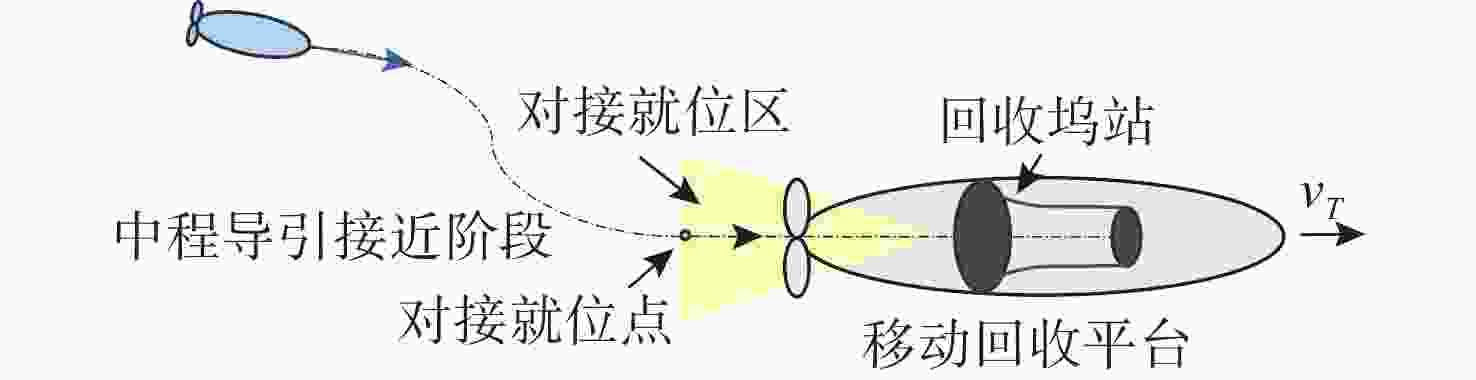
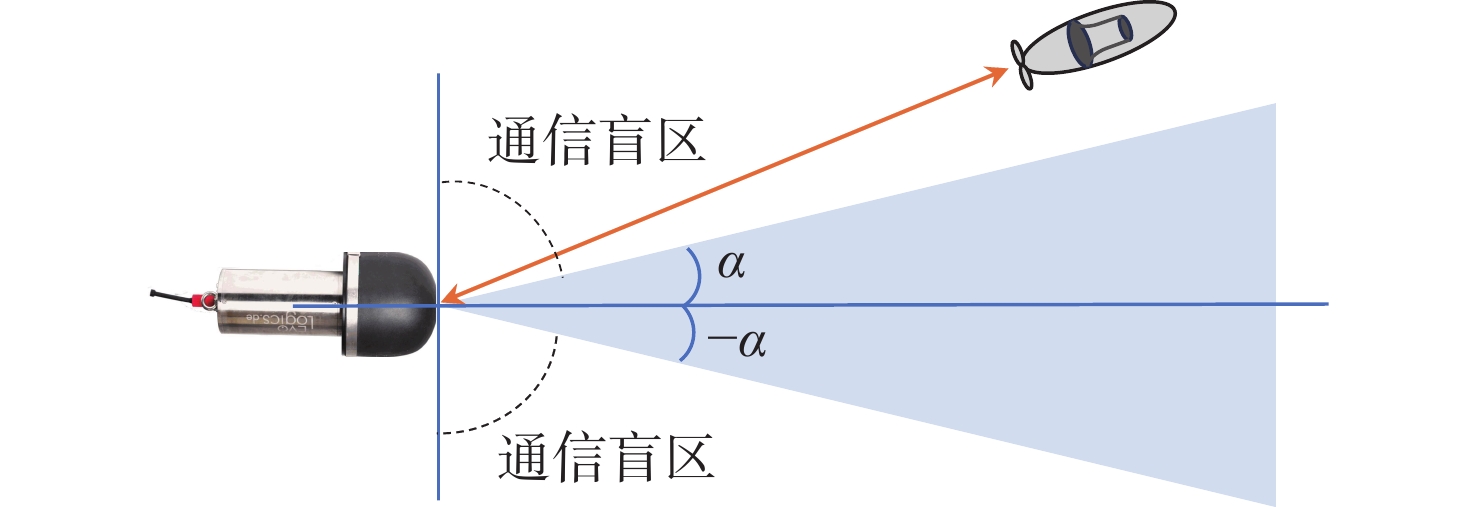
图 1 中程导引接近阶段轨迹规划示意图
Figure 1. Schematic diagram of trajectory planning in the mid-course guidance approach phase
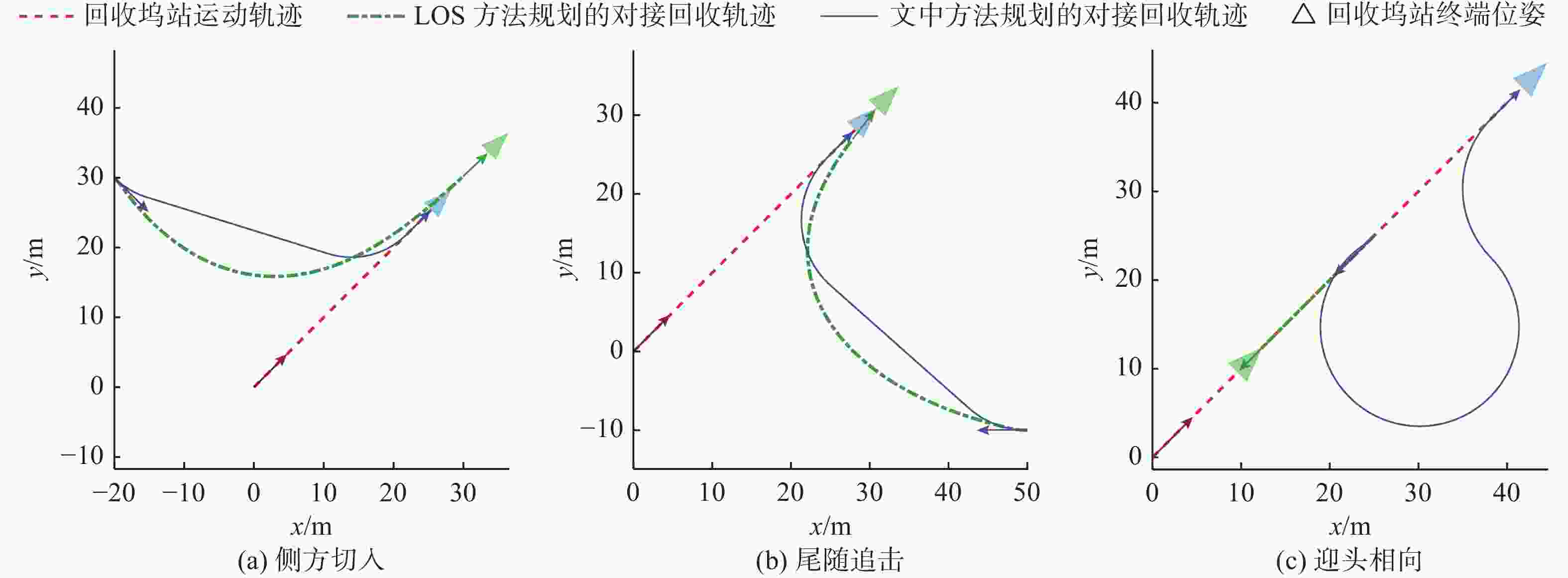
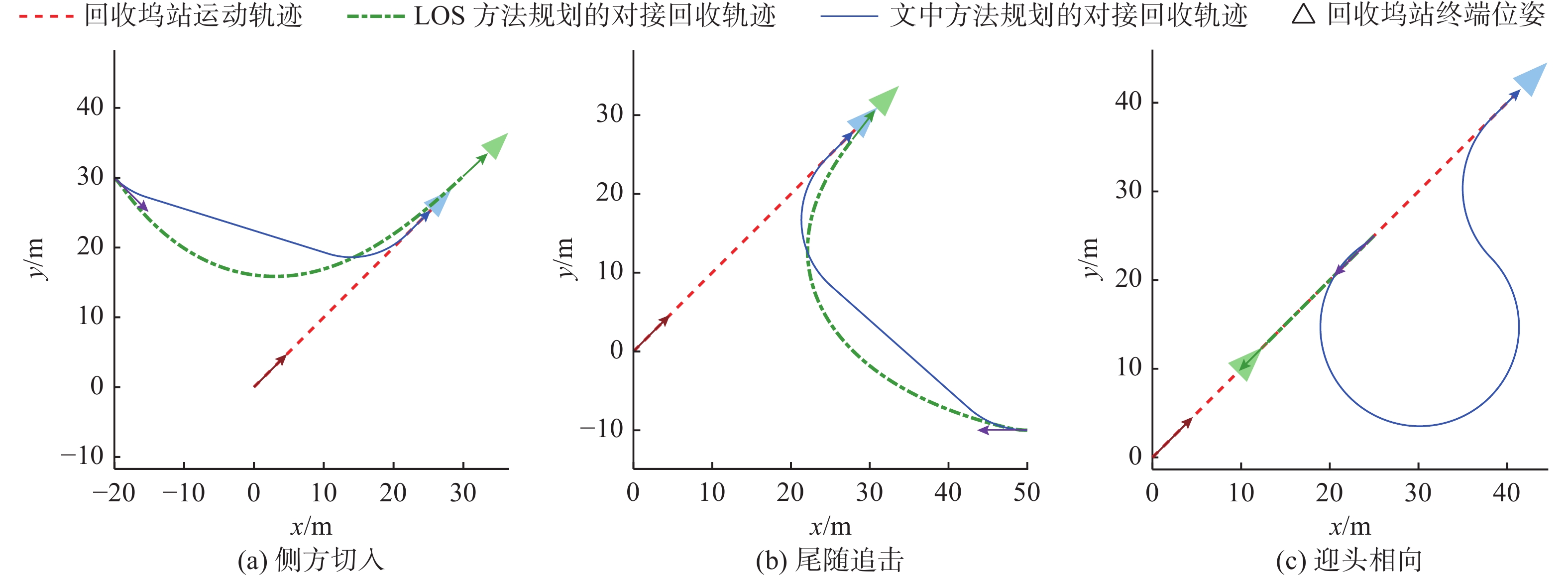
图 4 多工况下的AUV动态对接轨迹对比
Figure 4. Comparison of AUV dynamic docking trajectories under multiple working conditions
表 1 基于Dubins路径的动态对接回收轨迹规划算法
Table 1. Dynamic docking and recovery trajectory planning algorithm based on Dubins path
项目 内容 输入 AUV初始位姿$ {\boldsymbol{p}}_{A}({t}_{0}) $、航速$ {v}_{A} $与最小转弯半径$ {R}_{\min } $; 回收平台初始位姿$ {\boldsymbol{p}}_{T}({t}_{0}) $、航速$ {v}_{T} $、航向角$ {\psi }_{T} $; 时间步长$ \Delta t $、容许滞后时间$ {T}_{\text{allow}} $、最大任务时间$ {T}_{\max } $ 输出 最优对接就位点位姿; 时间最优Dubins可行轨迹 步骤 1) 在任务时间窗口$ [{t}_{0},{t}_{0}+{T}_{\max }] $内, 以时间步长$ \Delta t $枚举候选交会时间点集合$ \left\{{t}_{k}\right\} $; 2) 对每个候选时间点$ \left\{{t}_{k}\right\} $, 计算回收平台预测位姿$ {\boldsymbol{p}}_{T}({t}_{k}) $, 求解AUV从初始位姿至该位姿的Dubins最短路径长度$ L({t}_{k}) $; 3) 计算对应航行时间$ {\tau }_{A}({t}_{k}) $与时间残差$ f({t}_{k}) $, 判断是否满足同步交会约束(9); 4) 选取最早满足约束的时间点$ {t}^{*} $作为最优交会时刻, 输出对应对接就位点位姿$ {\boldsymbol{p}}_{T}({t}^{*}) $及Dubins可行路径; 5) 若时间窗口内无可行解, 适当降低AUV航速$ {v}_{A} $扩大可行域, 重新执行步骤1)~4)。  下载: 导出CSV
表 2 仿真参数
Table 2. Simulation parameters
参数名称 符号 数值 时间步长/s $ \Delta t $ 0.1 AUV航速/(m/s) $ {v}_{A} $ 1.5 移动平台速度/(m/s) $ {v}_{T} $ 1.2 AUV最小转弯半径/m $ R_{\min} $ 11.2 最大偏航角速度/[(°)/s] $ {\omega }_{\max } $ 8.05 USBL采样更新周期/s $ T_\text{USBL} $ 10 USBL有效观测波束角/(°) $ \alpha $ ±40 对接就位区距离/m $ {d}_{s} $ 5.0
下载: 导出CSV
表 3 多工况下动态对接性能指标对比
Table 3. Performance comparison of dynamic docking under multiple scenarios
工况 方法 航行
时间/s终端相
对距离/m终端航向
角误差/(°)运算
时间/ms1 LOS 39.06 4.983 1.947 2.099 文中 29.92 4.943 0 3.136 2 LOS 36.40 4.996 7.355 0.198 文中 33.16 4.991 0.000 0.749 3 LOS 11.30 4.845 180.000 0.192 文中 49.15 4.860 0 0.832
下载: 导出CSV
-
[1] Wibisono A, Piran M J, Song H K, et al. A survey on unmanned underwater vehicles: challenges, enabling technologies, and future research directions[J]. Sensors, 2023, 23(17): 7321. doi: 10.3390/s23177321 [2] 高永宁, 周欢思. 水下航行器布放与回收现状及关键技术综述[J]. 数字海洋与水下攻防, 2025, 8(4): 437-444. doi: 10.19838/j.issn.2096-5753.2025.04.007Gao Y N, Zhou H S. Review of current status and key technologies of underwater vehicle deployment and recovery[J]. Digital Ocean & Underwater Warfare, 2025, 8(4): 437-444. doi: 10.19838/j.issn.2096-5753.2025.04.007 [3] Rohan A, Tolie H F, Hasan M J, et al. Full autonomy in underwater robotics systems: A realistic prospect?[J]. Engineering Applications of Artificial Intelligence, 2025, 162: 112638. doi: 10.1016/j.engappai.2025.112638 [4] Xu S, Jiang Y, Li Y, et al. A stereo visual navigation method for docking autonomous underwater vehicles[J]. Journal of Field Robotics, 2024, 41(2): 374-395. doi: 10.1002/rob.22269 [5] 孟令帅, 李明烁, 林扬, 等. 自主水下机器人布放回收技术综述[J]. 无人系统技术, 2024, 7(1): 1-19. doi: 10.19942/j.issn.2096-5915.2024.01.01Meng L S, Li M S, Lin Y, et al. Launch and recovery technology of autonomous underwater vehicle[J]. Unmanned Systems Technology, 2024, 7(1): 1-19. doi: 10.19942/j.issn.2096-5915.2024.01.01 [6] Vishwakarma S, Bedmutha T, Patel D K, et al. A survey on sensor-based planning and control for unmanned underwater vehicles[PP/OL]. V1. arXiv (2026-04-05)[2026-05-03]. https://doi.org/10.48550/arXiv.2604.05003. [7] Liu J, Yu F, He B, et al. A review of underwater docking and charging technology for autonomous vehicles[J]. Ocean Engineering, 2024, 297: 117154. doi: 10.1016/j.oceaneng.2024.117154 [8] Xie T, Li Y, Jiang Y, et al. Turning circle based trajectory planning method of an underactuated AUV for the mobile docking mission[J]. Ocean Engineering, 2021, 236: 109546. doi: 10.1016/j.oceaneng.2021.109546 [9] He L, Xie M, Zhang Y. A review of path following, trajectory tracking, and formation control for autonomous underwater vehicles[J]. Drones, 2025, 9(4): 286. doi: 10.3390/drones9040286 [10] Zhang W, Wu W, Teng Y, et al. An underwater docking system based on UUV and recovery mother ship: design and experiment[J]. Ocean Engineering, 2023, 281: 114767. doi: 10.1016/j.oceaneng.2023.114767 [11] 沈蔚, 丁子涵, 徐顾自. 融合人工势场与LOS导引的多艇协同控制方法设计[J]. 控制与决策, 2026, 41(3): 685-691. doi: 10.13195/j.kzyjc.2025.0421Shen W, Ding Z H, Xu G Z. Design of cooperative control method for multi-USVs based on fusion of artificial potential field and LOS guidance[J]. Control and Decision, 2026, 41(3): 685-691 doi: 10.13195/j.kzyjc.2025.0421 [12] 毕成, 段富海. 结合ILOS及IPID-GWO的无人水翼航行器路径跟踪优化[J]. 水下无人系统学报, 2025, 33(4): 648-656.Bi C, Duan F H. Path tracking optimization for unmanned hydrofoil vehicle based on ILOS and IPID-GWO[J]. Journal of Unmanned Undersea Systems, 2025, 33(4): 648-656. [13] Du B, Yang K, Zhang W, et al. Terminal line-of-sight angle-constrained target tracking guidance for unmanned surface vehicles[J]. IEEE Transactions on Vehicular Technology, 2024, 73(9): 12515-12529. doi: 10.1109/TVT.2024.3390001 [14] Ghosh P, Mandal P. AUV way-point tracking at constant velocity: cross-track error(CTE) and line-of-sight(LOS) guidance[J]. Engineering Research Express, 2024, 6(2): 025501. doi: 10.1088/2631-8695/ad36b0 [15] Yang Q, Liu H, Hong L, et al. Anti-disturbance control strategy in capture stage for AUV dynamic base docking with optical guided constraints[J]. Ocean Engineering, 2024, 311: 118946. doi: 10.1016/j.oceaneng.2024.118946 [16] 刘硼棚, 匡兵. 一种改进Dubins曲线的路径规划方法[J]. 机械设计与制造, 2026(4): 343-348. doi: 10.19356/j.cnki.1001-3997.20250919.011Liu P P, Kuang B. A path planning method to improve Dubins curve[J]. Machinery Design & Manufacture, 2026(4): 343-348. doi: 10.19356/j.cnki.1001-3997.20250919.011 [17] Chitsaz H, LaValle S M, Balkcom D J, et al. Minimum wheel-rotation paths for differential-drive mobile robots[J]. The International Journal of Robotics Research, 2009, 28(1): 66-80. doi: 10.1177/0278364908096750 [18] Dai N, Zhang Y, Yang C. An AUV underwater docking technology realization based on Dubins curve and improved virtual force field[C]//Proceedings of the 4th International Conference on Artificial Intelligence and Computer Engineering, 2023: 1061-1068. [19] 高剑, 刘富樯, 严卫生. 自主水下航行器回坞路径规划与跟踪控制[J]. 机械科学与技术, 2012, 31(5): 810-813,817. doi: 10.13433/j.cnki.1003-8728.2012.05.035Gao J, Liu F Q, Yan W S. Homing path planning and following control of an autonomous underwater vehicle[J]. Mechanical Science and Technology for Aerospace Engineering, 2012, 31(5): 810-813,817. doi: 10.13433/j.cnki.1003-8728.2012.05.035 [20] Wang Q, Xu D, Liu X, et al. Trajectory planning method for formation rendezvous of underactuated multi-UUV under multiple constraints[J]. Journal of Marine Science and Engineering, 2024, 12(12): 2118. doi: 10.3390/jmse12122118 [21] Zhang M, Cai W, Chen H. Automatic docking trajectory design-based time-varying-radius Dubins for unmanned surface vessel[J]. Applied Sciences, 2023, 13(3): 1583. doi: 10.3390/app13031583 [22] 时常鸣, 刘开周, 赵洋, 等. 面向AUV水下移动对接的实时路径规划方法[J]. 舰船科学技术, 2020, 42(9): 148-152.Shi C M, Liu K Z, Zhao Y, et al. Research on real-time path planning for AUV underwater mobile docking[J]. Ship Science and Technology, 2020, 42(9): 148-152. [23] Dai H, Zhang Y, Cui S, et al. Research on the control method for remotely operated vehicle active docking with autonomous underwater vehicles based on GFSMO-NMPC[J]. Journal of Marine Science and Engineering, 2025, 13(3): 601. doi: 10.3390/jmse13030601 [24] Zhang Y, Gao J, Chen G, et al. Hierarchical model predictive control for safe docking to moving stations of underactuated autonomous underwater vehicles[J]. Ocean Engineering, 2026, 349: 123993. doi: 10.1016/j.oceaneng.2025.123993 [25] 陈杰, 赵斌, 王政陽, 等. 基于滚动时域决策的异构无人集群跨域协同搜索路径规划[J/OL]. 兵工学报, 2026-03-23. https://link.cnki.net/urlid/11.2176.tj.20260323.1532.002.Chen J, Zhao B, Wang Z Y, et al. Cross-domain cooperative search path planning for heterogeneous UAV swarms based on receding horizon decision-making[J/OL]. Acta Armamentarii, 2026-03-23. https://link.cnki.net/urlid/11.2176.tj.20260323.1532.002. [26] Wang Z, Xiang X, Xiong X, et al. Kalman filter-based acoustic guidance docking system for autonomous underwater vehicle[C]//International Conference on Intelligent Robotics and Applications, 2024: 68-79. [27] 张晓飞, 辛明真, 隋海琛, 等. 基于交互式多模型卡尔曼滤波的AUV超短基线跟踪算法[J]. 水下无人系统学报, 2022, 30(1): 29-36.Zhang X F, Xin M Z, Sui H C, et al. AUV ultra-short baseline tracking algorithm based on interactive multi-model Kalman filter[J]. Journal of Unmanned Undersea Systems, 2022, 30(1): 29-36. [28] Zhang Y, Gao J, Chen Y, et al. Adaptive neural network control for visual docking of an autonomous underwater vehicle using command filtered backstepping[J]. International Journal of Robust and Nonlinear Control, 2022, 32(8): 4716-4738. doi: 10.1002/rnc.6051 [29] Whitcomb L, Yoerger D, Singh H. Advances in Doppler-based navigation of underwater robotic vehicles[C]//Proceedings 1999 IEEE International Conference on Robotics and Automation (Cat. No. 99CH36288C), 1999: 399-406. -

 下载:

 点击查看大图
计量
- 文章访问数: 3
- HTML全文浏览量: 3
- PDF下载量: 0
- 被引次数: 0