

An Effectiveness Analysis Method for UAV Magnetic Anomaly Detection Based on the Equivalent Magnetic Detection Radius
-
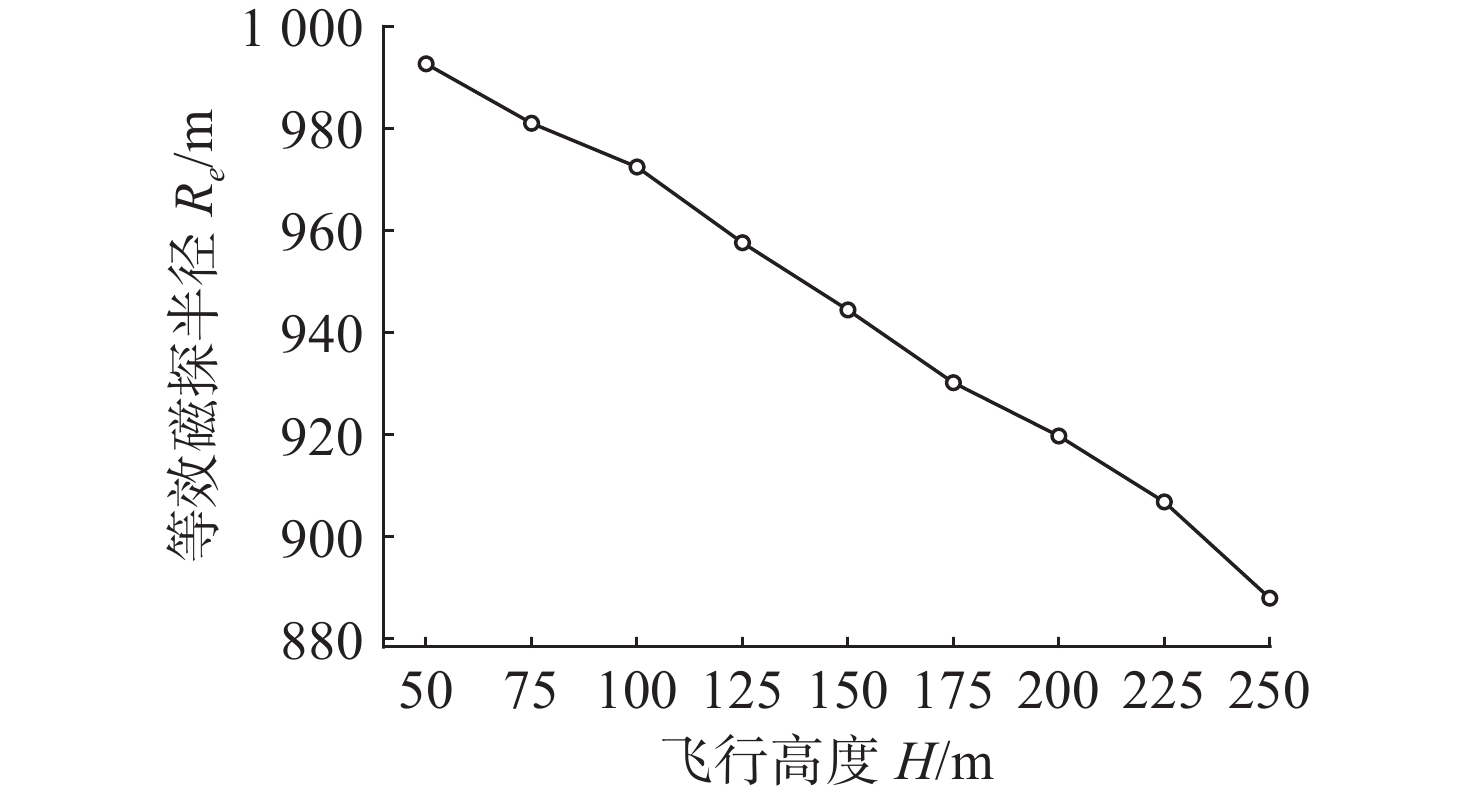
摘要: 无人机(unmanned aerial vehicle, UAV)磁异常探测任务中, 目标磁场空间非均匀性显著, 有限元连续磁场分布难以直接用于航迹规划、覆盖分析与效能评估。为建立磁场响应到工程效能指标的转换方法, 文中提出基于等效磁探半径的UAV磁探效能分析方法。首先, 基于磁静力学构建水下铁磁目标数值模型, 经参数化扫描得到磁异常响应; 其次, 对有无目标工况的三分量磁场差分求取磁异常模值, 采用判识阈值提取有效探测区域, 按面积等效定义等效磁探半径; 最后进一步建立单机、平行航迹及多机协同覆盖模型, 分析航高、航迹间距、搜索策略与平台数量对搜索效能的影响。结果表明: 取0.16 nT阈值、150 m航高时, 等效磁探半径为944.5 m; 航高由50 m增至250 m, 等效磁探半径由992.7 m降至888.0 m, 有效探测面积减少约20.0%。该方法将连续磁异常场转化为几何参数, 可为航迹设计、覆盖分析及多平台调度提供定量依据。Abstract: In UAV-based magnetic anomaly detection missions, the magnetic response of an underwater target exhibits pronounced spatial nonuniformity. Consequently, continuous magnetic-field distributions obtained from finite-element simulations are difficult to use directly for trajectory planning, coverage analysis, and search-effectiveness evaluation. To establish a quantitative transformation from physical magnetic-field responses to engineering effectiveness metrics, this study proposes an effectiveness analysis method for UAV magnetic anomaly detection based on the equivalent magnetic detection radius. First, a numerical model of an underwater ferromagnetic target is developed on the basis of magnetostatic theory, and magnetic anomaly responses are analyzed through parametric simulations along typical relative-motion paths. The target-induced magnetic anomaly magnitude is then obtained by pointwise component-wise subtraction of the three magnetic-field components between target-present and target-absent background cases under identical computational conditions. A reference engineering detection threshold is introduced to extract the effective magnetic detection response region, and the equivalent magnetic detection radius is defined according to the area-equivalence principle. On this basis, models for single-platform static coverage probability, parallel-track coverage, and multi-UAV cooperative coverage are established to analyze the effects of flight altitude, track spacing, search strategy, and platform number on search effectiveness. The results show that, under the specified target parameters and background geomagnetic-field conditions, a reference engineering detection threshold of 0.16 nT yields an equivalent magnetic detection radius of 944.5 m at a baseline flight altitude of 150 m. As the flight altitude increases from 50 m to 250 m, the equivalent magnetic detection radius decreases monotonically from 992.7 m to 888.0 m, while the effective magnetic detection response area decreases by approximately 20.0%. The proposed method compresses a continuous magnetic anomaly field into a geometric scale parameter suitable for mission planning and provides a quantitative basis for flight-altitude selection, track-spacing design, search-coverage analysis, and multi-platform resource allocation.
-
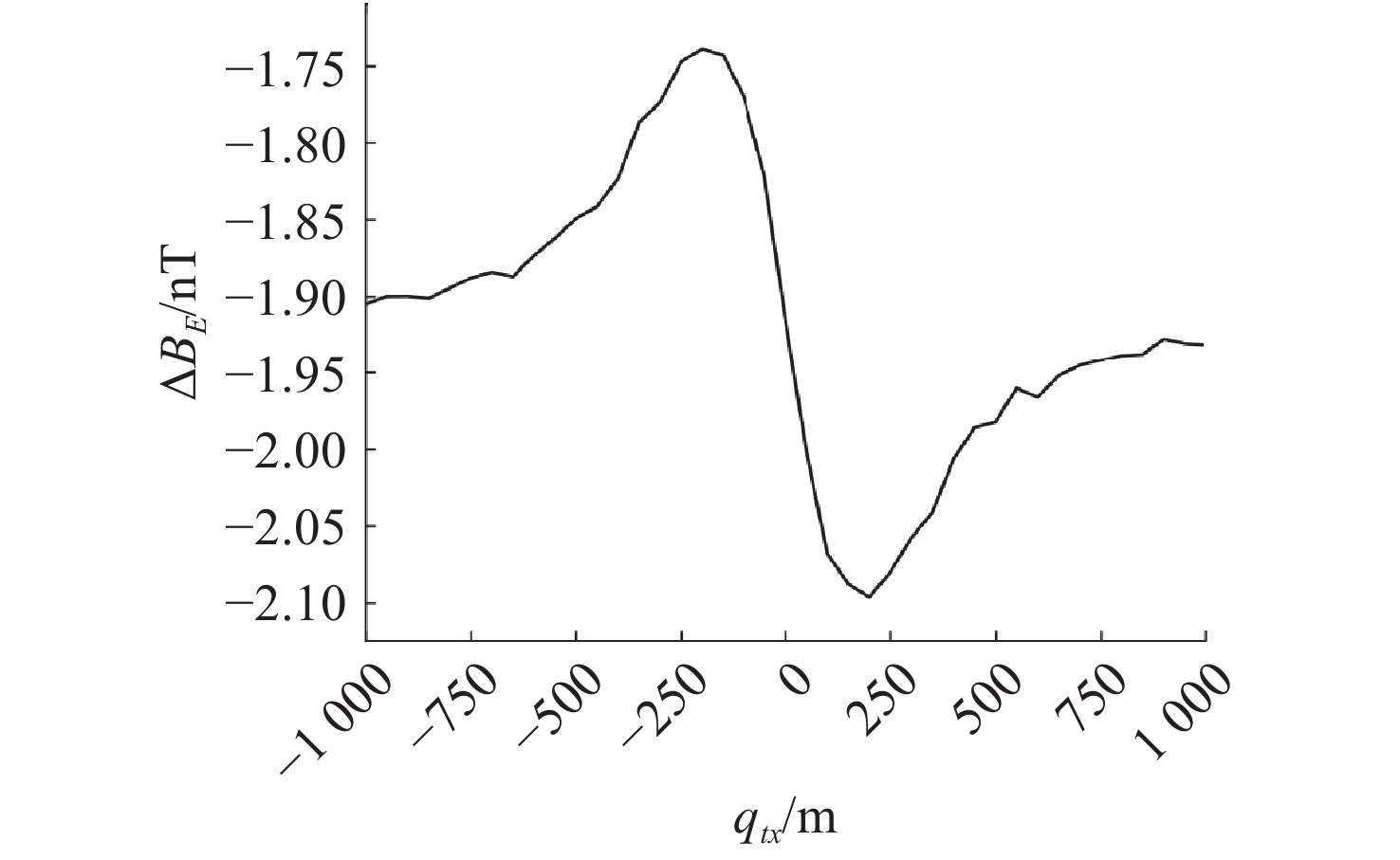
图 1 水平通过路径下磁异常东西向分量$ {{\boldsymbol{B}}}_{{\boldsymbol{x}}} $
Figure 1. East–west component of magnetic anomaly along the horizontal pass path $ {\boldsymbol{B}}_{\boldsymbol{x}} $
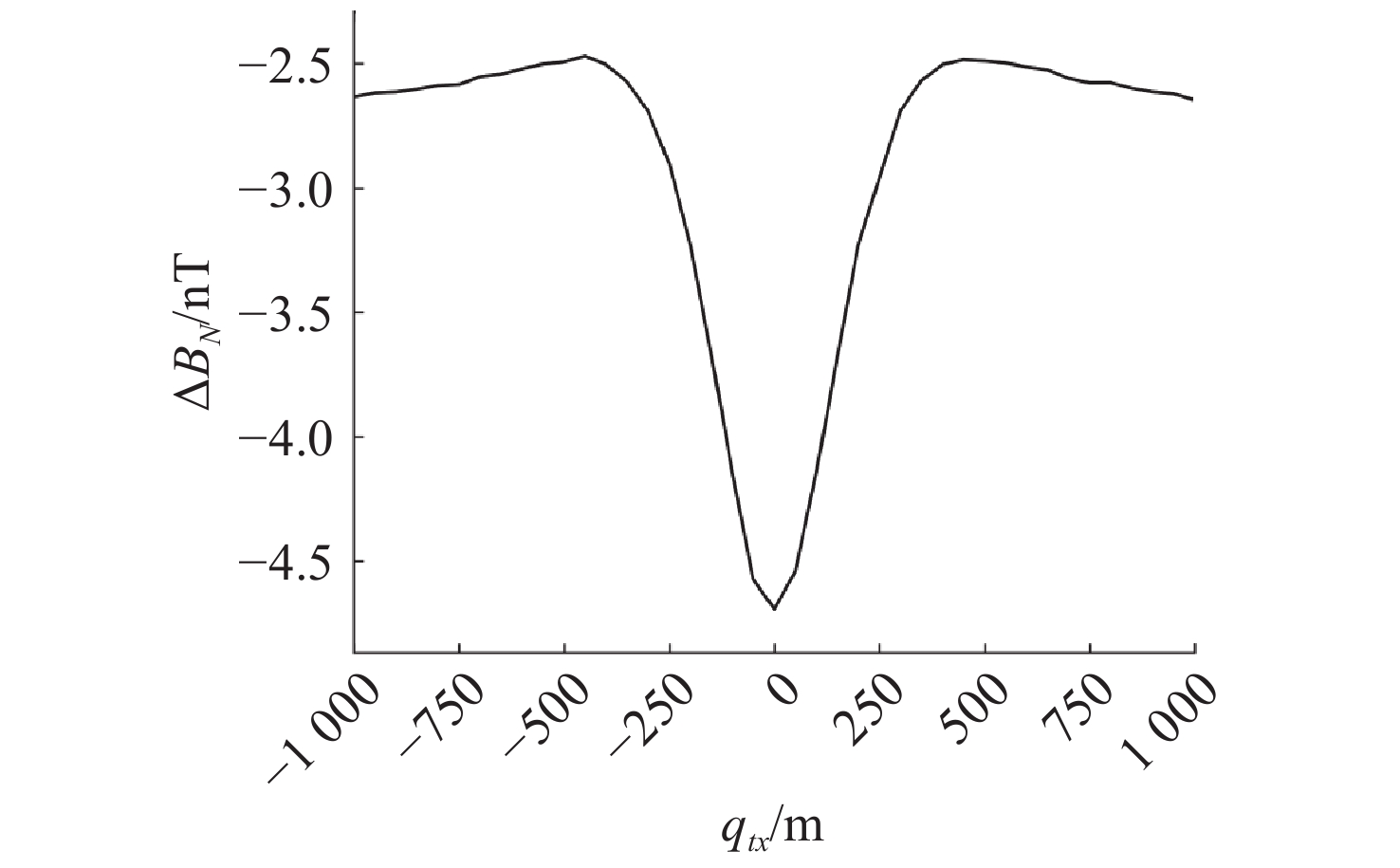
图 2 水平通过路径下磁异常南北向分量$ {{\boldsymbol{B}}}_{{\boldsymbol{y}}} $
Figure 2. North–south component of magnetic anomaly along the horizontal pass path $ {\boldsymbol{B}}_{\boldsymbol{y}} $
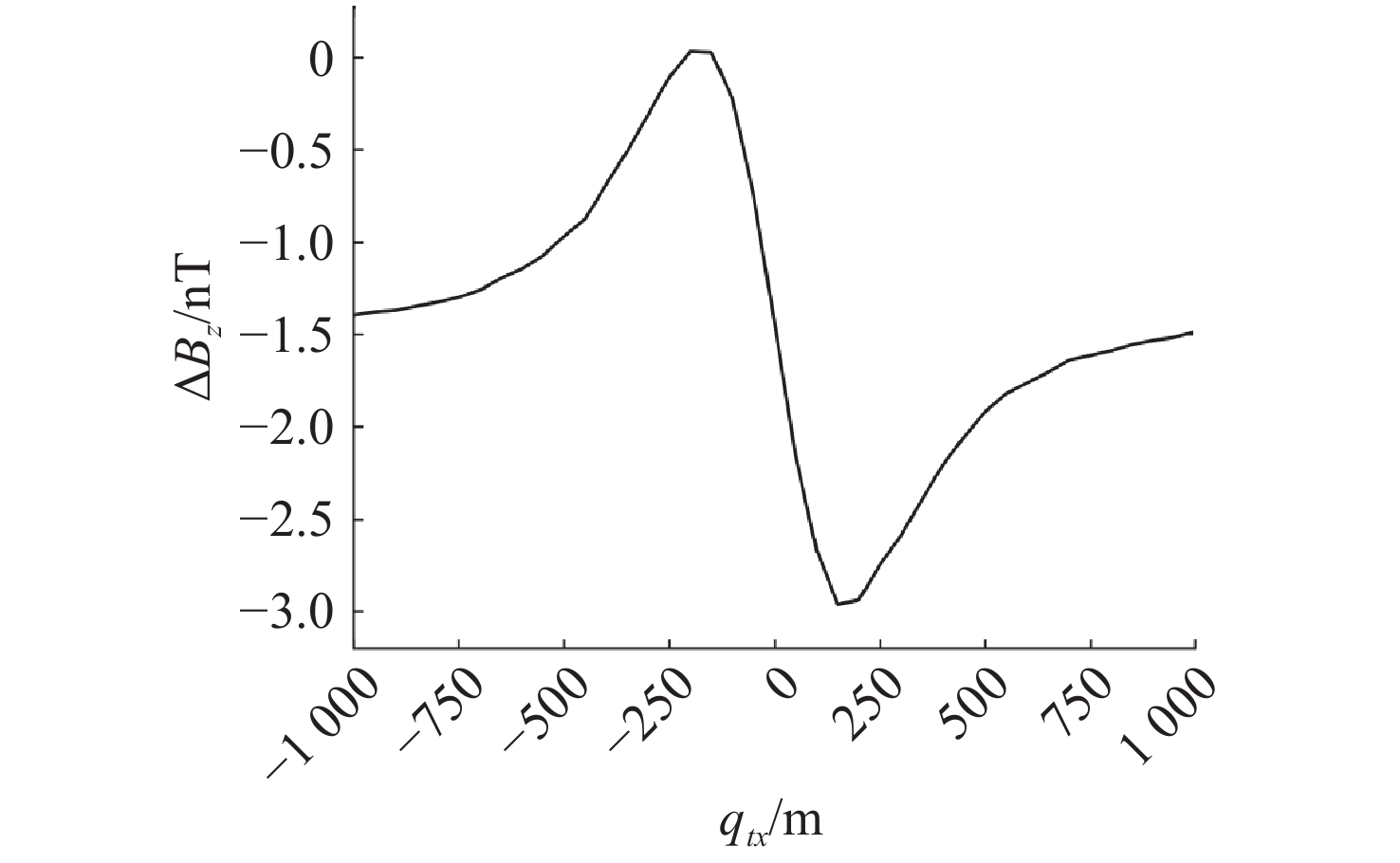
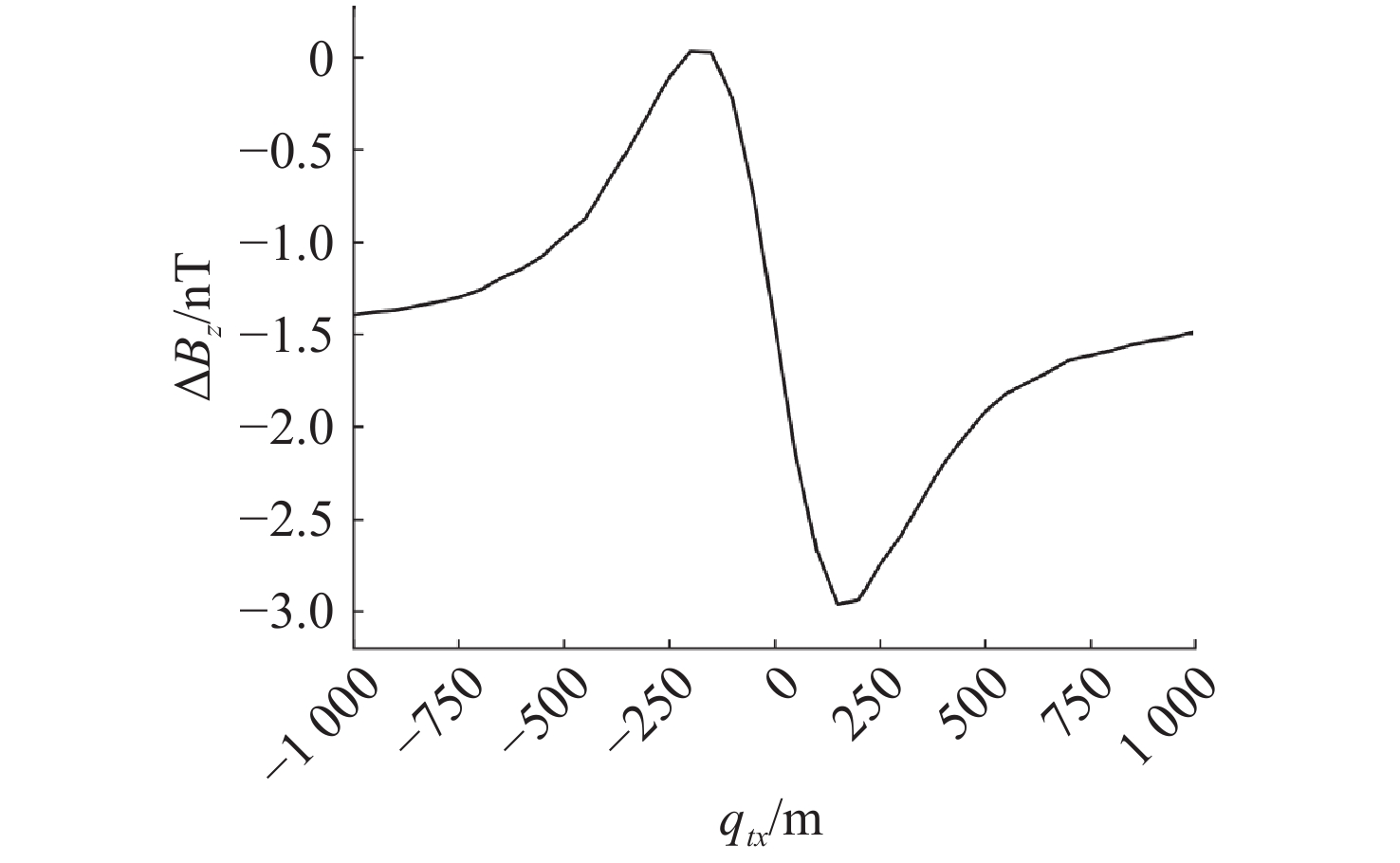
图 3 水平通过路径下磁异常垂直向分量$ {{\boldsymbol{B}}}_{\boldsymbol{z}} $
Figure 3. Vertical component of magnetic anomaly along the horizontal pass path $ {\boldsymbol{B}}_{\boldsymbol{z}} $
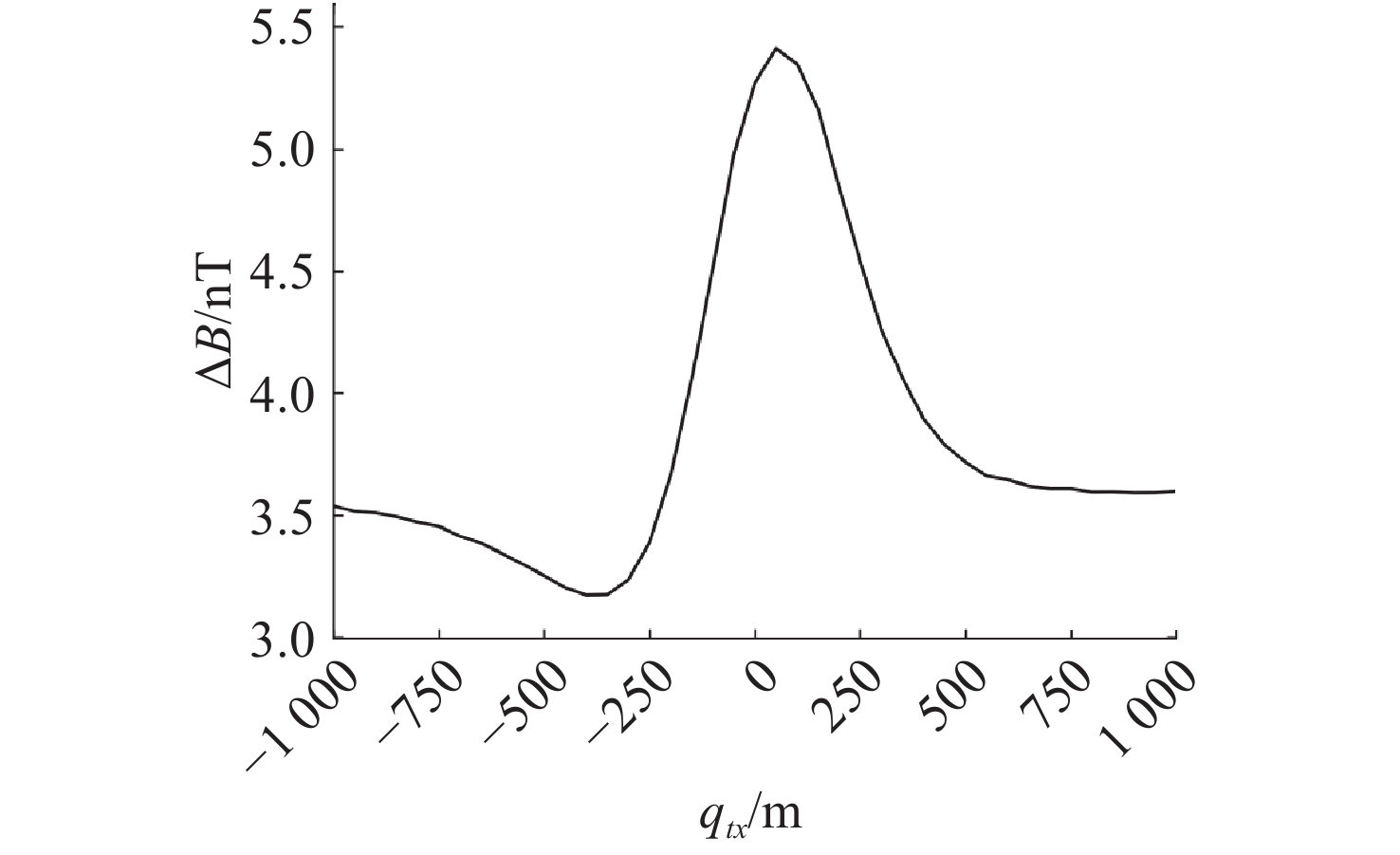
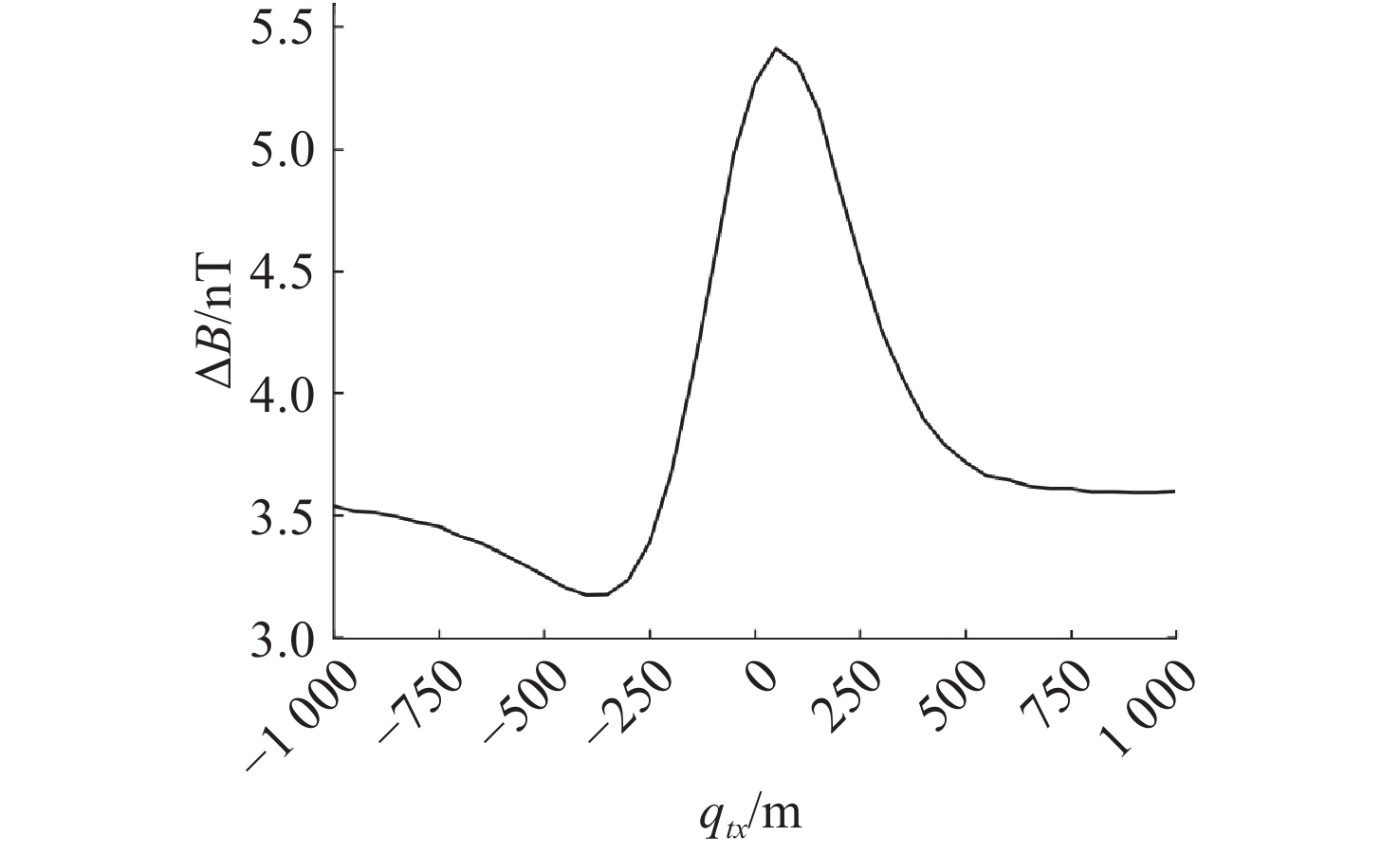
图 4 水平通过路径下磁异常模值$ \left|\left|\mathit{\Delta }{\boldsymbol{B}}\right|\right| $
Figure 4. Magnitude of magnetic anomaly along the horizontal pass path $ \left|\left|\boldsymbol{\mathit{\Delta }}\boldsymbol{B}\right|\right| $
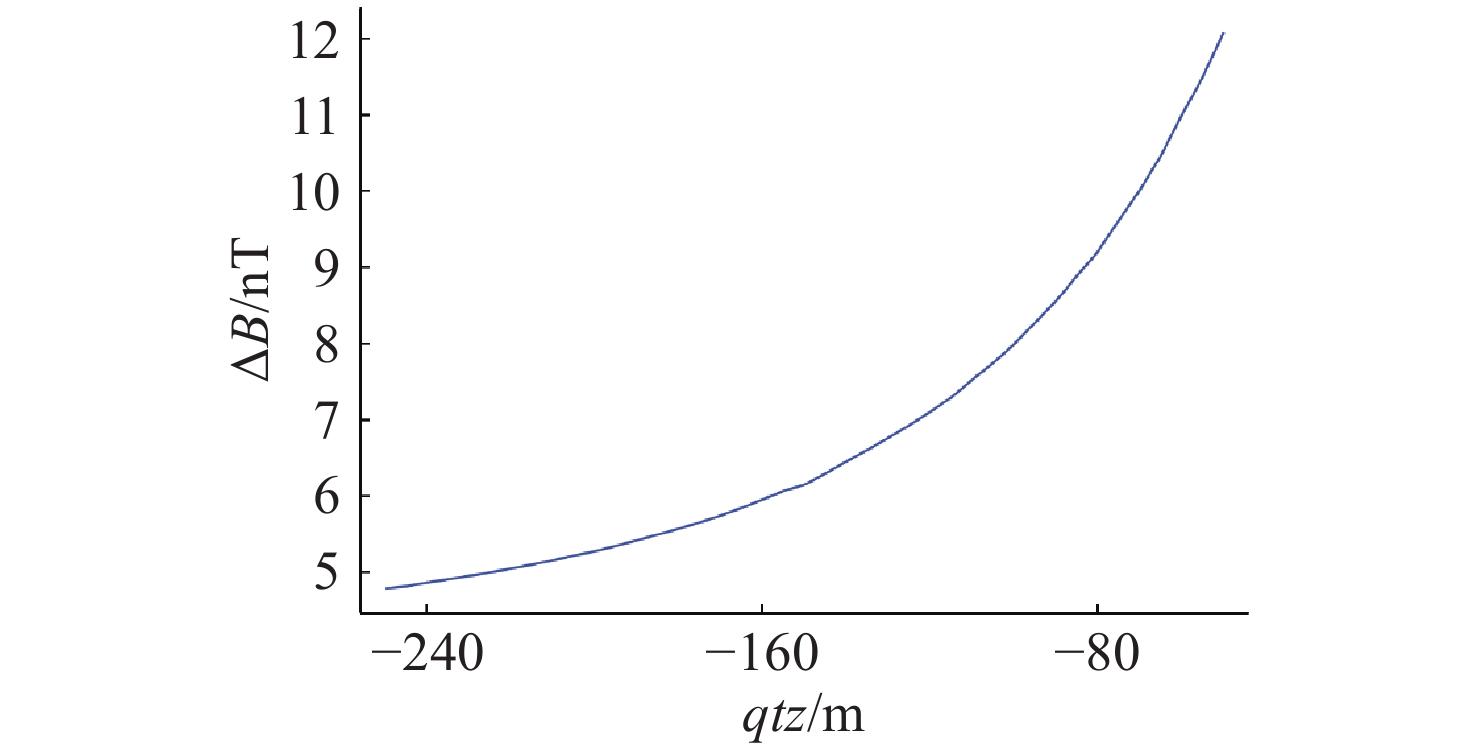
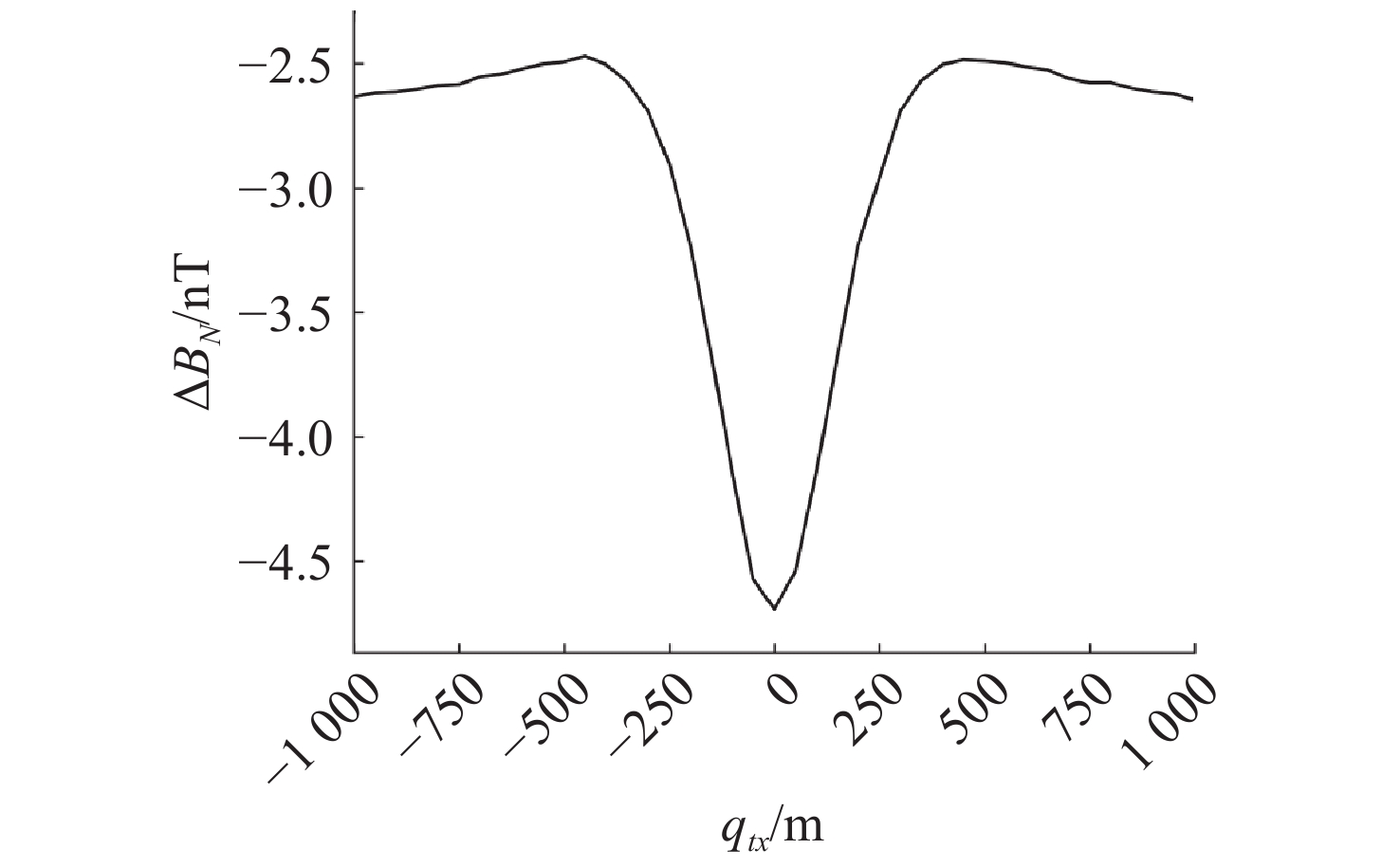
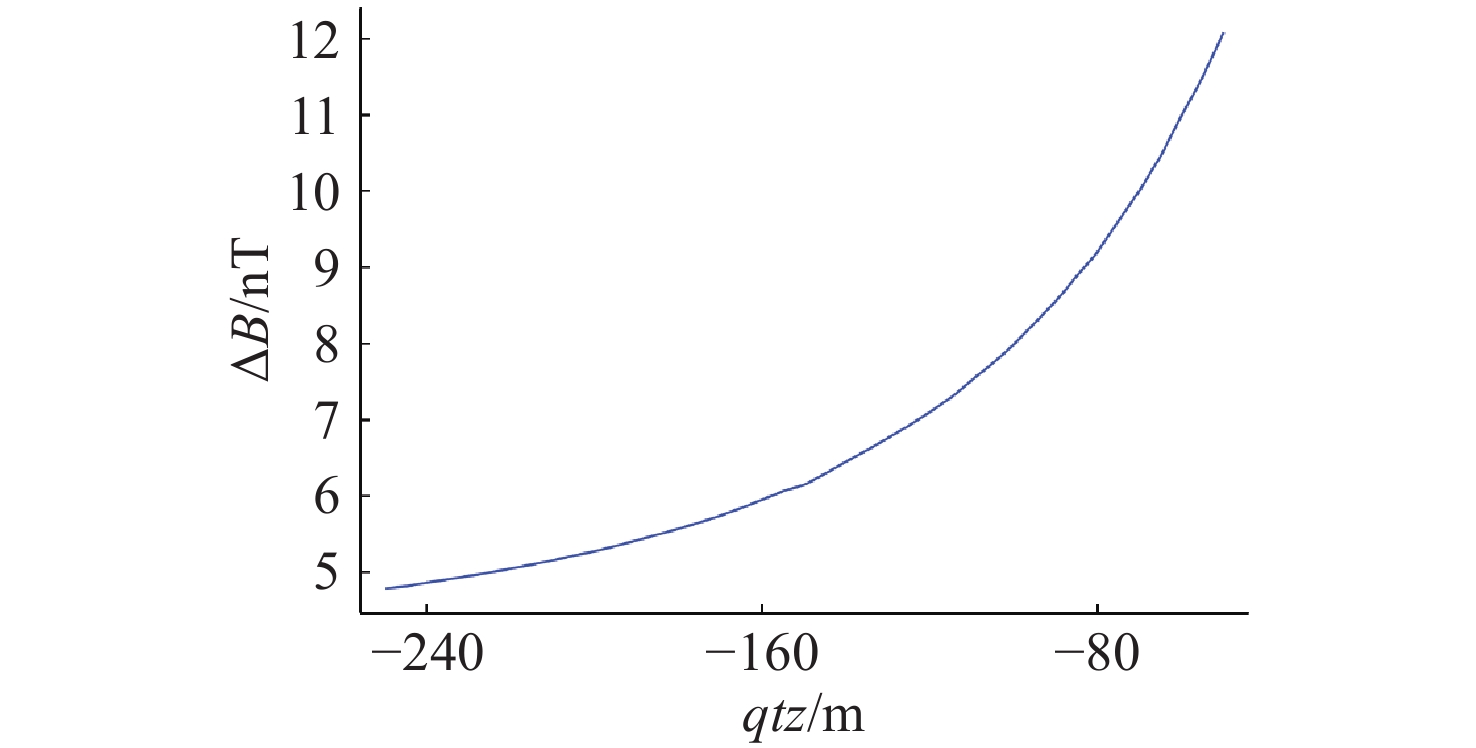
图 5 垂直距离变化下磁异常模值响应
Figure 5. Magnetic anomaly modulus response under variation of vertical distance
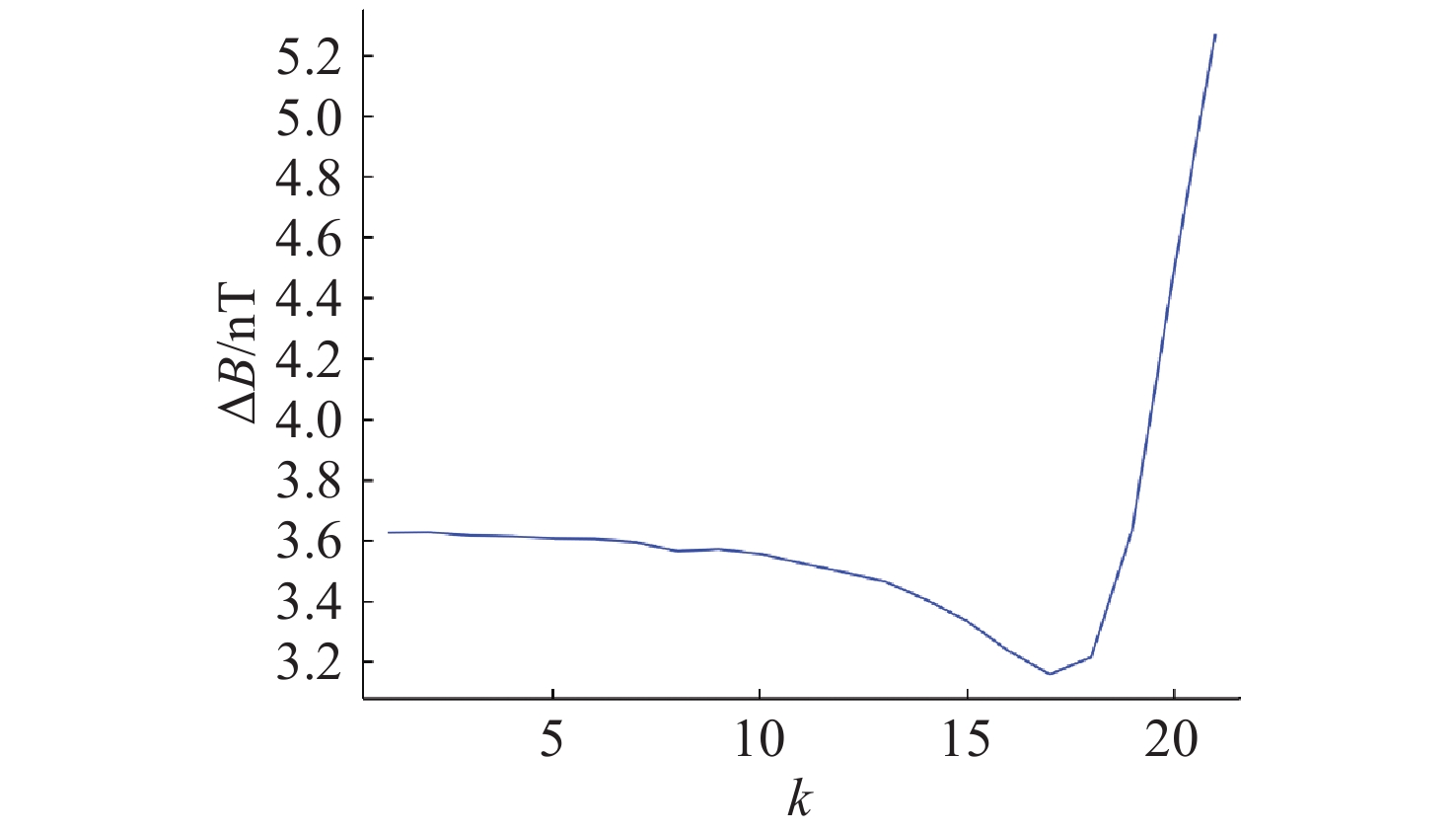
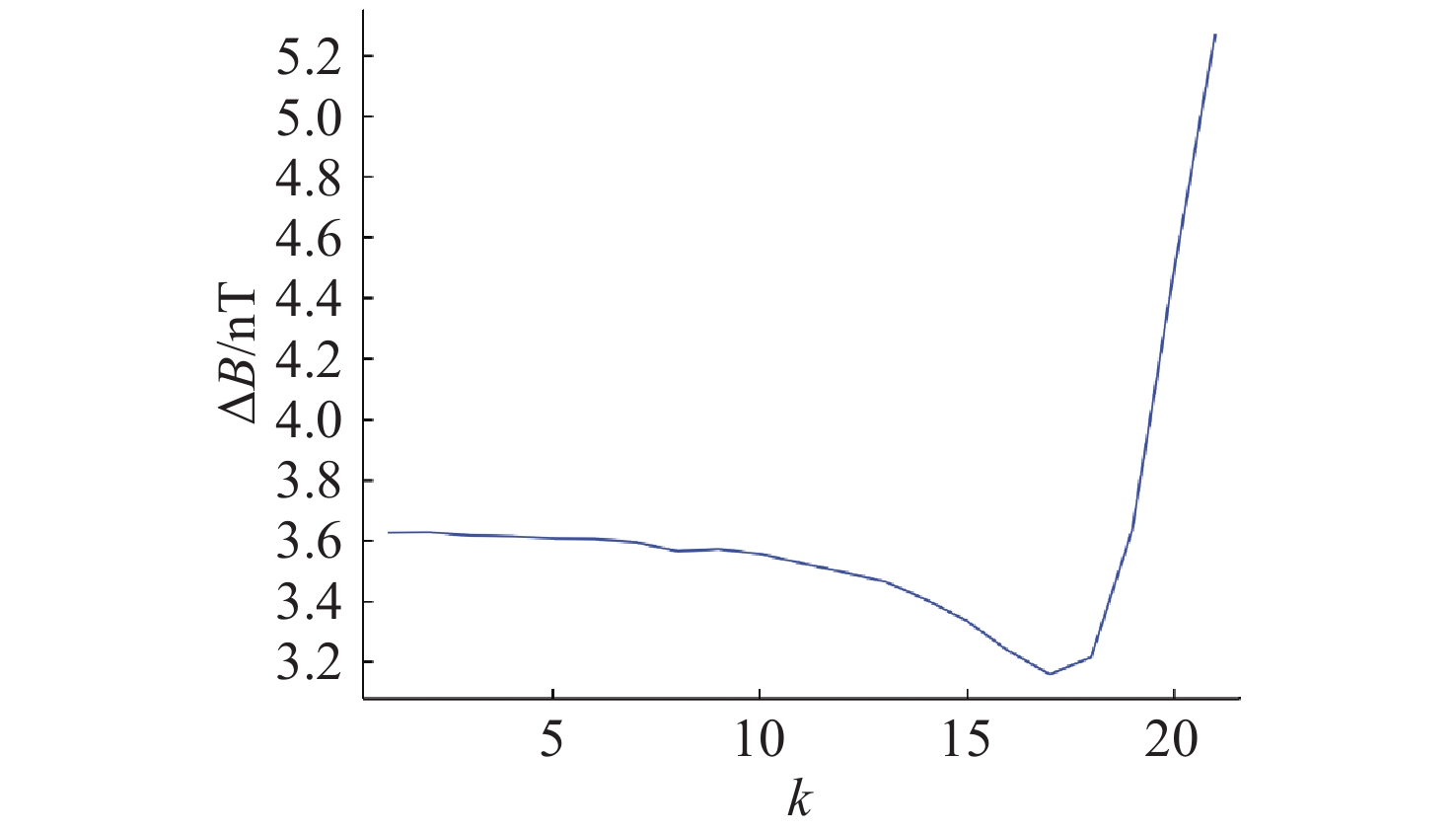
图 6 斜向相对接近路径下磁异常模值响应
Figure 6. Magnetic anomaly modulus response under oblique relative approach path
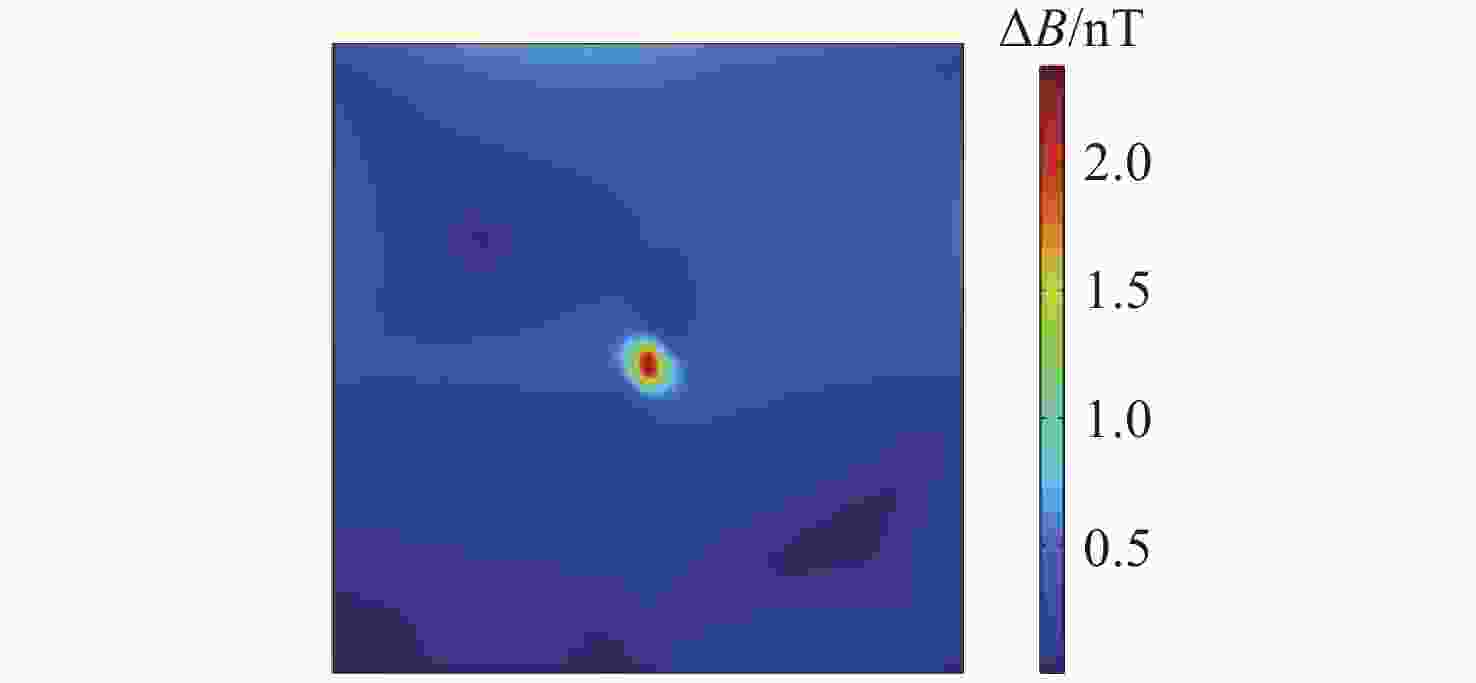
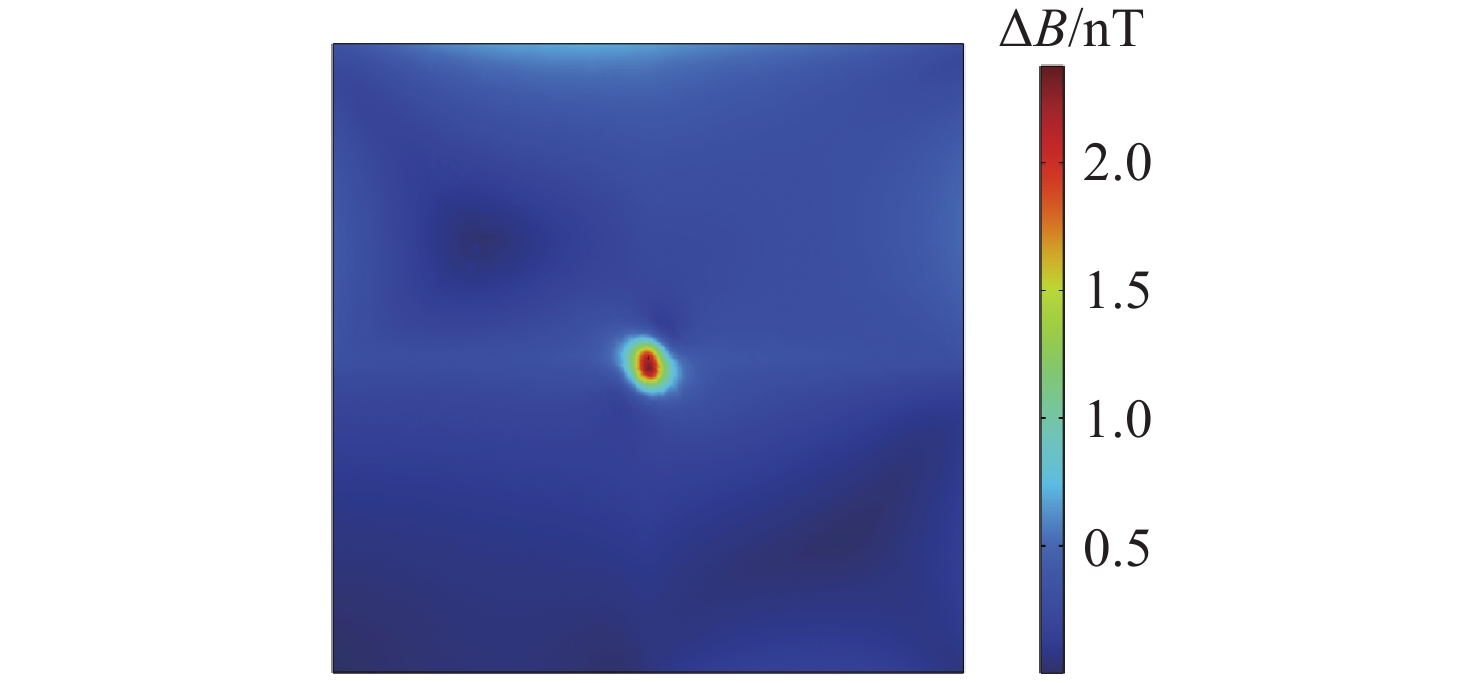
图 7 UAV探测平面上的磁异常模值分布
Figure 7. Magnetic anomaly magnitude distribution on the UAV detection plane
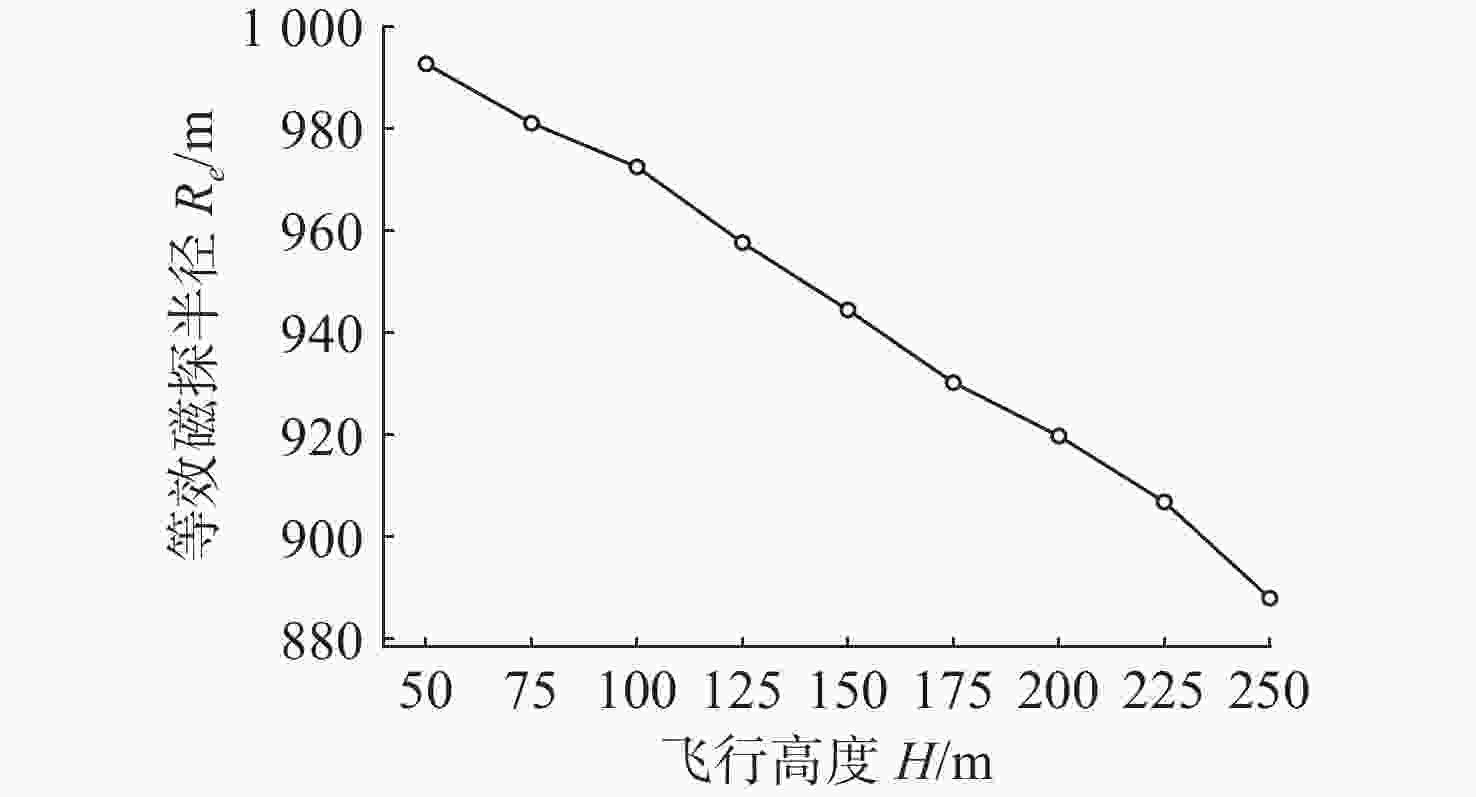
图 9 飞行高度对等效磁探半径的影响
Figure 9. Effect of flight altitude on the equivalent magnetic detection radius

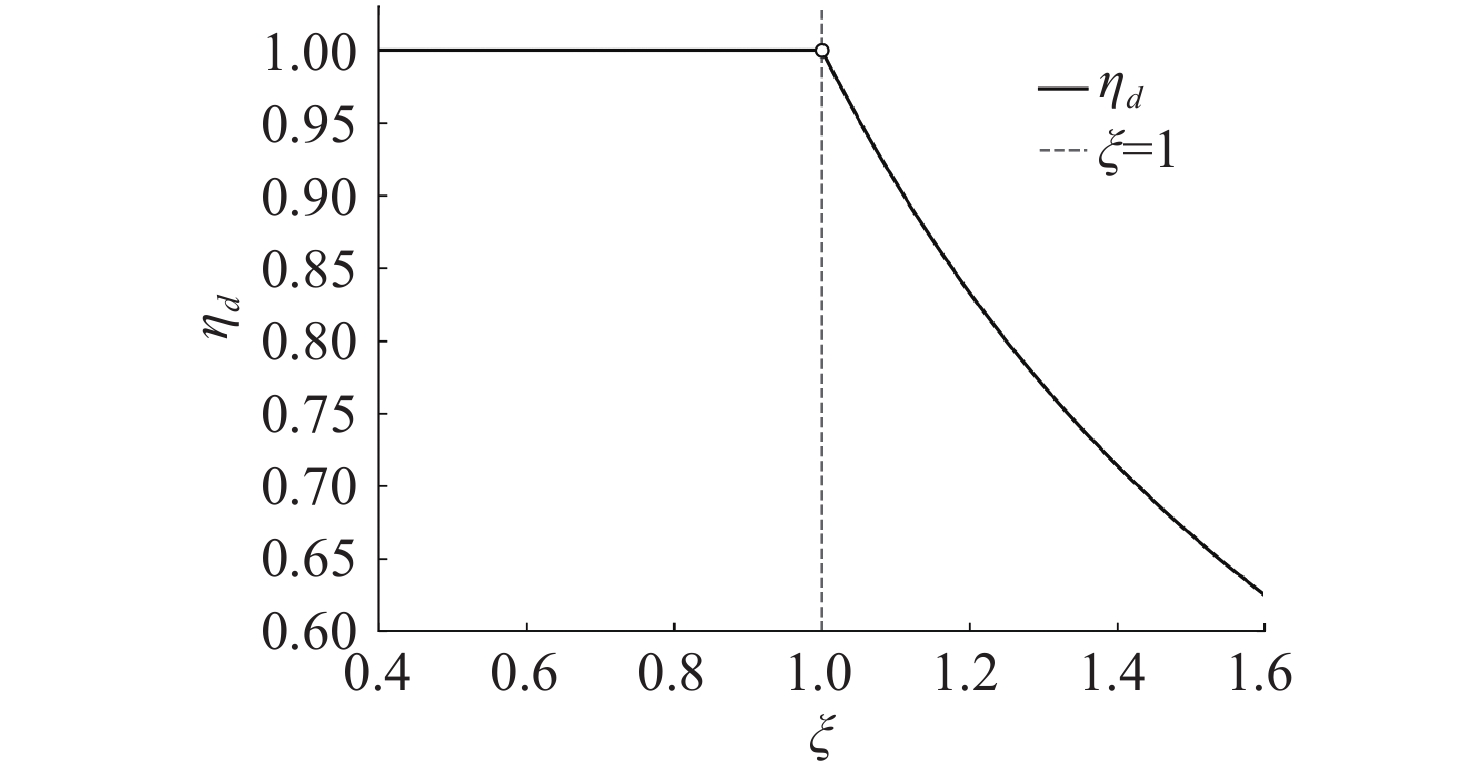
图 10 归一化航迹间距对横向覆盖系数的影响
Figure 10. Effect of normalized track spacing on lateral coverage coefficient
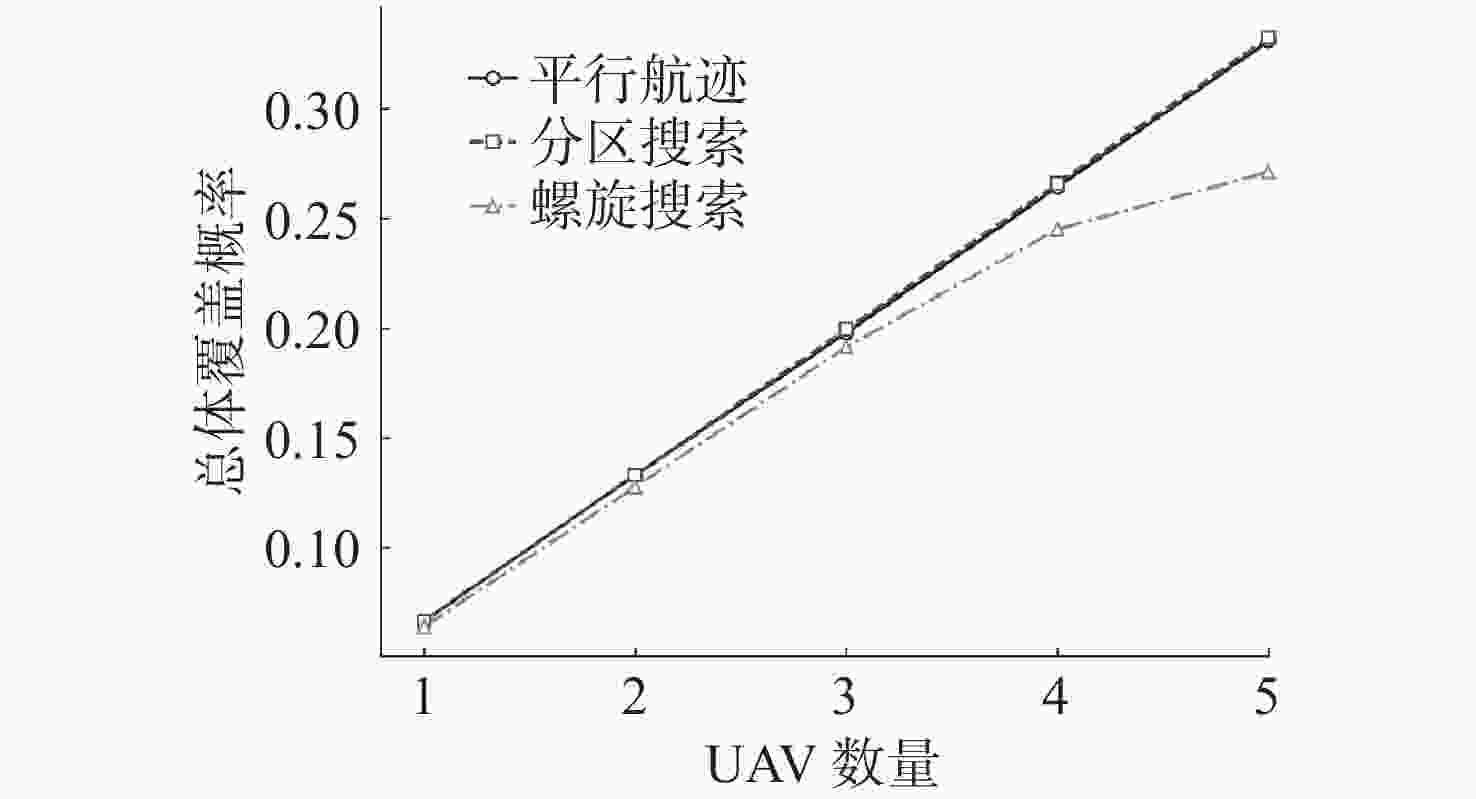
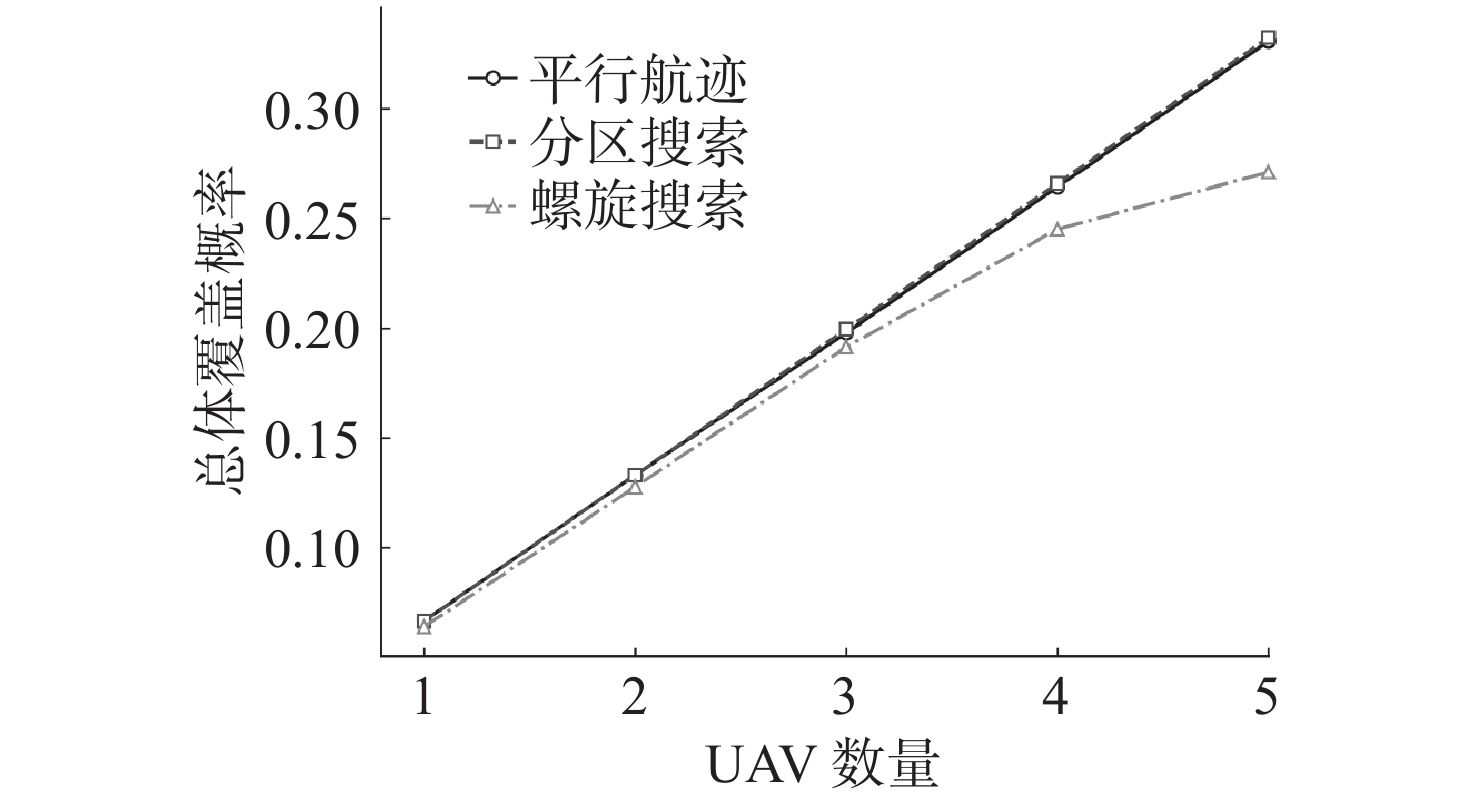
图 11 不同协同搜索策略下UAV数量对总体覆盖概率的影响
Figure 11. Effect of the number of UAVs on overall coverage probability under different cooperative search strategies
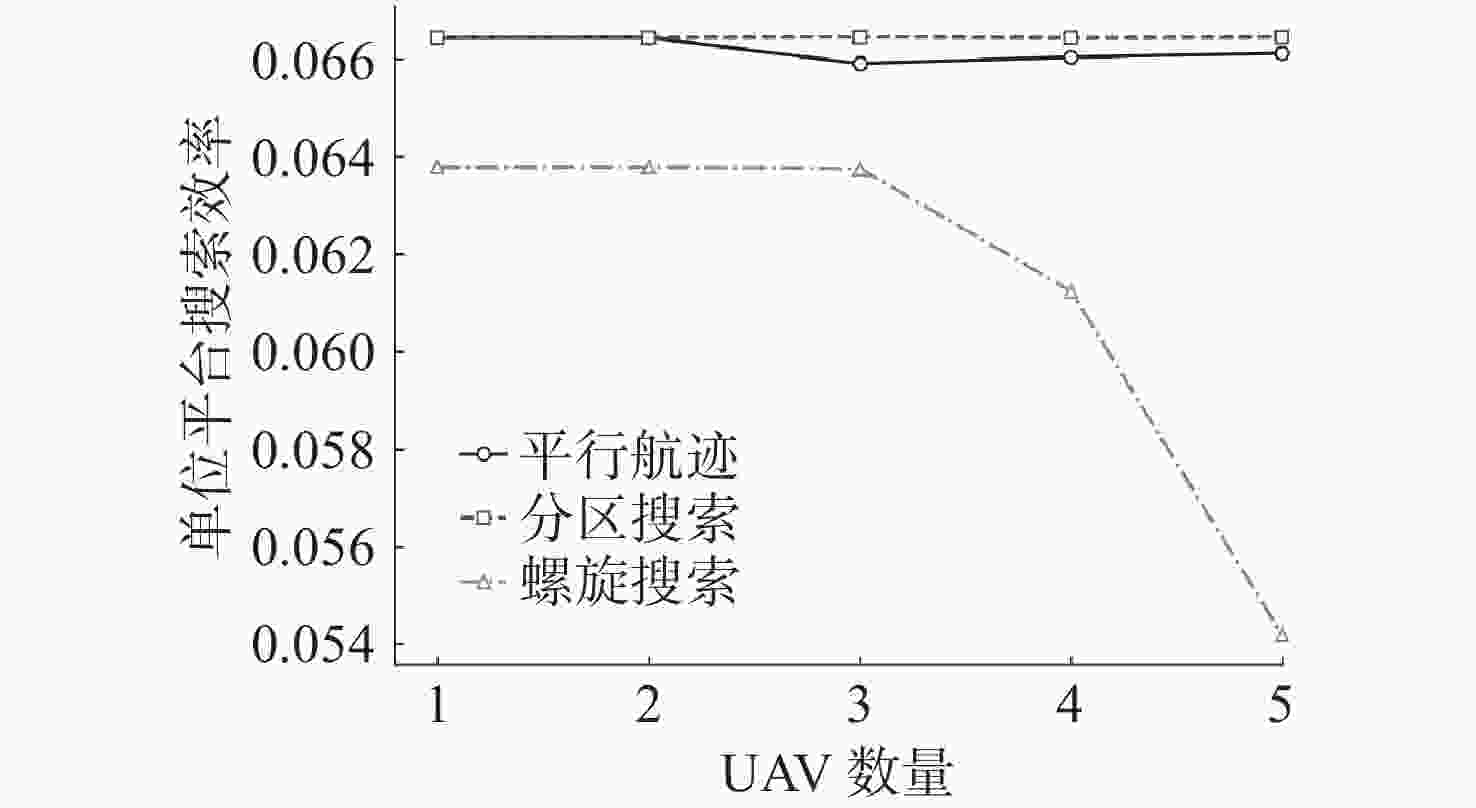
图 12 不同协同搜索策略下UAV数量对单位平台搜索效率的影响
Figure 12. Effect of the number of UAVs on unit-platform search efficiency under different cooperative search strategies
表 1 有限元模型基准工况参数
Table 1. Parameters of the finite element model under benchmark working condition
参数 规格 背景地磁场输入 IGRF区域三维地磁数据, $ {B}_{x}\left(x,y,{\textit{z}}\right) $、
$ {B}_{y}\left(x,y,{\textit{z}}\right) $、$ {B}_{\textit{z}}\left(x,y,{\textit{z}}\right) $线性插值基准位置背景地磁场 ( 28597.657 ,−5272.981 ,−8865.525 ) nT,
模值30401.116 nT计算域尺寸 水域5 km×5 km×1 km;
空域5 km×5 km×0.5 km基准UAV位置 (0,0,150) m 基准目标中心位置 (0,0,−200) m,
垂向间距350 m目标磁学参数
$ {\mu }_{r}=1.05 $,
$ {B}_{r}=1.0\times {10}^{-4}\text{T} $目标外包络尺寸 约120 m×10 m×22 m  下载: 导出CSV
-
[1] 陶荣华, 王丹, 迟铖. 国外航空磁探潜装备应用分析及发展趋势[J]. 水下无人系统学报, 2021, 29(4): 369-373. doi: 10.11993/j.issn.2096-3920.2021.04.001Tao R H, Wang D, Chi C. Application and development trend of foreign airborne magnetic detection equipment[J]. Journal of Unmanned Undersea Systems, 2021, 29(4): 369-373. doi: 10.11993/j.issn.2096-3920.2021.04.001 [2] 成建波, 孙心毅. 航空磁异常探潜技术发展综述[J]. 声学与电子工程, 2018(3): 46-49.Cheng J B, Sun X Y. Review of the development of aerial magnetic anomaly technology for underwater target detection[J]. Acoustics and Electronics Engineering, 2018(3): 46-49. [3] Dames P M, Schwager M, Rus D, et al. Active magnetic anomaly detection using multiple micro aerial vehicles[J]. IEEE Robotics and Automation Letters, 2015, 1(1): 153-160. doi: 10.1109/lra.2015.2511444 [4] 周家新, 陈建勇, 单志超等. 航空磁探中潜艇磁场建模方法分析[J]. 海军航空工程学院学报, 2017, 32(1): 143-148. doi: 10.7682/j.issn.1673-1522.2017.01.008Zhou J X, Chen J Y, Shan Z C, et al. Analysis of submarine magnetic field modeling method for aero magnetic detection[J]. Journal of Naval Aeronautical and Astronautical University, 2017, 32(1): 143-148. doi: 10.7682/j.issn.1673-1522.2017.01.008 [5] 李启飞, 韩蕾蕾, 熊雄, 等. 潜艇目标态势对航空磁探测的影响分析[J]. 火力与指挥控制, 2020, 45(6): 113-117. doi: 10.3969/j.issn.1002-0640.2020.06.021Li Q F, Han L L, Xiong X, et al. Influence analysis of submarine target situation on airborne magnetic detection[J]. Fire Control & Command Control, 2020, 45(6): 113-117. doi: 10.3969/j.issn.1002-0640.2020.06.021 [6] 成建波. 基于声呐浮标的大型无人机搜潜效能分析[J]. 声学与电子工程, 2023(1): 37-40. doi: 10.3969/j.issn.2096-2657.2023.01.08Cheng J B. Search effectiveness analysis of large UAV based on sonobuoys[J]. Acoustics and Electronics Engineering, 2023(1): 37-40. doi: 10.3969/j.issn.2096-2657.2023.01.08 [7] Woloszyn M, Tarnawski J. Magnetic signature reproduction of ferromagnetic ships at arbitrary geographical position, direction and depth using a multi-dipole model[J]. Scientific Reports, 2023, 13(1): 14601. doi: 10.1038/s41598-023-41702-4 [8] 窦振家, 孙宇慧, 胡凯, 等. 基于FlightGear的航磁数据仿真平台[J]. 智能计算机与应用, 2019, 9(1): 280-283.Dou Z J, Sun J Y, Hu K, et al. An aeromagnetic data simulation platform based on FlightGear[J]. Intelligent Computer and Applications, 2019, 9(1): 280-283. [9] 张琦, 潘孟春, 陈棣湘, 等. 潜艇磁化场的有限元方法研究[J]. 舰船科学技术, 2009, 31(1): 75-78. doi: 10.3404/j.issn.1672-7649.2009.01.014Zhang Q, Pan M C, Chen D X, et al. Study on finite element method for submarine magnetization field[J]. Ship Science and Technology, 2009, 31(1): 75-78. doi: 10.3404/j.issn.1672-7649.2009.01.014 [10] Jiang D, Zeng Z, Zhou S, et al. Integration of an aeromagnetic measurement system based on an unmanned aerial vehicle platform and its application in the exploration of the Ma’anshan magnetite deposit[J]. IEEE Access, 2020, 8: 189576-189586. doi: 10.1109/ACCESS.2020.3031395 [11] Ye L, Yu Z, Zhang Y, et al. An aeromagnetic compensation strategy for large UAVs[J]. Sensors, 2024, 24(12): 3775. doi: 10.3390/s24123775 [12] 周家新, 陈建勇, 单志超, 等. 航空磁探中潜艇目标的联合估计检测方法研究[J]. 兵工学报, 2018, 39(5): 833-840. doi: 10.3969/j.issn.1000-1093.2018.05.001Zhou J X, Chen J Y, Shan Z C, et al. Research on joint estimation and detection method for submarine targets in airborne magnetic detection[J]. Acta Armamentarii, 2018, 39(5): 833-840. doi: 10.3969/j.issn.1000-1093.2018.05.001 [13] Sithiravel R, Balaji B, Nelson B, et al. Airborne maritime surveillance using magnetic anomaly detection signature[J]. IEEE Transactions on Aerospace and Electronic Systems, 2020, 56(5): 3476-3490. doi: 10.1109/TAES.2020.2973866 [14] Yan Y, Liu Y, Bi Y, et al. Research on Anti-Submarine Warfare Method of Unmanned Aerial Vehicle Cluster Based on Area Coverage and Distributed Optimization Control[J]. Drones, 2024, 8(12): 732. doi: 10.3390/drones8120732 [15] Li Y, Chen W, Fu B, et al. A distributed cooperative dynamic target search method for multi-UAV systems in complex adversarial environments[J]. IEEE Internet of Things Journal, 2025, 12(18): 38155-38171. doi: 10.1109/jiot.2025.3585158 [16] 尹俊杰, 吕日毅, 梁红. 空投磁探无人机集群应召反潜作战效能分析[J]. 南京理工大学学报, 2020, 44(6): 752-758. doi: 10.14177/j.cnki.32-1397n.2020.44.06.016Yin J J, Lü R Y, Liang H. Effectiveness analysis of airdropped magnetic-detection UAV swarm in on-call anti-submarine operations[J]. Journal of Nanjing University of Science and Technology, 2020, 44(6): 752-758. doi: 10.14177/j.cnki.32-1397n.2020.44.06.016 -

 下载:



 点击查看大图
计量
- 文章访问数: 0
- HTML全文浏览量: 0
- PDF下载量: 0
- 被引次数: 0