

Trajectory Tracking Control for Underactuated AUVs via Gaussian Process Regression and Stochastic Model Predictive Control
-
摘要: 针对欠驱动自主水下航行器(AUV)在复杂海洋环境中由于模型失配和外部扰动导致轨迹跟踪性能下降甚至系统失稳的问题, 提出了一种基于高斯过程回归的随机模型预测控制(GP-SMPC)策略。该方法在AUV标称动力学模型基础上, 引入高斯过程回归(GPR)这一基于概率推断的非参数建模技术, 利用在线采集的历史输入输出数据对标称模型误差、未建模动态及外部集总扰动进行学习与估计。在此基础上, 将GPR预测得到的后验均值与协方差信息引入随机模型预测控制(SMPC)框架中, 构建GP-SMPC控制器, 实现对未知扰动的在线补偿和预测不确定性的概率传播。最后通过仿真验证表明, 相较于基于反步稳定化设计的BS-NMPC方法, 所提出的GP-SMPC策略能够有效应对模型不确定, 在复杂、时变的海洋环境下, 能够相较于BS-NMPC进一步降低轨迹跟踪误差, 并改善系统对模型失配和外部扰动的适应能力。Abstract: To address the degradation of trajectory tracking performance and even system instability in underactuated autonomous undersea vehicles (AUVs) caused by model mismatch and external disturbances in complex ocean environments, this paper proposes a stochastic model predictive control (SMPC) strategy augmented with Gaussian process regression (GP-SMPC). The method builds upon the nominal dynamic model of the AUV and introduces Gaussian process regression (GPR), a non-parametric probabilistic modeling technique, to learn and estimate the nominal model error, unmodeled dynamics, and lumped external disturbances from online collected historical input–output data. The posterior mean and covariance predicted by GPR are then incorporated into the SMPC framework, resulting in the GP-SMPC controller that enables online compensation for unknown disturbances and probabilistic propagation of prediction uncertainties. Finally, simulation results demonstrate that, compared with the backstepping stabilization-based nonlinear model predictive control (BS-NMPC) method, the proposed GP-SMPC strategy effectively mitigates model mismatch. Under complex and time-varying ocean conditions, GP-SMPC achieves further reduced trajectory tracking errors and improved system adaptability to model mismatches and external disturbances relative to BS-NMPC.
-
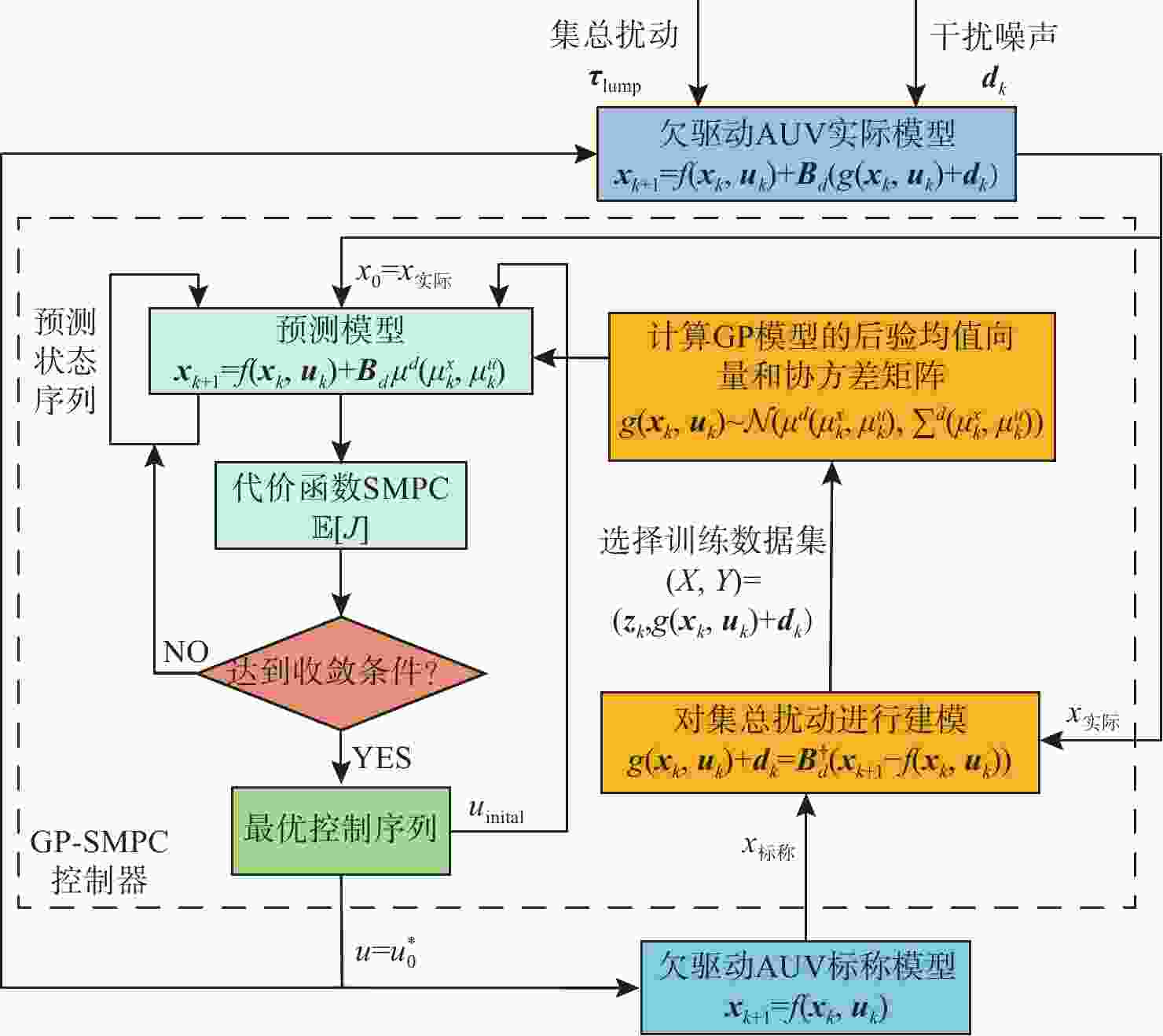
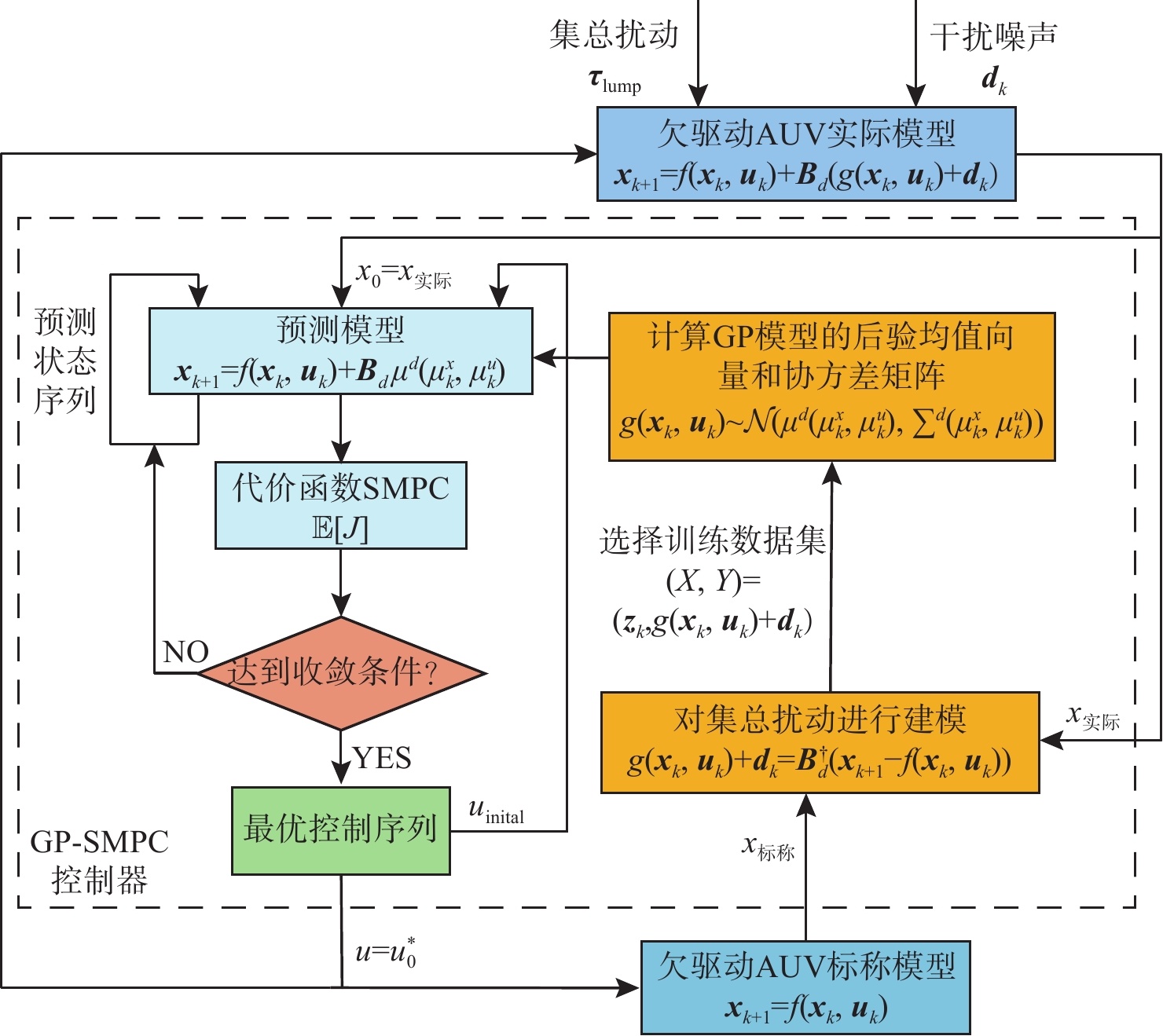
图 2 基于GP-SMPC方法的欠驱动AUV轨迹跟踪控制原理图
Figure 2. Schematic diagram of the trajectory tracking control framework for an underactuated AUV based on the GP-SMPC method
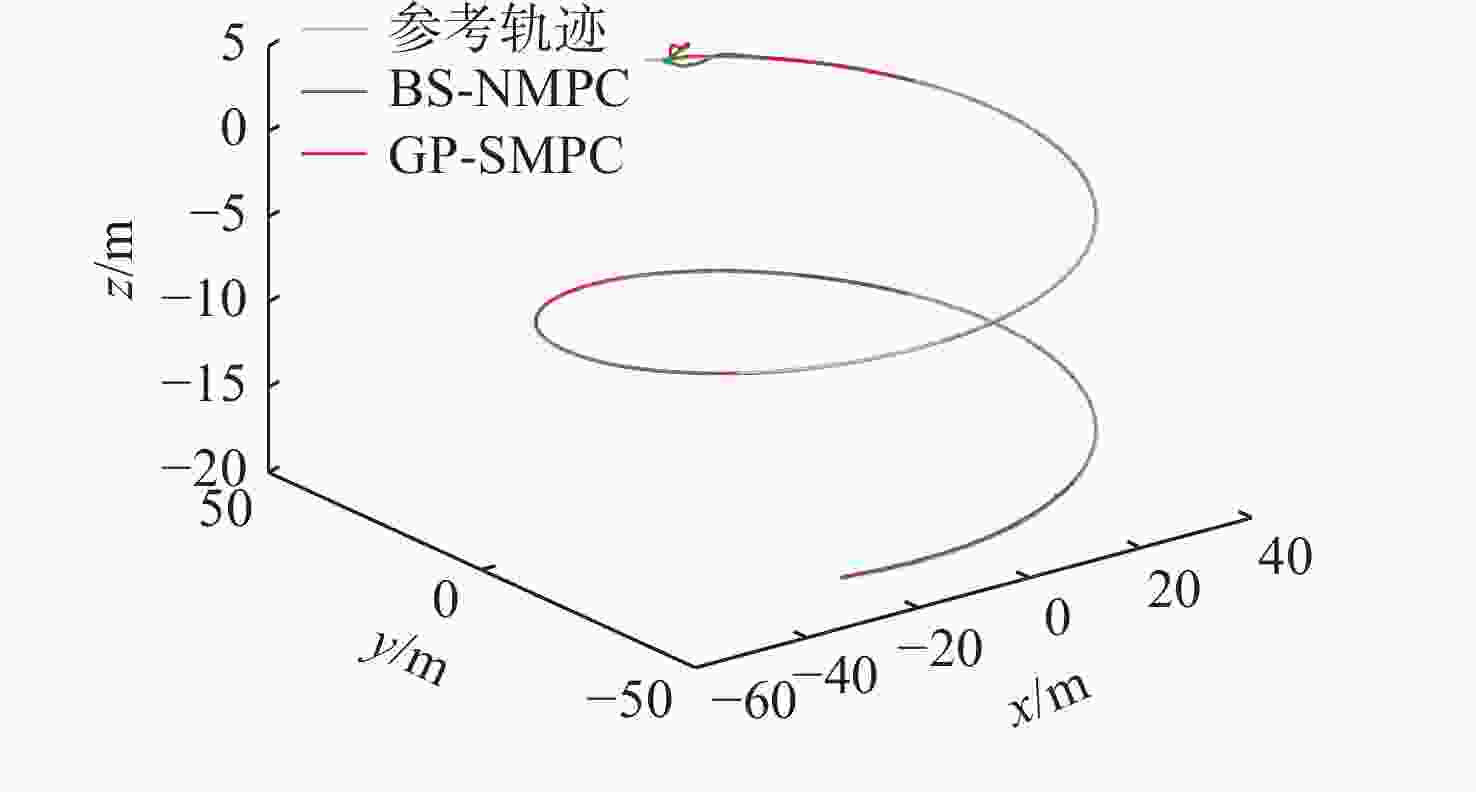
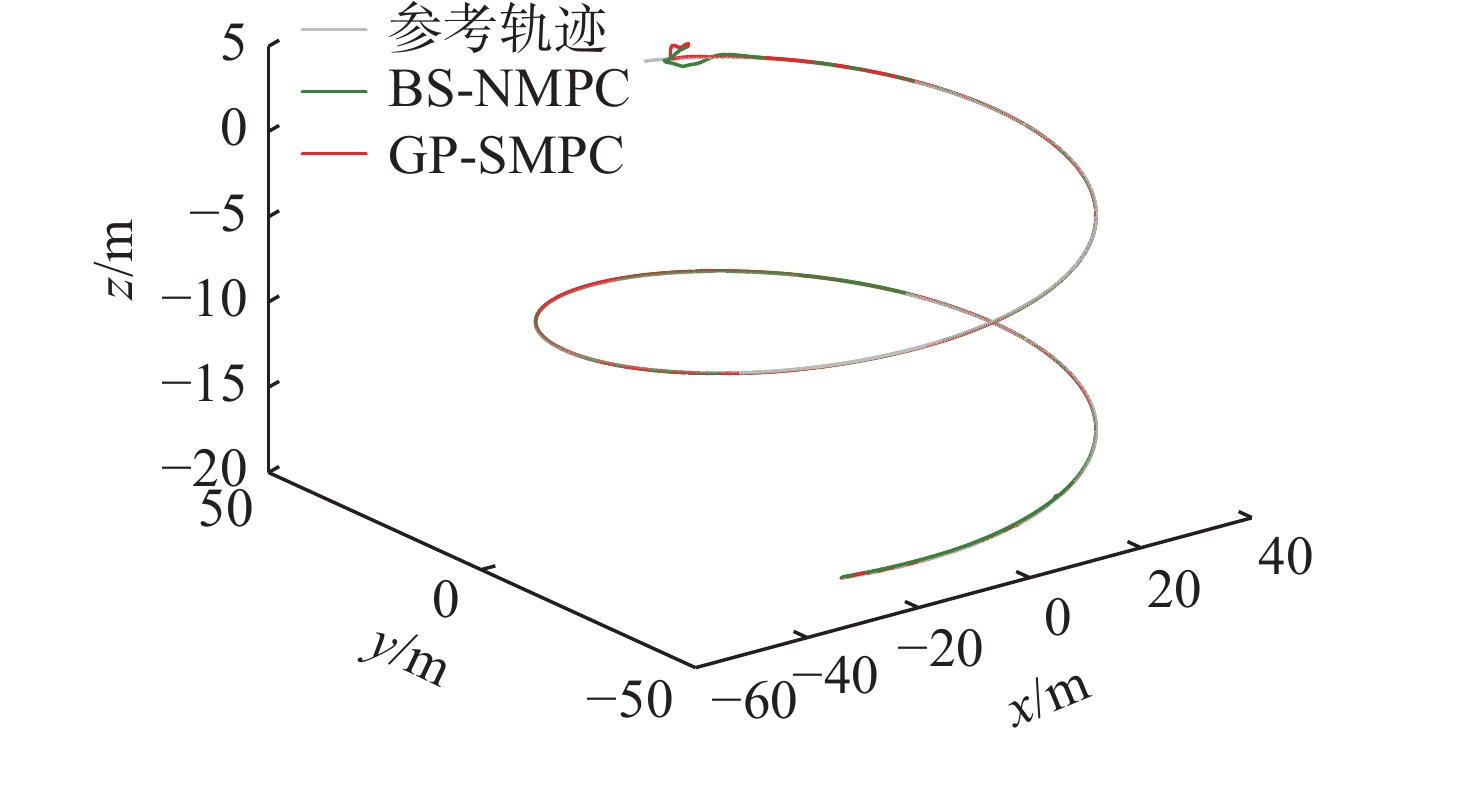
图 3 BS-NMPC与GP-SMPC控制下的AUV三维轨迹跟踪结果
Figure 3. Three-dimensional trajectory tracking results of the AUV under BS-NMPC and GP-SMPC control schemes
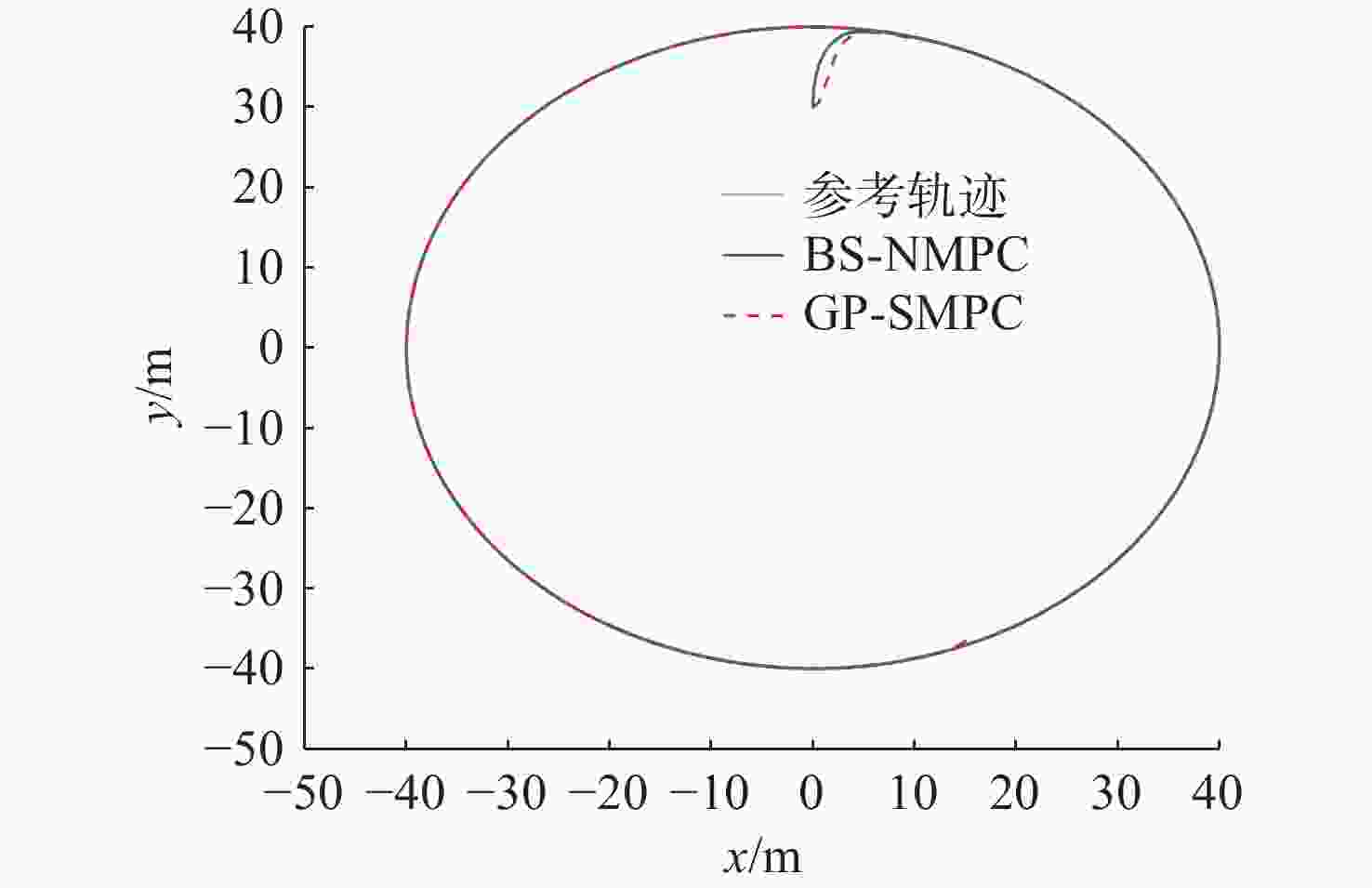
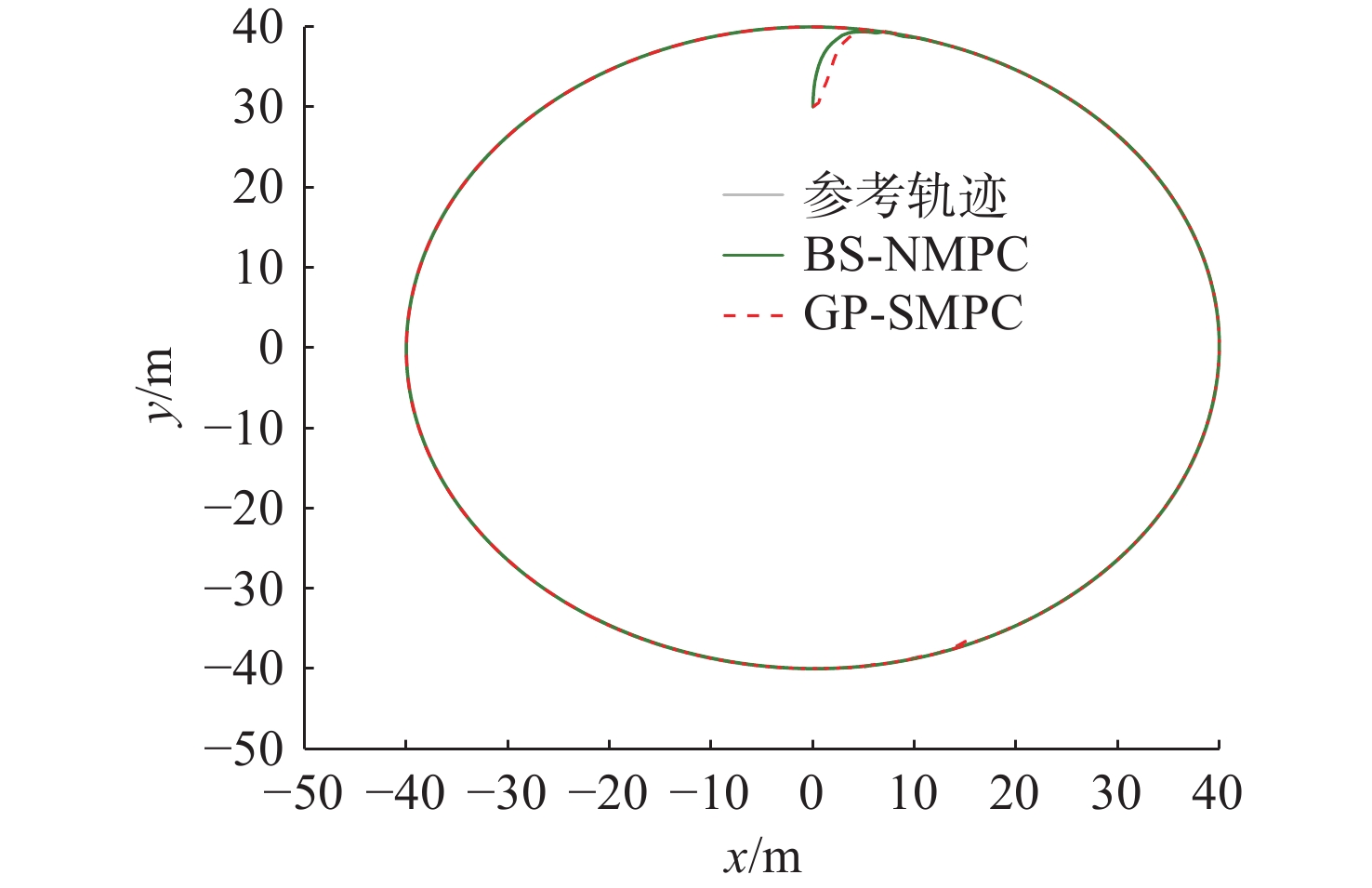
图 4 轨迹跟踪曲线水平面投影
Figure 4. Horizontal plane projection of the trajectory tracking curves
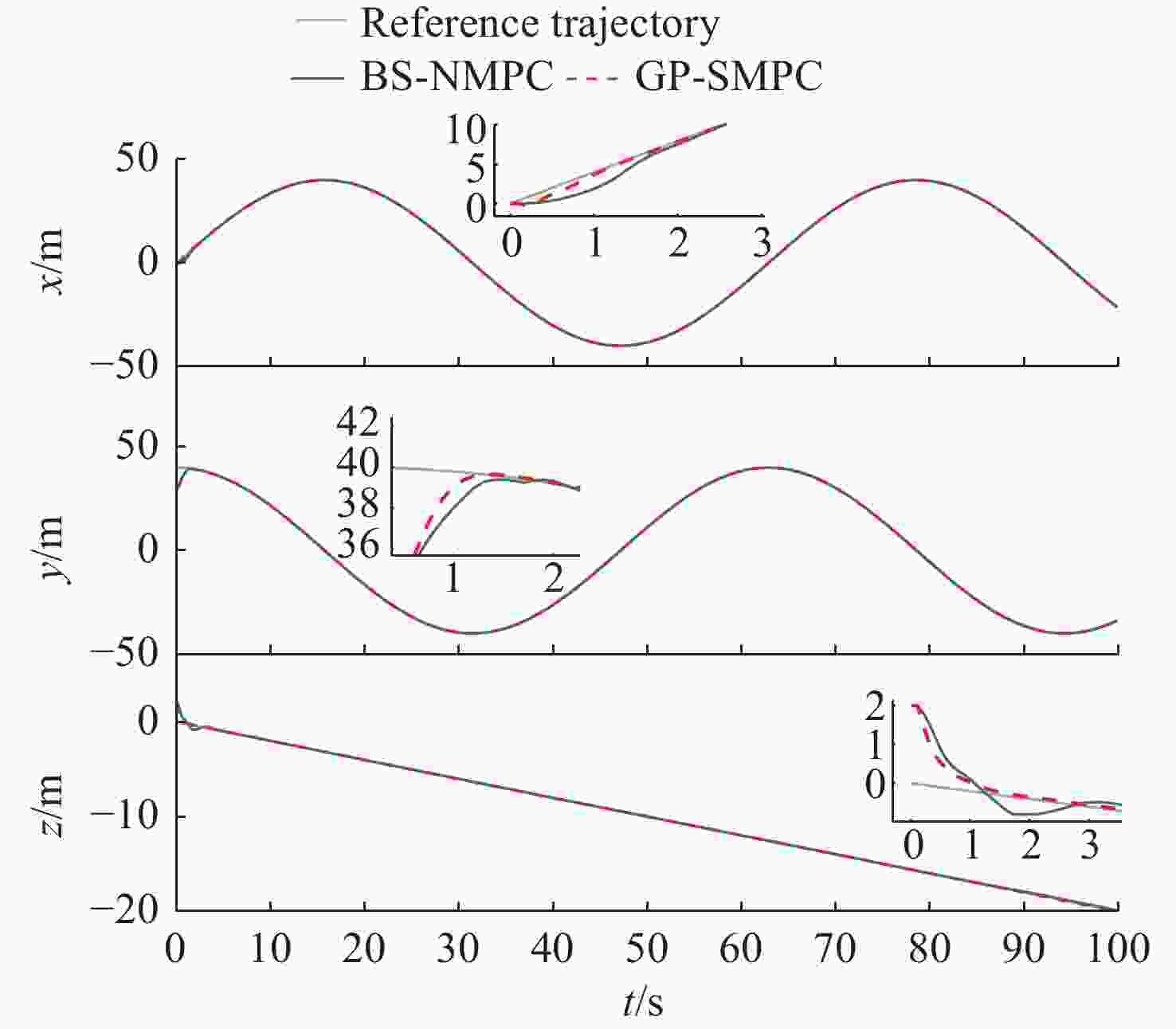
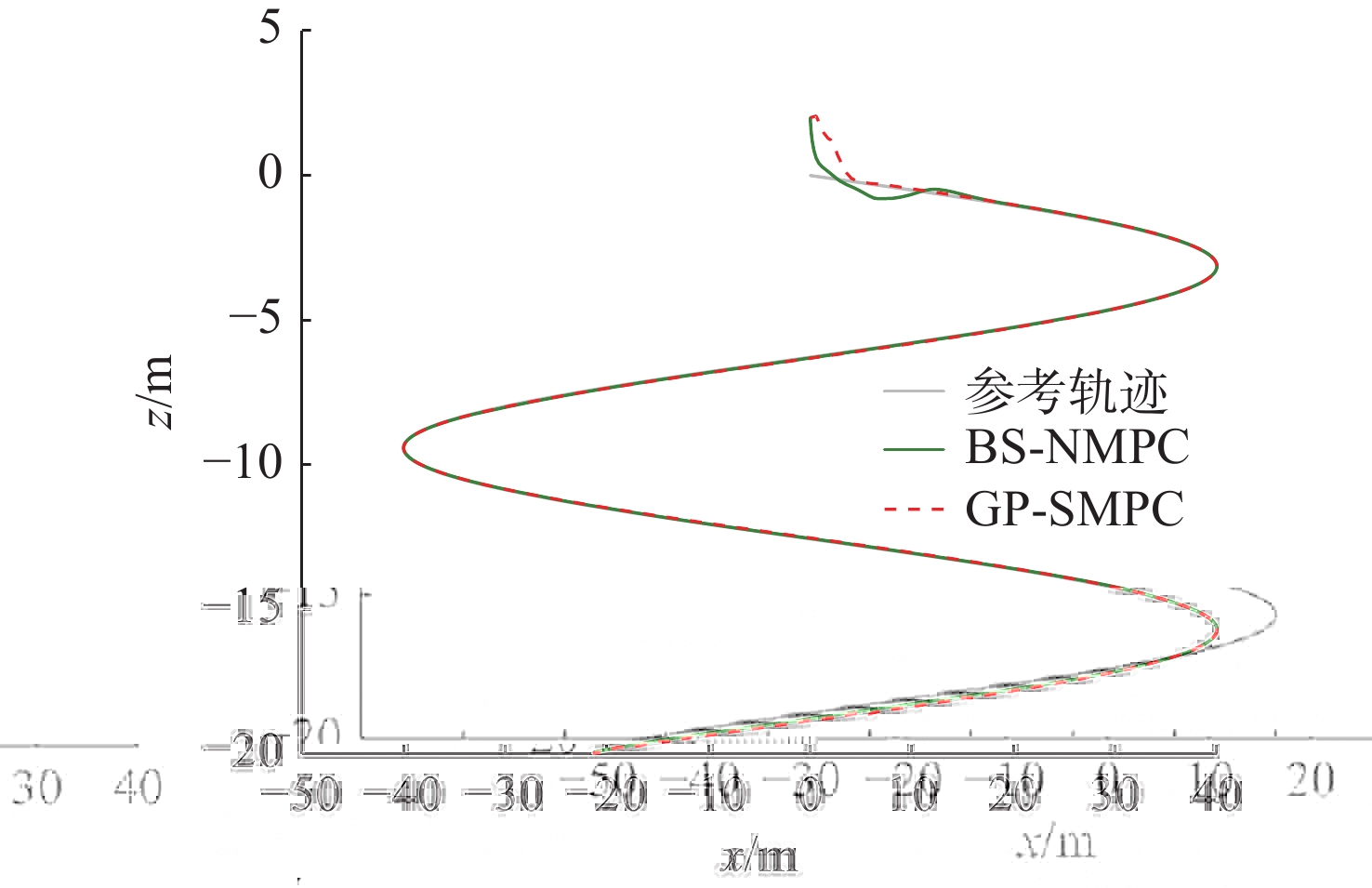
图 6 BS-NMPC与GP-SMPC控制下AUV在x、 y和z方向的位置跟踪结果
Figure 6. Position tracking results of the AUV in the x、 y and z directions under BS-NMPC and GP-SMPC control
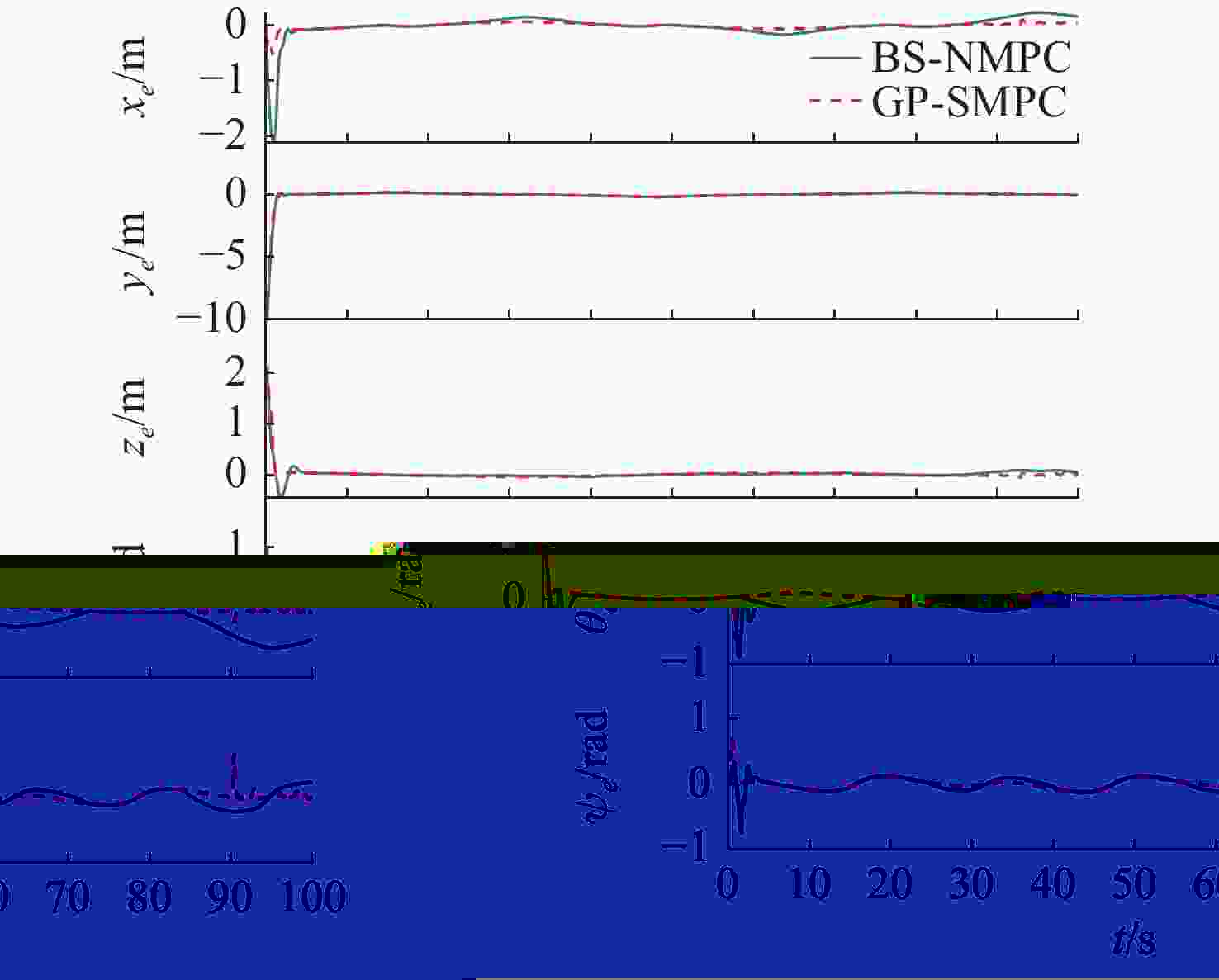
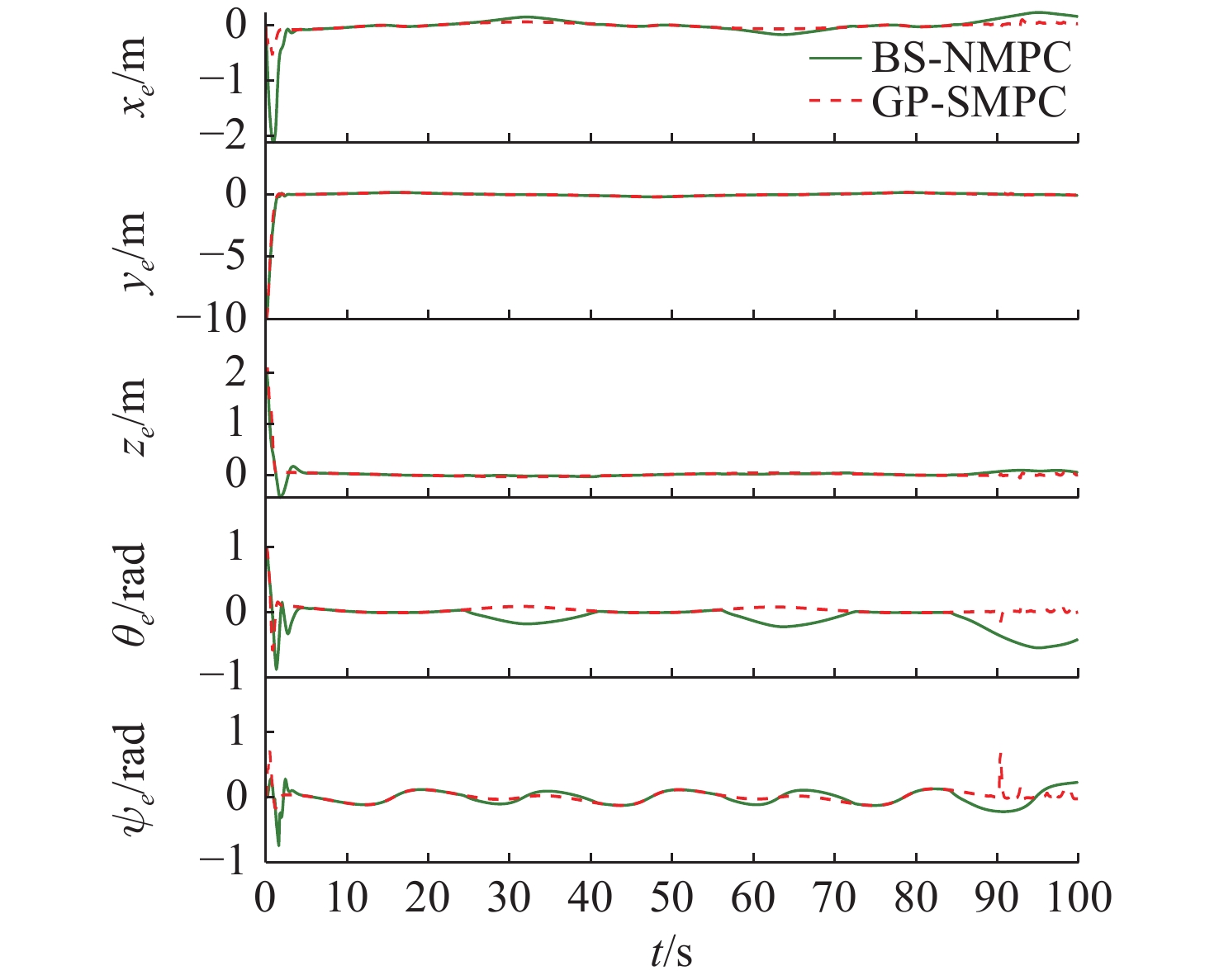
图 7 BS-NMPC与GP-SMPC控制下AUV5-DOF方向的轨迹跟踪误差
Figure 7. Trajectory tracking errors of the AUV in five degrees of freedom under BS-NMPC and GP-SMPC control
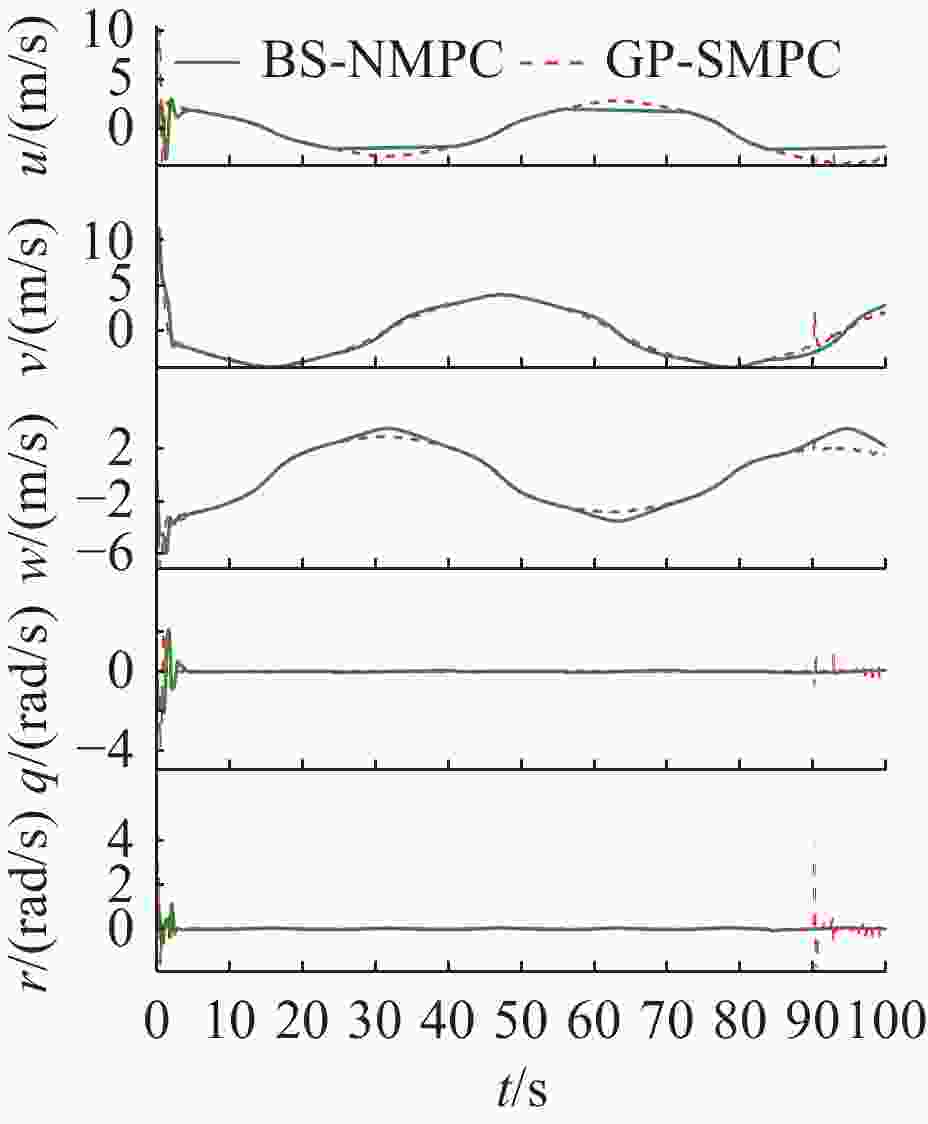
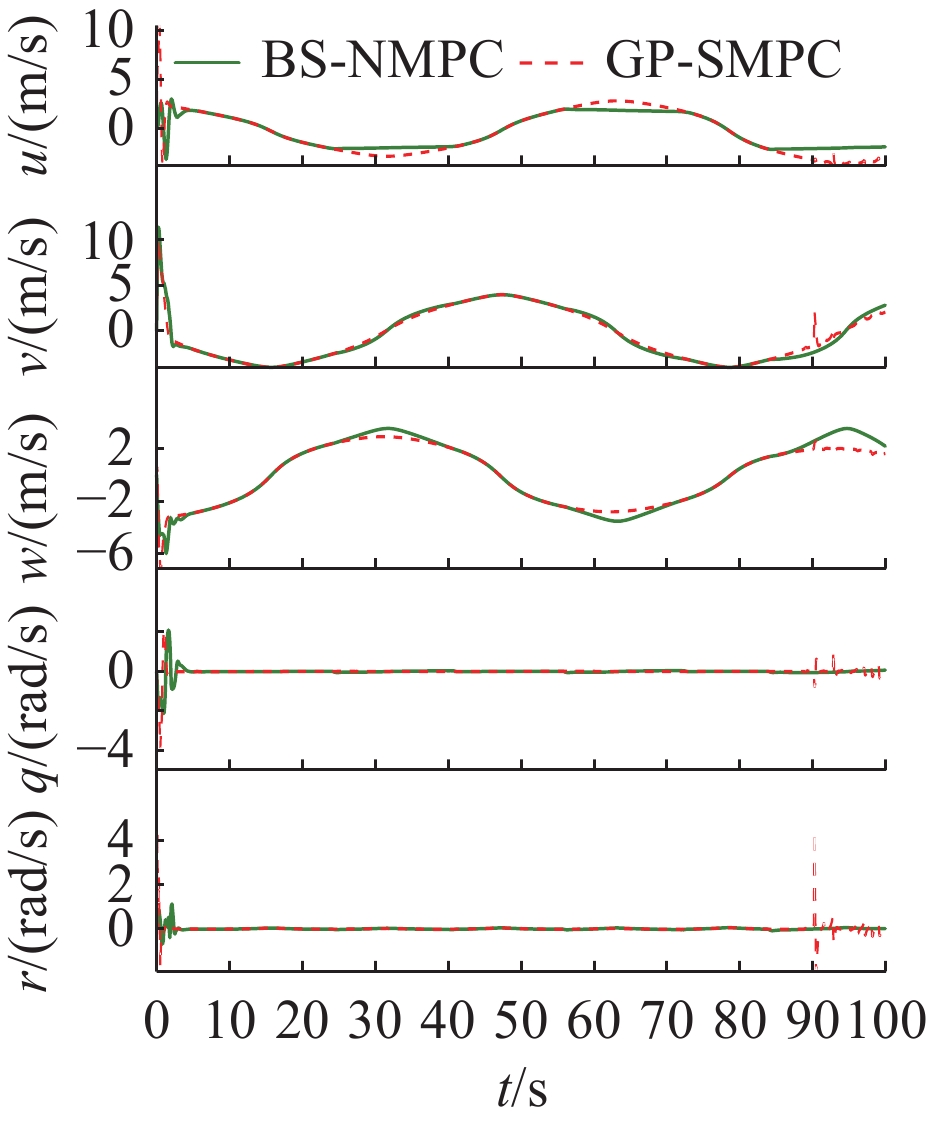
图 8 BS-NMPC与GP-SMPC控制下AUV的线速度与角速度响应
Figure 8. Linear and angular velocity responses of the AUV under BS-NMPC and GP-SMPC control
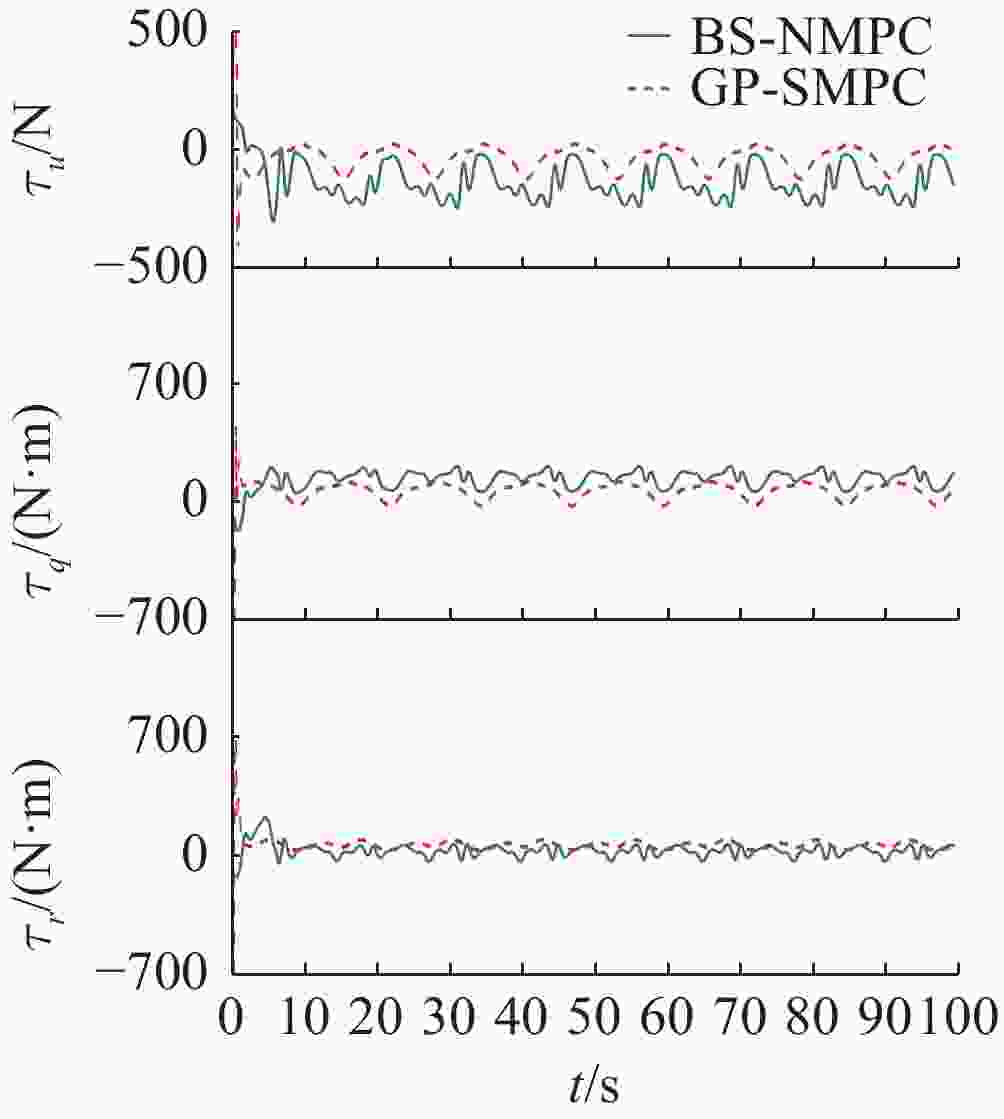
图 9 BS-NMPC与GP-SMPC控制下AUV的控制输入变化图
Figure 9. Control input profiles of the AUV under BS-NMPC and GP-SMPC control
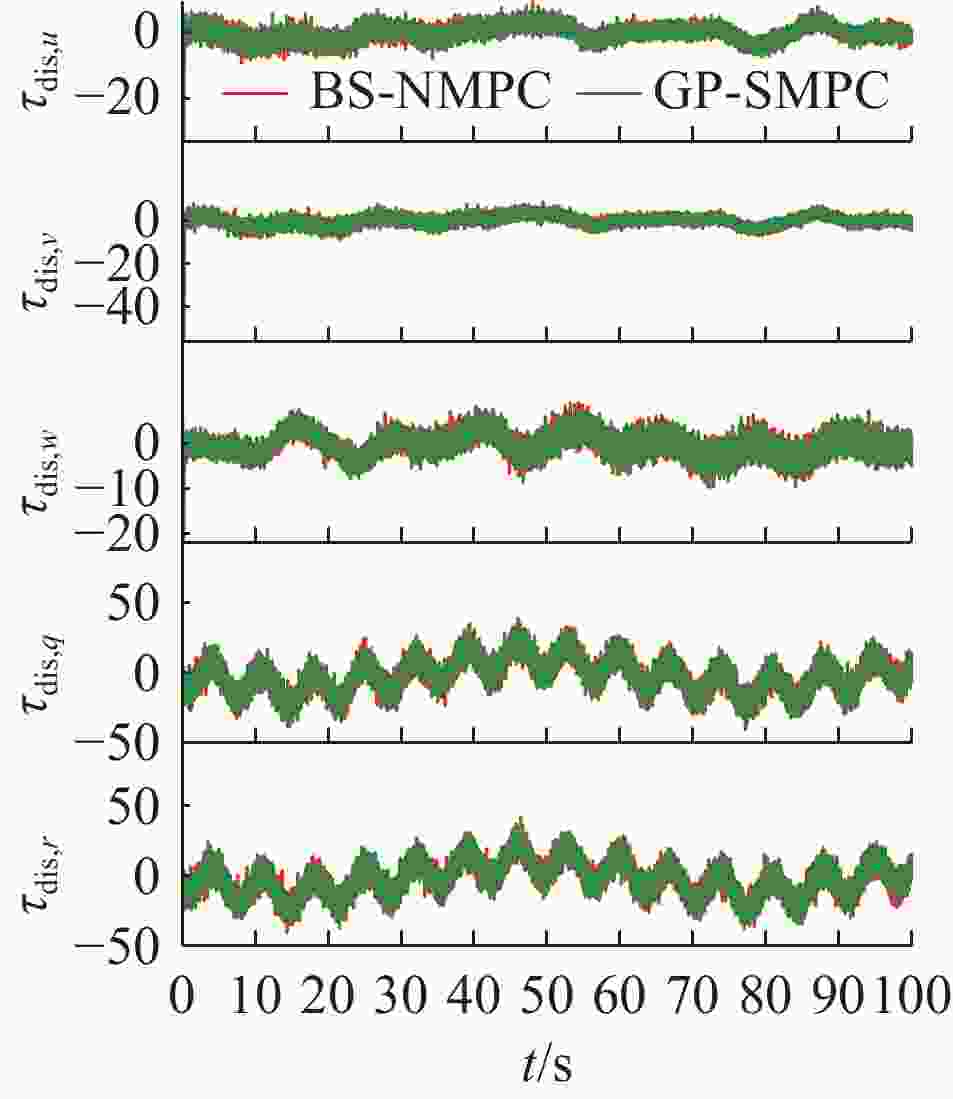
图 10 BS-NMPC与GP-SMPC控制下AUV所受集总扰动对比
Figure 10. Comparison of lumped disturbances acting on the AUV under BS-NMPC and GP-SMPC control
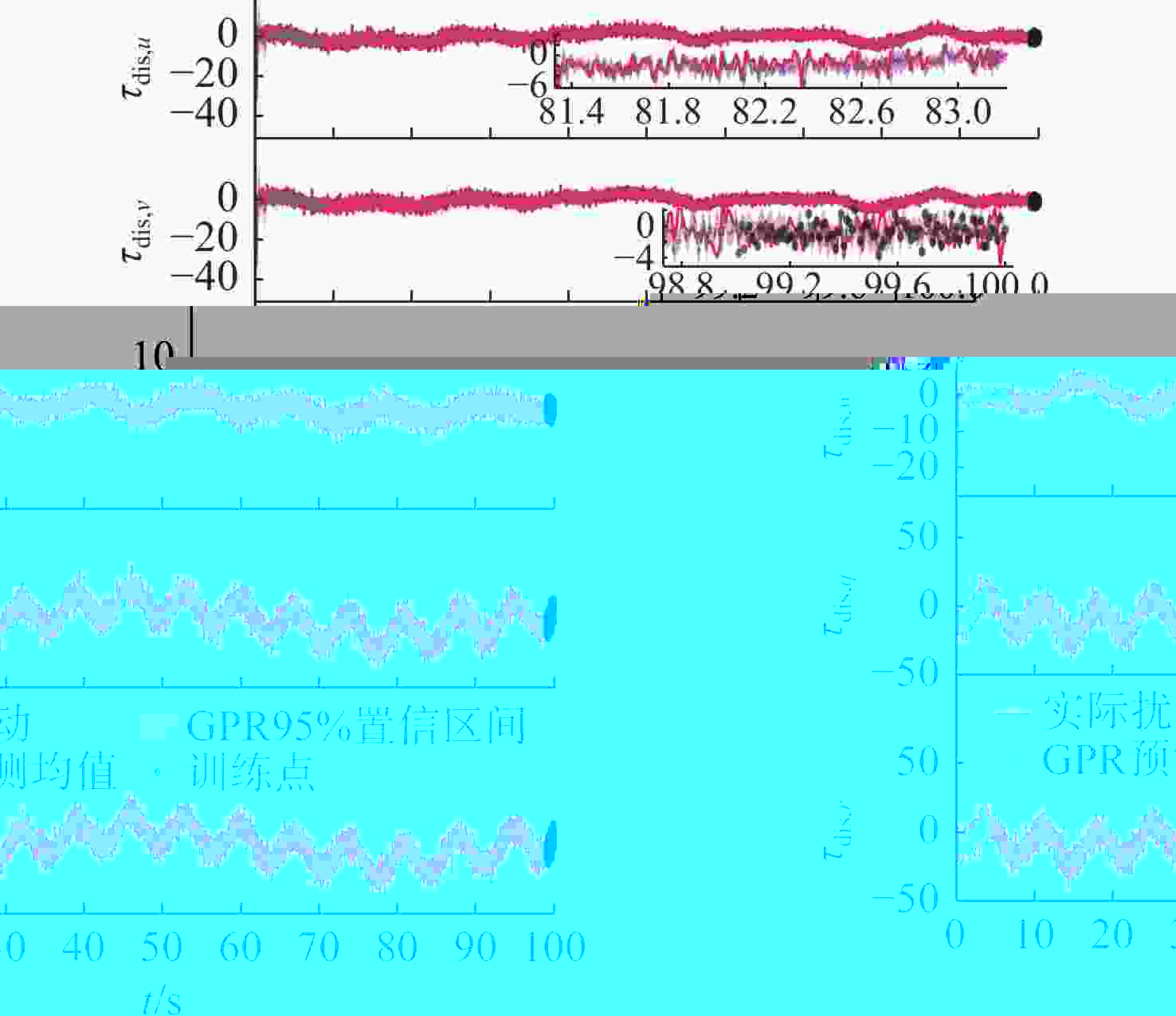
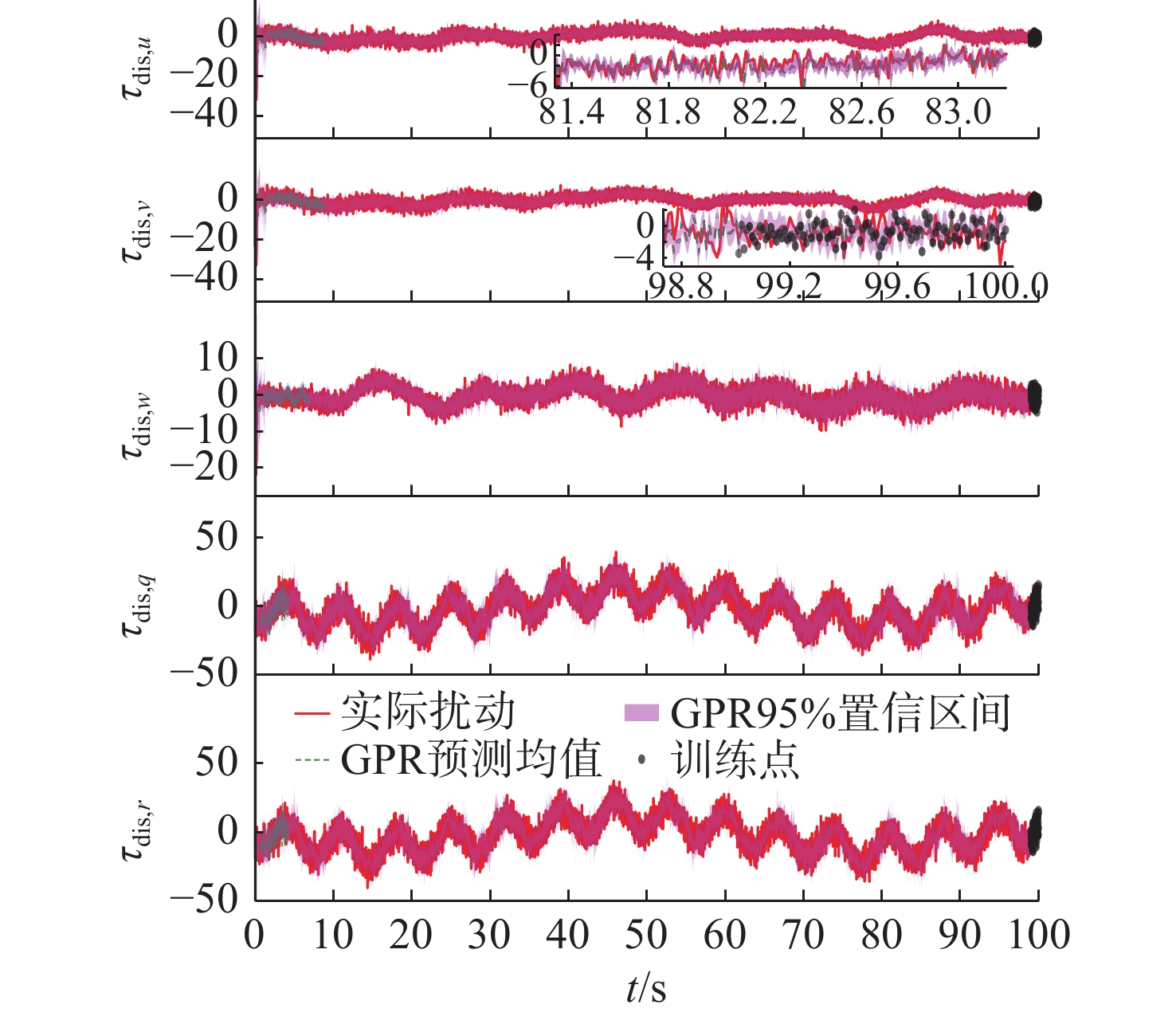
图 11 GP-SMPC控制方法中基于高斯过程回归的集总扰动观测
Figure 11. Lumped disturbance estimation based on Gaussian Process Regression in the GP-SMPC control framework
表 1 模型参数列表
Table 1. List of model parameters
参数 符号 数值 质量/kg $ {m}_{ii},i=1,\cdots ,3 $ $ \begin{aligned}&{m}_{11}=31.41\\&{m}_{22}={m}_{33}=65.98\end{aligned} $ 附加质量项1/kg $ {m}_{ii},i=4,5 $ $ {m}_{44}={m}_{55}=8.33 $ 附加质量项2/(kg/s) $ {I}_{i},I=X,Y,Z;i=u,v,w $ $ \begin{aligned} &{X}_{u}=13.5\\&{Y}_{v}={Z}_{w}=66.6\end{aligned} $ 附加质量项3/(kg·m2) $ {I}_{i},I=M,N;i=q,r $ $ {M}_{q}={N}_{r}=6.87 $ 交叉阻尼项1/(kg·m) $ {I}_{i\left| i\right| },I=X,Y,Z;i=u,v,w $ $ \begin{aligned} &{X}_{u\left| u\right| }=3.9\\&{Y}_{v\left| v\right| }={Z}_{w\left| w\right| }=131\end{aligned} $ 交叉阻尼项2/(kg/m2) $ {I}_{i\left| i\right| },I=M,N;i=q,r $ $ {M}_{q\left| q\right| }={N}_{r\left| r\right| }=9.4 $ 浮力/重力 $ W,G $ $ W=G=300 $ 稳心高度/m $ {\overline{BG}}_{\textit{z}} $ $ {\overline{BG}}_{\textit{z}}=0.02 $  下载: 导出CSV
表 2 控制器参数
Table 2. Controller parameters
参数名称 数值 $ {T}_{\text{sim}} $ 100 $ T $ 0.01 $ N $ 10 $ Q $ $ \text{diag}(500,500,500,500,500,1,1,1,1,1) $ $ R $ $ \text{diag}(0.005,0.005,0.005) $ $ K $ $ \text{diag}(5,2,2) $ $ {u}_{\max } $ $ [500,700,700] $ $ {u}_{\min } $ $ [-500,-700,-700] $ $ {\varepsilon }_{x},{\varepsilon }_{u} $ 0.05 $ {N}_{w} $ 100 $ {N}_{\text{update}} $ 20
下载: 导出CSV
表 3 基于BS-NMPC和GP-SMPC控制器的MSE比较
Table 3. Comparison of MSE between BS-NMPC and GP-SMPC controllers
MSE BS-NMPC GP-SMPC 改进率/% $ x $ 0.049 67 0.007 952 6 83.989 $ y $ 0.495 67 0.497 36 −0.340 71 $ {\textit{z}} $ 0.020 639 0.014 207 31.166 $ \theta $ 0.038 785 0.007 492 9 80.681 $ \psi $ 0.012 359 0.007 614 4 38.392
下载: 导出CSV
表 4 不同滑动窗口大小下系统性能与计算时间对比
Table 4. Comparison of system performance and computational time under different sliding window sizes
滑动窗口大小 轨迹RMSE 扰动估计MSE 平均单步计算时间/ms 20 0.0674 0.0218 11.6 40 0.0531 0.0152 13.4 60 0.0468 0.0114 15.1 80 0.0432 0.0091 17.3 100 0.0416 0.0083 19.8 150 0.0404 0.0077 27.6 200 0.0398 0.0073 39.4
下载: 导出CSV
-
[1] 周晶, 司玉林, 林渊. 海底 AUV 关键技术综述[J]. 海洋学报, 2023, 45(10): 1-12.Zhou J, Si Y L, Lin Y. Review on key technologies of seafloor AUV[J]. Acta Oceanologica Sinica, 2023, 45(10): 1-12. [2] Liu L, Zhang L, Pan G, et al. Robust yaw control of autonomous underwater vehicle based on fractional-order PID controller[J]. Ocean Engineering, 2022, 257: 111493. doi: 10.1016/j.oceaneng.2022.111493 [3] Ye Y, Wang Y, Wang L, et al. A modified predictive PID controller for dynamic positioning of vessels with autoregressive model[J]. Ocean Engineering, 2023, 284: 115176. doi: 10.1016/j.oceaneng.2023.115176 [4] Turan A. PID controller design with a new method based on proportional gain for cruise control system[J]. Journal of Radiation Research and Applied Sciences, 2024, 17(1): 100810. doi: 10.1016/j.jrras.2023.100810 [5] Dong W, He F, Wang J, et al. Modeling and numerical analysis of PID-controlled phase-change transpiration cooling[J]. International Journal of Thermal Sciences, 2024, 196: 108729. doi: 10.1016/j.ijthermalsci.2023.108729 [6] Cho G R, Li J H, Park D, et al. Robust trajectory tracking of autonomous underwater vehicles using back-stepping control and time delay estimation[J]. Ocean Engineering, 2020, 201: 107131. doi: 10.1016/j.oceaneng.2020.107131 [7] Bi F Y, Wei Y J, Zhang J Z, et al. Position-tracking control of underactuated autonomous underwater vehicles in the presence of unknown ocean currents[J]. IET control theory & applications, 2010, 4(11): 2369-2380. doi: 10.1049/iet-cta.2009.0265 [8] 刘陆, 丁世宏, 李世华. 高阶滑模控制理论综述[J]. 控制理论与应用, 2022, 39(12): 2193-2201.Liu L, Ding S H, Li S H. A survey for high-order sliding mode control theory[J]. Control Theory & Applications, 2022, 39(12): 2193-2201. [9] Zhang Z, Guo Y, Zhu S, et al. Adaptive integral sliding-mode finite-time control with integrated extended state observer for uncertain nonlinear systems[J]. Information Sciences, 2024, 667: 120456. doi: 10.1016/j.ins.2024.120456 [10] Xia Y, Xu K, Li Y, et al. Improved line-of-sight trajectory tracking control of under-actuated AUV subjects to ocean currents and input saturation[J]. Ocean engineering, 2019, 174: 14-30. doi: 10.1016/j.oceaneng.2019.01.025 [11] Makavita C D, Nguyen H D, Ranmuthugala D, et al. Composite model reference adaptive control for an unmanned underwater vehicle[J]. Underwater Technology, 2015, 33(2): 81-93. doi: 10.3723/ut.33.081 [12] Shen C, Shi Y, Buckham B. Trajectory tracking control of an autonomous underwater vehicle using Lyapunov-based model predictive control[J]. IEEE Transactions on Industrial Electronics, 2017, 65(7): 5796-5805. [13] Wang W, Yan J, Wang H, et al. Adaptive MPC trajectory tracking for AUV based on Laguerre function[J]. Ocean Engineering, 2022, 261: 111870. doi: 10.1016/j.oceaneng.2022.111870 [14] Pan J, Zhang P, Wang J, et al. Learning for depth control of a robotic penguin: A data-driven model predictive control approach[J]. IEEE Transactions on Industrial Electronics, 2022, 70(11): 11422-11432. [15] Choi W Y, Lee S H, Chung C C. Horizonwise model-predictive control with application to autonomous driving vehicle[J]. IEEE transactions on industrial informatics, 2021, 18(10): 6940-6949. doi: 10.1109/tii.2021.3137169 [16] 黄浩乾, 刘睿童, 王迪, 等. 基于扰动观测器的AUV固定时间积分滑模控制方法[J]. 中国惯性技术学报, 2023, 31(3): 292-300. doi: 10.13695/j.cnki.12-1222/o3.2023.03.011Huang H Q, Liu R T, Wang D, et al. Fixed-time integral sliding mode control method for AUV based on disturbance observer[J]. Journal of Chinese Inertial Technology, 2023, 31(3): 292-300. doi: 10.13695/j.cnki.12-1222/o3.2023.03.011 [17] Maiworm M, Limon D, Findeisen R. Online learning-based model predictive control with Gaussian process models and stability guarantees[J]. International Journal of Robust and Nonlinear Control, 2021, 31(18): 8785-8812. doi: 10.1002/rnc.5361 [18] Huang K, Wei K, Li F, et al. LSTM-MPC: A deep learning based predictive control method for multimode process control[J]. IEEE Transactions on Industrial Electronics, 2022, 70(11): 11544-11554. [19] Cui Y, Peng L, Li H. Filtered probabilistic model predictive control-based reinforcement learning for unmanned surface vehicles[J]. IEEE Transactions on Industrial Informatics, 2022, 18(10): 6950-6961. doi: 10.1109/TII.2022.3142323 [20] Liu T, Zhao J, Huang J. A Gaussian-process-based model predictive control approach for trajectory tracking and obstacle avoidance in autonomous underwater vehicles[J]. Journal of Marine Science and Engineering, 2024, 12(4): 676. doi: 10.3390/jmse12040676 [21] Shen X, Sun G, Mao Y, et al. Gaussian process-based model predictive control for autonomous underwater vehicles[J]. Journal of Physics: Conference Series, 2024, 2718(1): 012063. doi: 10.1088/1742-6596/2718/1/012063 [22] Hu K, Wan Y, Yang S, et al. Gaussian process-based hierarchical model predictive control for underactuated AUV with plant-model mismatch[J]. IFAC-PapersOnLine, 2025, 59(22): 36-41. doi: 10.1016/j.ifacol.2025.11.604 [23] Wu C, Dai Y, Shan L, et al. Data-driven trajectory tracking control for autonomous underwater vehicle based on iterative extended state observer[J]. Math. Biosci. Eng, 2022, 19(3): 3036-3055. doi: 10.3934/mbe.2022140 [24] Zieglmeier S, de Badyn M H, Warakagoda N D, et al. Data-enabled predictive control and guidance for autonomous underwater vehicles[PP/OL]. V3. arXiv (2026-05-31)[2026-06-01]. https://arxiv.org/pdf/2510.25309. [25] Fossen T I. Handbook of marine craft hydrodynamics and motion control[M]. Hoboken, New Jersey: John Wiley & Sons, 2011. [26] Wen G, Ge S S, Chen C L P, et al. Adaptive tracking control of surface vessel using optimized backstepping technique[J]. IEEE transactions on cybernetics, 2018, 49(9): 3420-3431. [27] Zhang F. The Schur complement and its applications[M]. Berlin, Germany: Springer Science & Business Media, 2006. [28] Hewing L, Kabzan J, Zeilinger M N. Cautious model predictive control using Gaussian process regression[J]. IEEE Transactions on Control Systems Technology, 2019, 28(6): 2736-2743. doi: 10.1109/tcst.2019.2949757 [29] Fayzullayev B S H, Masharipov A M, Atamurotova A A. Jensen's inequality and its applications[J]. Medicine, pedagogy and technology: theory and practice, 2024, 2(7): 90-105. [30] Grüne L, Kellett C M. ISS-Lyapunov functions for discontinuous discrete-time systems[J]. IEEE Transactions on Automatic Control, 2014, 59(11): 3098-3103. doi: 10.1109/TAC.2014.2321667 -

 下载:




 点击查看大图
计量
- 文章访问数: 2
- HTML全文浏览量: 1
- PDF下载量: 0
- 被引次数: 0