

Loss Evolution Characteristics of a Micro Axial-Flow Turbine Under Variable Operating Conditions
-
摘要: 针对微型水下航行器在宽速域运行条件下微型轴流式汽轮机面临的效率问题, 开展了变工况损耗演化机理研究。基于Modelica语言, 构建了热-机-流多物理场耦合机理模型, 引入了轮盘摩擦损失、部分进汽损失、叶顶间隙泄漏损失及余速损失等微尺度非线性损耗修正。通过典型任务剖面的瞬态仿真与全速域参数扫描, 揭示了变工况过程中损耗机制的阶段性演变: 低速巡航阶段, 余速损失、轮盘摩擦损失与部分进汽损失占比相近, 形成三者协同主导的局面, 同时泄漏损失构成较为稳定的损耗; 高速突击阶段, 部分进汽损失与轮盘摩擦损失成为主导损耗源。进一步研究表明, 系统性能受运行参数与几何参数显著影响: 提高进口压力和进口温度可降低损耗占比, 但是要注意进口参数和气动特性的匹配; 控制叶顶间隙、适当增大部分进汽度并采用偏小的动叶出口角, 可有效抑制动能耗散与微尺度损失, 改善全工况效率。研究结果为微型动力系统的能量管理、高效运行区间界定及结构优化提供了理论依据与仿真支撑。Abstract: A study on the evolution mechanism of off-design losses is carried out to address the efficiency issues of micro axial-flow turbines in micro underwater vehicles operating over a wide speed range. A thermo-mechanical-fluid multi-physics coupling model is developed using the Modelica language, incorporating micro-scale nonlinear loss corrections such as disk friction loss, partial admission loss, tip clearance leakage loss, and exit velocity loss. Through transient simulations under a typical mission profile and full-speed-range parameter sweeps, the stage-wise evolution of the loss mechanism under variable operating conditions is revealed: during low-speed cruise, exit velocity loss, disk friction loss, and partial admission loss share comparable contributions, forming a co-dominant regime, while leakage loss remains relatively stable; during high-speed dash, partial admission loss and disk friction loss become the dominant loss sources. Further investigation shows that system performance is significantly influenced by both operating and geometric parameters. Increasing inlet pressure and temperature can reduce the loss proportion, but proper matching between inlet parameters and aerodynamic characteristics must be ensured. Controlling tip clearance, appropriately increasing the number of nozzles to raise the partial admission ratio, and adopting a small rotor exit angle can effectively suppress kinetic energy dissipation and micro-scale penalties, thereby improving the turbine efficiency over the whole operating range. The findings provide theoretical support and simulation-based guidance for energy management, definition of high-efficiency operating intervals, and structural optimization of micro power systems.
-
图 1 Li/SF6闭式循环动力系统原理结构图
Figure 1. Principle structural diagram of Li/SF6 closed-cycle power system
图 2 动力系统热-机-流耦合集成模型结构
Figure 2. Structural diagram of the thermal-mechanical-fluid coupling integrated model for power systems
图 4 变工况过程中各项损失演化曲线
Figure 4. Evolution curve of various losses during the variable operating condition process
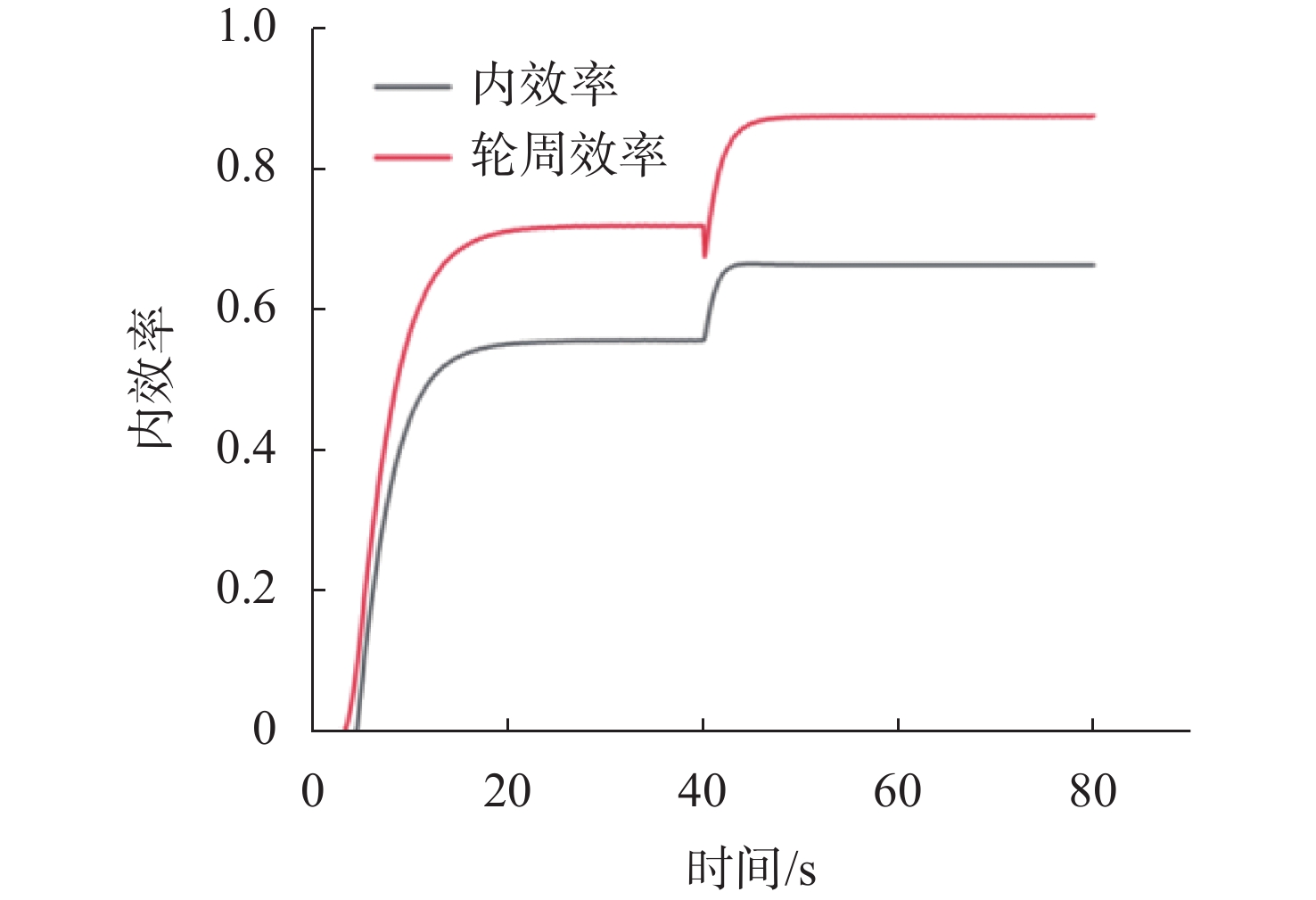
图 5 内效率和轮周效率变化曲线
Figure 5. Curves of internal efficiency and wheel-space efficiency changes
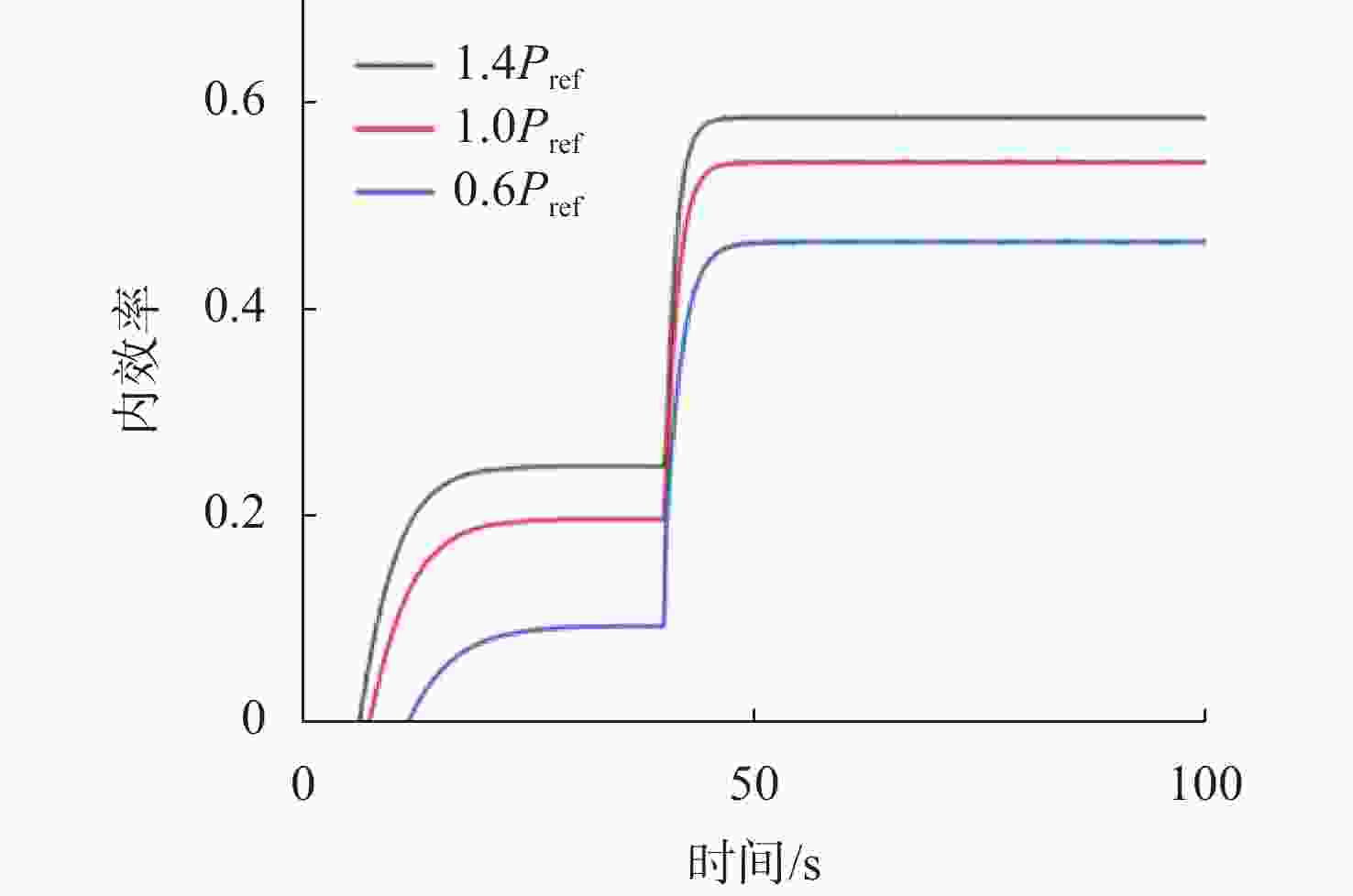
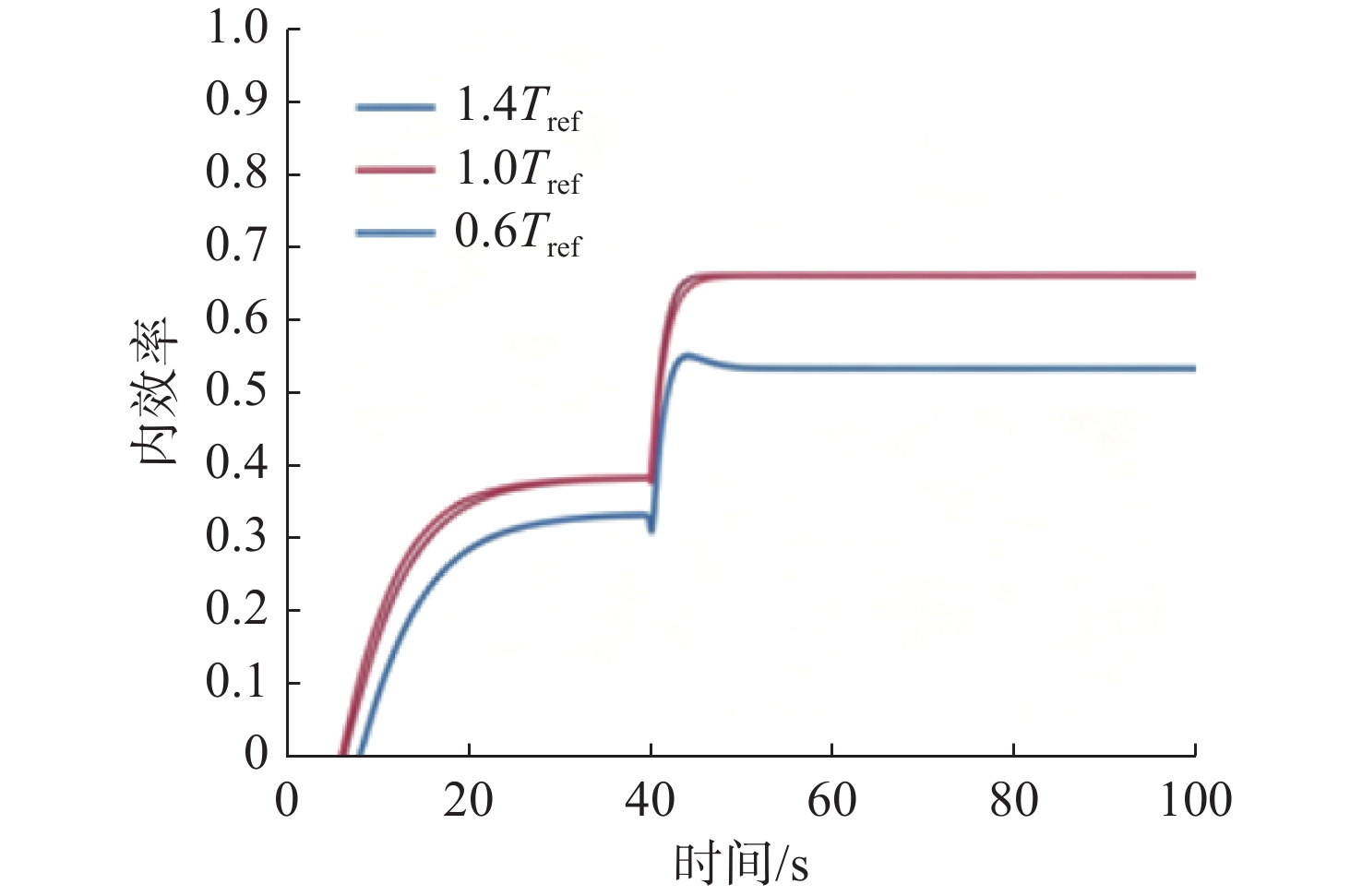
图 6 调节进口压力后的内效率变化
Figure 6. Change in internal efficiency after adjusting inlet pressure
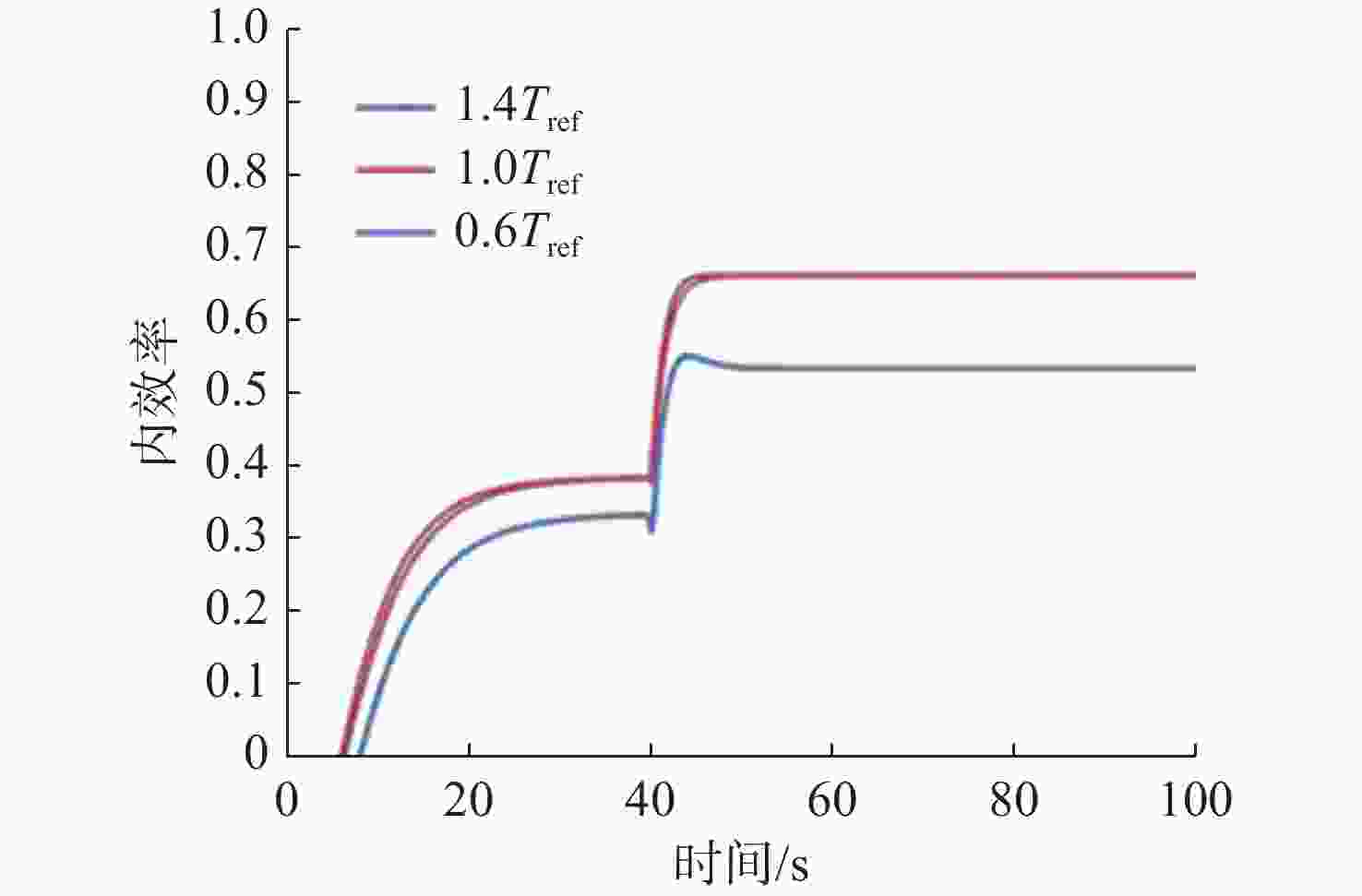
图 7 调节进口温度后的内效率变化
Figure 7. Change in internal efficiency after adjusting the inlet temperature
表 1 稳态工况仿真与实验数据对比
Table 1. Comparison between simulation and experimental data under steady-state conditions
项目 相对实验值 相对仿真值 相对误差/% 汽轮机转速 1.00nref 0.97nref 2.68 出口蒸汽温度 1.00Tout,ref 0.93 Tout,ref 7.46 蒸汽流量 $1.00{\dot m_{{\mathrm{ref}}}} $ $0.96{m_{{\mathrm{ref}}}} $ 4.16 汽轮机功率 1.00Pt,ref 0.96Pt,ref 4.37  下载: 导出CSV
-
[1] 史小锋, 党建军, 梁跃, 等. 水下攻防武器能源动力技术发展现状及趋势[J]. 水下无人系统学报, 2021, 29(6): 634-647.Shi X F, Dang J J, Liang Y, et al. Development status and trends of energy and power technology for underwater offensive and defensive weapons[J]. Journal of Unmanned Undersea Systems, 2021, 29(6): 634-647. [2] Włodarski W, Piwowarski M. A model modification for a microturbine set with partial admission stages[J]. Energies, 2024, 17(8): 1792. [3] 付雷, 丰镇平. 毫米级微型燃气轮机系统设计原则与可实现性循环分析[J]. 西安交通大学学报, 2011, 45(5): 42-46.Fu L, Feng Z P. Design principles and feasibility cycle analysis of millimeter-scale micro gas turbine systems[J]. Journal of Xi’an Jiaotong University, 2011, 45(5): 42-46. [4] Barsi D, Satta F, Ubaldi M, et al. A comparative analysis of distributor and rotor single regulation strategies for low head mini hydraulic turbines[J]. Energies, 2024, 17(10): 2304. [5] Horlock J H. Axial flow turbines: fluid mechanics and thermodynamics[M]. London: Butterworth, 1973. [6] Yu Q, Howell R. Challenges in aerodynamic performance of micro gas turbines and design inefficiencies[J]. Journal of Turbomachinery, 2026, 148(2): 021001. [7] Zhou F, et al. Cavitation performance analysis of tip clearance in a bulb-type hydro turbine[J]. Computer Modeling in Engineering & Sciences, 2025, 145(1): 411-429. [8] Traupel W. Thermische turbomaschinen. band 1: Thermodynamisch-strömungstechnische berechnung[M]. 4. Aufl. Berlin, Heidelberg: Springer, 2001. [9] 郭兆元, 曹浩, 赵卫兵. 纯冲动式鱼雷汽轮机动叶栅超音速流动数值仿真[J]. 鱼雷技术, 2013, 21(1): 43-47.Guo Z Y, Cao H, Zhao W B. Numerical simulation of supersonic flow in the rotor cascade of a pure impulse torpedo turbine[J]. Torpedo Technology, 2013, 21(1): 43-47. [10] Cho S Y, Cho C H, Ahn K Y. Performance characteristics and prediction on a partially admitted single-stage axial-type micro turbine[J]. Journal of the Korean Society of Marine Engineering, 2006, 30(5): 581-588. [11] Cho S Y, Cho C H, Ahn K Y. Performance prediction on a partially admitted small axial-type turbine[J]. JSME International Journal Series B, 2006, 49(4): 1290-1297. [12] Castillo S A, Paniagua G. Experimental assessment of squealer tip leakage flow structures in a small-core high-speed turbine[J]. Journal of Turbomachinery, 2026, 148(7). [13] 漆粤川, 马灿, 苏欣荣, 等. 极小展弦比跨音速汽轮机叶片非定常流动机理研究[J]. 热能动力工程, 2025, 40(6): 1-10.Qi Y C, Ma C, Su X R, et al. Study on the unsteady flow mechanism of transonic turbine blades with extremely low aspect ratio[J]. Journal of Engineering for Thermal Energy and Power, 2025, 40(6): 1-10. [14] 鲁宇轩, 华山, 郭萌萌, 等. 基于Modelica的凝结水节流调节过程600 MW汽轮机组动态特性及㶲分析[J]. 中国电机工程学报, 2026, 46(7): 2912-2924.Lu Y X, Hua S, Guo M M, et al. Dynamic characteristics and exergy analysis of a 600 MW steam turbine unit during condensate throttling regulation based on Modelica[J]. Proceedings of the CSEE, 2026, 46(7): 2912-2924. [15] Wang H, Luo K, Kong L, et al. Characterization of loss, temperature, and stress on partial admission axial impulse turbines with liquid jet impingement cooling[J]. Applied Thermal Engineering, 2024, 252: 12364. [16] Hu Z, Jiang H, Zhuge W, et al. Effects of partial admission ratio on the performance and flow characteristics of a supercritical carbon dioxide axial-flow turbine[J]. Energies, 2025, 18(16): 4259. -

 下载:
下载:

 点击查看大图
计量
- 文章访问数: 183
- HTML全文浏览量: 94
- PDF下载量: 7
- 被引次数: 0