


Development Status and Prospects of Acoustic Recognition Methods for Underwater Low-Speed Small Targets
-
摘要: 以蛙人、无人水下航行器为代表的水下慢速小目标, 凭借隐蔽性强、机动性高及破坏性大等特点, 已成为近岸军事和经济设施的主要威胁, 其识别是当前水下安防领域的研究热点与难点。文中聚焦水下慢速小目标声学识别中的声信号特征分析、声特征提取与声特征分类3个环节, 系统梳理了该领域的研究现状、关键挑战与发展趋势。首先, 从主动回波信号和被动辐射噪声角度, 分析了水下慢速小目标的声信号特征; 其次围绕主动特征和被动特征, 总结了当前主流特征提取方法; 然后归纳并对比统计学习与深度学习2类主流分类方法; 接着阐述了该领域面临的主要挑战及相应解决措施; 最后结合技术发展趋势对未来研究方向进行展望, 以期为水下慢速小目标识别技术发展提供参考。Abstract: Underwater low-speed small targets, represented by divers and unmanned undersea vehicles, have become major threats to nearshore military and economic facilities due to their strong concealment, high maneuverability, and significant destructive potential. Their recognition has emerged as a hot topic and a challenging issue in the field of underwater security. This paper focused on three key aspects of acoustic recognition for underwater low-speed small targets: acoustic signal characteristic analysis, feature extraction, and feature classification. It systematically reviewed the current research status, core challenges, and development trends in this field. First, the acoustic signal characteristics of underwater low-speed small targets were analyzed from the perspectives of active echo signals and passive radiated noise. Subsequently, mainstream feature extraction methods were summarized based on active and passive features. Then, two major classification approaches, namely statistical learning and deep learning, were introduced and compared. Following this, the main challenges faced in this field and corresponding countermeasures were discussed. Finally, in light of technological development trends, future research directions were prospected, aiming to provide references for the advancement of underwater low-speed small target recognition technologies.
-
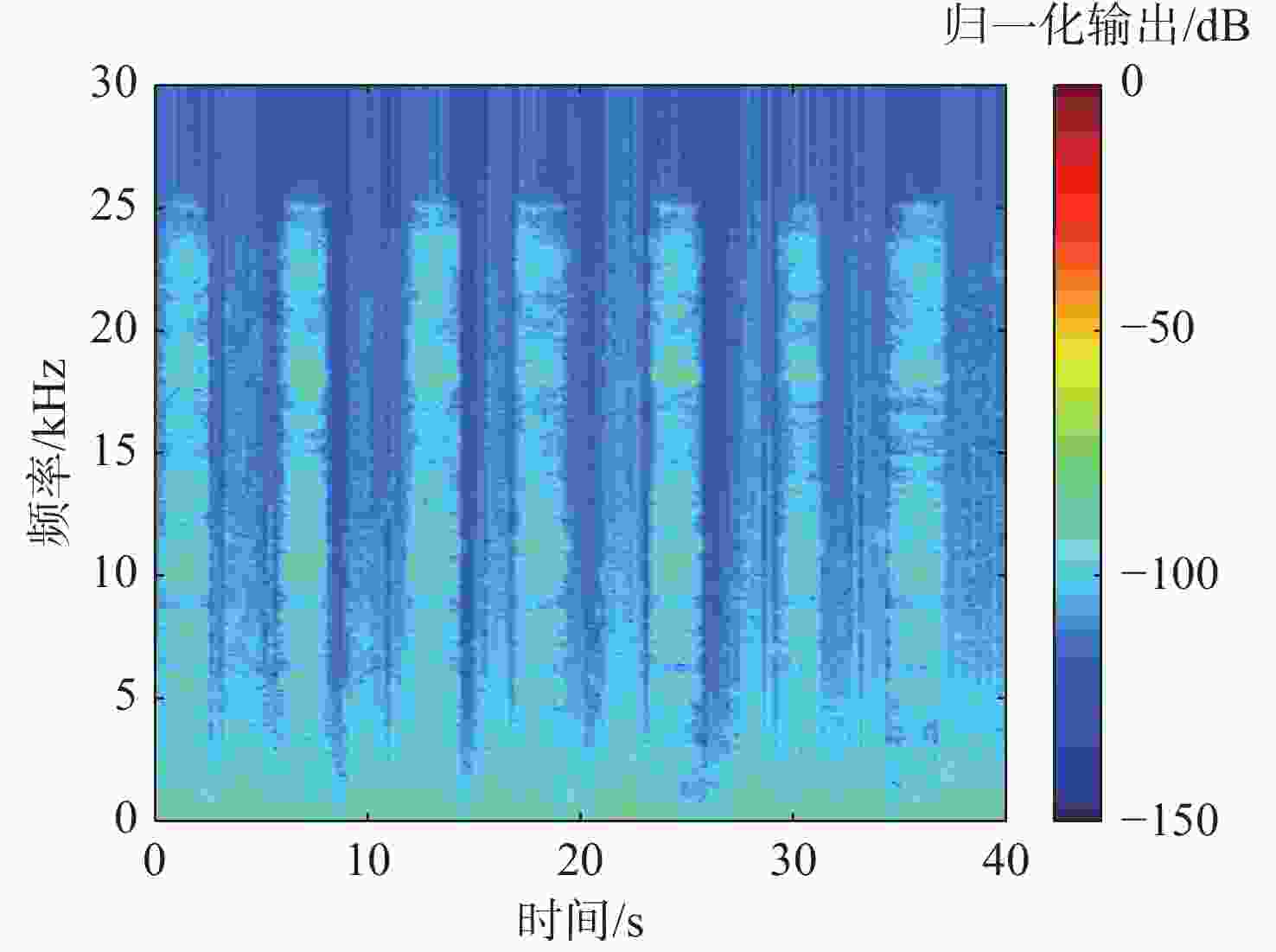
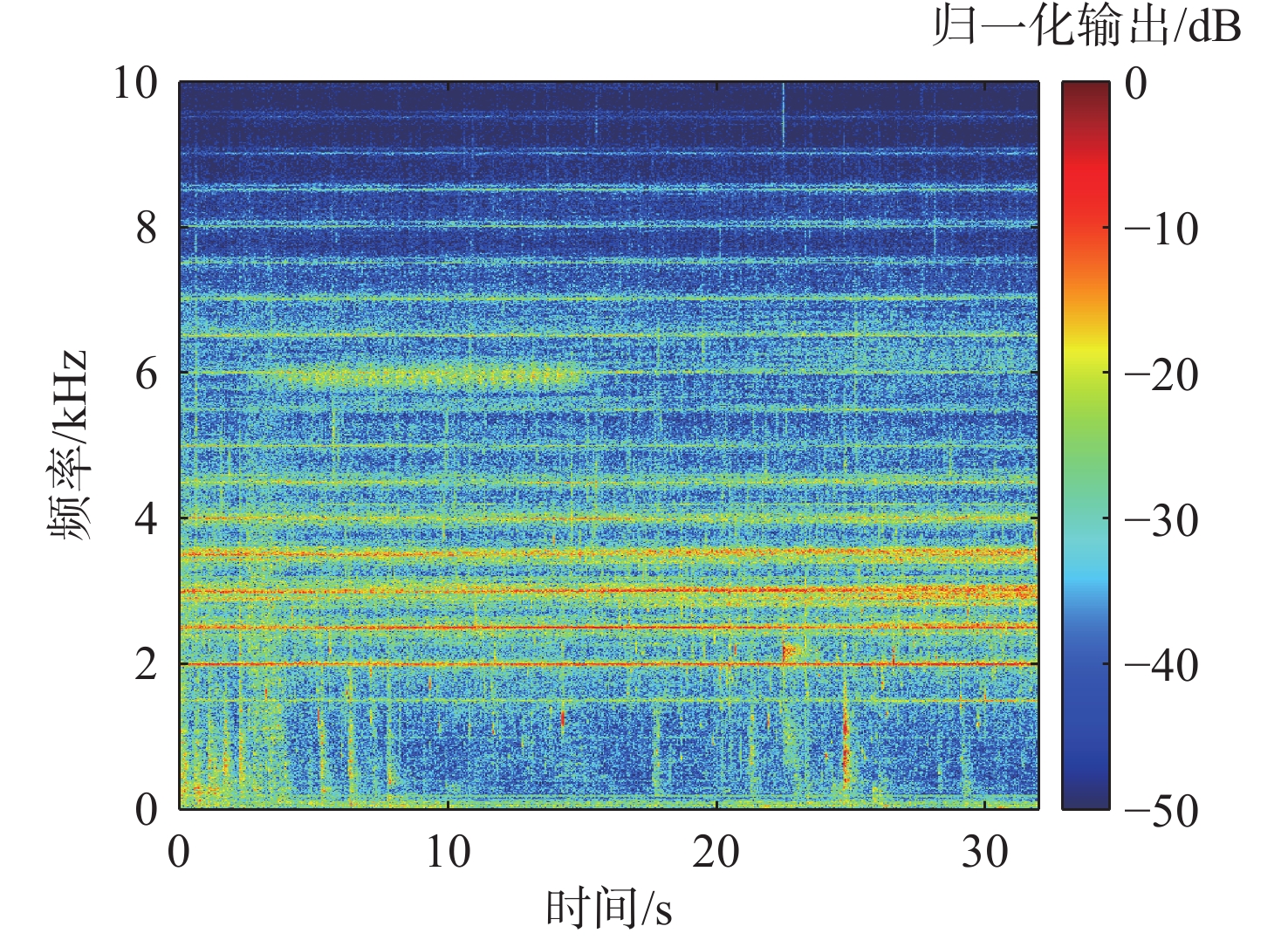
图 3 开式呼吸器蛙人辐射噪声时频谱
Figure 3. Time-frequency spectrum of the radiated noise from a diver carring an open-circuit scuba
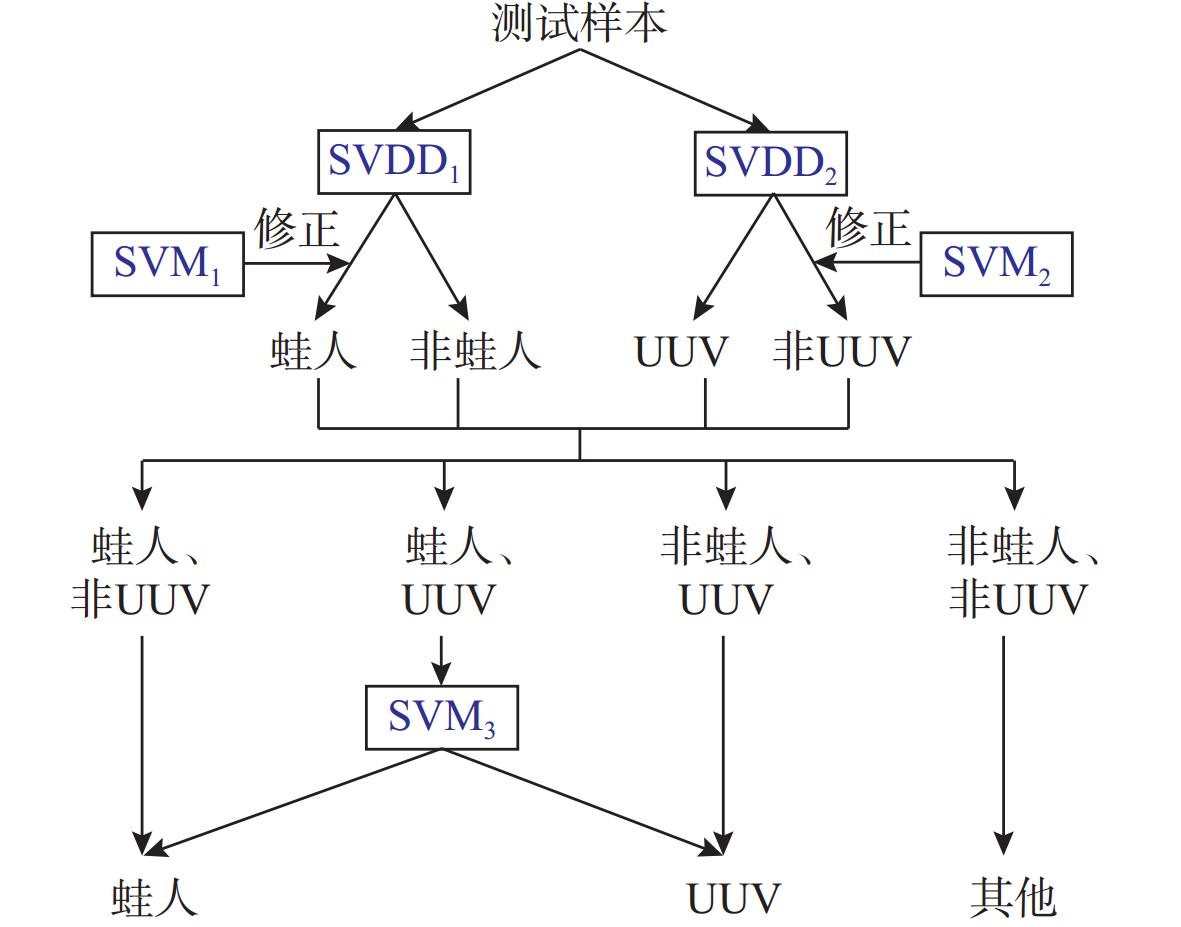
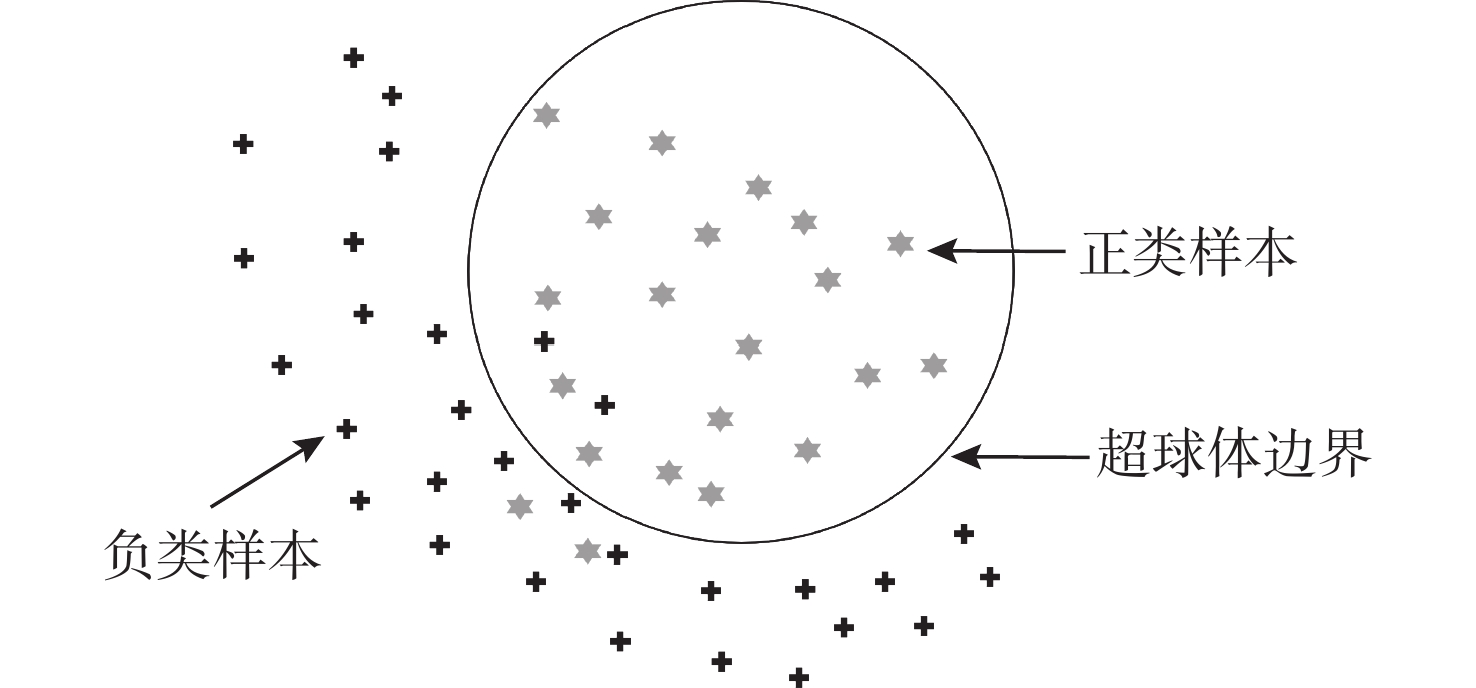
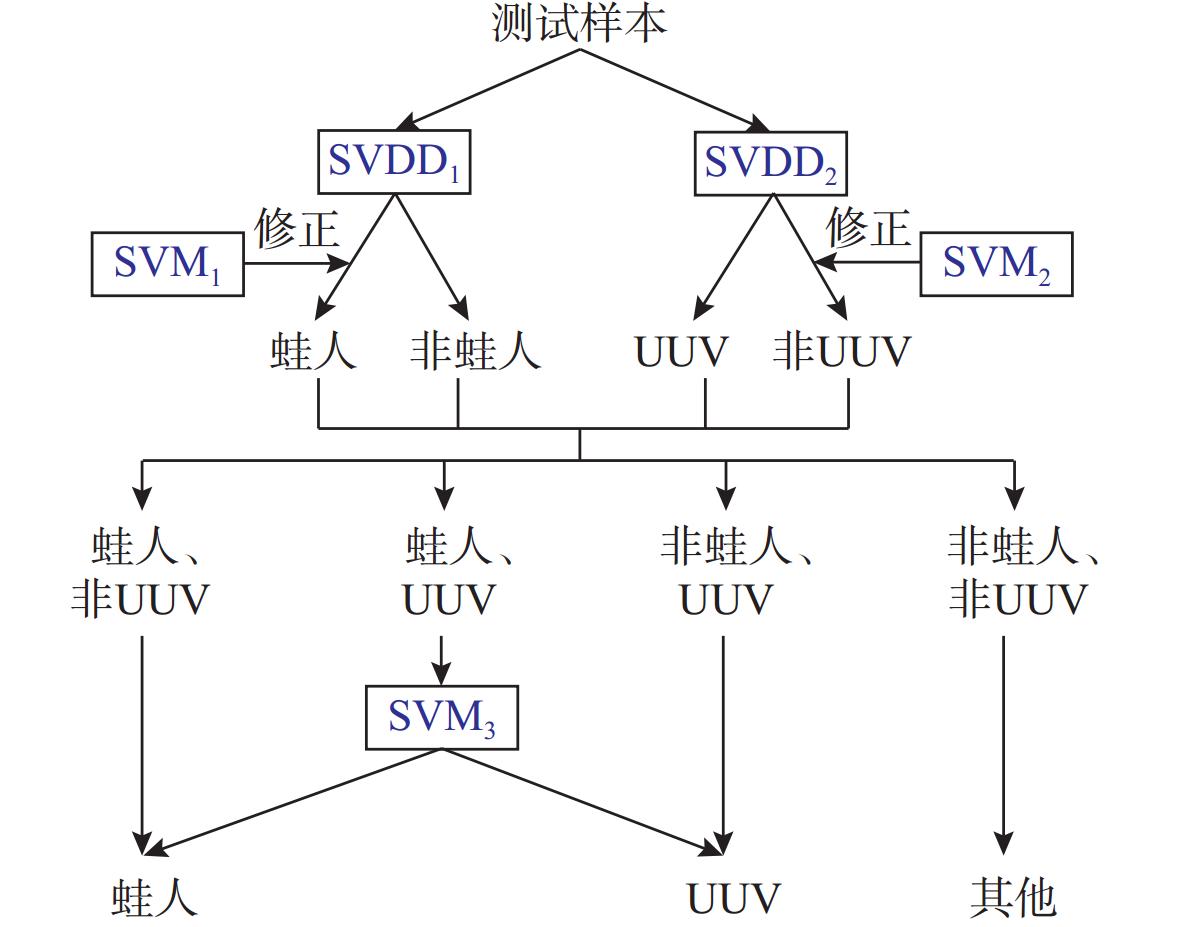
图 8 SVDD-SVM联合分类器信息处理流程
Figure 8. Information processing flow of the joint SVDD-SVM classifier
表 1 小目标主被动特征框架及其性能对比
Table 1. Framework and performance comparison of active and passive features for small targets
特征
属性特征
类型适用
距离信混/噪比
需求抗干扰
能力主动
特征声散射特征 较近/较远 较高/较低 较弱/较强 图像特征 近 高 弱 运动特征 较远 较低 较强 被动
特征时频特征 近/较近 较高/次较高 较弱 高阶统计量 较近 次较高 较弱 听觉特征 近 较高 较弱 音色特征 近 较高 较弱 γ参数 较近 次较高 较弱  下载: 导出CSV
-
[1] 邢更力, 徐常星, 范殿梁, 等. 近岸水域反恐防范技术发展现状及关键技术[J]. 中国安全防范技术与应用, 2018(5): 8-12. doi: 10.3969/j.issn.1672-1470.2018.05.002 [2] 许钢灿, 倪东波, 郭建. 反蛙人声呐系统发展综述[J]. 中国安全防范技术与应用, 2018(5): 13-18. [3] 黄颖淞, 葛辉良, 王付印, 等. 蛙人探测声呐系统发展综述[J]. 水下无人系统学报, 2020, 28(1): 1-9.Huang Y S, Ge H L, Wang F Y, et al. Review on the development of diver detection sonar system[J]. Journal of Unmanned Undersea Systems, 2020, 28(1): 1-9. [4] 孙玉臣, 王德石, 李宗吉, 等. 蛙人探测声呐系统发展综述[J]. 水下无人系统学报, 2021, 29(5): 509-523.Sun Y C, Wang D S, Li Z J, et al. Review of diver detection sonar system[J]. Journal of Unmanned Undersea Systems, 2021, 29(5): 509-523. [5] 兰同宇, 刘本奇, 刘亮. 反UUV探测声呐系统发展综述[J]. 水下无人系统学报, 2022, 30(6): 704-713.Lan T Y, Liu B Q, Liu L. Review on anti-UUV detection sonar system[J]. Journal of Unmanned Undersea Systems, 2022, 30(6): 704-713. [6] 孙玉臣, 陈维义, 王平波, 等. 蛙人水下声信号特征研究综述[J]. 声学技术, 2022, 41(4): 479-488. doi: 10.16300/j.cnki.1000-3630.2022.04.001Sun Y C, Chen W Y, Wang P B, et al. Review of research on the characteristics of underwater acoustic signal of frogman[J]. Technical Acoustics, 2022, 41(4): 479-488. doi: 10.16300/j.cnki.1000-3630.2022.04.001 [7] 王琦, 范军, 王斌. 闭式蛙人目标强度预报及试验[J]. 声学技术, 2022, 41(2): 173-179.Wang Q, Fan J, Wang B. Target strength of closed frogman: measurements and modelling[J]. Technical Acoustics, 2022, 41(2): 173-179. [8] 刘博, 范军, 王斌. 某小型潜航器的声散射特性研究[J]. 声学技术, 2021, 40(4): 458-463.Liu B, Fan J, Wang B. Study on acoustic scattering characteristics of a small submersible vehicle[J]. Technical Acoustics, 2021, 40(4): 458-463. [9] 刘博. 微小型无人潜航器典型结构声散射特性研究[D]. 上海: 上海交通大学, 2020: 65. [10] Hollett R D, Kessel R T, Pinto M. At-sea measurements of diver target strengths at 100 kHz: measurement technique and first results[C]//NATO Undersea Research Centre, La Spezia(Italy), 2006. [11] 张波, 马忠成. 蛙人目标强度的水下测量[C]//中国声学学会2009年青年学术会议, 2009: 313-314. [12] 张波, 刘文章. 蛙人回波建模与实验研究[J]. 应用声学, 2010, 29(4): 313-320.Zhang B, Liu W Z. Modeling and experimental study of echo from a diver[J]. Applied Acoustics, 2010, 29(4): 313-320. [13] 聂东虎, 乔钢, 朱知萌, 等. 水下蛙人主被动探测实验研究[J]. 声学技术, 2015, 34(4): 300-305. doi: 10.16300/j.cnki.1000-3630.2015.04.002Nie D H, Qiao G, Zhu Z Y, et al. Experimental research of passive and active detection for underwater diver[J]. Technical Acoustics, 2015, 34(4): 300-305. doi: 10.16300/j.cnki.1000-3630.2015.04.002 [14] 刘伯胜, 黄益旺, 陈文剑, 等. 水声学原理[M]. 北京: 科学出版社, 2019: 174. [15] 王萍, 余华兵, 乔钢, 等. 蛙人湖试试验处理分析方法[C]//2016年全国声学学术会议, 2016: 219-222. [16] Radford C A, Jeffs A G, Tindle C T, et al. Bubbled waters: the noise generated by underwater breathing apparatus[J]. Marine and Freshwater Behaviour and Physiology, 2005, 38(4): 259-267. doi: 10.1080/10236240500333908 [17] Borowski B, Sutin A, Roh H S, et al. Passive acoustic threat detection in estuarine environments[C]//SPIE Conference on Optics and photonics in global homeland security, 2008: 694513. [18] 穆志海. 水下小目标探测技术研究[D]. 哈尔滨: 哈尔滨工程大学, 2012: 29. [19] 李玉阳, 李锐, 李遥. 某型蛙人运载器辐射噪声测量与特征分析[J]. 声学技术, 2023, 42(6): 726-732.Li Y Y, Li R, Li Y. Measurement and characteristic analysis of the radiated noise of frogman vehicle[J]. Technical Acoustics, 2023, 42(6): 726-732. [20] Lohrasbipeydeh H, Dakin T, Gulliver T, et al. Passive energy based acoustic signal analysis for diver detection[C]//Oceans Conference, 2014: 1-5. [21] Holmes J D, Carey W M, Lynch J F. An overview of unmanned underwater vehicle noise in the low to mid frequency bands[J]. Journal of the Acoustical Society of America, 2010, 9(1): 065007. doi: 10.1121/1.3384121 [22] 张洪岩. 水下小型UUV辐射噪声特征提取技术研究[D]. 哈尔滨: 哈尔滨工程大学, 2019: 18. [23] Gebbie J, Siderius M, Allen J S. Aspect-dependent radiated noise analysis of an underway autonomous underwater vehicle[J]. Journal of the Acoustical Society of America, 2012, 132(5): 351-357. doi: 10.1121/1.4754419 [24] 杨天宇. 水下小尺寸目标声散射回波特性及特征研究[D]. 哈尔滨: 哈尔滨工程大学, 2023: 5. [25] 蔡悦斌, 张明之, 史习智, 等. 舰船噪声波形结构特征提取及分类研究[J]. 电子学报, 1999(6): 129-130. doi: 10.3321/j.issn:0372-2112.1999.06.030Cai Y B, Zhang M Z, Shi X Z, et al. The feature extraction and classification of ocean acoustic signals based on wave structure[J]. Chinese Journal of Electronics, 1999(6): 129-130. doi: 10.3321/j.issn:0372-2112.1999.06.030 [26] 侯平魁, 史习智, 林良骥, 等. 水下目标识别的特征融合分类器设计[J]. 电子学报, 2001(4): 443-446. doi: 10.3321/j.issn:0372-2112.2001.04.004Hou P K, Shi X Z, Lin L J, et al. Design of feature fusion classifier for underwater targets recognition[J]. Chinese Journal of Electronics, 2001(4): 443-446. doi: 10.3321/j.issn:0372-2112.2001.04.004 [27] 王集. 水下小目标单/双基地声散射信号特征提取[D]. 哈尔滨: 哈尔滨工程大学, 2024: 26. [28] Cohen L. Time-frequency distributions-a review[J]. Proceedings of the IEEE, 1989, 77(7): 941-981. doi: 10.1109/5.30749 [29] 邓兵, 陶然, 齐林, 等. 基于分数阶傅里叶变换的混响抑制方法研究[J]. 兵工学报, 2005(6): 43-47. doi: 10.3321/j.issn:1000-1093.2005.06.010Deng B, Tao R, Qi L, et al. A study on anti-reverberation method based on fractional fourier transform[J]. Acta Armamentarii, 2005(6): 43-47. doi: 10.3321/j.issn:1000-1093.2005.06.010 [30] Azimi-Sadjadi M R, Yao D. Underwater target classification using wavelet packets and neural networks[J]. Neural Networks IEEE Transactions on, 2000, 11(3): 784-794. doi: 10.1109/72.846748 [31] 李新欣. 船舶及鲸类声信号特征提取和分类识别研究[D]. 哈尔滨: 哈尔滨工程大学, 2012: 33-41. [32] 李秀坤, 夏峙. 水下目标回波盲分离性能的瞬时频率特征评价方法[J]. 声学学报, 2015, 40(5): 655-664. doi: 10.15949/j.cnki.0371-0025.2015.05.006Li X K, Xia Z. A performance evaluation methods based on instantaneous frequency feature of underwater target echo blind separation[J]. Chinese Journal of Acoustics, 2015, 40(5): 655-664. doi: 10.15949/j.cnki.0371-0025.2015.05.006 [33] 张文亮. 水下小目标的声呐图像识别方法研究[D]. 哈尔滨: 哈尔滨工程大学, 2016: 14-29. [34] Suzuki S, Be K. Topological structural analysis of digitized binary images by border following[J]. Computer Vision Graphics & Image Processing, 1985, 30(1): 32-46. doi: 10.1016/0734-189X(85)90016-7 [35] 王玮, 黄非非, 李见为, 等. 采用LBP金字塔的人脸描述与识别[J]. 计算机辅助设计与图形学学报, 2009, 21(1): 94-100, 106.Wang W, Huang F F, Li J W, et al. Face description and recognition by LBP pyramid[J]. Journal of Computer-Aided Design & Computer Graphics, 2009, 21(1): 94-100, 106. [36] Freund Y, Schapire R E. A desicion-theoretic generalization of on-line learning and an application to boosting[J]. Journal of Computer and System Sciences, 1997, 55(1): 119-139. doi: 10.1006/jcss.1997.1504 [37] Dalal N, Triggs B. Histograms of oriented gradients for human detection[C]//IEEE Computer Society Conference on Computer Vision & Pattern Recognition, 2005: 886-893. [38] Dong H, Zhao L, Shu Y, et al. X-ray image denoising based on wavelet transform and median filter[J]. Applied Mathematics and Nonlinear Sciences, 2020, 5(2): 435-442. doi: 10.2478/amns.2020.2.00062 [39] 朱可卿, 田杰, 黄海宁. 水下高分辨率声图中小目标的深度网络分类方法[J]. 声学学报, 2019, 44(4): 595-603. doi: 10.15949/j.cnki.0371-0025.2019.04.020Zhu K Q, Tian J, Huang H N. Underwater objects classification method in high-resolution sonar images using deep neural network[J]. Chinese Journal of Acoustics, 2019, 44(4): 595-603. doi: 10.15949/j.cnki.0371-0025.2019.04.020 [40] 王霞. 面向声呐图像的水下小目标识别方法研究[D]. 哈尔滨: 哈尔滨工程大学, 2020: 19-26. [41] 曾强. 水下低速运动小目标的图像识别方法研究[D]. 成都: 电子科技大学, 2021: 12-16. [42] 张家利. 基于深度学习的水下小目标声呐图像识别方法[D]. 哈尔滨: 哈尔滨工程大学, 2023: 33-38. [43] 张纯, 许枫. 基于运动特征的水下蛙人目标识别方法[J]. 声学技术, 2011, 30(3): 174-176.Zhang C, Xu F. Diver target identification based on motion feature[J]. Technical Acoustics, 2011, 30(3): 174-176. [44] 刘雄厚, 时荣伟, 杨益新. 利用跟踪轨迹特征和SVDD-SVM联合分类器的水下慢速小目标分类方法[J]. 声学学报, 2023, 48(4): 646-655.Liu X H, Shi R W, Yang Y X. Underwater slowly-moving small target classification method using tracking trajectory features and SVDD-SVM classifier[J]. Chinese Journal of Acoustics, 2023, 48(4): 646-655. [45] 赖凯, 刘雄厚, 杨益新. 利用支持向量数据描述和递归特征消除的水下慢速小目标轨迹特征选择方法[J]. 声学学报, 2025, 50(2): 475-485. doi: 10.12395/0371-0025.2024377Lai K, Liu X H, Yang Y X. Underwater low-speed small target trajectory feature selection using support vector data description and recursive feature elimination[J]. Chinese Journal of Acoustics, 2025, 50(2): 475-485. doi: 10.12395/0371-0025.2024377 [46] 胡钢. 基于深度学习的水下目标识别和运动行为分析技术研究[D]. 哈尔滨: 哈尔滨工程大学, 2021: 94-108. [47] 宋振宇, 丁勇鹏, 赵秀丽, 等. 基于LOFAR谱图的水下目标识别方法[J]. 海军航空工程学院学报, 2011, 26(3): 283-286. doi: 10.3969/j.issn.1673-1522.2011.03.010 [48] 熊紫英, 朱锡清. 基于LOFAR谱和DEMON谱特征的舰船辐射噪声研究[J]. 船舶力学, 2007, 11(2): 300-306. doi: 10.3969/j.issn.1007-7294.2007.02.018Xiong Z Y, Zhu X Q. Ship radiated-noise research based on the LOFAR spectrum and DEMON spectrum characteristics[J]. Journal of Ship Mechanics, 2007, 11(2): 300-306. doi: 10.3969/j.issn.1007-7294.2007.02.018 [49] 李思纯. 基于矢量水听器的目标特征提取与识别技术研究[D]. 哈尔滨: 哈尔滨工程大学, 2008: 37-61. [50] Sutin A, Bunin B, Sedunov A, et al. Stevens passive acoustic system for underwater surveillance[C]//International Waterside Security Conference, 2010: 1-6. [51] Sutin A, Salloum H, Delorme M, et al. Stevens passive acoustic system for surface and underwater threat detection[C]//International Conference on Technologies for Homeland Security, 2013: 195-200. [52] Chung K W, Sutin A, Sedunov A, et al. DEMON acoustic ship signature measurements in an urban harbor[J]. Advances in Acoustics and Vibration, 2011(1): 1-13. doi: 10.1155/2011/952798 [53] Pollara A, Sutin A, Salloum H. Passive acoustic methods of small boat detection, tracking, and cla-ssification[J]. IEEE International Symposium on Technologies for Homeland Security, 2017: 1-6. [54] 张义军. 基于高阶统计量的舰船辐射噪声特征提取及分类识别研究[D]. 西安: 西北工业大学, 2001: 25-39. [55] 温旋旋. 基于高阶统计量的舰船辐射噪声包络特征提取[D]. 哈尔滨: 哈尔滨工程大学, 2017: 23-39. [56] 朱知萌, 郭育, 王冠, 等. 水下蛙人呼吸声Mel倒谱特征的实验研究[J]. 声学技术, 2017, 36(3): 286-292.Zhu Z Y, Guo Y, Wang G, et al. Experimental research on mel cepstrum feature of the underwater diver breathing-signal[J]. Technical Acoustics, 2017, 36(3): 286-292. [57] 吴晏辰, 王英民. 基于Gammatone频率倒谱系数的舰船辐射噪声分析[J]. 水下无人系统学报, 2021, 29(1): 60-64. doi: 10.11993/j.issn.2096-3920.2021.01.009Wu Y C, Wang Y M. Ship-radiated noise analysis based on the gammatone frequency cepstrum coefficient[J]. Journal of Unmanned Undersea Systems, 2021, 29(1): 60-64. doi: 10.11993/j.issn.2096-3920.2021.01.009 [58] 连梓旭, 孙向前. 基于Gammatone滤波器组与子带瞬时频率的水声目标特征提取[J]. 声学技术, 2022, 41(6): 827-832.Lian Z X, Sun X Q. Feature extraction of underwater acoustic target based on gammatone filter-bank and subband instantaneous frequency[J]. Technical Acoustics, 2022, 41(6): 827-832. [59] 王娜, 陈克安. 分段谱质心特征在水下目标识别中的应用[J]. 兵工学报, 2009, 30(2): 144-149. doi: 10.3321/j.issn:1000-1093.2009.02.004Wang N, Chen K A. Application of sub-band spectral centroid features to recognizing underwater targets[J]. Acta Armamentarii, 2009, 30(2): 144-149. doi: 10.3321/j.issn:1000-1093.2009.02.004 [60] 杨阳. 基于音色参量的声呐回波特征提取及分类[D]. 哈尔滨: 哈尔滨工程大学, 2012: 14-15. [61] 张伟豪, 许枫. 水下蛙人被动探测技术实验研究[J]. 声学学报, 2012, 37(3): 301-307. doi: 10.15949/j.cnki.0371-0025.2012.03.006Zhang W H, Xu F. Experiment and study for passive acoustic detection of underwater divers[J]. Chinese Journal of Acoustics, 2012, 37(3): 301-307. doi: 10.15949/j.cnki.0371-0025.2012.03.006 [62] 周威存. 水下蛙人辐射声矢量时变特征提取技术研究[D]. 哈尔滨: 哈尔滨工程大学, 2014: 50-60. [63] 郑航. 水下蛙人被动检测算法研究[D]. 哈尔滨: 哈尔滨工程大学, 2015: 9-41. [64] 赵武. 蛙人被动式探测中的识别方法研究[D]. 成都: 电子科技大学, 2017: 46-61. [65] 涂强, 林聪仁, 伊锦旺, 等. 时间帧能量法提取蛙人呼吸信号特征[C]//2017年西安-上海声学学会第五届声学学术交流会议, 2017: 126-129. [66] 周志华. 机器学习[M]. 北京: 清华大学出版社, 2016: 73-95. [67] Cortes C, Vapnik V. Support-vector networks[J]. Machine Learning, 1995, 20(3): 273-297. doi: 10.1023/A:1022627411411 [68] Veropoulos K, Campbell C, Cristianini N. Controlling the sensitivity of support vector machines[C]//International Joint Conference on Artificial Intelligence, 1999: 55-60. [69] 关鑫, 李然威, 胡鹏, 等. 基于改进支持向量机的水声目标-杂波不平衡分类研究[J]. 应用声学, 2021, 40(5): 715-722. doi: 10.11684/j.issn.1000-310X.2021.05.009Guan X, Li R W, Hu P, et al. The imbalanced classification of underwater acoustic target-clutter based on improved support vector machine[J]. Applied Acoustics, 2021, 40(5): 715-722. doi: 10.11684/j.issn.1000-310X.2021.05.009 [70] Tax D M J, Duin R P W. Support vector data description[J]. Machine Learning, 2004, 54: 45-66. doi: 10.1023/B:MACH.0000008084.60811.49 [71] Rumelhart D E, Hinton G E, Williams R J. Learning representations by back propagating errors[J]. Nature, 1986, 323: 533-536. [72] Krizhevsky A, Sutskever I, Hinton G. ImageNet classification with deep convolutional neural networks[J]. Communications of the ACM, 2017, 60(6): 84-90. [73] Redmon J, Divvala S, Girshick R, et al. You only look once: unified, real-time object detection[C]//2016 IEEE Conference on Computer Vision and Pattern Recognition, 2016: 779-788. [74] Liu X Y, Wu J, Zhou Z H. Exploratory undersampling for class-imbalance learning[J]. IEEE Transactions on Systems Man & Cybernetics Part B, 2009, 39(2): 539-550. [75] Nguyen H M, Cooper E W, Kamei K. Borderline over-sampling for imbalanced data classification[J]. International Journal of Knowledge Engineering and Soft Data Paradigms, 2011, 3(1): 4-21. [76] Wasikowski M, Chen X W. Combating the small sample class imbalance problem using feature selection[J]. IEEE Transactions on Knowledge & Data Engineering, 2010, 22(10): 1388-1400. [77] Victoria L, Alberto F, Salvador G, et al. An insight into classification with imbalanced data: Empirical results and current trends on using data intrinsic chara-cteristics[J]. Information Sciences, 2013, 250: 113-141. [78] Vinyals O, Blundell C, Lillicrap T, et al. Matching networks for one shot learning[PP/OL]. V2. arXiv (2017-12-09) [2026-04-20]. https://arxiv.org/abs/1606.04080. [79] Han H, Wang W Y, Mao B H. Borderline-SMOTE: A new over-sampling method in imbalanced data sets learning[J]. Lecture Notes in Computer Science, 2005: 878-887. [80] Dong Q, Gong S G, Zhu X T. Imbalanced deep learning by minority class incremental rectification[J]. IEEE Transactions on Pattern Analysis and Machine Intelligence, 2019, 41(6): 1367-1381. [81] Elkan C. The foundations of cost-sensitive learning[C]//17th International Joint Conference on Artificial Intelligence, 2001: 973-978. [82] Dietterich T G. Ensemble methods in machine learning[M]//Multiple Classifier Systems, Berlin: Springer, 2000: 1-15. [83] Domingos P. A few useful things to know about machine learning[J]. Communications of the ACM, 2012, 55(10): 78-87. [84] Sagawa S, Koh P W, Hashimoto T B, et al. Distributionally robust neural networks for group shifts: on the importance of regularization for worst-case generalization[C]//8th International Conference on Learning Representations, 2020. [85] Hendrycks D, Gimpel K. A baseline for detecting misclassified and out-of-distribution examples in neural networks[C]//5th International Conference on Learning Representations, 2017. [86] Bengio Y, Courville A, Vincent P. Representation learning: a review and new perspectives[J]. IEEE Transactions on Pattern Analysis and Machine Intelligence, 2013, 35(8): 1798-1828. [87] Geng C X, Huang S J, Chen S C. Recent advances in open set recognition: A survey[J]. IEEE Transactions on Pattern Analysis and Machine Intelligence, 2021, 43(10): 3614-3631. [88] 杨益新, 谢磊, 杨龙, 等. 水下声隐身目标探测关键技术与发展趋势[J]. 中国舰船研究, 2025, 20(5): 3-13.Yang Y X, Xie L, Yang L, et al. Research advances and development trends in acoustic target detection[J]. Chinese Journal of Ship Research, 2025, 20(5): 3-13. [89] Lai K, Liu X H, Yang Y X, et al. On joint active-passive sonar detection performance of underwater long-range low-speed small target[C]//6th International Conference on Information Communication and Signal Processing, 2023: 1059-1064. [90] 赵亚聪, 刘雄厚, 杨益新. 极浅水环境中水体深度对水底混响强度的影响分析[J]. 声学学报, 2025, 50(4): 933-945.Zhao Y C, Liu X H, Yang Y X. Influence of waveguide depth on bottom reverberation strength in very shallow water environments[J]. Chinese Journal of Acoustics, 2025, 50(4): 933-945. [91] 刘雄厚, 孙超, 杨益新, 等. 单基地多输入多输出声呐的方位分辨力[J]. 声学学报, 2016, 41(2): 163-173.Liu X H, Sun C, Yang Y X, et al. On angle resolution of mono-static multiple-input multiple-output sonar[J]. Chinese Journal of Acoustics, 2016, 41(2): 163-173. [92] Liu X H, Sun C, Yang Y X, et al. High-range-resolution two-dimensional imaging using frequency diversity multiple-input–multiple-output sonar[J]. IET Radar Sonar & Navigation, 2016, 10(5): 983-991. [93] Liu X H, Sun C, Yang Y X, et al. Hybrid phase shift and shifted sideband beamforming for large-aperture MIMO sonar imaging[J]. IET Radar Sonar & Navigation, 2017, 11(12): 1782-1789. [94] Liu X H, Sun C, Yang, Y X, et al. Low sidelobe range profile synthesis for sonar imaging using stepped-frequency pulses[J]. IEEE Geoscience and Remote Sensing Letters, 2017, 14(2): 218-221. [95] 刘雄厚, 樊嘉豪, 魏焘, 等. 有源声呐距离维波束形成方法[J]. 声学学报, 2019, 44(4): 715-725.Liu X H, Fan J H, Wei T, et al. Active sonar range-dimensional beamforming[J]. Chinese Journal of Acoustics, 2019, 44(4): 715-725. [96] Liu X H, Fan J H, Sun C, et al. Deconvolving range profile for sonar imaging using stepped-frequency LFM pulses[J]. IEEE Geoscience and Remote Sensing Letters, 2021, 18(6): 954-958. [97] Liu X H, Fan J, Sun C, et al. High-resolution and low-sidelobe forward-look sonar imaging using deconvolution[J]. Applied Acoustics, 2021, 178: 107986. [98] Liu X H, Wei T, Sun C, et al. High-resolution two-dimensional imaging using MIMO sonar with limited physical size[J]. Applied Acoustics, 2021, 182: 108280. [99] Liu X H, Shi R W, Sun C, et al. Using deconvolution to suppress range sidelobes for MIMO sonar imaging[J]. Applied Acoustics, 2022, 186: 108491. [100] Fan K, Liu X H, Sun C. MIMO transmission diversity and spatial smoothing: a joint decorrelation effect study[J]. Signal Process, 2022, 199: 108629. [101] Fan K, Liu X H, Sun C. Multiple-input multiple-output sonar adaptive beamforming using transmission diversity smoothing and backward processing[J]. IET Radar, Sonar & Navigation, 2023, 17(3): 478-489. [102] Liu X H, Yang Y X, Sun C, et al. High-angular and range-resolution imaging using MIMO sonar with two-dimensional deconvolution[J]. IET Radar, Sonar & Navigation, 2023, 17(6): 991-1001. [103] Fan J H, Liu X H, Yao X, et al. High-definition sonar imaging using 2-D low-complexity adaptive processing[J]. IEEE Transactions on Instrumentation and Measurement, 2025, 74: 1-18. [104] Fan J H, Liu X H, Yao X, et al. High-quality MIMO sonar imaging using cross correlation suppression[J]. IEEE Geoscience and Remote Sensing Letters, 2025, 22: 1-5. [105] 刘建设, 殷敬伟, 朱广平, 等. 冰下运动目标主动探测技术研究[J]. 应用声学, 2019, 38(4): 562-568.Liu J S, Yin J W, Zhu G P, et al. Research on technologies of active sonar moving target detection in under-ice waters[J]. Applied Acoustics, 2019, 38(4): 562-568. [106] 刘冰. 冰区混响背景下动目标的探测方法研究[D]. 哈尔滨: 哈尔滨工程大学, 2020. [107] Hermand J P, Roderick W I. Acoustic model-based matched filter processing for fading time-dispersive ocean channels: theory and experiment[J]. IEEE Journal of Oceanic Engineering, 1993, 18(4): 447-465. [108] Lucy L B. An iterative technique for rectification of observed distributions[J]. The Astronomical Journal, 1974, 79(6): 745-754. [109] Guyon I, Weston J, Barnhill S, et al. Gene selection for cancer classification using support vector machines[J]. Machine Learning, 2002, 46(1-3): 389-422. [110] Jeong Y S, Kang I H, Jeong M K, et al. A new feature selection method for one-class classification problems[J]. IEEE Transactions on Systems, Man, and Cybernetics, Part C(Applications and Reviews), 2012, 42(6): 1500-1509. [111] Zhang L, Lu X N. New fast feature selection methods based on multiple support vector data description[J]. Applied Intelligence, 2018, 48(7): 1776-1790. [112] Yan K, Zhang D. Feature selection and analysis on correlated gas sensor data with recursive feature elimination[J]. Sensors & Actuators B Chemical, 2015; 212: 353-363. [113] Ding Y Y, Wilkins D. Improving the performance of SVM-RFE to select genes in microarray data[J]. BMC Bioinformatics, 2006, 7(2): 1-8. [114] Oord A V D, Dieleman S, Zen H, et al. WaveNet: A generative model for raw audio[C]//Proceedings of the Speech Synthesis Workshop; 2016: 125. [115] 王聪, 刘雄厚, 孙超, 等. 基于频率着色的被动声呐宽带能量检测方法[J]. 哈尔滨工程大学学报, 2021, 42(4): 456-462.Wang C, Liu X H, Sun C, et al. Passive sonar broadband energy detection using frequency coloring[J]. Journal of Harbin Engineering University, 2021, 42(4): 456-462. [116] 邓玉鑫, 刘雄厚, 杨益新. 浅海环境中用于目标深度属性判别的线谱起伏特征量分析[J]. 物理学报, 2024, 73(13): 175-189.Deng Y X, Liu X H, Yang Y X. Analysis of line spectral fluctuation characteristics for source depth discrimination in shallow water[J]. Acta Physica Sinica, 2024, 73(13): 175-189. [117] 王聪, 刘雄厚, 杨益新. 利用低复杂度傅里叶积分法的水声无源弱目标探测方法[J]. 声学学报, 2025, 50(5): 1181-1193.Wang C, Liu X H, Yang Y X. Underwater acoustic passive weak target detection using low-complexity Fourier integral method[J]. Chinese Journal of Acoustics, 2025, 50(5): 1181-1193. [118] 杨益新, 周建波, 李明杨, 等. 水声学研究现状与发展趋势[J]. 声学技术, 2025, 44(3): 309-332.Yang Y X, Zhou J B, Li M Y, et al. Underwater acoustics: current status and future trends[J]. Technical Acoustics, 2025, 44(3): 309-332. [119] 陈冲, 朱啸宇, 王芳, 等. 物理引导的深度学习研究综述: 进展、挑战和展望[J]. 计算机科学与探索, 2025, 19(2): 277-294.Chen C, Zhu X Y, Wang F, et al. Comprehensive review of physics-guided deep learning: advancements, challenges, and perspectives[J]. Journal of Frontiers of Computer Science and Technology, 2025, 19(2): 277-294. [120] Miao H B, Zhang Y X, Li L, et al. Passive ranging for underwater broadband source using matched field based on physics-informed neural network[J]. Chinese Journal of Acoustics, 2026, 51(1): 77-91. [121] 时荣伟. 水下慢速小目标一体化跟踪与识别方法研究[D]. 西安: 西北工业大学, 2023: 69-76. -

 下载:
下载:

 点击查看大图
计量
- 文章访问数: 3651
- HTML全文浏览量: 667
- PDF下载量: 234
- 被引次数: 0
图(10) / 表(1)