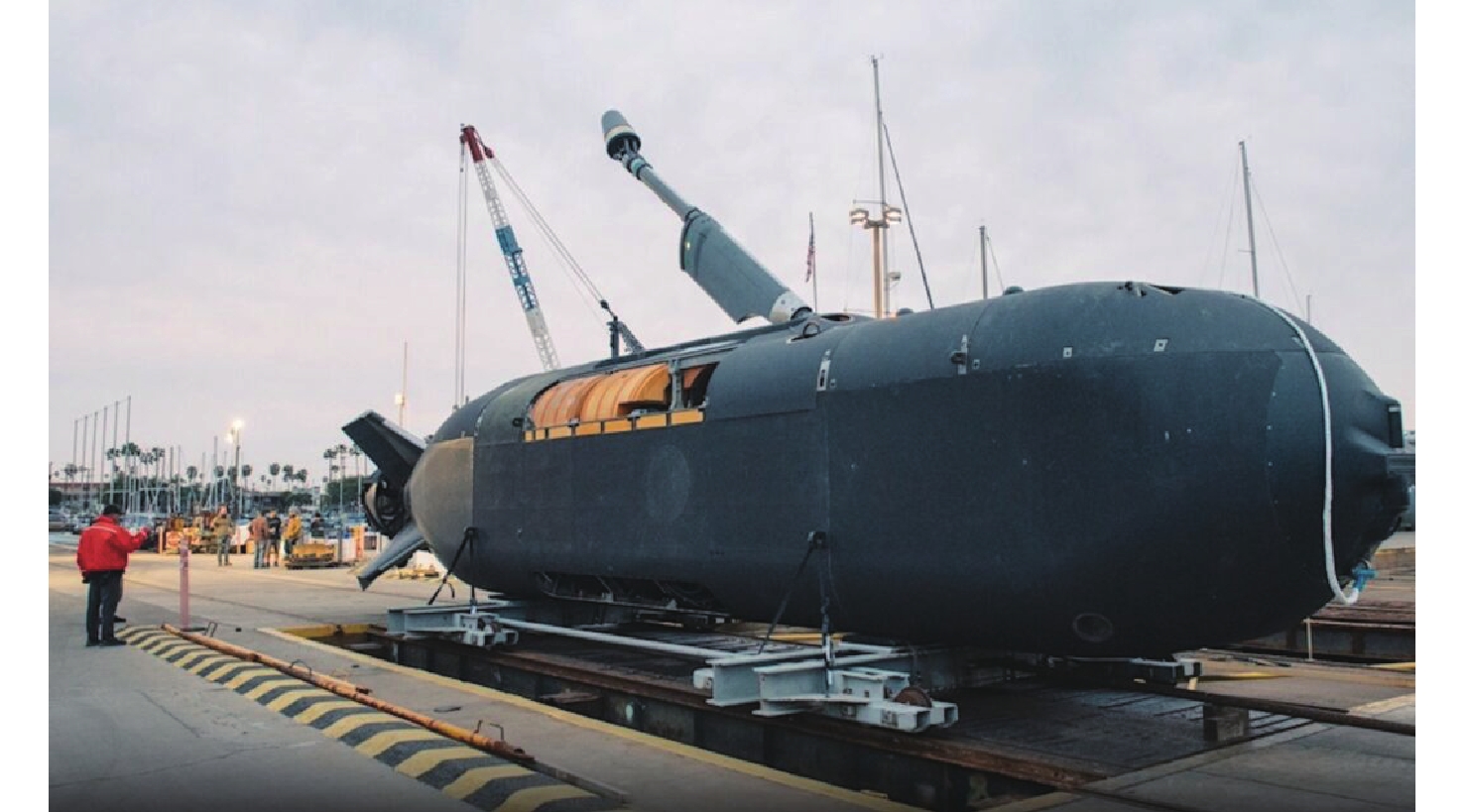


Research on Operational Effectiveness Evaluation of Underwater Vehicles Based on Bayesian Optimized BP Neural Network
-
摘要: 针对水下航行器作战效能评估的问题, 构建了包含9项核心指标与6项非线性交互指标的潜航器侦察作战效能评估指标体系; 传统BP神经网络在评估作战效能时易陷入局部最优, 因此采用贝叶斯优化(BO)对BP神经网络进行超参数寻优, 构建基于BO-BP神经网络的潜航器作战效能评估模型, 并利用Python实现了模型的仿真验证。仿真计算结果表明: 本文所构建的作战效能评估指标体系与工程化适配方案, 能够更准确反映潜航器真实作战效能, 可为潜航器装备论证、作战部署与改装升级提供了更具实战价值的参考, 相较于通用化评估方案, 在场景贴合度、评估精准度与工程实用价值上均有明显提升。Abstract: Aiming at the problem of operational effectiveness evaluation of underwater vehicles, an evaluation indicator system for reconnaissance operational effectiveness of underwater vehicles has been established, consisting of 9 core indicators and 6 nonlinear interaction indicators. Traditional BP neural networks are prone to fall into local optima in operational effectiveness evaluation. Therefore, Bayesian Optimization (BO) is used to optimize the hyperparameters of the BP neural network, and an operational effectiveness evaluation model of underwater vehicles based on the BO-BP neural network is established. The simulation verification of the model is realized by Python.The operational effectiveness evaluation indicator system and engineering-oriented adaptation scheme constructed in this paper can more accurately reflect the actual operational effectiveness of underwater vehicles, and provide practically valuable references for their equipment demonstration, operational deployment, modification and upgrading. Compared with generalized evaluation schemes, the proposed approach exhibits significant improvements in scenario adaptability, evaluation accuracy and engineering practical value.
-
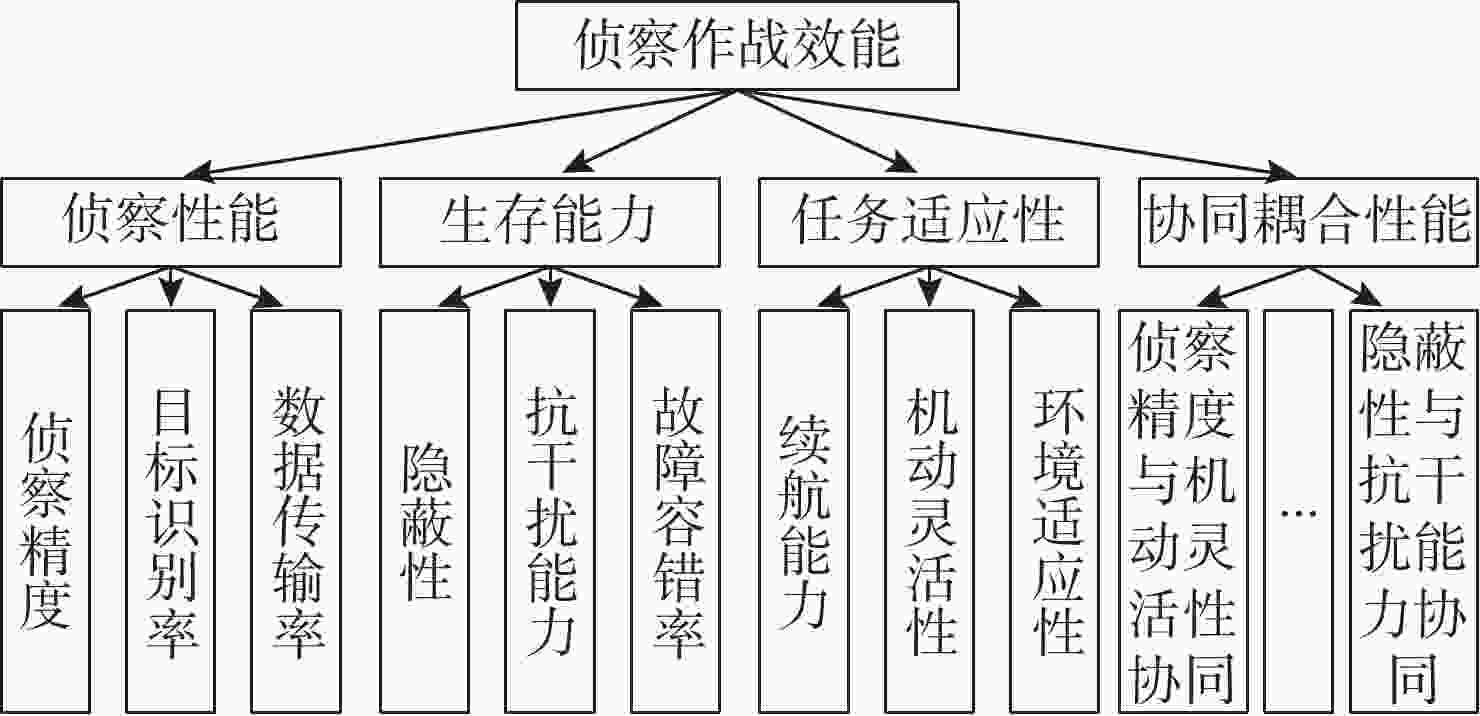
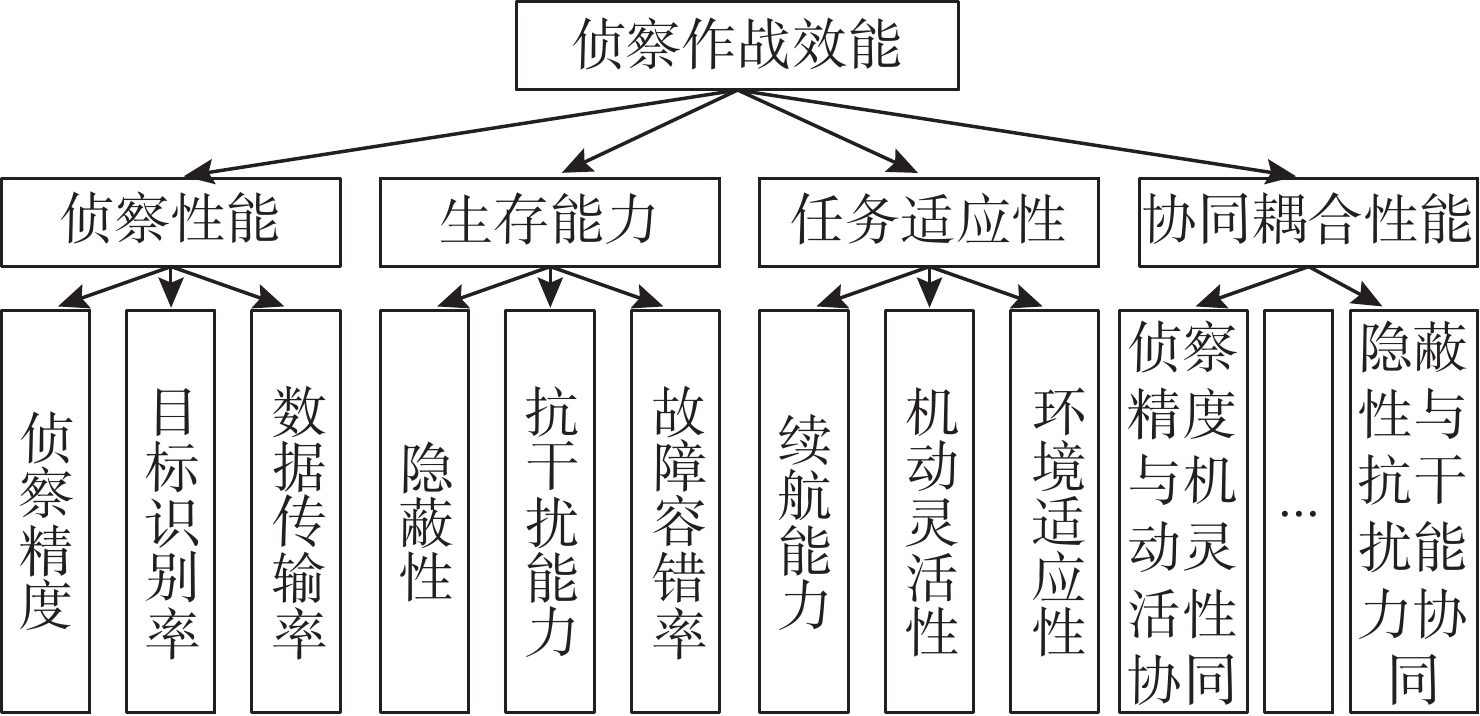
图 2 水下航行器侦察作战效能评估体系
Figure 2. Underwater Vehicle Reconnaissance Operational Effectiveness Evaluation System
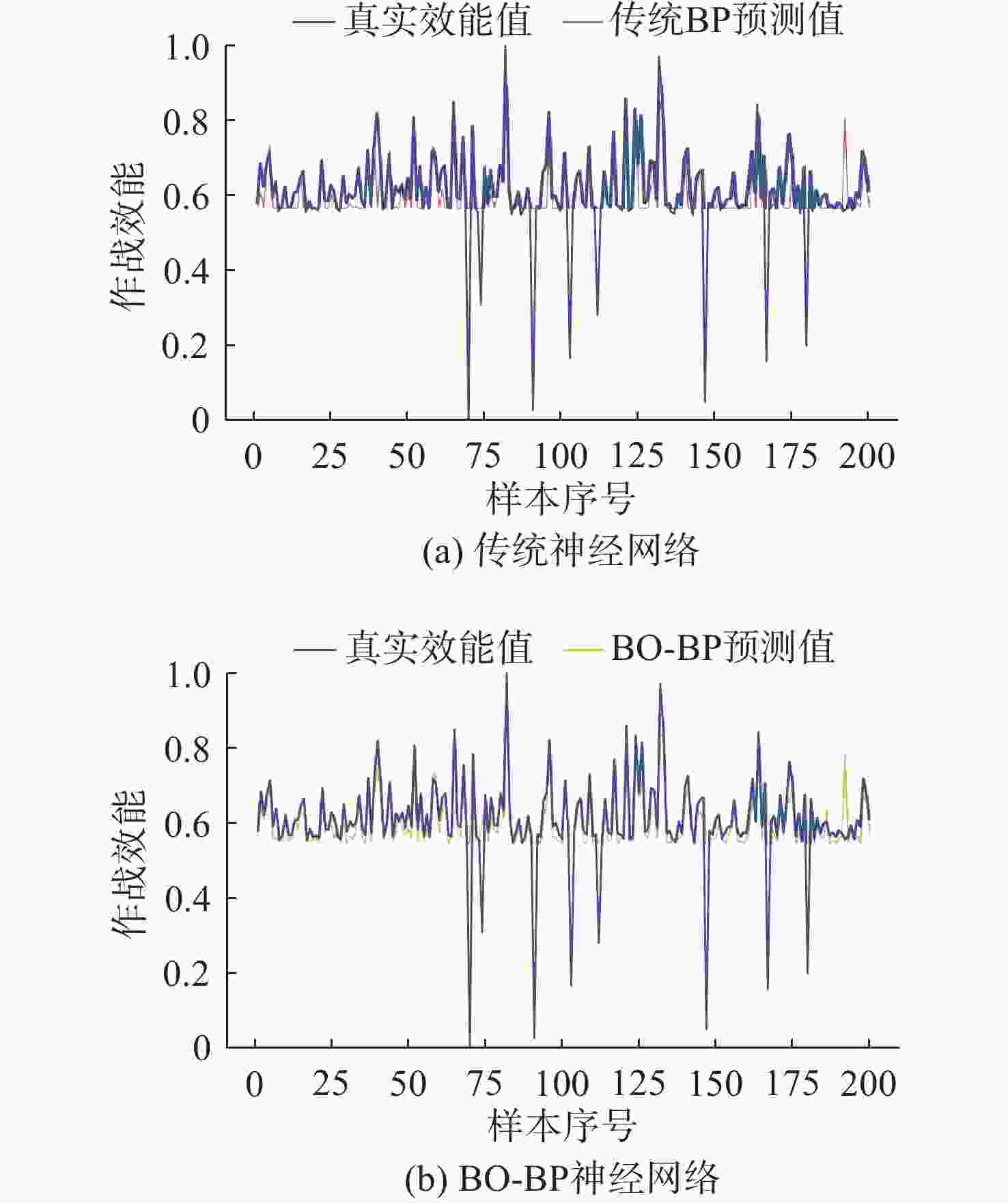
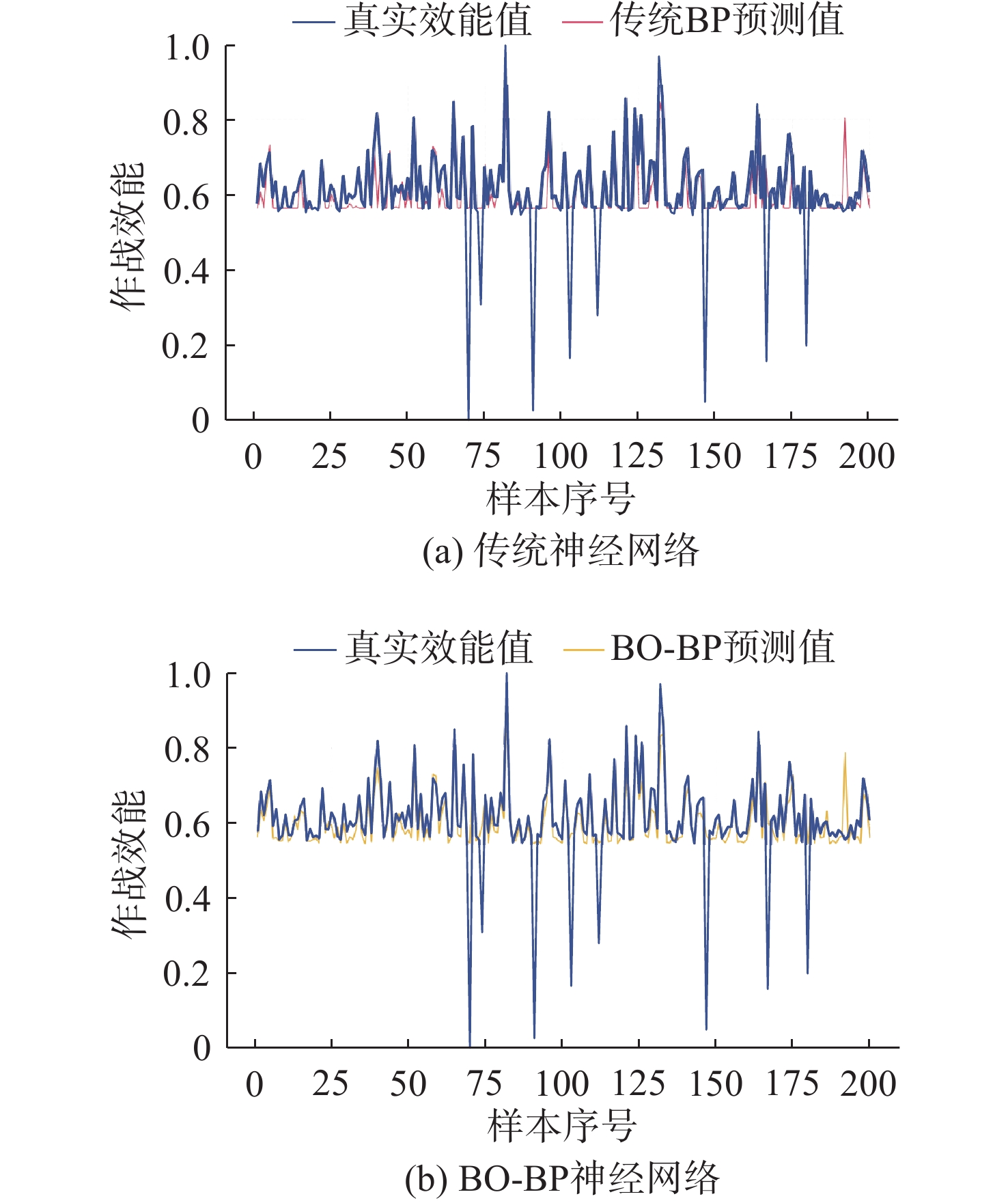
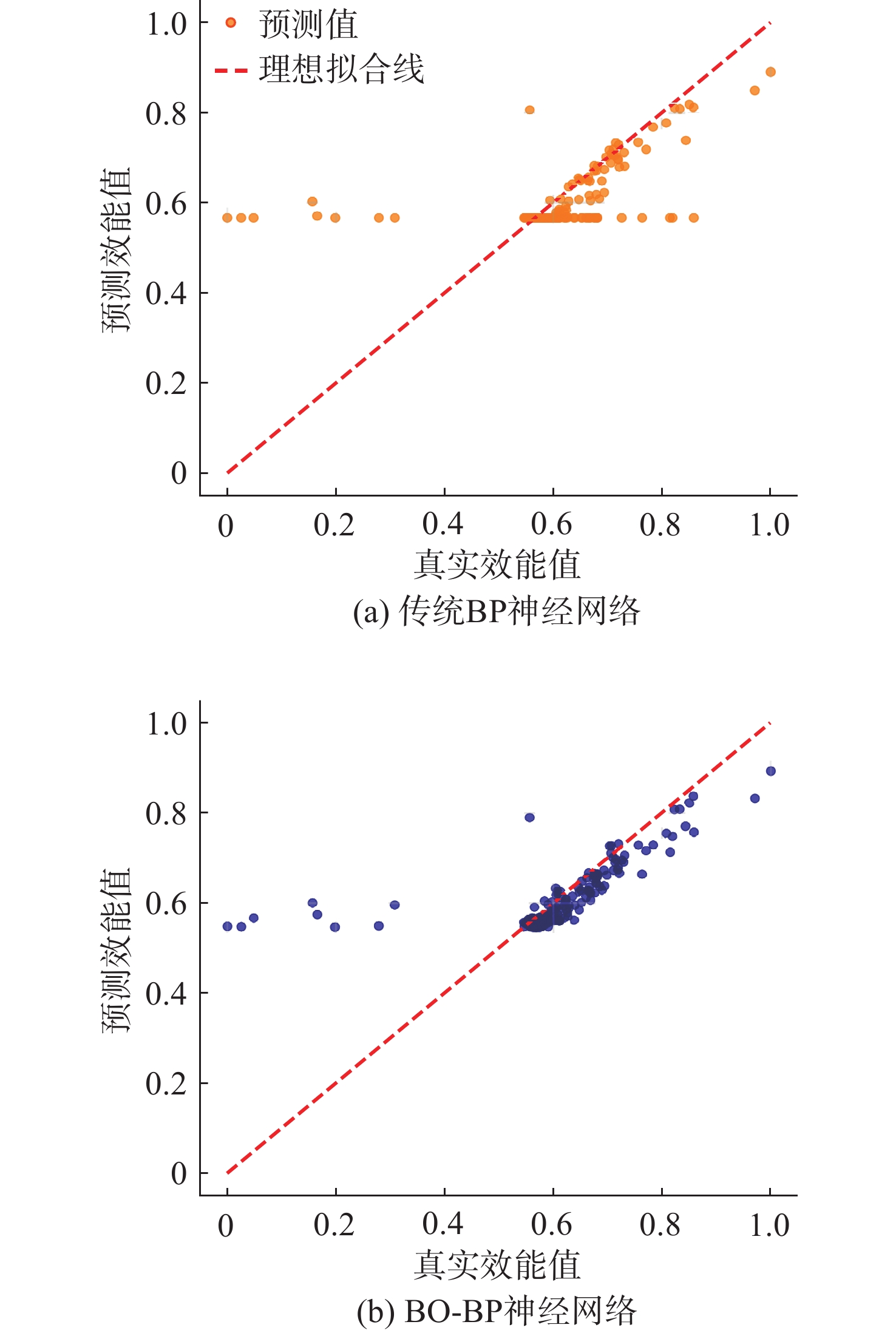
图 5 传统BP神经网络与BO-BP神经网络预测效果图
Figure 5. Prediction Effect Diagram of Traditional BP Neural Network and BO-BP Neural Networkd
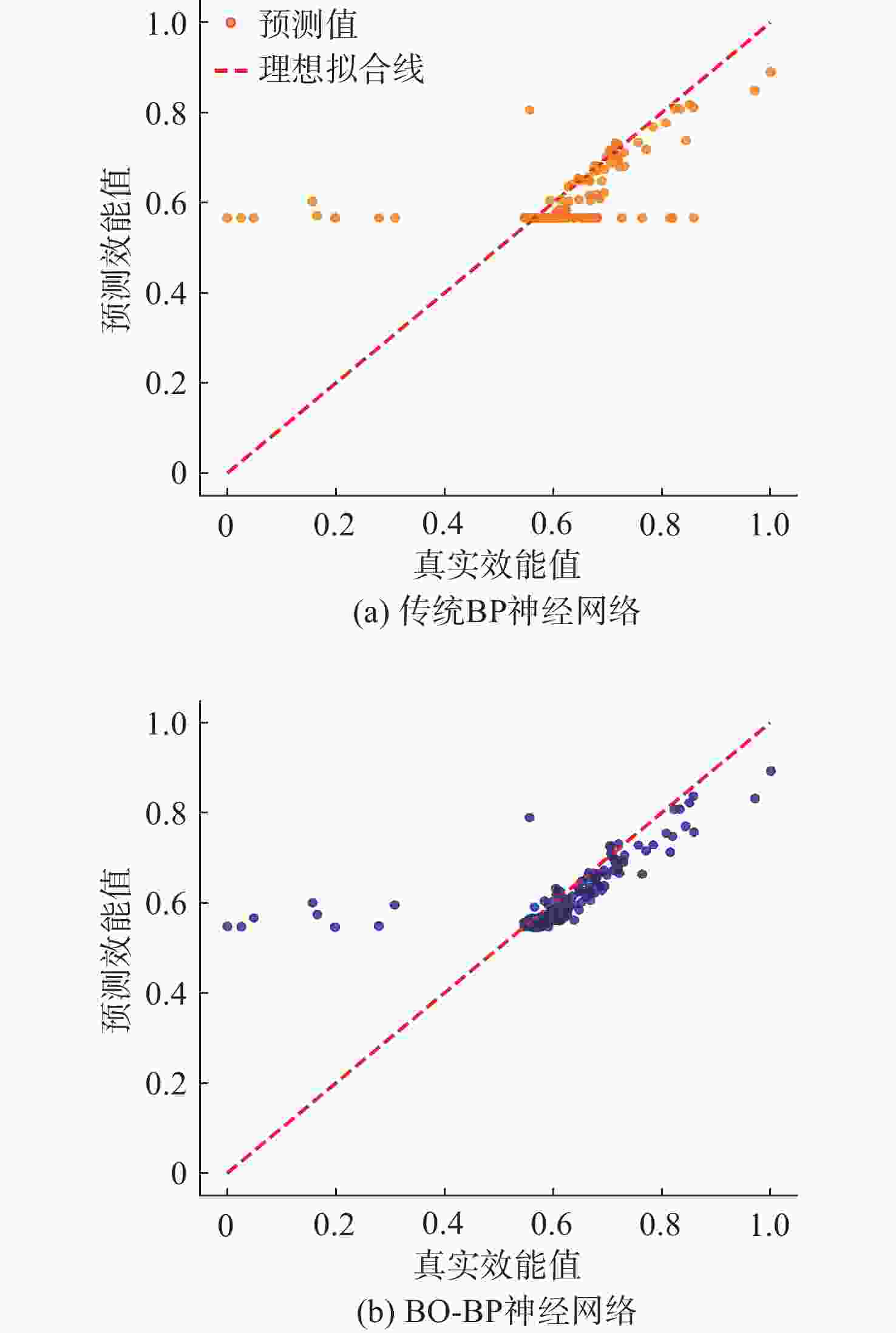
图 6 传统BP神经网络与BO-BP神经网络评估精度对比图
Figure 6. Evaluation Accuracy Comparison Chart of Traditional BP Neural Network and BO-BP Neural Network
表 1 6项交互指标释义
Table 1. Definitions of Six Interaction Metrics
交互指标 计算公式 设计机理 $ {I}_{1} $ $ {I}_{1}={X}_{1}\cdot \ln ({X}_{2}+1) $ 刻画X1与X2的正向协同效应, 引入对数变换修正X2的边际贡献, 当X2处于低水平时, 小幅提升即可显著改善侦察效能; 当X2达到高阈值后, 继续提升的实战增益逐步饱和。 I2 $ {I}_{2}=\sqrt{{X}_{4}}\cdot {X}_{5} $ 刻画X4与X5的正向协同效应, X4是水下航行器生存的基础, 隐蔽性较差时平台易被探测锁定, X5无发挥场景; X4达到一定水平后, X5可有效抵御复杂水声干扰, 重点保障探测感知与通信链路稳定, 避免态势信息失真、侦察数据传输异常, 侧重反映X5对侦察作战效能的保障作用, 同时依托X4构建良好战场环境, 提升整体任务可靠性。 I3 $ {I}_{3}={X}_{7}\cdot {X}_{8}{}^{2} $ 刻画X7与X8的正向协同效应, X7决定水下航行器的任务覆盖范围与滞空时间, 为机动执行提供基础保障; X8可高效提升侦察、识别、威胁规避水平, 具备非线性增益特征, 通过平方项体现对效能的放大作用。 I4 $ {I}_{4}={X}_{3}\cdot (1-{X}_{9}) $ 刻画X9与X3的制约关系, 环境劣化带来的侦察精度、机动性能衰减为平台固有能力下降, 无法通过传输手段改善; X3主要用于弥补恶劣环境下的通信短板, (1—X9)用来量化恶劣海况下传输能力的兜底保障价值。 I5 $ {I}_{5}={X}_{2}\cdot {X}_{6} $ 刻画X2与X6的耦合关系, 二者分别提供核心侦察信息, 保障装备稳定运行, 共同支撑作战决策的稳定性。 I6 $ {I}_{6}={X}_{1}\cdot {X}_{8} $ 刻画X1与X8的协同增益, 体现机动优化侦察路径、实现精准探测的效能规律。二者耦合易受战场环境干扰, 依托含高斯噪声与异常值的仿真数据覆盖战场不确定性, 结合神经网络自主拟合复杂关联, 在保证模型可解释性的同时, 契合效能评估的精简性与工程应用要求。  下载: 导出CSV
表 2 传统BP神经网络与BO-BP神经网络预测结果
Table 2. Prediction Results of Traditional BP Neural Network and BO-BP Neural Network
序号 真实值 传统BP预测值 BO-BP预测值 0 0.580 3 0.566 7 0.565 6 1 0.684 5 0.609 1 0.637 1 2 0.622 6 0.566 7 0.607 2 3 0.679 4 0.671 4 0.645 4 4 0.714 7 0.733 0 0.696 8 5 0.593 2 0.566 7 0.560 3 6 0.637 7 0.566 7 0.562 3 7 0.557 0 0.566 7 0.552 9 8 0.567 6 0.566 7 0.554 0 9 0.623 0 0.566 7 0.608 4 10 0.569 7 0.566 7 0.551 6 11 0.568 0 0.566 7 0.563 8 12 0.607 3 0.566 7 0.620 9 13 0.610 2 0.566 7 0.584 2 14 0.646 4 0.654 5 0.634 5
下载: 导出CSV
表 3 输入指标对作战效能影响排名
Table 3. Ranking of the Impact of Input Indicators on Operational Effectiveness
排名 输入指标 重要性占比/% 指标类型 1 X4 12.30 核心指标 2 I3 10.31 交互指标 3 I4 9.97 交互指标 4 I2 8.93 交互指标 5 X6 8.35 核心指标 6 I5 6.73 交互指标
下载: 导出CSV
-
[1] 张效天. 武器装备作战效能评估研究现状分析[J]. 科技与创新, 2024(11): 157-159,163. doi: 10.15913/j.cnki.kjycx.2024.11.048 [2] 邵明军, 刘树光, 严惊涛. 基于ADC-BP模型的对地攻击无人机自主作战效能评估[J]. 空军工程大学学报, 2023, 24(6): 112-119. doi: 10.3969/j.issn.2097-1915.2023.06.015Shao M J, Liu S G, Yan J T. Assessment of autonomous combat effectiveness of ground-attack UAV based on ADC-BP model[J]. Journal of Air Force Engineering University, 2023, 24(6): 112-119. doi: 10.3969/j.issn.2097-1915.2023.06.015 [3] 乔梁. 基于ADC模型的对地攻击机作战效能评估研究[J]. 舰船电子工程, 2023, 43(12): 175-181. doi: 10.3969/j.issn.1672-9730.2023.12.036Qiao L. Research on combat effectiveness evaluation of an attack aircraft based on ADC model[J]. Ship Electronic Engineering, 2023, 43(12): 175-181. doi: 10.3969/j.issn.1672-9730.2023.12.036 [4] 常会振, 秦大国, 孙盛智, 等. 基于ADC模型优化的海上无人机作战效能评估[J]. 兵器装备工程学报, 2023, 44(9): 58-68. doi: 10.11809/bqzbgcxb2023.09.008Chang H Z, Qin D G, Sun S Z, et al. Operational effectiveness evaluation of marine unmanned aerial vehicle based on ADC model optimization[J]. Journal of Ordnance Equipment Engineering, 2023, 44(9): 58-68. doi: 10.11809/bqzbgcxb2023.09.008 [5] 朱信尧, 宋保维, 毛昭勇. ADC模型的高空滑翔UUV作战效能分析[J]. 火力与指挥控制, 2012, 37(5): 40-43. doi: 10.3969/j.issn.1002-0640.2012.05.010Zhu X Y, Song B W, Mao S Y. An effectiveness analysis on high-altitude gliding UUV based on ADC[J]. Fire Control & Command Control, 2012, 37(5): 40-43. doi: 10.3969/j.issn.1002-0640.2012.05.010 [6] 张道成. 基于AHP的登陆作战效能评估研究[J]. 舰船电子工程, 2023, 43(10): 176-179. doi: 10.3969/j.issn.1672-9730.2023.10.037Zhang D C. Research on Operational Effectiveness Evaluation of Landing Operations Based on AHP[J]. Ship Electronic Engineering, 2023, 43(10): 176-179. doi: 10.3969/j.issn.1672-9730.2023.10.037 [7] 寇昆湖, 刘登攀, 钱峰, 等. 基于改进层次分析法的无人机作战效能评估方法研究[J]. 舰船电子工程, 2023, 43(2): 110-114. doi: 10.3969/j.issn.1672-9730.2023.02.023Kou K H, Liu D P, Qian F, et al. Research on Operational Effectiveness Evaluation of UAV Based on Improved Analytic Hierarchy Process[J]. Ship Electronic Engineering, 2023, 43(2): 110-114. doi: 10.3969/j.issn.1672-9730.2023.02.023 [8] 方勇. 基于ADC和AHP的UUV装备作战效能分析[J]. 兵工自动化, 2022, 41(10): 84-87. doi: 10.7690/bgzdh.2022.10.017Fang Y. Operational Effectiveness Analysis of UUV Equipment Based on ADC and AHP[J]. Ordnance Industry Automation, 2022, 41(10): 84-87. doi: 10.7690/bgzdh.2022.10.017 [9] 单正驰. 基于AHP和模糊层次分析法的无人机作战效能评估[J]. 舰船电子工程, 2024, 44(6): 128-132. doi: 10.3969/j.issn.1672-9730.2024.06.027Shan Z C. Evaluation of Unmanned Aerial Vehicle Combat Effectiveness Based on AHP and Fuzzy Analytic Hierarchy Process[J]. Ship Electronic Engineering, 2024, 44(6): 128-132. doi: 10.3969/j.issn.1672-9730.2024.06.027 [10] 何希盈, 黄凡, 朱璟, 等. 基于SEA法的水下无人航行器侦察效能评估[J]. 舰船电子工程, 2016, 36(12): 161-164. doi: 10.3969/j.issn.1672-9730.2016.12.036He X Y, Huang F, Zhu J, et al. Reconnaissance Efficiency of Unmanned Underwater Vehicle Based on SEA[J]. Ship Electronic Engineering, 2016, 36(12): 161-164. doi: 10.3969/j.issn.1672-9730.2016.12.036 [11] 寇昆湖, 刘登攀, 王超, 等. 基于BP神经网络的无人机对海侦察作战效能评估[J]. 舰船电子工程, 2024, 44(12): 145-148. doi: 10.3969/j.issn.1672-9730.2024.12.030Kou K H, Liu D P, Wang C, et al. Evaluation of the Operational Effectiveness of UAV in Sea Reconnaissance Based on BP Neural Network[J]. Ship Electronic Engineering, 2024, 44(12): 145-148. doi: 10.3969/j.issn.1672-9730.2024.12.030 [12] 王晓军, 黄沛, 唐彬鑫. 基于GA-BP神经网络的无人防空装备作战效能评估[J]. 无人系统技术, 2022, 5(3): 106-113. doi: 10.19942/j.issn.2096-5915.2022.3.032Wang X J, Huang P, Tang B X. Operational Effectiveness Evaluation of Unmanned Air Defense Equipment Based on GA-BP Neural Network[J]. Unmanned Systems Technology, 2022, 5(3): 106-113. doi: 10.19942/j.issn.2096-5915.2022.3.032 [13] 陈侠, 胡乃宽. 基于APSO-BP神经网络的无人机空地作战效能评估研究[J]. 飞行力学, 2018, 36(1): 88-92.Chen X, Hu N K. Research on effectiveness evaluation of UAV air-to-ground attack based on APSO-BP neural network[J]. Flight Dynamics, 2018, 36(1): 88-92. [14] 张效天, 彭文成, 刘瑞. 某无人机系统作战效能评估研究[J]. 火力与指挥控制, 2024, 49(5): 152-157. doi: 10.3969/j.issn.1002-0640.2024.05.021Zhang X T, Peng W C, Liu R. Research on the evaluation of the combat effectiveness of a certain UAV system[J]. Fire Control & Command Control, 2024, 49(5): 152-157. doi: 10.3969/j.issn.1002-0640.2024.05.021 [15] 朱国, 薛蕾蕾, 杜毅. 军用无人潜航器作战效能评估模型[J]. 舰船电子工程, 2016, 36(6): 69-71. doi: 10.3969/j.issn.1672-9730.2016.06.019Zhu G, Xue L L, Du Y. Operational effectiveness assessment model of military unmanned underwater vehicle[J]. Ship Electronic Engineering, 2016, 36(6): 69-71. doi: 10.3969/j.issn.1672-9730.2016.06.019 [16] 隋先辉, 韦定江, 王晗秋, 等. 基于DoDAF的无人潜航器作战效能静态评估研究[J]. 舰船电子工程, 2023, 43(4): 121-125, 135. doi: 10.3969/j.issn.1672-9730.2023.04.026Sui X H, Wei D J, Wang H Q, et al. Research on cooperative combat effectiveness evaluation of unmanned underwater vehicle based on DoDAF[J]. Ship Electronic Engineering, 2023, 43(4): 121-125, 135. doi: 10.3969/j.issn.1672-9730.2023.04.026 [17] 邹启明, 宋书龙, 彭远鸣, 等. 攻击型UUV效能评估系统设计[J]. 水下无人系统学报, 2022, 30(5): 671-676. doi: 10.11993/j.issn.2096-3920.202109019Zou Q M, Song S L, Peng Y M, et al. Designing an effective evaluation system for attacking UUVs[J]. Journal of Unmanned Undersea Systems, 2022, 30(5): 671-676. doi: 10.11993/j.issn.2096-3920.202109019 [18] 刘钰婷. 以作战仿真评估UUV集群作战效能[J]. 数字海洋与水下攻防, 2022, 5(4): 374-380. doi: 10.19838/j.issn.2096-5753.2022.04.014Liu Y T. Evaluation of UUV cluster combat effectiveness based on combat simulation[J]. Digital Ocean&Underwater Warfare, 2022, 5(4): 374-380. doi: 10.19838/j.issn.2096-5753.2022.04.014 [19] 曹方方, 刘卫东, 李娟丽. 基于水下网络的多UUV协同作战效能评估[J]. 计算机测量与控制, 2011, 19(6): 1397-1399, 1402. doi: 10.16526/j.cnki.11-4762/tp.2011.06.017Cao F F, Liu W D, Li J L. Efficiency evaluation of multi-UUVs coordinated operation based on underwater network[J]. Computer Measurement & Control, 2011, 19(6): 1397-1399, 1402. doi: 10.16526/j.cnki.11-4762/tp.2011.06.017 -

 下载:
下载:

 点击查看大图
计量
- 文章访问数: 106
- HTML全文浏览量: 50
- PDF下载量: 8
- 被引次数: 0