

Terminal Effectiveness Analysis of Undersea Vehicles Incorporating a Terminal Guidance Mechanism
-
摘要: 在水下精准高效终点作用技术发展背景下, 对机动目标的终点作用效能评估需要更为全面地考量制导、近场触发机构及终点作用单元等多分系统参数综合作用。文中提出了一种引入末制导机制的水下航行器终点作用效能评估方法。该方法通过回溯末制导机制, 并引入控制与导引2类误差模型, 对随机弹道进行蒙特卡洛抽样以获取近场触发点位置。选取3种典型制导律构建末弹道模型, 实现机动条件下的终点作用效能分析。算例分析表明, 相比于直接瞄准法, 滑模制导律跟踪交会机动目标的重度终点作用概率更高, 文中还以比例引导法跟踪交会蛇行目标为例, 分析了多项耦合参数对最终终点作用效能的影响, 结果表明, 为实现稳定高效的作用, 航行器需达2~3倍目标速度、1.5以上的导引系数, 较为理想的近场触发机构启动距离为2.5~4 m, 较为理想的延迟时间为0.4 s以下。文中方法综合考虑制导-近场触发机构-终点作用单元多分系统参数, 能够更准确全面地反映机动条件下参数对终点作用结果的影响, 可为相关装备的优化设计与运用提供参考。Abstract: terminal-effect technologies, the assessment of terminal effectiveness against maneuvering targets requires more comprehensive consideration of the combined effects of multisubsystem parameters, including guidance, near-field triggering mechanisms, and terminal effect units. This paper proposes a terminal effectiveness assessment method for undersea vehicles that incorporates a terminal guidance mechanism. By backtracking the terminal guidance mechanism and introducing two types of error models, namely control error and guidance error models, Monte Carlo sampling is performed on random trajectories to obtain near-field trigger point positions. Three typical guidance laws are selected to construct terminal trajectory models, thereby enabling terminal effectiveness analysis under maneuvering conditions. Case studies show that, compared with the direct aiming method, the sliding mode guidance law yields a higher probability of severe terminal effects when tracking and encountering maneuvering targets. Taking the proportional navigation guidance method for tracking and encountering a weaving target as an example, the effects of multiple coupled parameters on final terminal effectiveness are further analyzed. The results indicate that, to achieve stable and efficient terminal effects, the vehicle must attain 2~3 times the target velocity and a guidance coefficient greater than 1.5; the desirable initiation distance of the near-field triggering mechanism is 2.5~4 m, and the desirable delay time is below 0.4 s. The proposed method comprehensively considers multisubsystem parameters of guidance, the near-field triggering mechanism, and the terminal effect unit, and can more accurately and comprehensively reflect the influence of parameters on terminal effectiveness results under maneuvering conditions, thereby providing a reference for the optimal design and operational use of relevant equipment.
-
Key words:
- undersea vehicle /
- terminal effectiveness analysis /
- terminal guidance
-
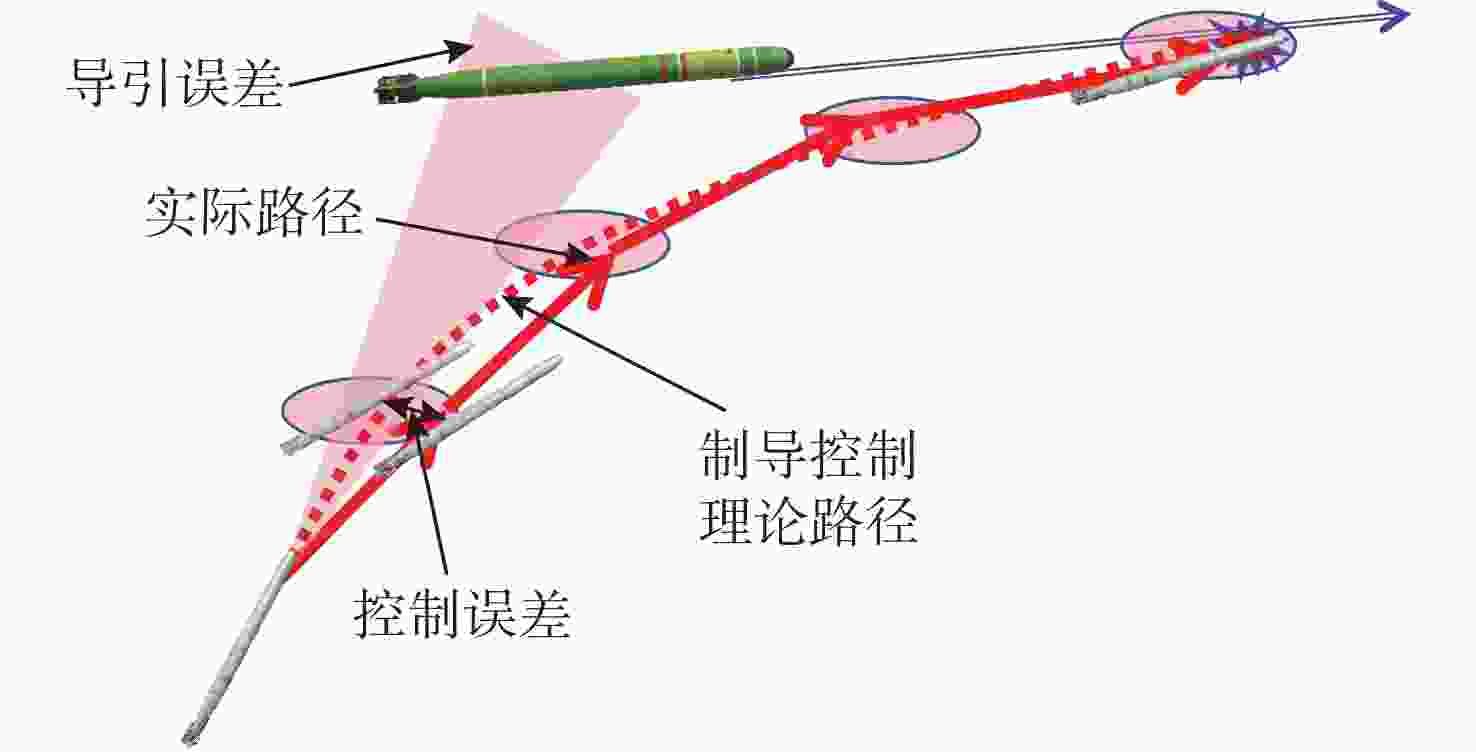
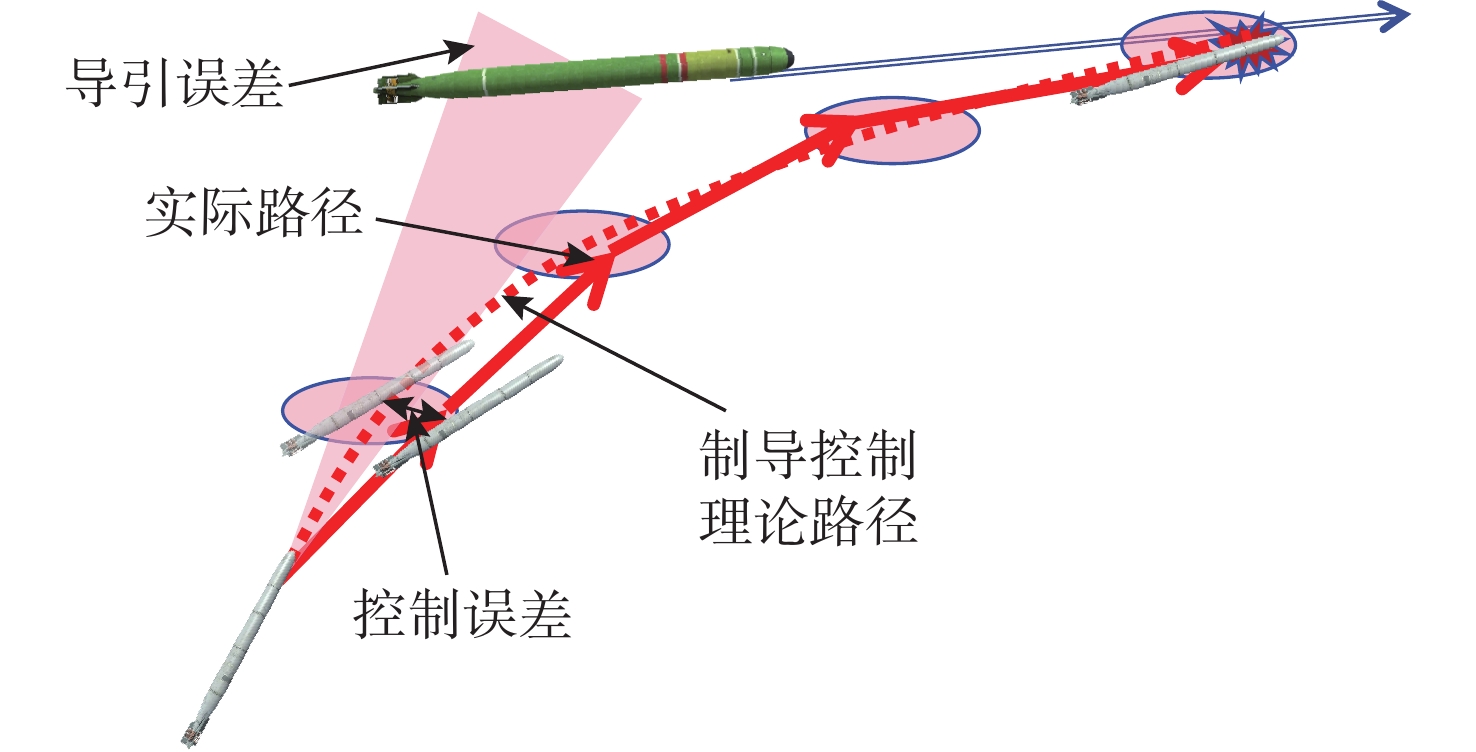
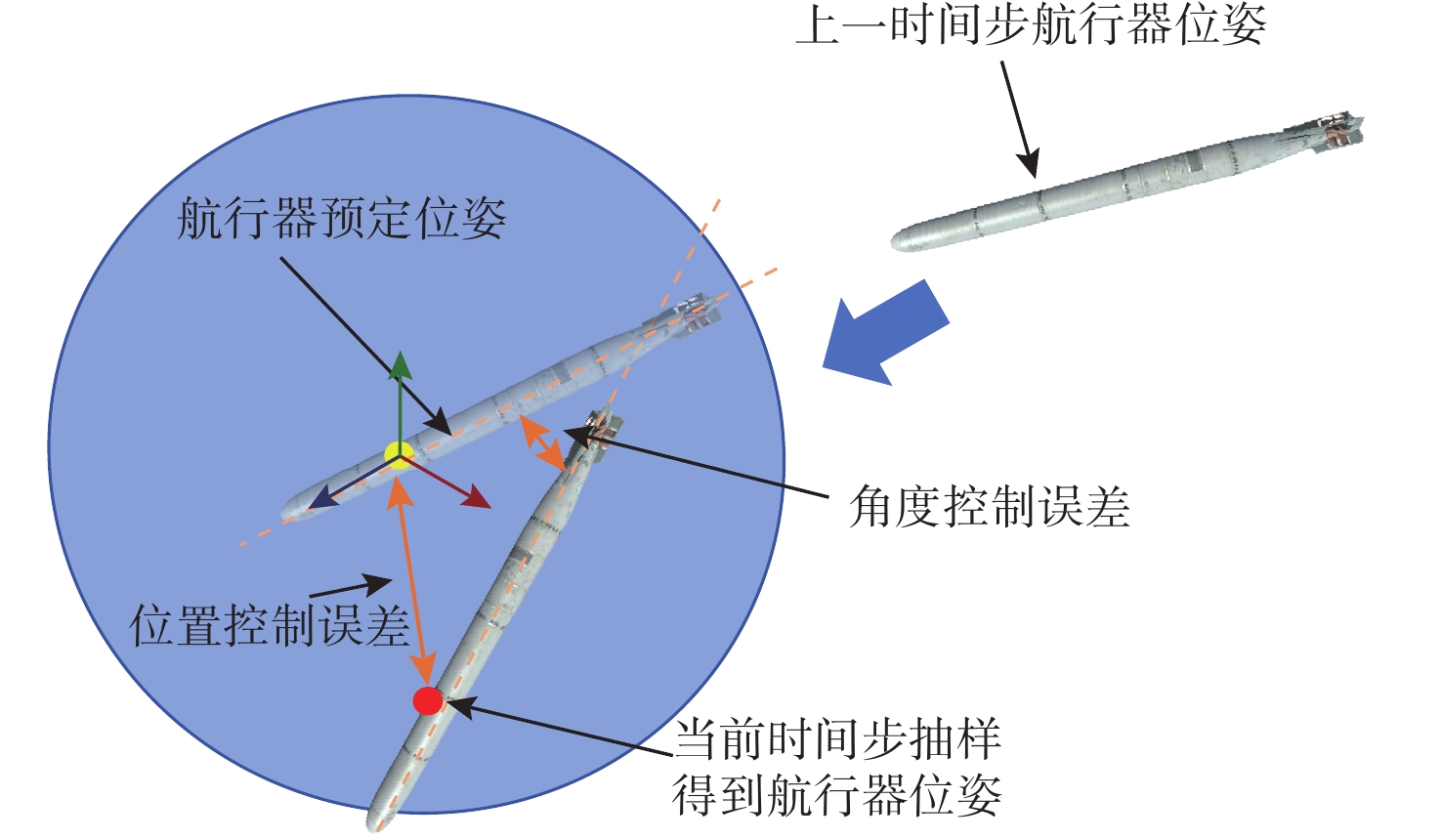
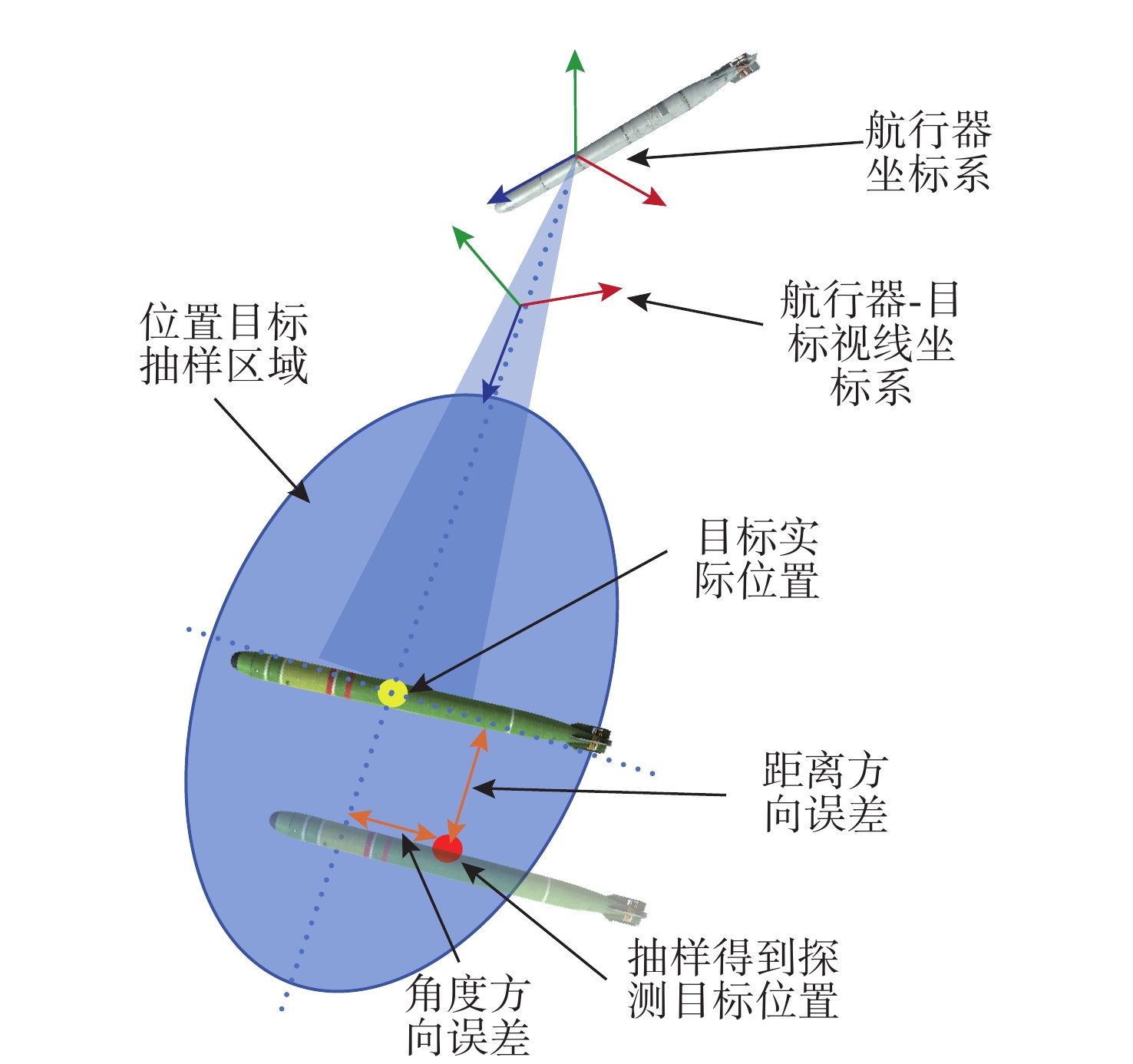
图 1 文中方法设计思想示意图
Figure 1. Schematic diagram of the design idea of the method in this paper
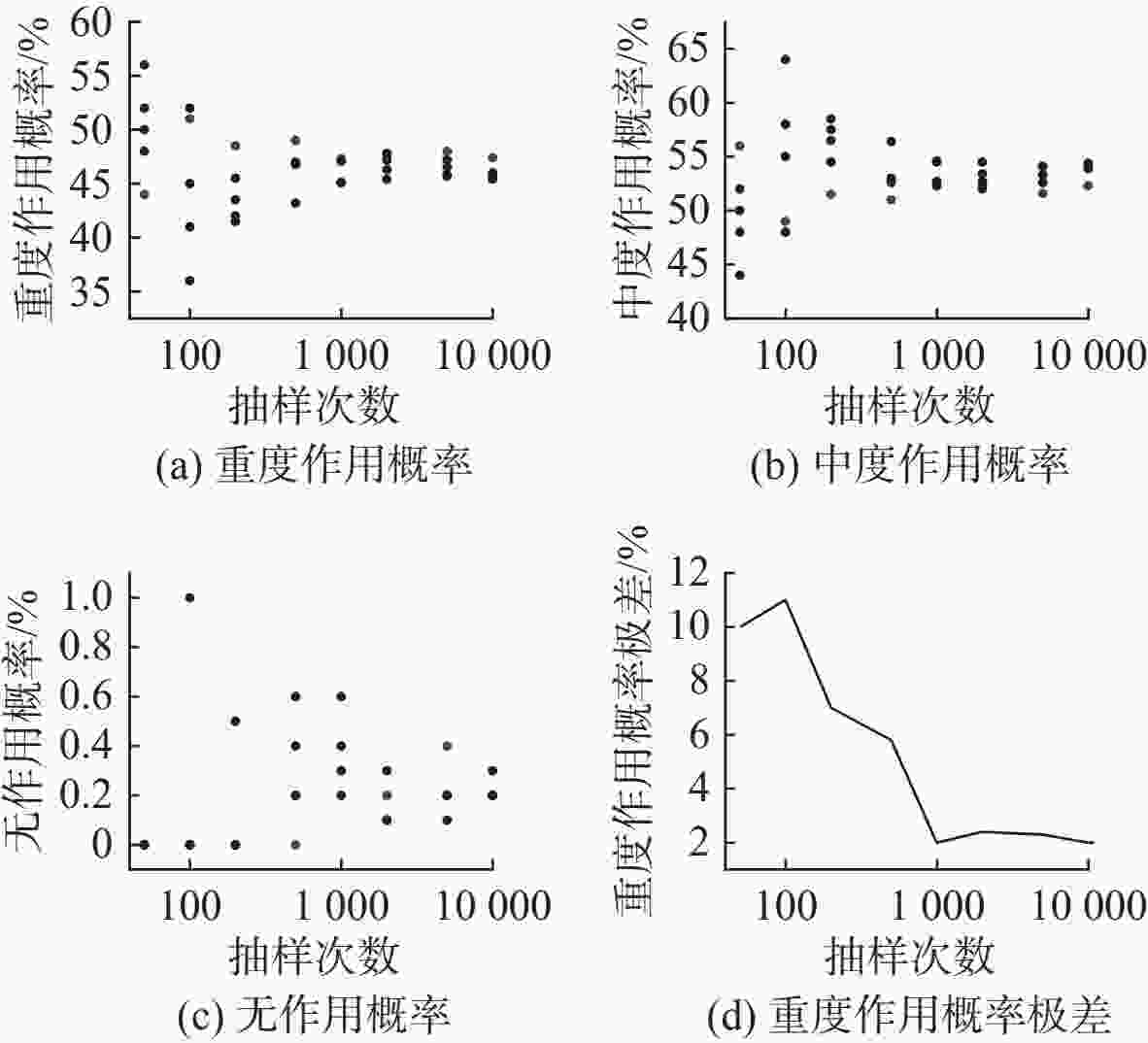
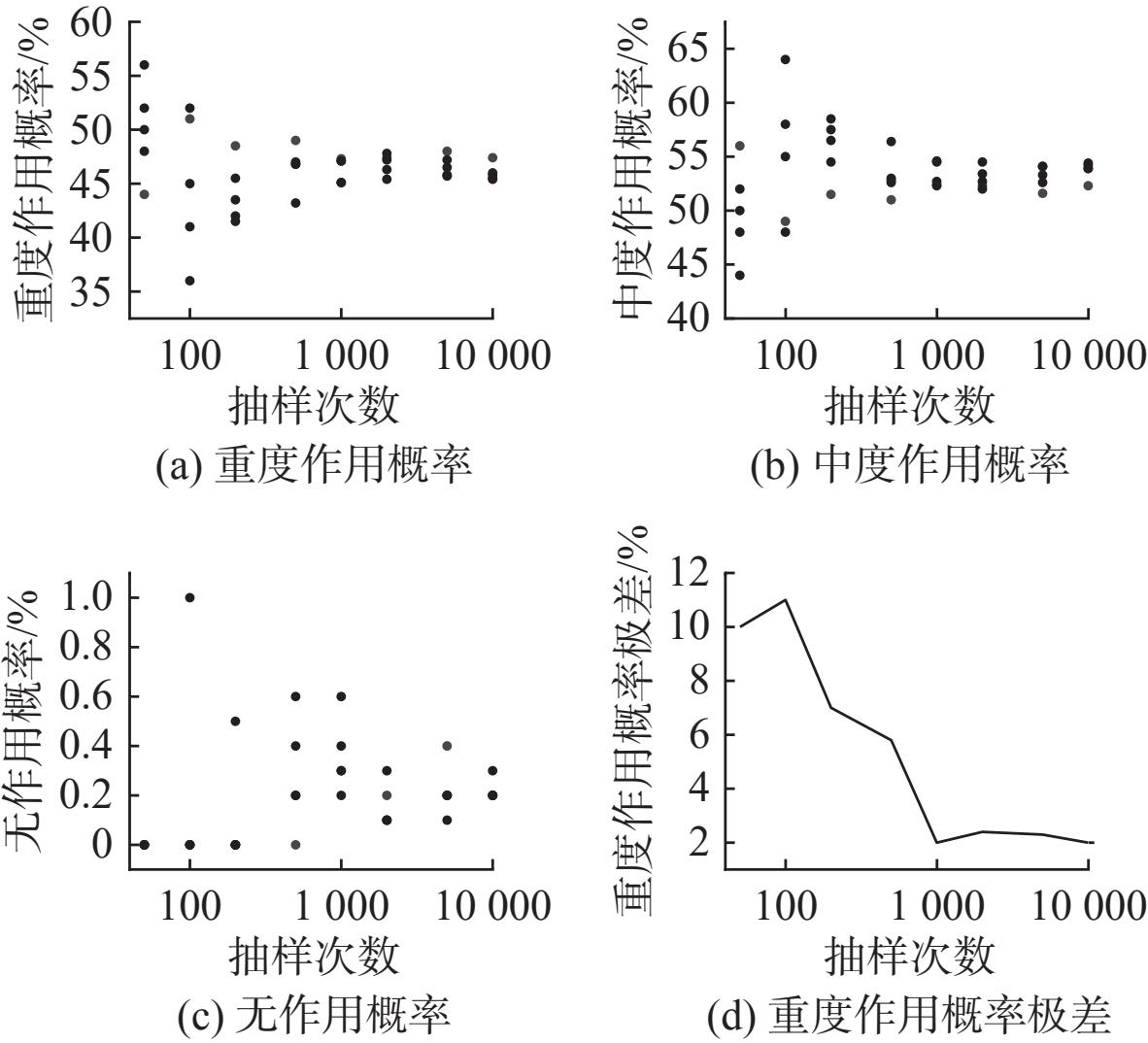
图 13 不同抽样次数下终点作用计算结果
Figure 13. Terminal effects computation results under different sampling counts
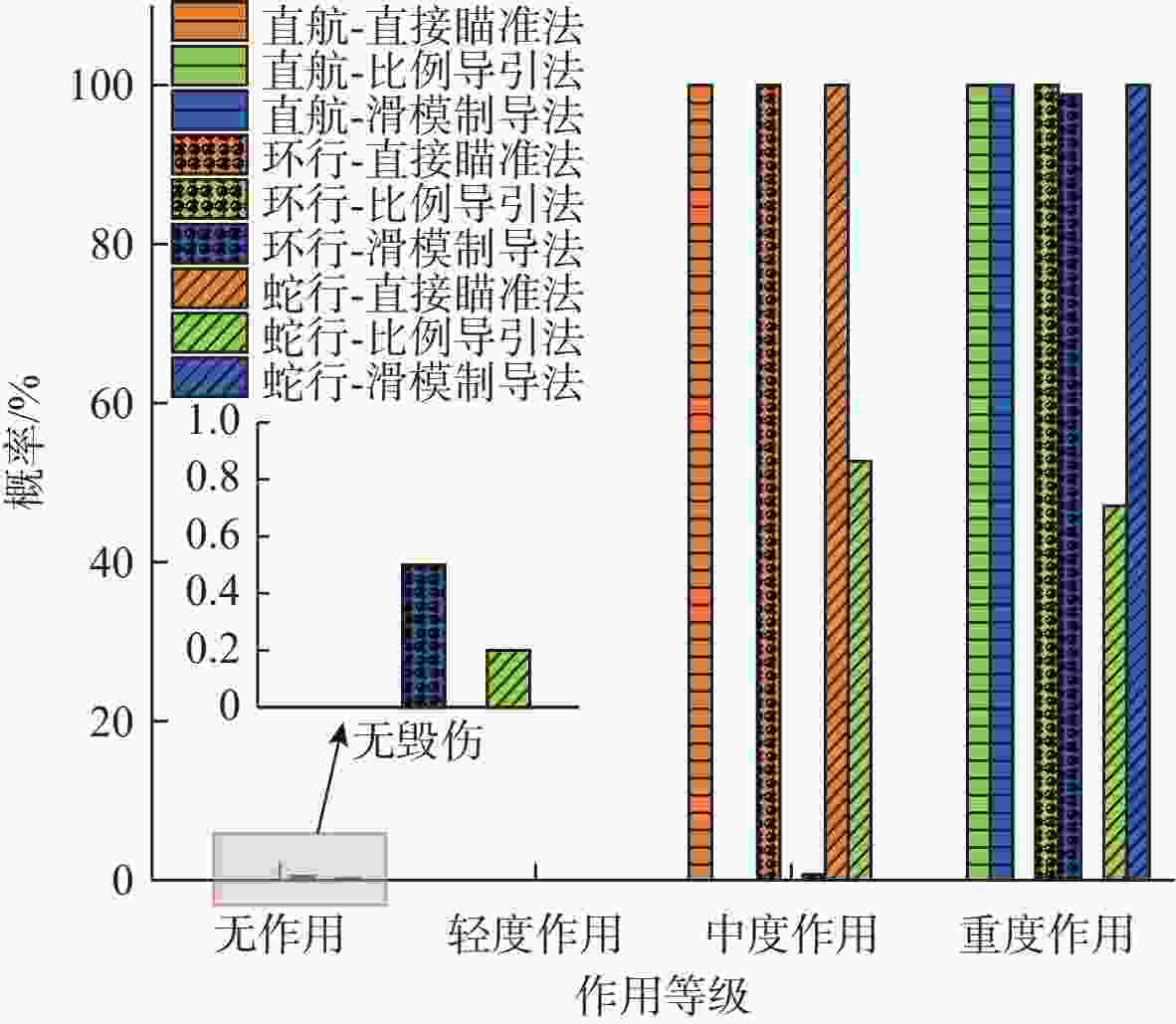
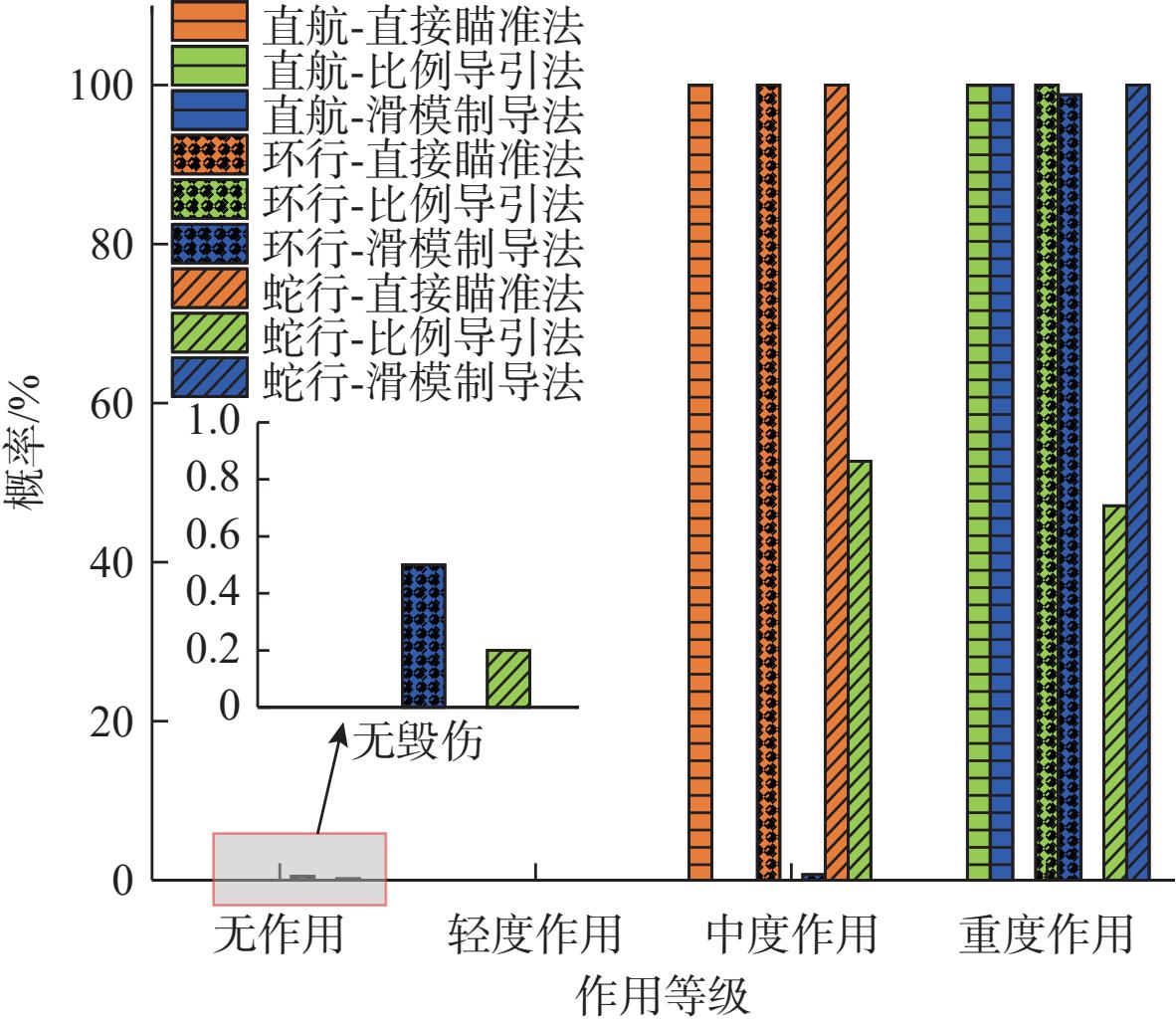
图 14 不同制导方法-机动方式组合下终点作用计算结果
Figure 14. Terminal effects computation results under different sampling counts
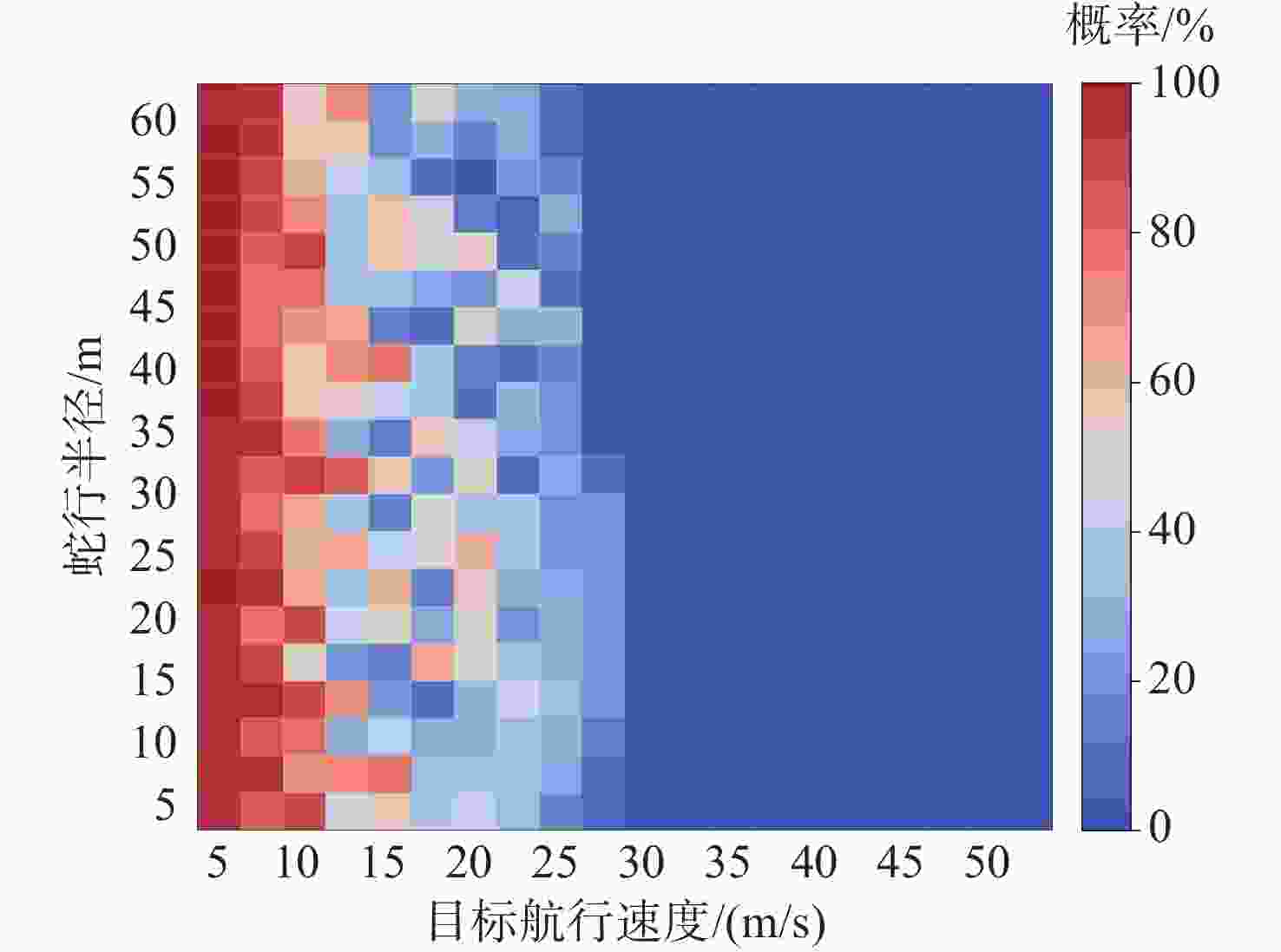
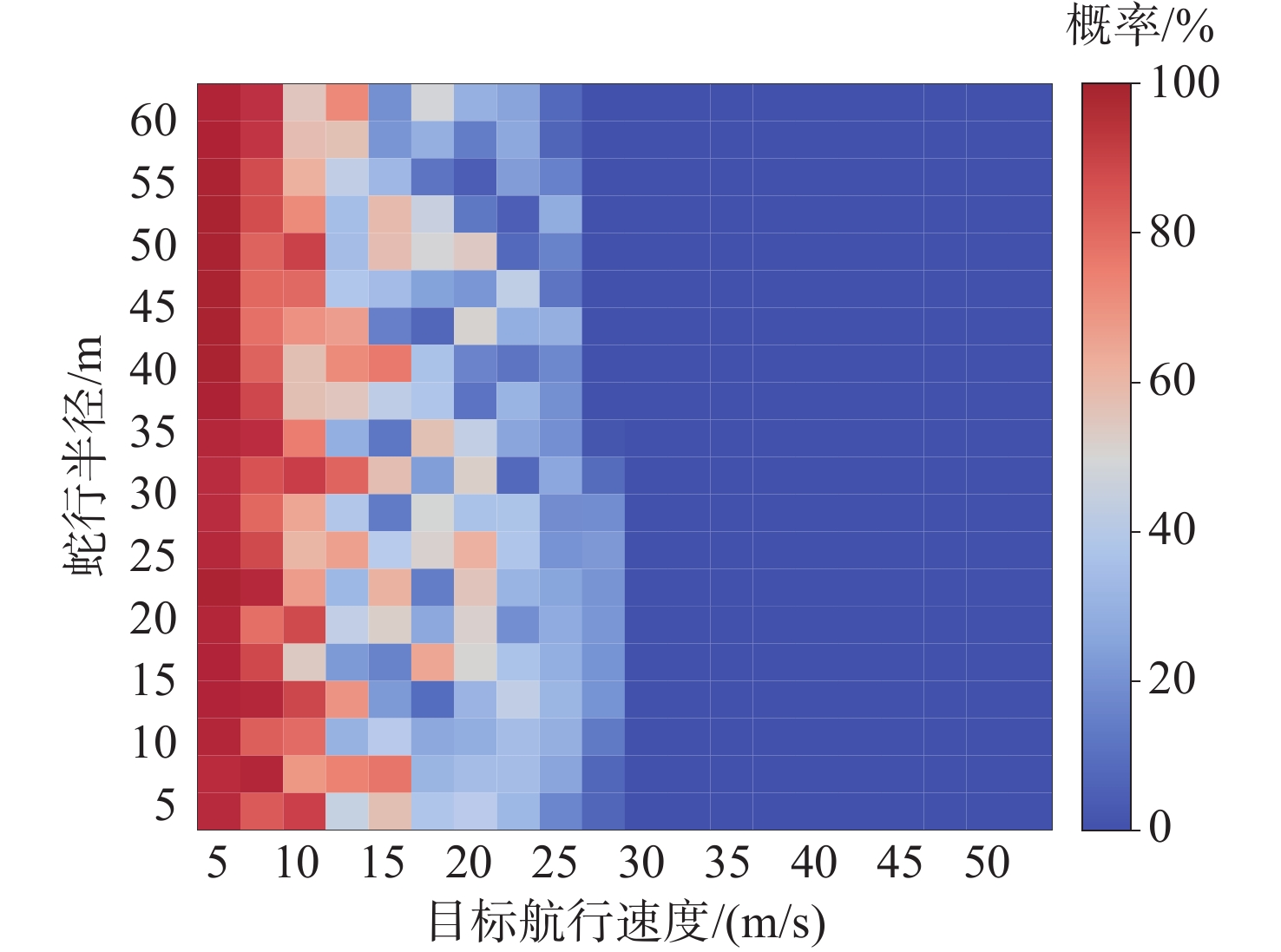
图 15 不同目标速度-蛇行半径下重度终点作用概率
Figure 15. Probability of severe terminal effects under different target velocities and weaving radii
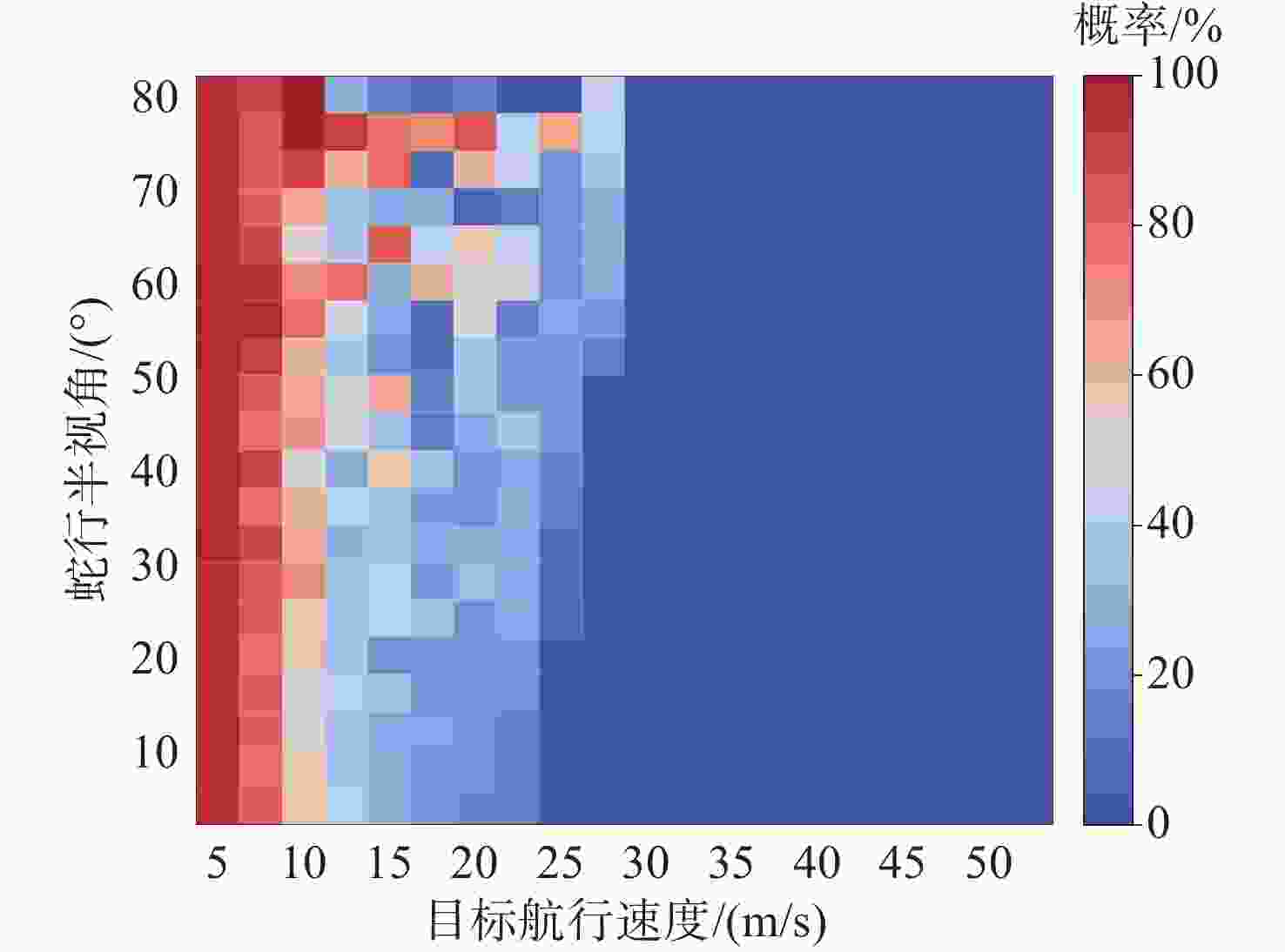
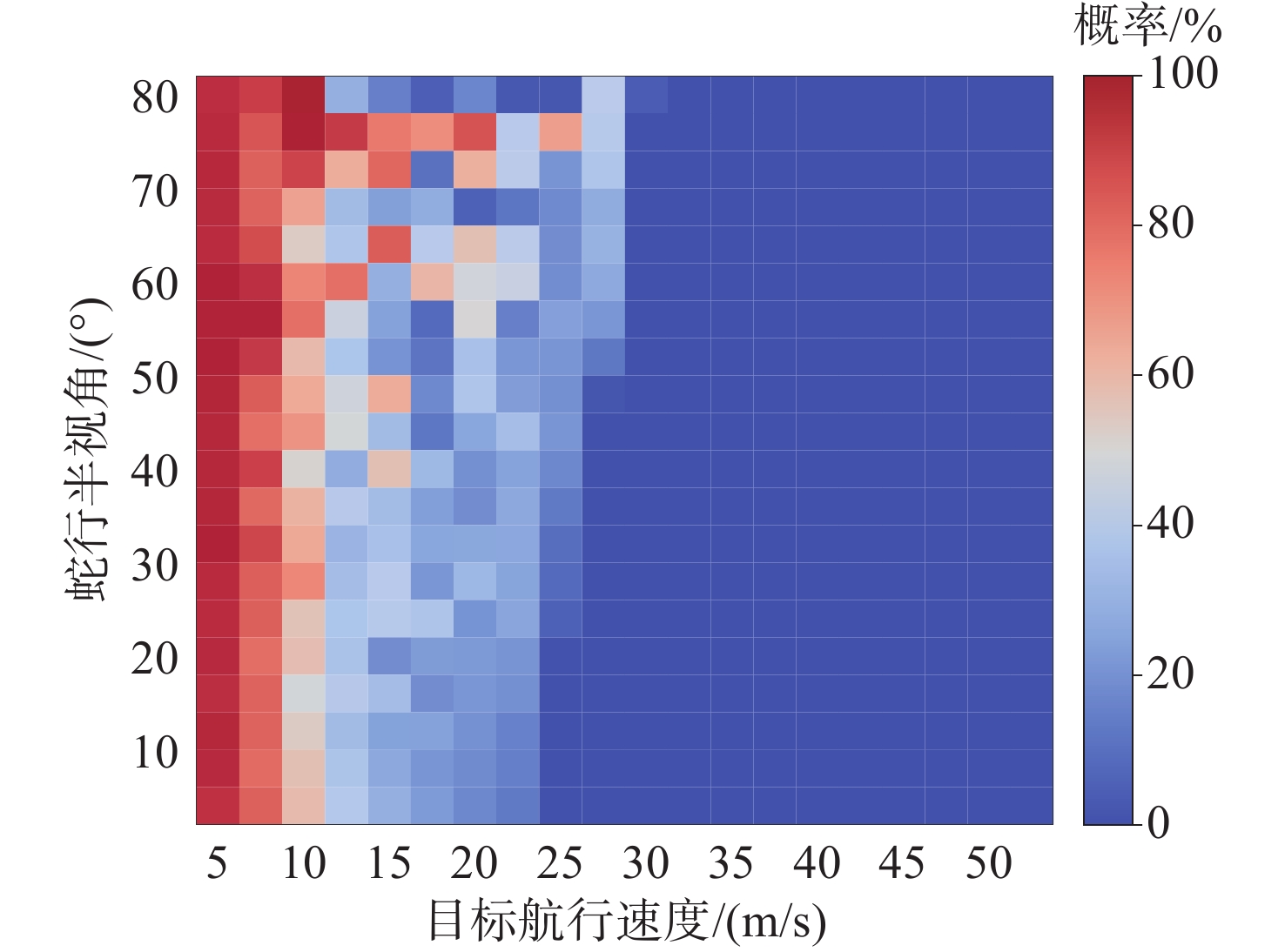
图 16 不同目标速度-蛇行半视角下重度终点作用概率
Figure 16. Probability of severe terminal effects under different target velocities and weaving half-angle
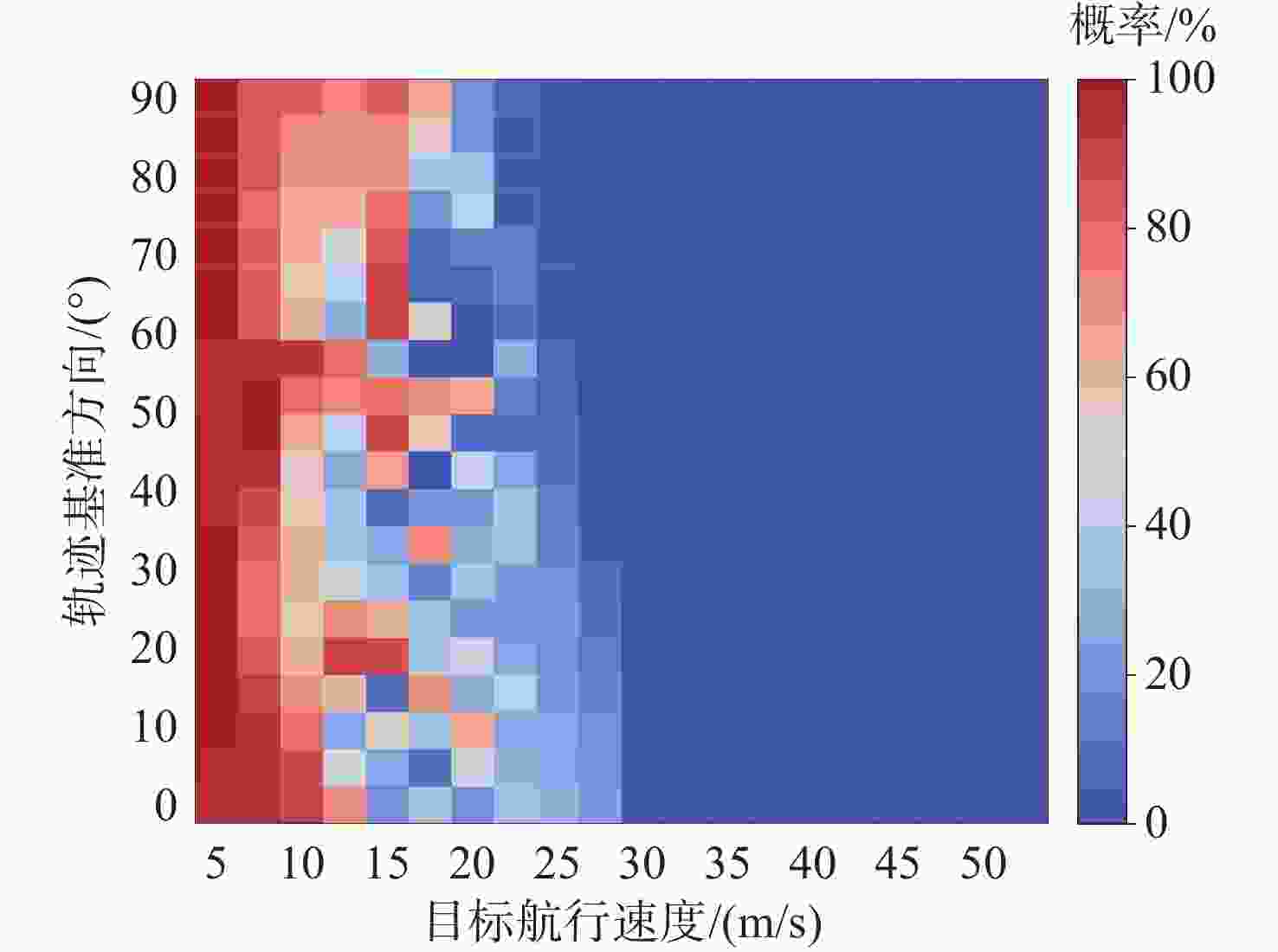
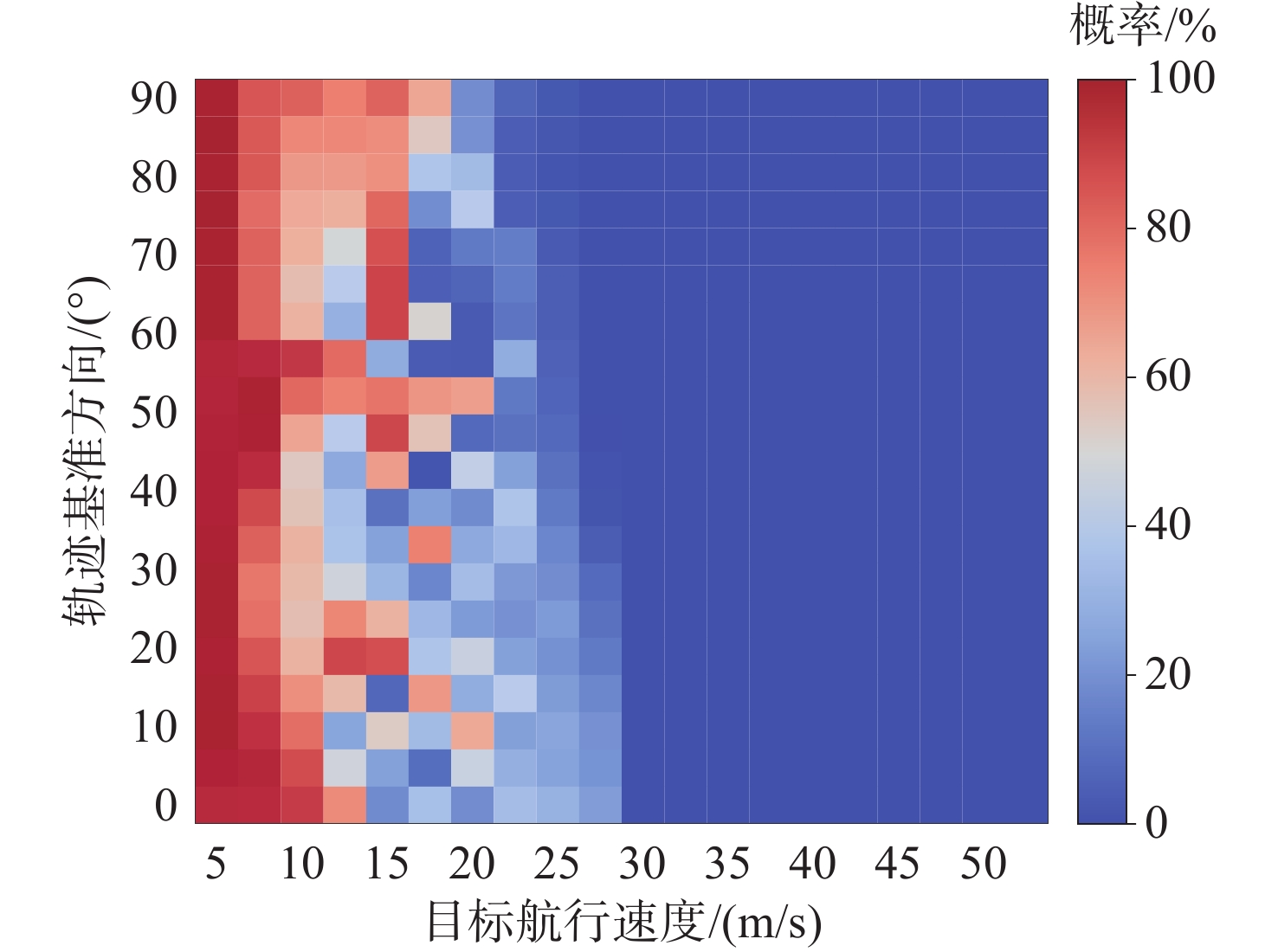
图 17 不同目标速度-轨迹基准方向下重度终点作用概率
Figure 17. Probability of severe terminal effects under different target velocities and reference trajectory directions
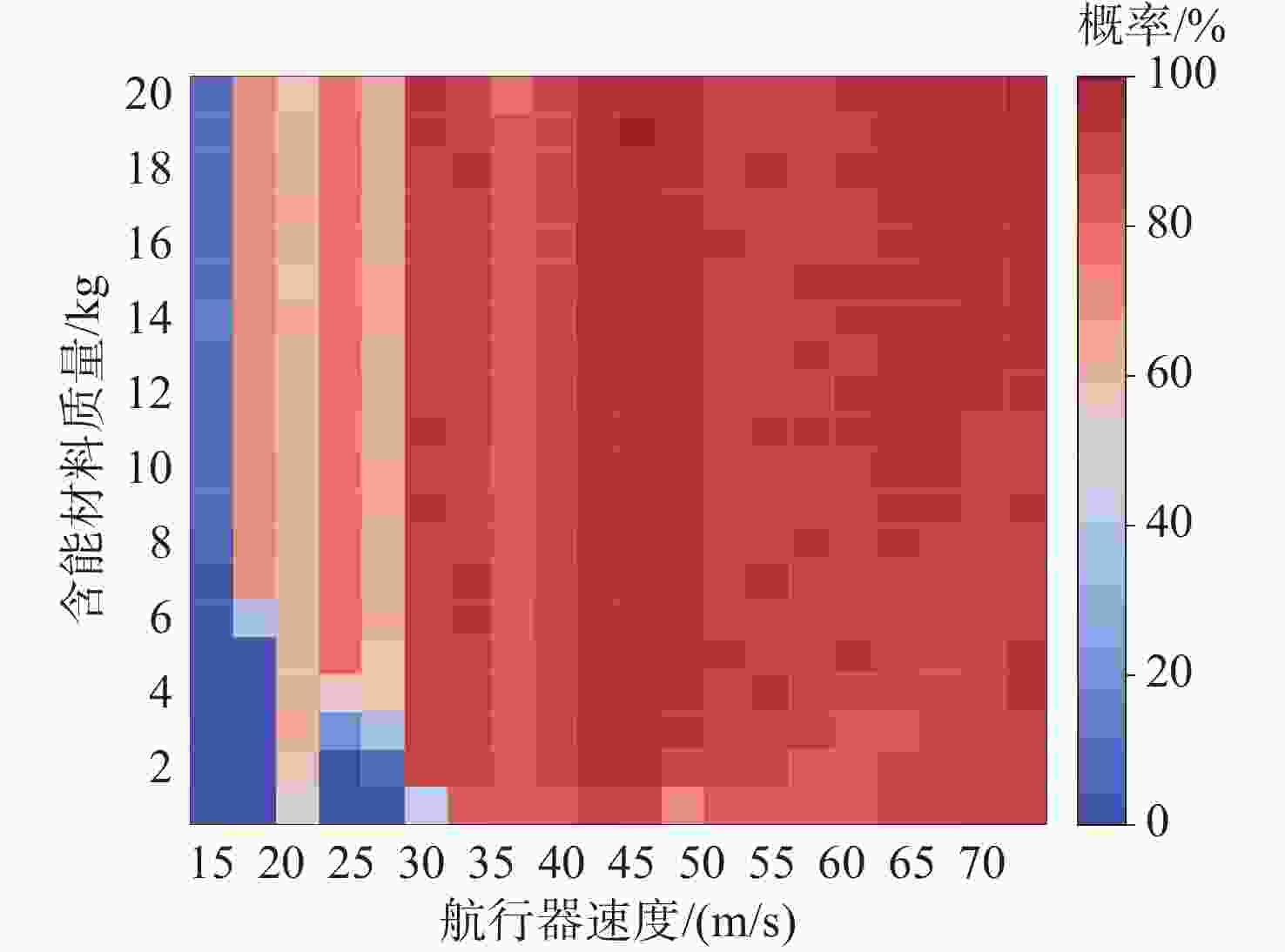
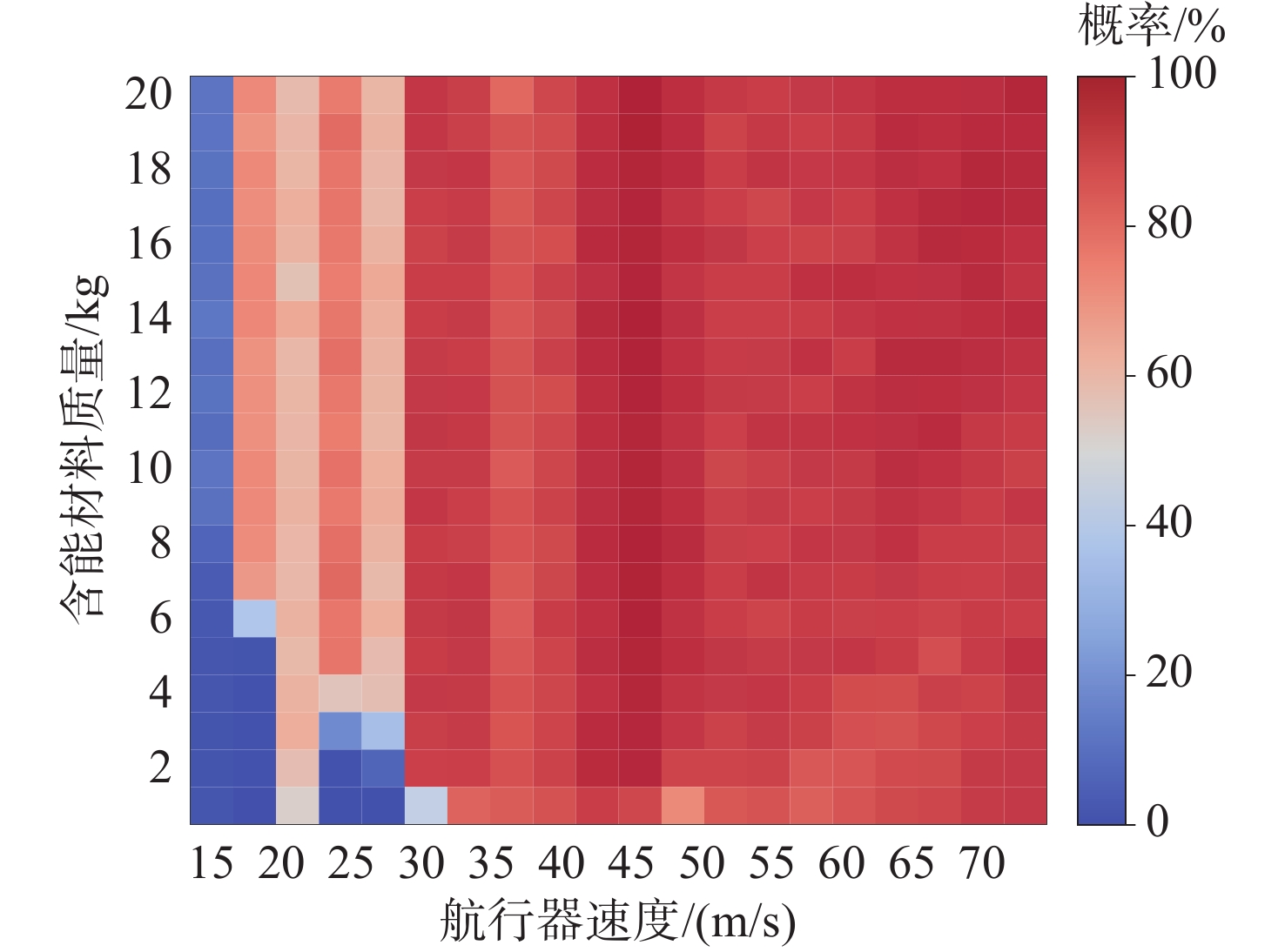
图 18 不同航行器速度-含能材料质量下重度终点作用概率
Figure 18. Probability of severe terminal effects under different combinations of vehicle speed and energetic material mass
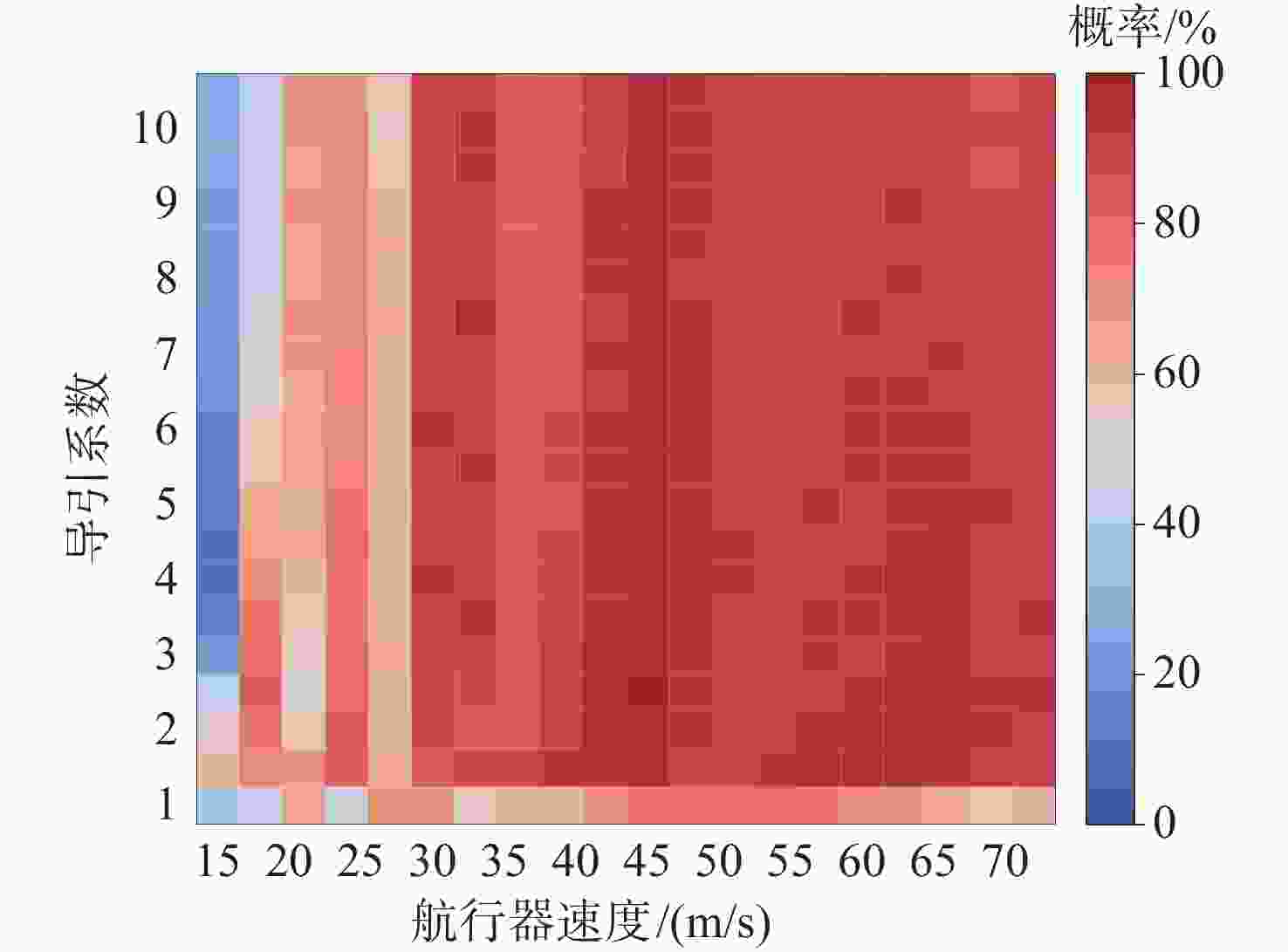
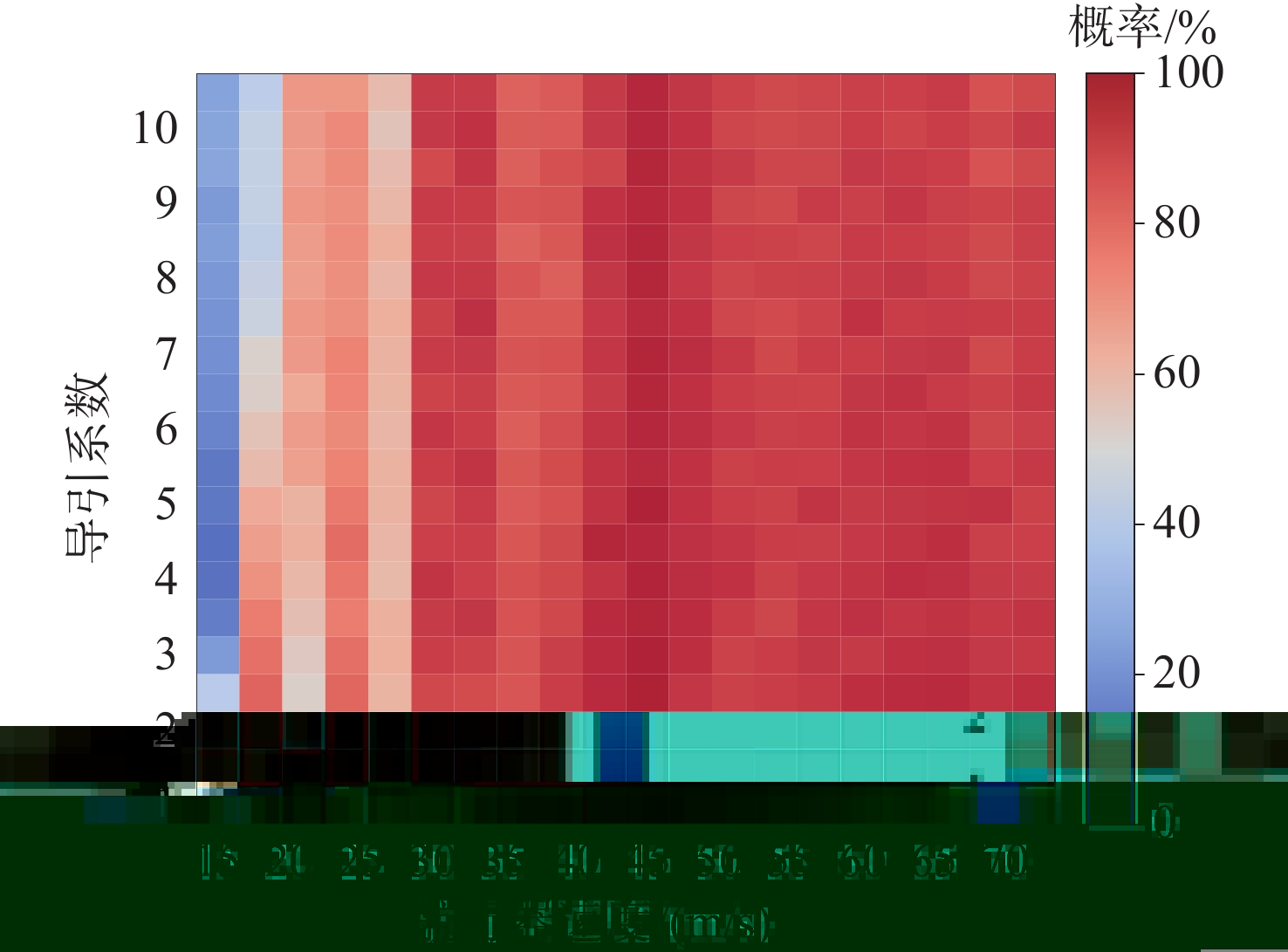
图 19 不同航行器速度-导引系数下重度终点作用概率
Figure 19. Probability of severe terminal effects under different vehicle velocities and guidance coefficients
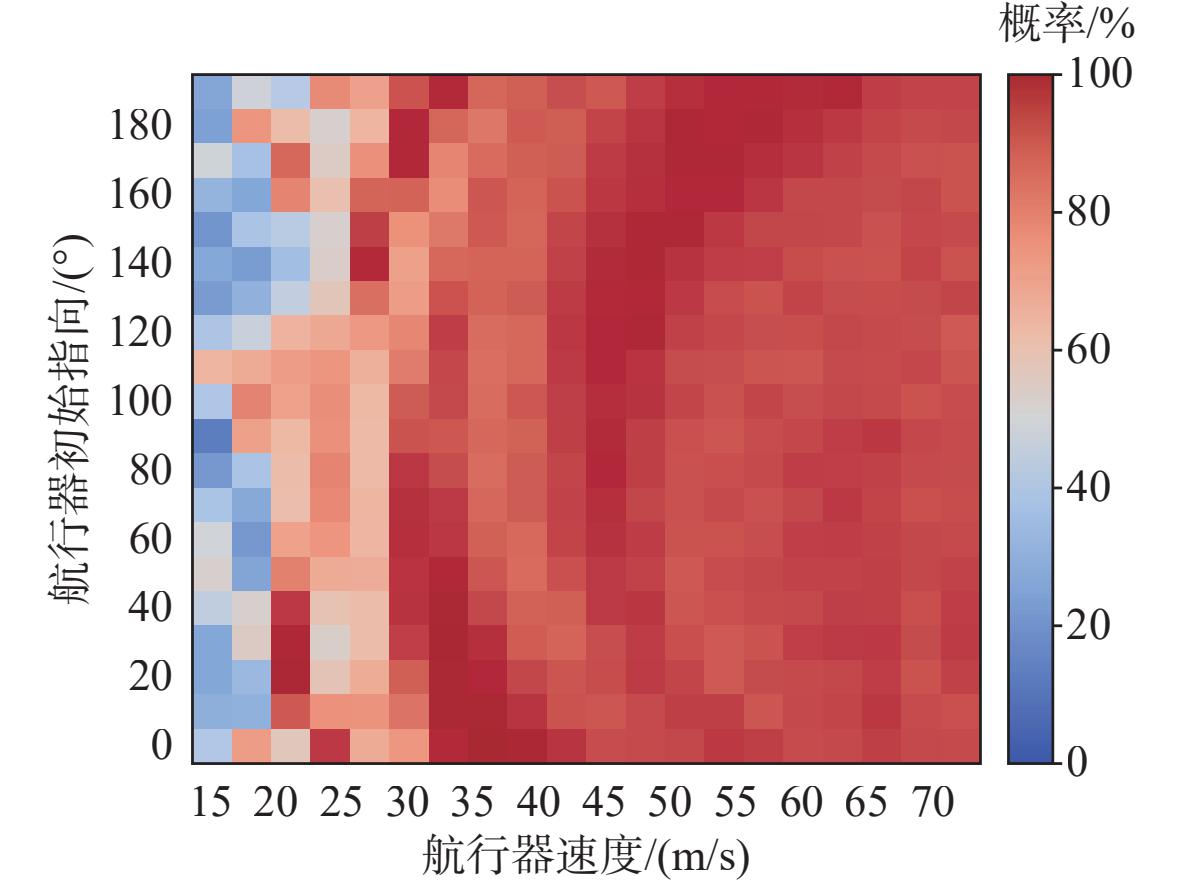
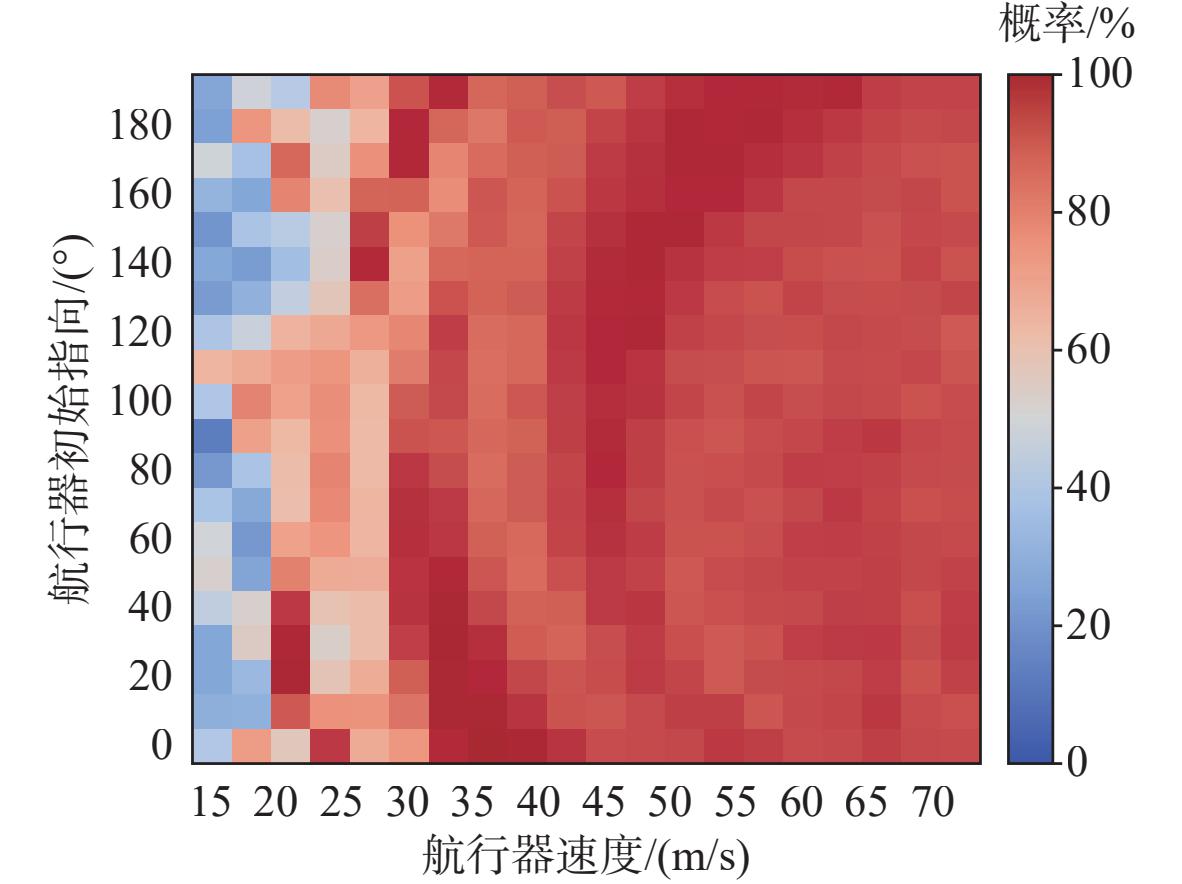
图 20 不同航行器速度-初始指向下重度终点作用概率
Figure 20. Probability of severe terminal effects under different vehicle velocities and initial pointing directions
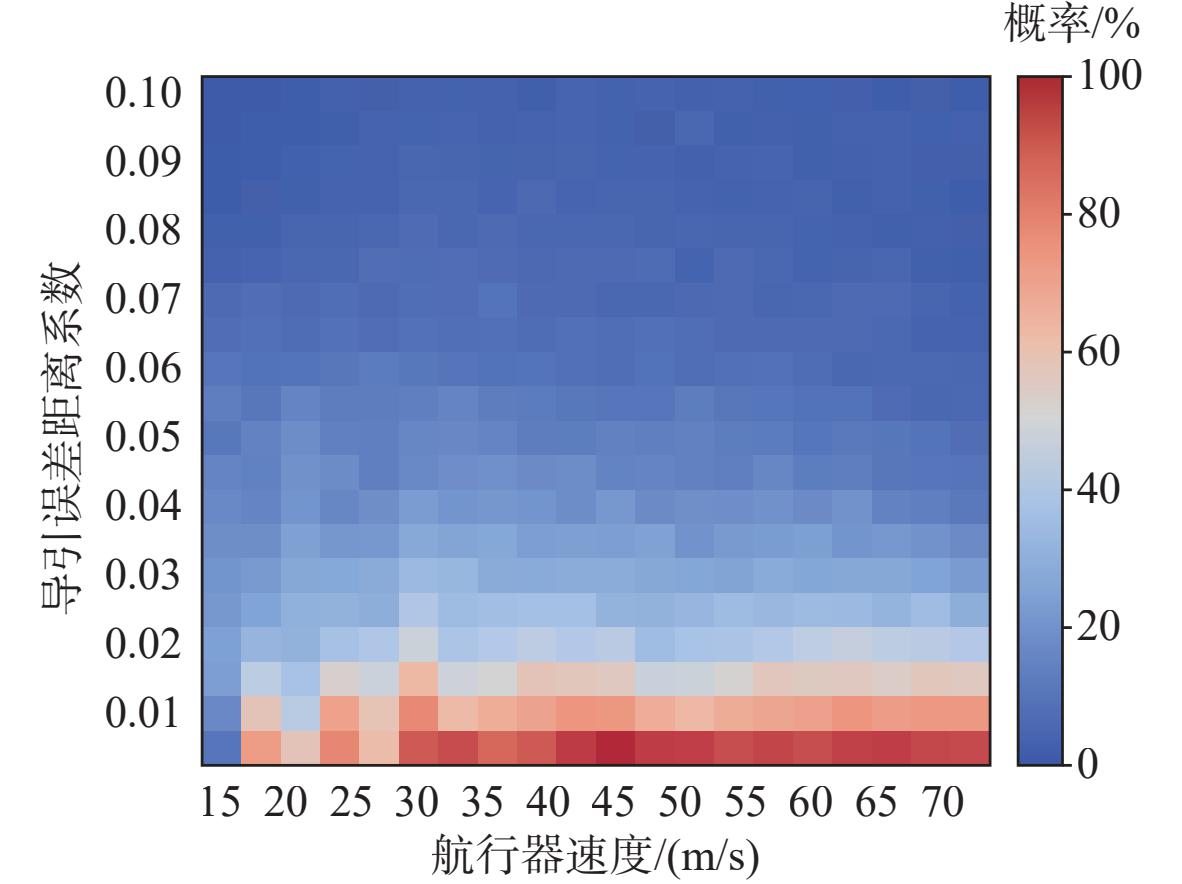
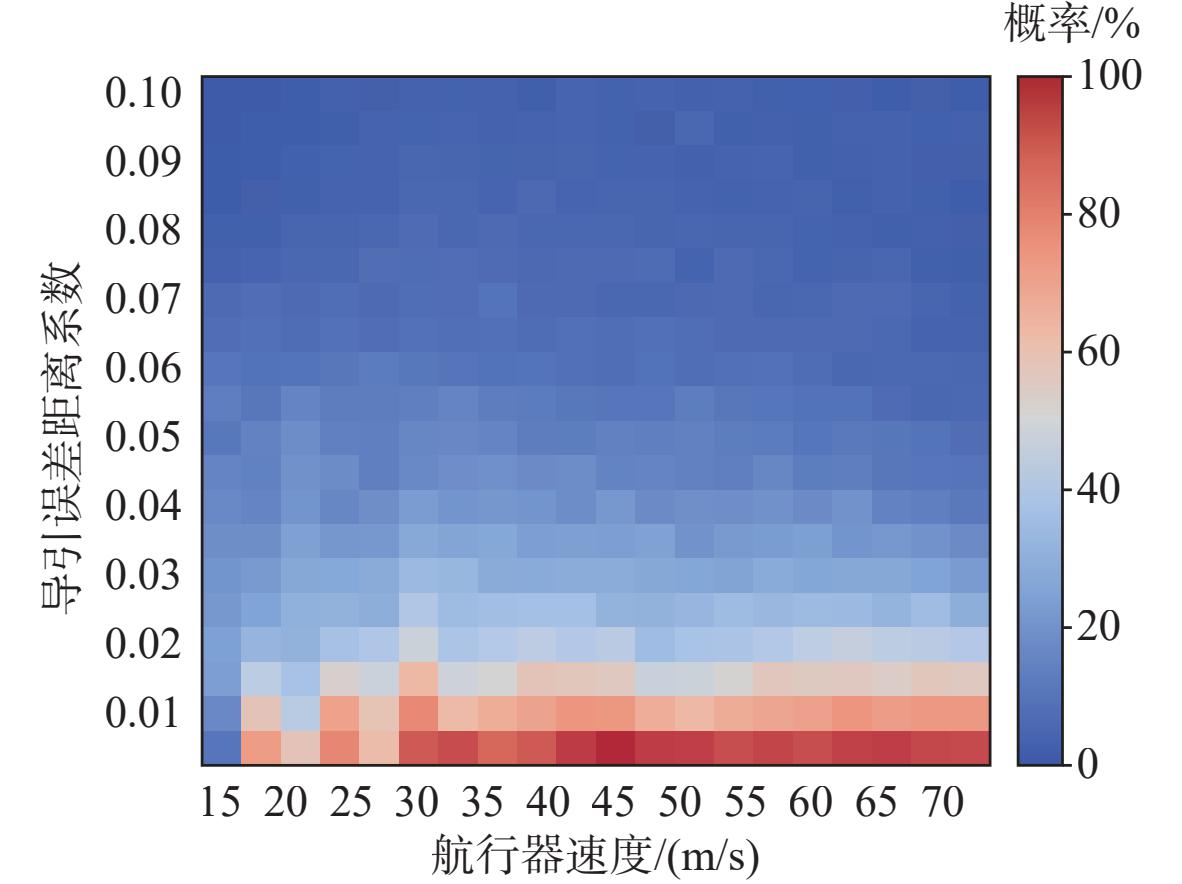
图 21 不同航行器速度-导引误差距离系数(角度方向)下重度终点作用概率
Figure 21. Probability of severe terminal effects under different combinations of vehicle velocities and guidance error distance coefficient in the angular direction
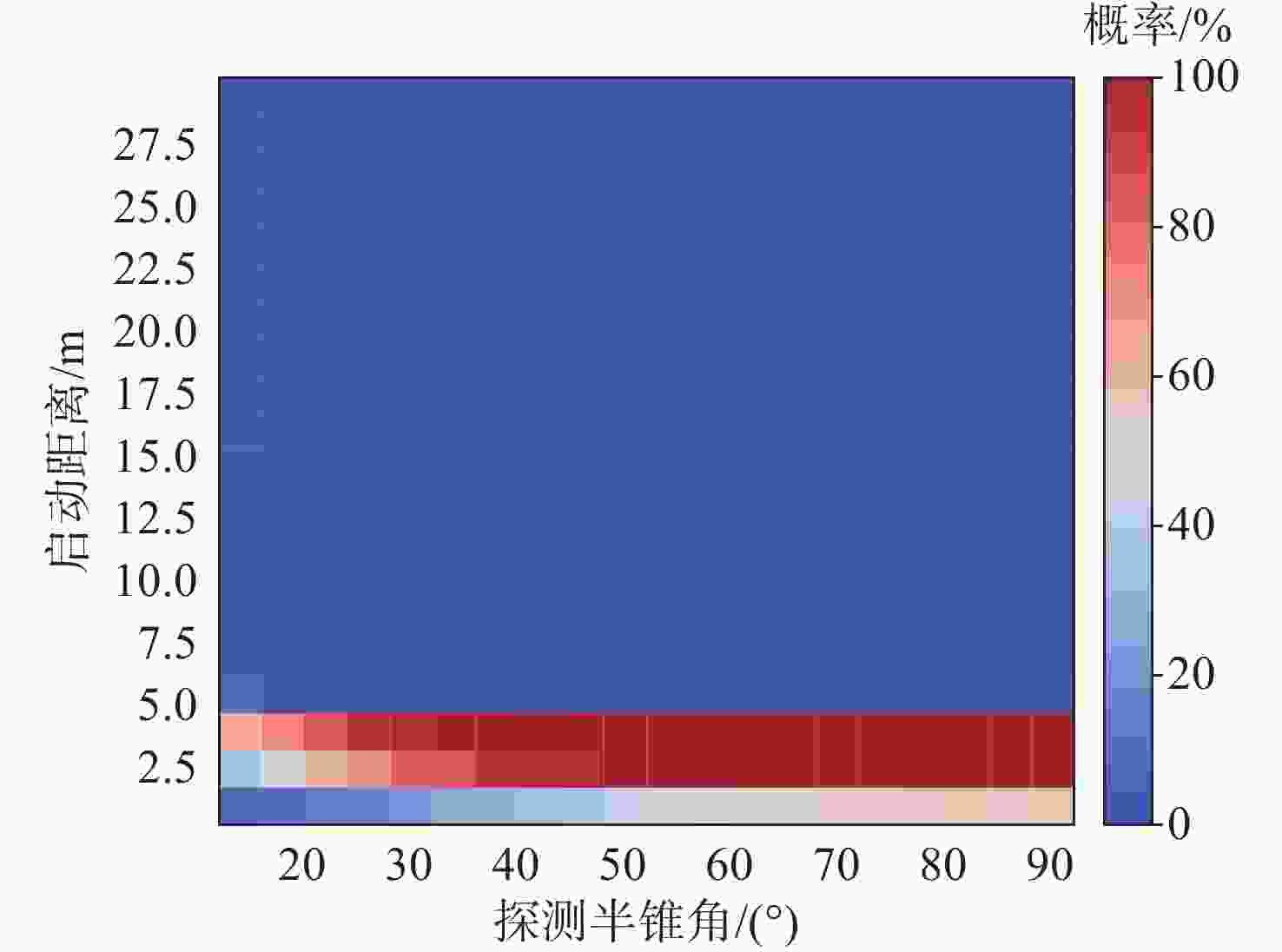
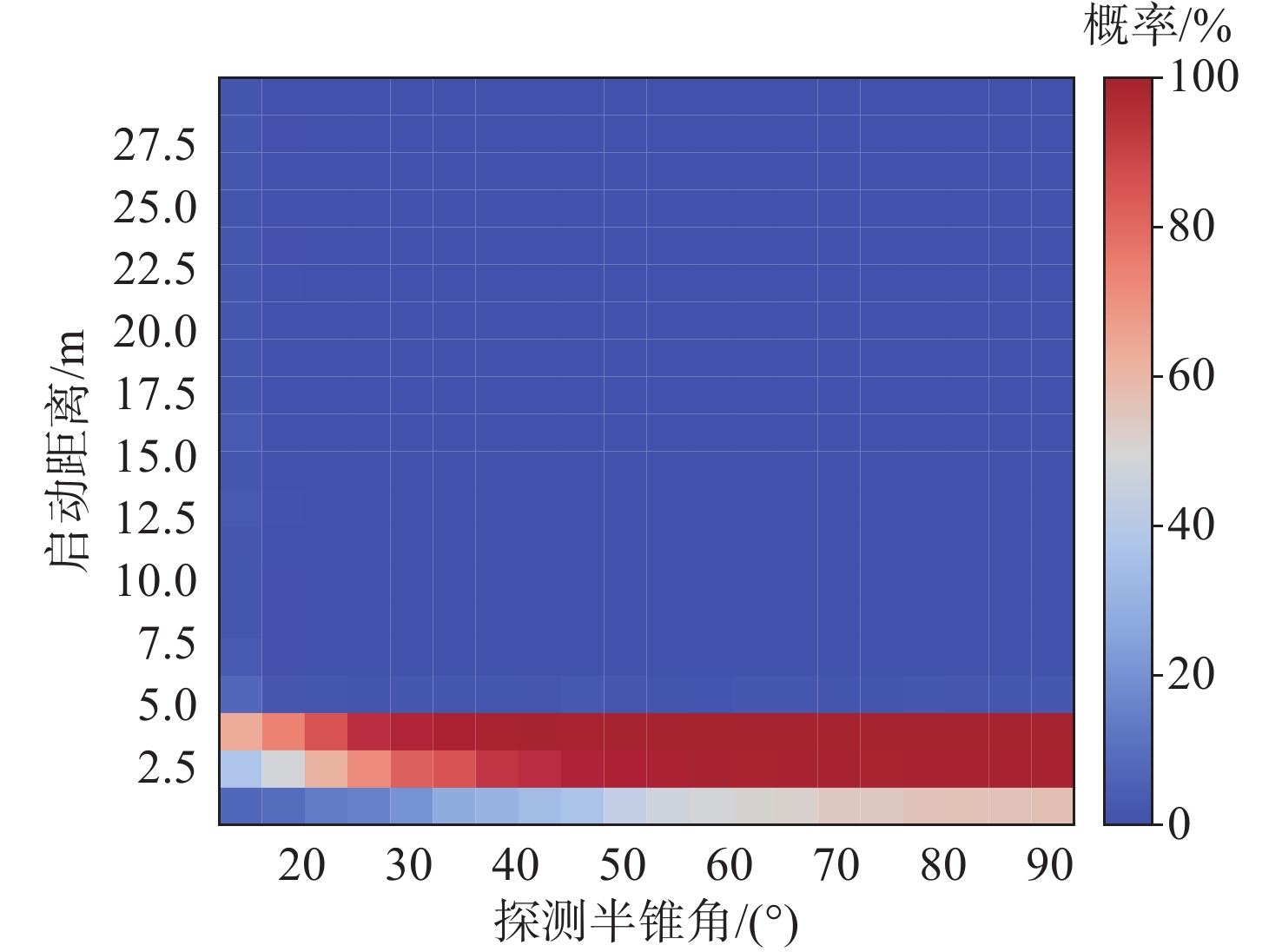
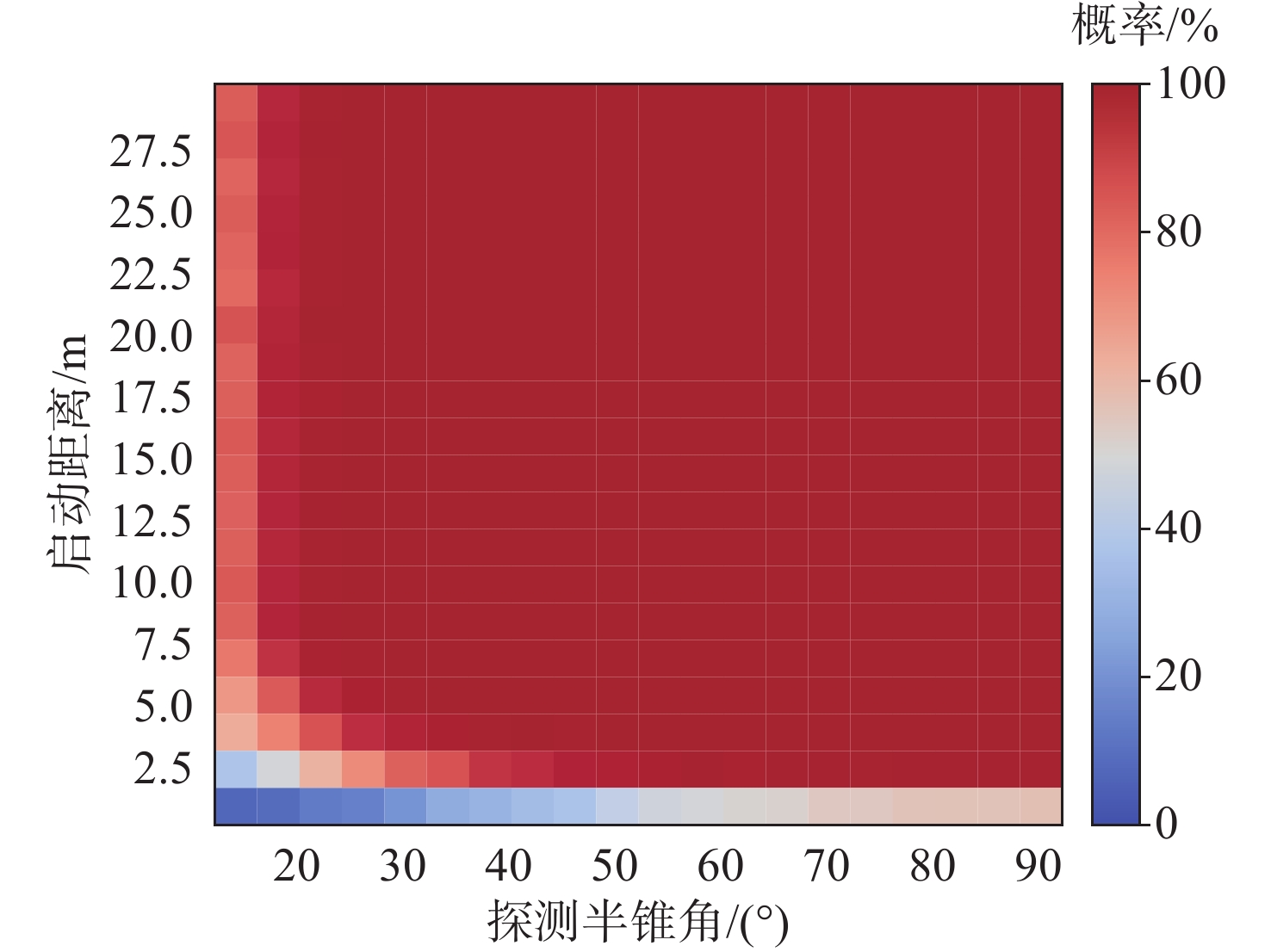
图 22 不同近场触发机构探测半锥角-启动距离下重度终点作用概率
Figure 22. Probability of severe terminal effects under different combinations of near-field triggering mechanism detection half-cone angle and triggering distance
图 23 不同近场触发机构探测半锥角-启动距离下轻度及中度终点作用概率
Figure 23. Probability of light and moderate terminal effects under different near-field triggering mechanism detection half-cone angles and activation distances
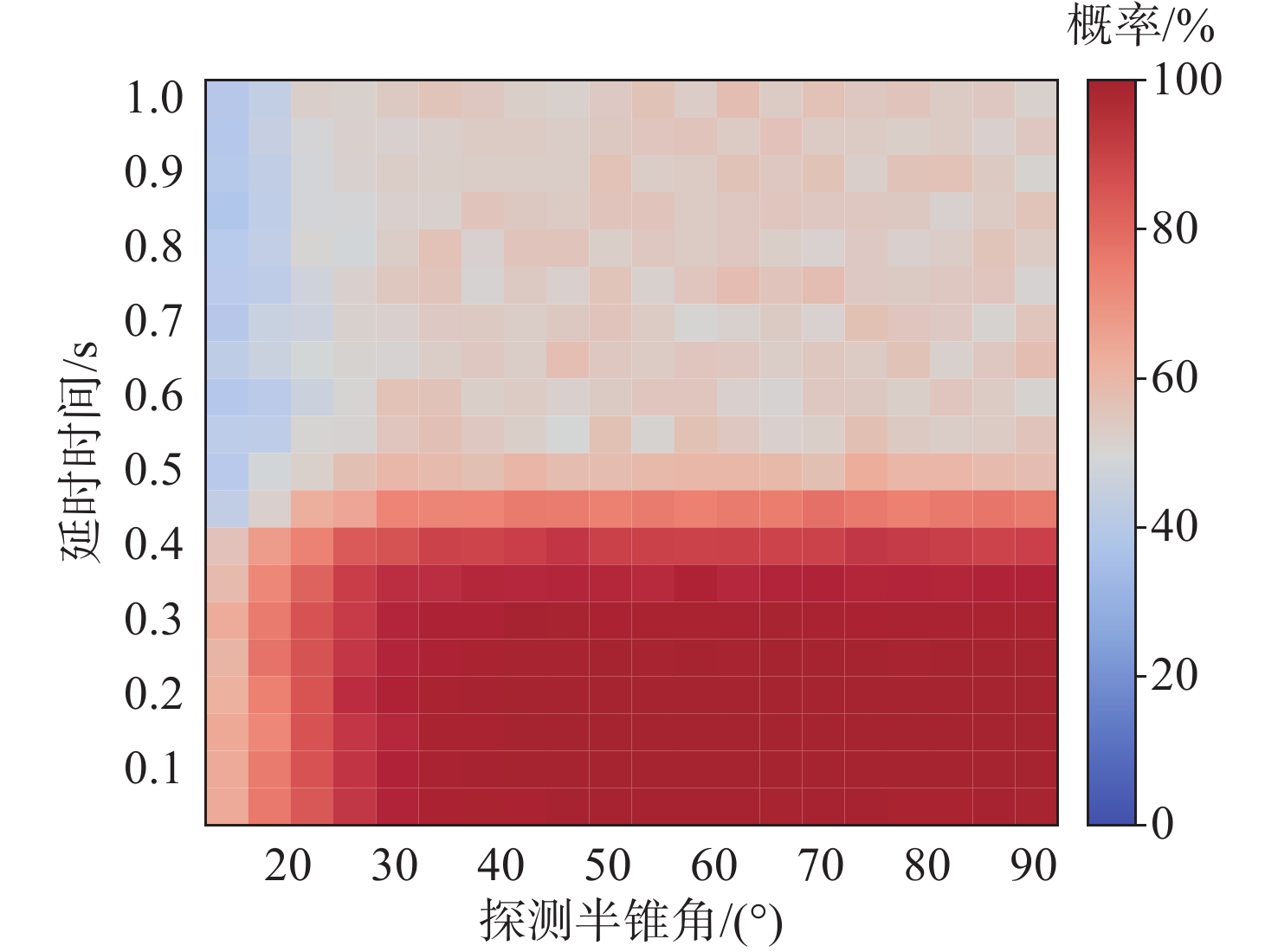
图 24 不同近场触发机构探测半锥角-延时时间下重度终点作用概率
Figure 24. Probability of severe terminal effects under different combinations of near-field triggering mechanism detection half-cone angle and delay time
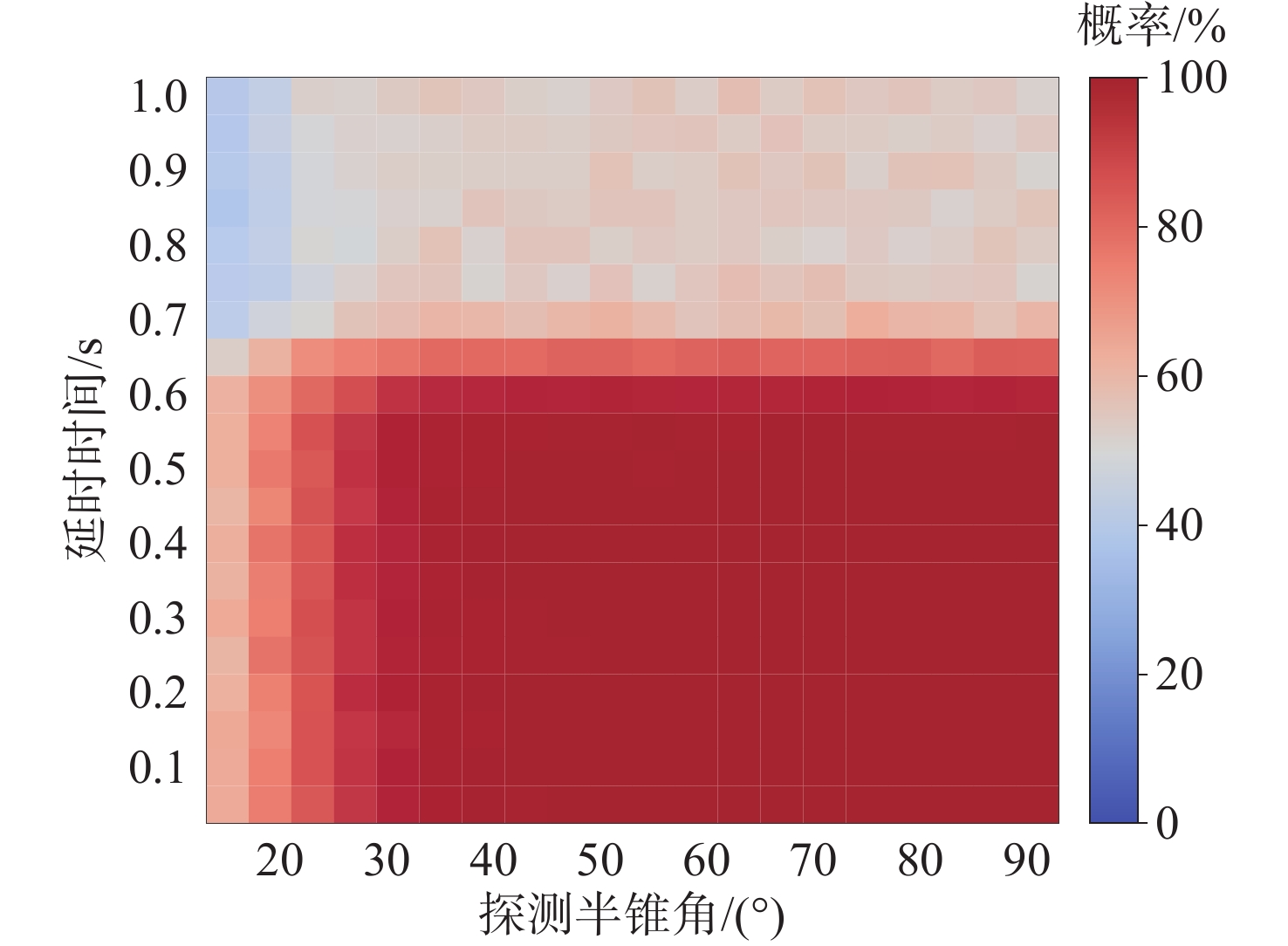
图 25 不同近场触发机构探测半锥角-延时时间下轻度及中度终点作用概率
Figure 25. Probability of light and moderate terminal effects under different near-field triggering mechanism detection half-cone angles and delay times
表 1 算例航行器-目标交会初始参数
Table 1. Initial parameters for the vehicle-target intersection numerical example
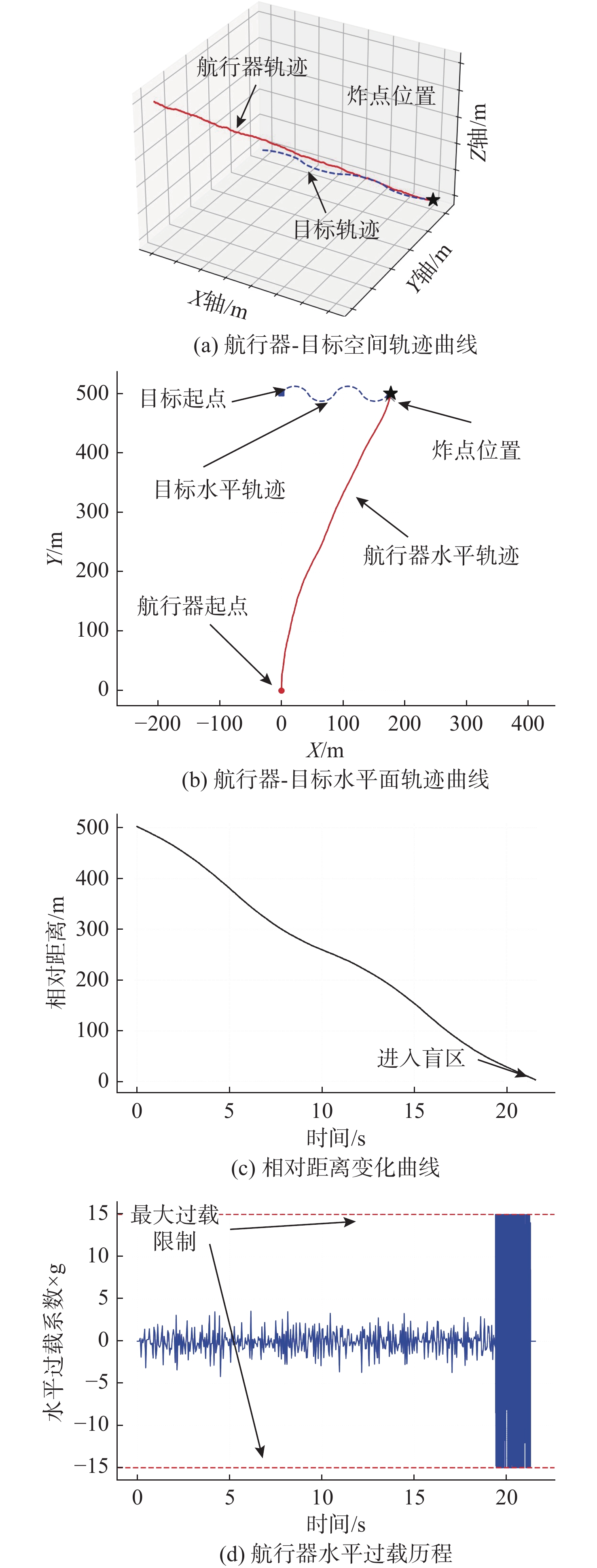
研究对象 初始位置/m 初始航向角/(°) 速度/(m·s−1) 目标 (0, 500, 50) 由机动方式确定 10 航行器 (0, 0, 0) 90 25  下载: 导出CSV
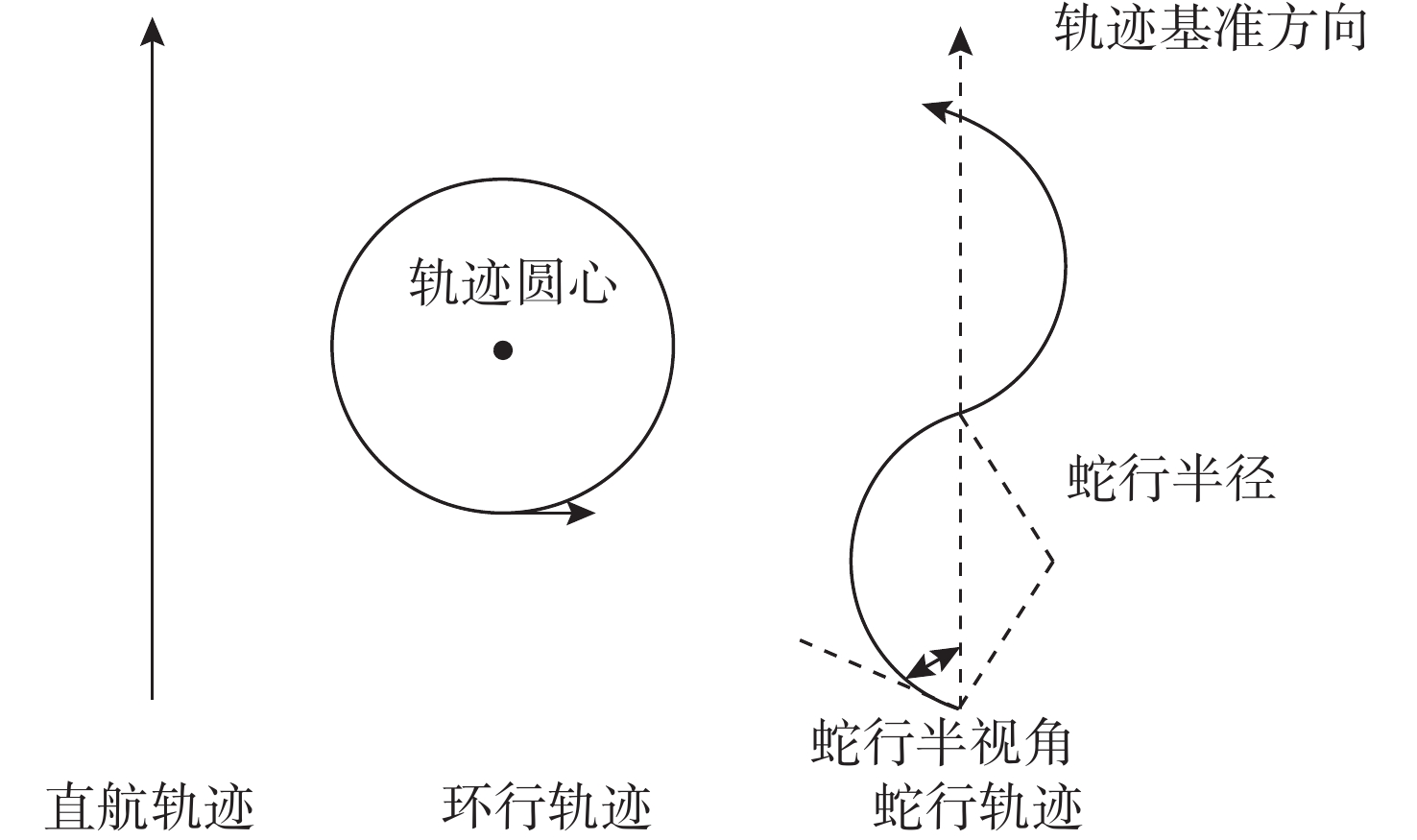
表 2 目标运动轨迹参数
Table 2. Parameters of the target trajectory
机动方式 参数 取值 直线 初始航向角/(°) 0 环行 轨迹圆心 (0, 550, 50) 蛇行 初始航向角/(°) 30 轨迹基准方向/(°) 0 蛇行半视角/(°) 30 蛇行半径/m 50
下载: 导出CSV
表 3 航行器制导律参数
Table 3. Parameters of the vehicle guidance law
制导律 参数 取值 直接瞄准法 前置角/(°) 0 比例导引法 导引比例系数 4 滑模制导律 导引比例系数 4 趋近律系数 3 趋近律系数 2 趋近律可调参数 0.5 水平期望约束落角 60
下载: 导出CSV
表 4 部分初始仿真参数
Table 4. Partial initial simulation parameters
参数类型 参数 取值 仿真与总体参数 仿真持续时间/s 200 远区仿真时间步长/s 0.05 近区仿真时间步长/s 0.005 航行器制导瞄准点 目标中心 航行器平面最大法向过载 15 探测盲区距离/m 8 误差参数 远区位置控制误差标准差/m 0.025 远区角度控制误差标准差/(°) 0.5 近区位置控制误差标准差/m 0.0025 近区角度控制误差标准差/(°) 0.5 角度方向导引误差距离系数 0.001 距离方向导引误差距离系数 0.01 近场触发机构参数 启动距离/m 4 启动半锥角/(°) 25 延时时间/s 0.05
下载: 导出CSV
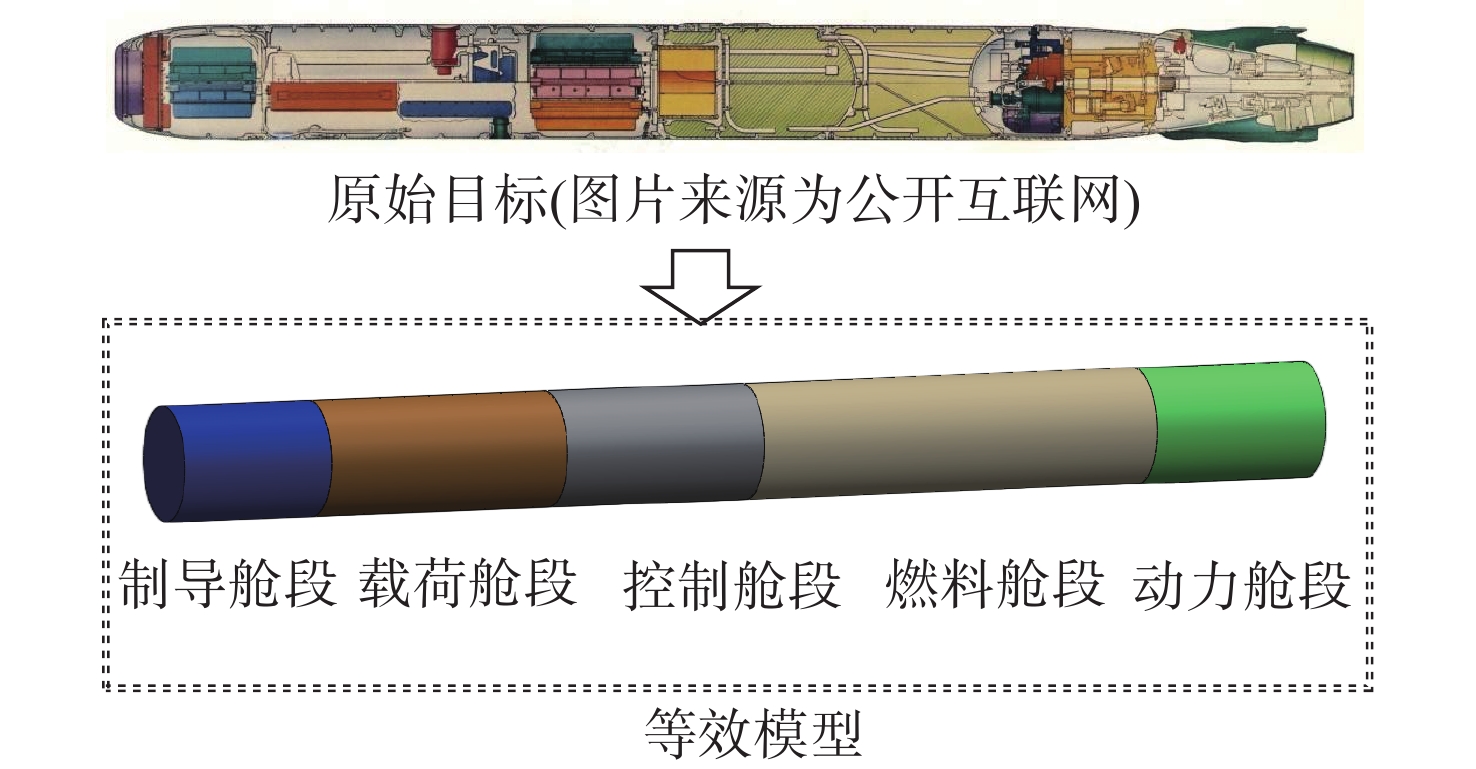
表 5 等效舱段长度与终点作用等级判据
Table 5. Equivalent section length and terminal effects level criterion
舱段 长度/m 重度判据 中度判据 轻度判据 制导舱段 0.75 1.30 0.66 0.20 载荷舱段 1.15 1.20 0.80 0.35 控制舱段 0.95 1.30 0.66 0.20 燃料舱段 1.95 1.0 0.50 0.25 动力舱段 0.80 1.30 0.66 0.30
下载: 导出CSV
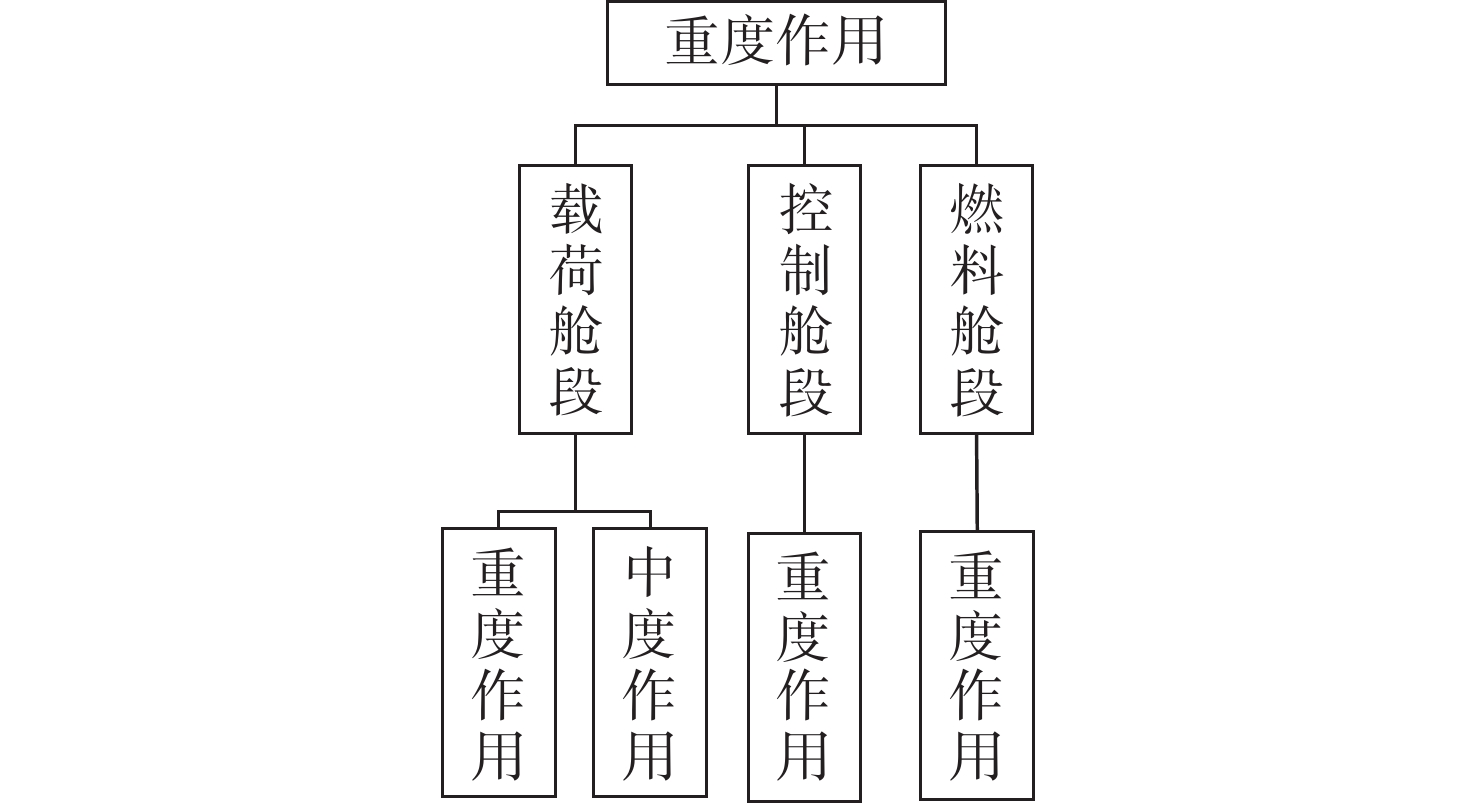
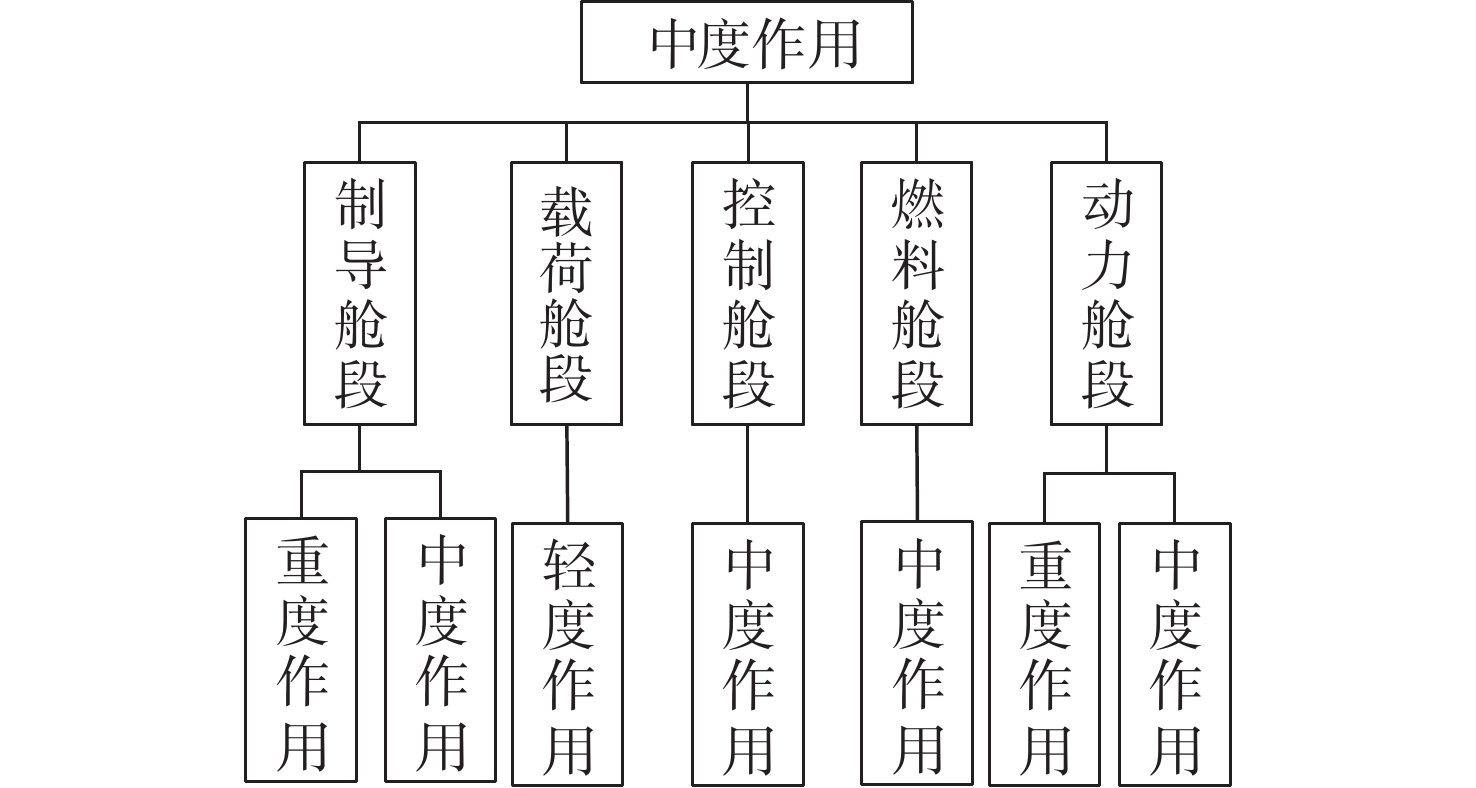
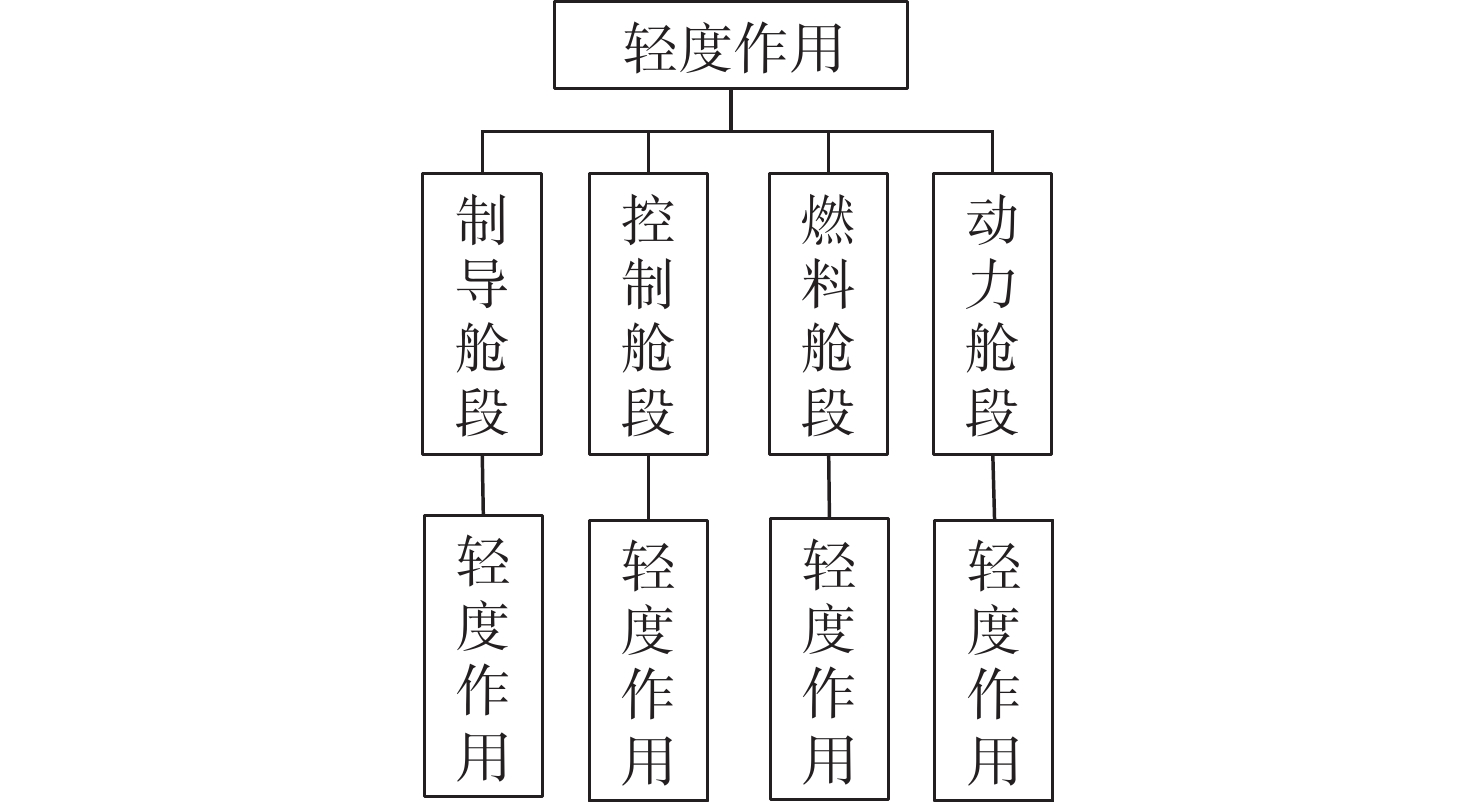
表 6 目标终点作用等级定义
Table 6. Definition of target terminal effects level
作用等级 情况描述 重度 重创, 功能丧失, 失去威胁 中度 受损, 功能下降, 威胁较小 轻度 轻伤, 功能受损, 威胁较大
下载: 导出CSV
-
[1] 王树山, 马峰, 郭勋成, 等. 武器弹药终点毁伤评估[M]. 北京: 北京理工大学出版社, 2021: 243. [2] 徐豫新, 蔡子雷, 吴巍, 等. 弹药毁伤效能评估技术研究现状与发展趋势[J]. 北京理工大学学报, 2021, 41(6): 569-578. [3] 刘彦, 柳明, 吕中杰, 等. 基于科学知识图谱的弹药毁伤评估技术发展现状与趋势研究[J]. 北京理工大学学报, 2024, 44(3): 219-230. [4] 刘建国, 邱从礼, 徐冰川, 等. 前向增强杀伤榴弹对轻型装甲车辆毁伤效能研究[J]. 弹箭与制导学报, 2025, 45(6): 1038-1043.Liu J G, Qiu C L, Xu B C, et al. Research on evaluation of the destructive effectiveness of forward enhanced fragmentation grenades on light armored vehicles[J]. Journal of Projectiles, Rockets, Missiles and Guidance, 2025, 45(6): 1038-1043. [5] 李元, 温玉全. 定向战斗部毁伤效能评估[J]. 兵工学报, 2021, 42(S1): 1-10.Li Y, Wen Y Q. Evaluation of damage effectiveness of directional warhead[J]. Acta Armamentarii, 2021, 42(S1): 1-10. [6] 张睿文, 裴扬, 侯鹏, 等. 破片式战斗部对预警机毁伤评估研究[J]. 北京理工大学学报, 2022, 42(4): 347-358. [7] 卢熹, 王树山, 王新颖. 水中爆炸对鱼雷壳体的毁伤准则和判据研究[J]. 兵工学报, 2016, 37(8): 1469-1475.Lu X, Wang S S, Wang X Y. Research on damage criterion of torpedo shell subjected to underwater explosive shock waves[J]. Acta Armamentarii, 2016, 37(8): 1469-1475. [8] 王树山, 桂秋阳, 卢熹, 等. 反潜战斗部对耐压壳结构的毁伤威力评估方法与实验[J]. 兵工学报, 2023, 44(4): 919-928.Wang S S, Gui Q Y, Lu X, et al. Assessment and experimental study of damage power of anti-submarine warhead to the pressure hull structure[J]. Acta Armamentarii, 2023, 44(4): 919-928. [9] 王树山, 贾曦雨, 高源, 等. 水下爆炸动力学的起源、发展与展望[J]. 水下无人系统学报, 2023, 31(1): 10-29.Wang S S, Jia X Y, Gao Y, et al. Underwater explosion dynamics: its origin, development, and prospect[J]. Journal of Unmanned Undersea Systems, 2023, 31(1): 10-29. [10] Wang S, Han F, Zhu W, et al. Study on the dynamic response and dynamic buckling modes of cylindrical shells under deep-water explosions[J]. Applied Ocean Research, 2025, 162: 104732. [11] 邵志宇. 弹药制导控制原理[M]. 北京: 北京理工大学出版社, 2022: 78-84. [12] 黄波, 杨俊. 基于比例导引法的鱼雷声自导导引弹道仿真分析[J]. 舰船科学技术, 2024, 46(21): 186-189. [13] 马雪飞, 王智, 宋清华, 等. 基于终端角度约束的鱼雷滑模制导律[J]. 中国惯性技术学报, 2023, 31(10): 1044-1052, 1060.Ma X F, Wang Z, Song Q H, et al. Torpedo sliding mode guidance law based on terminal angle constraint[J]. Journal of Chinese Inertial Technology, 2023, 31(10): 1044-1052, 1060. [14] 曹迟, 史文涛, 王百合, 等. 无人水下航行器反潜作战模型仿真[J]. 水下无人系统学报, 2025, 33(1): 156-163.Cao C, Shi W T, Wang B H, et al. Simulation of anti-submarine warfare model of unmanned undersea vehicles[J]. Journal of Unmanned Undersea Systems, 2025, 33(1): 156-163. [15] 孟庆玉. 鱼雷作战效能分析[M]. 北京: 国防工业出版社, 2003.5 [16] 严浙平, 赵玉飞, 陈涛, 等. 一种基于导航误差空间的无人水下航行器路径规划方法[J]. 兵工学报, 2014, 35(8): 1243-1250.Yan Z P, Zhao Y F, Chen T, et al. A novel method of UUV path planning based on navigation error space[J]. Acta Armamentarii, 2014, 35(8): 1243-1250. [17] 陈春玉. 反鱼雷技术[M]. 北京: 国防工业出版社, 2006: 5. -

 下载:

 点击查看大图
计量
- 文章访问数: 317
- HTML全文浏览量: 149
- PDF下载量: 0
- 被引次数: 0