

Robust Model Predictive Trajectory Tracking Control of AUV Based on Nonlinear Disturbance Observer
-
摘要: 针对复杂海洋环境中未知强时变干扰对自主水下航行器(AUV)轨迹跟踪精度造成的影响, 本文提出一种基于非线性干扰观测器(NDO)与鲁棒非线性模型预测控制(NMPC)的分层紧耦合轨迹跟踪控制框架。首先, 建立了包含外部环境扰动及模型不确定性的AUV非线性动力学模型。针对加速度信号难以可靠获取的问题, 设计了一种基于动量的非线性干扰观测器, 避免了对加速度测量的依赖, 仅利用速度和控制输入信息即可实现对集总干扰的实时估计。在此基础上, 将干扰估计结果引入NMPC框架, 构建基于前馈补偿的鲁棒NDO-NMPC方法, 对预测模型进行修正, 使控制器在滚动优化过程中能够主动抵消干扰影响。仿真结果表明, 在强时变海流及量测噪声作用下, 与基于扩张状态观测器的非线性模型预测控制(ESO-NMPC)方法相比, 所提方法可有效抑制由观测噪声放大及模型失配引起的轨迹漂移, 横向跟踪误差降低约 68.9%, 且控制输入更加平滑。在有效执行上层避障规划指令的同时, 显著提升了系统的鲁棒性、跟踪精度与执行器友好性。Abstract: To address the degradation of trajectory tracking accuracy of autonomous underwater vehicles(AUVs) caused by unknown strong time-varying disturbances in complex marine environments, this paper proposes a hierarchical tightly-coupled trajectory tracking control framework based on a nonlinear disturbance observer(NDO) and robust nonlinear model predictive control(NMPC). First, a nonlinear dynamic model of the AUV is established, incorporating external environmental disturbances and model uncertainties. To avoid the reliance on acceleration measurements that are difficult to obtain reliably, a momentum-based nonlinear disturbance observer is designed, which enables real-time estimation of lumped disturbances using only velocity and control input information. Based on the disturbance estimation, a robust NDO-NMPC scheme with feedforward compensation is developed by explicitly incorporating the estimated disturbance into the predictive model, thereby correcting the state prediction and allowing the controller to actively counteract disturbance effects during the receding horizon optimization process. Simulation results demonstrate that, under strong time-varying ocean current disturbances and measurement noises, the proposed method effectively suppresses trajectory drift caused by model mismatch and the amplification of observation noise. Compared with the extended state observer-based nonlinear model predictive control (ESO-NMPC) method, the lateral tracking error is reduced by approximately 68.9%, and the control inputs are smoother. Meanwhile, the proposed method significantly enhances system robustness, tracking accuracy, and actuator friendliness while effectively executing the upper-layer obstacle avoidance planning commands.
-
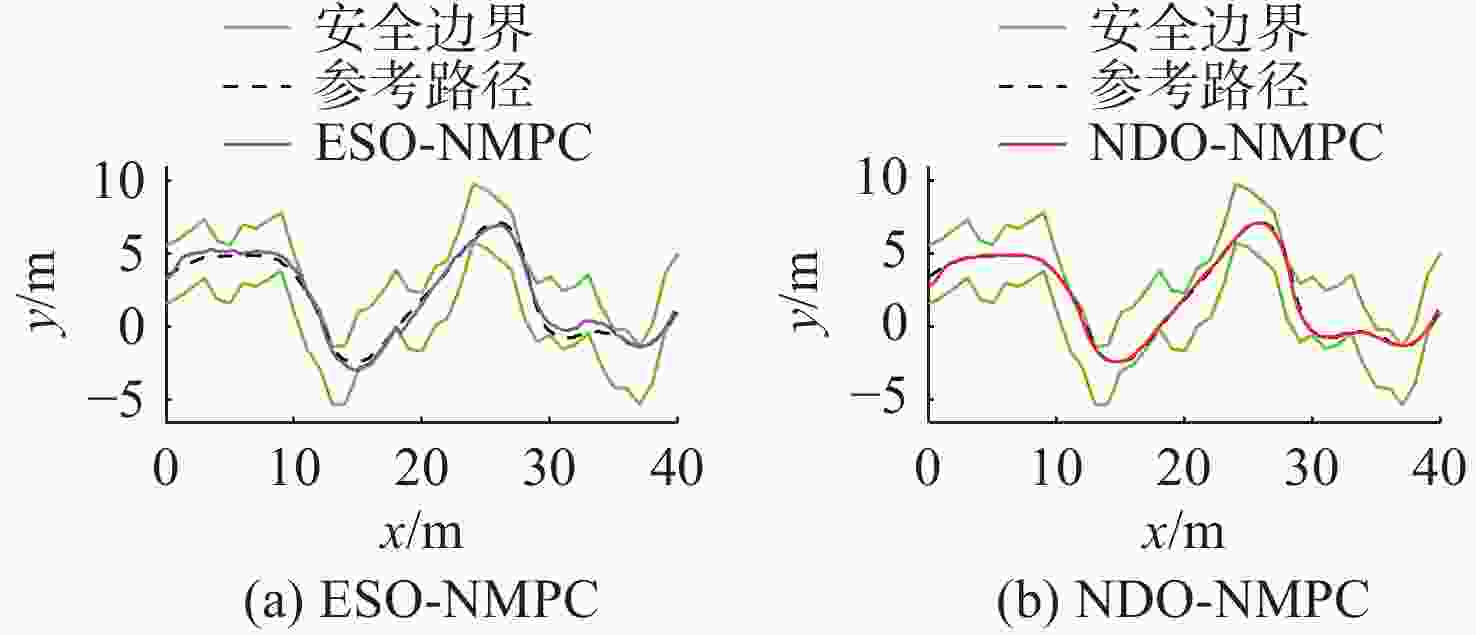
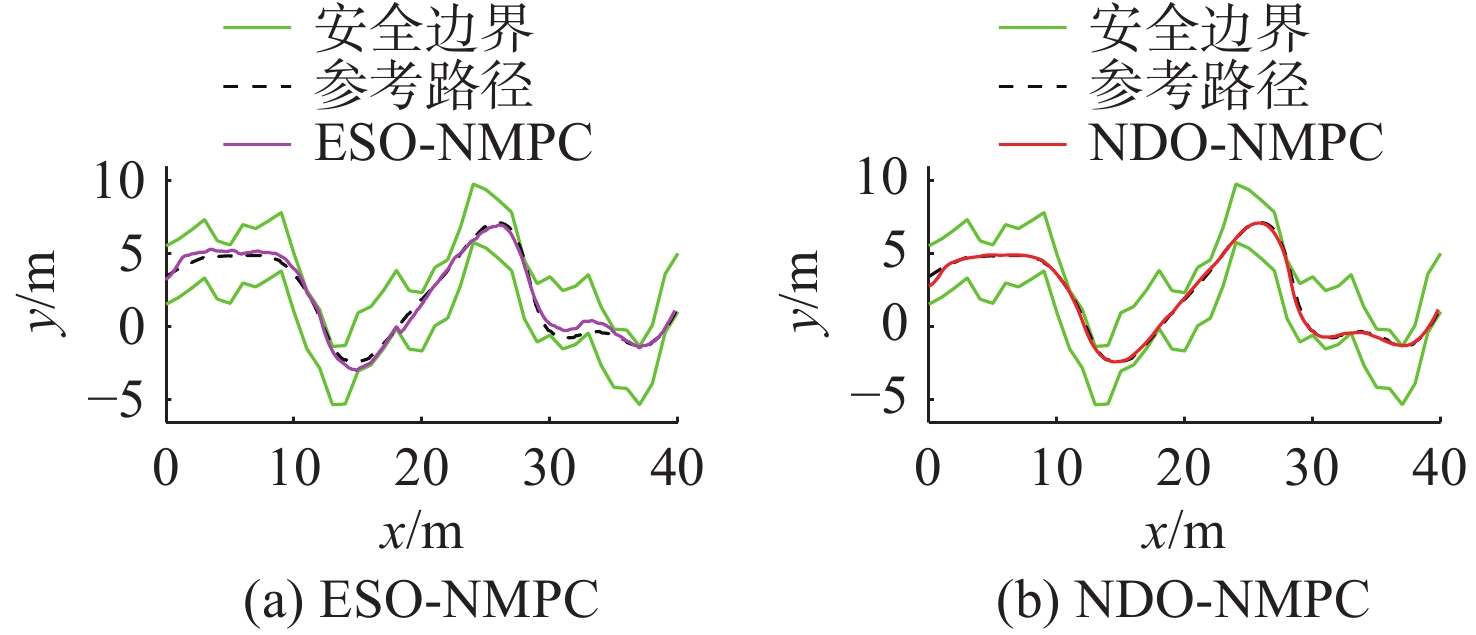
图 2 复杂流场下两种控制方案的 AUV 轨迹跟踪效果对比
Figure 2. Comparison of AUV trajectory tracking results of the two control schemes in complex currents
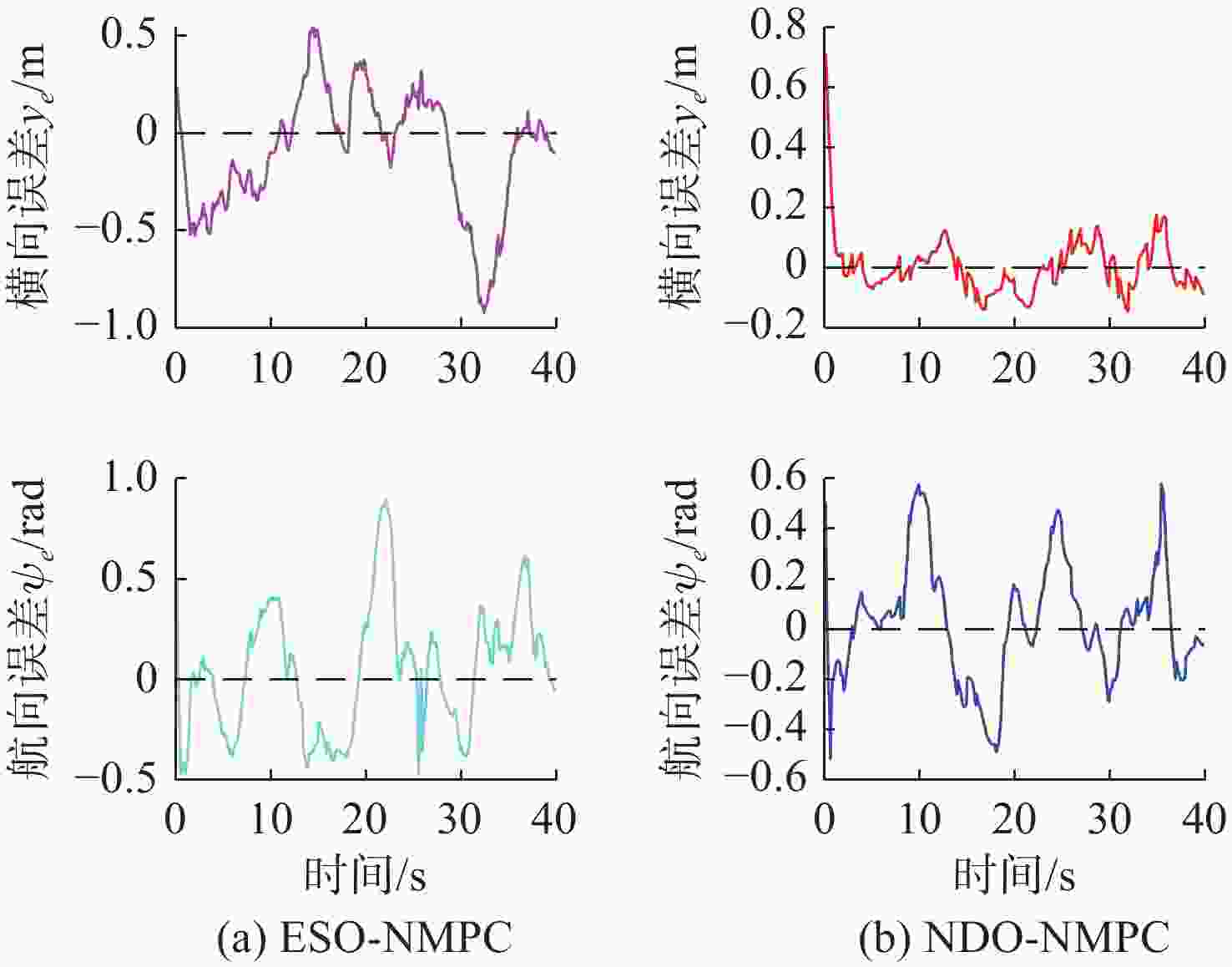
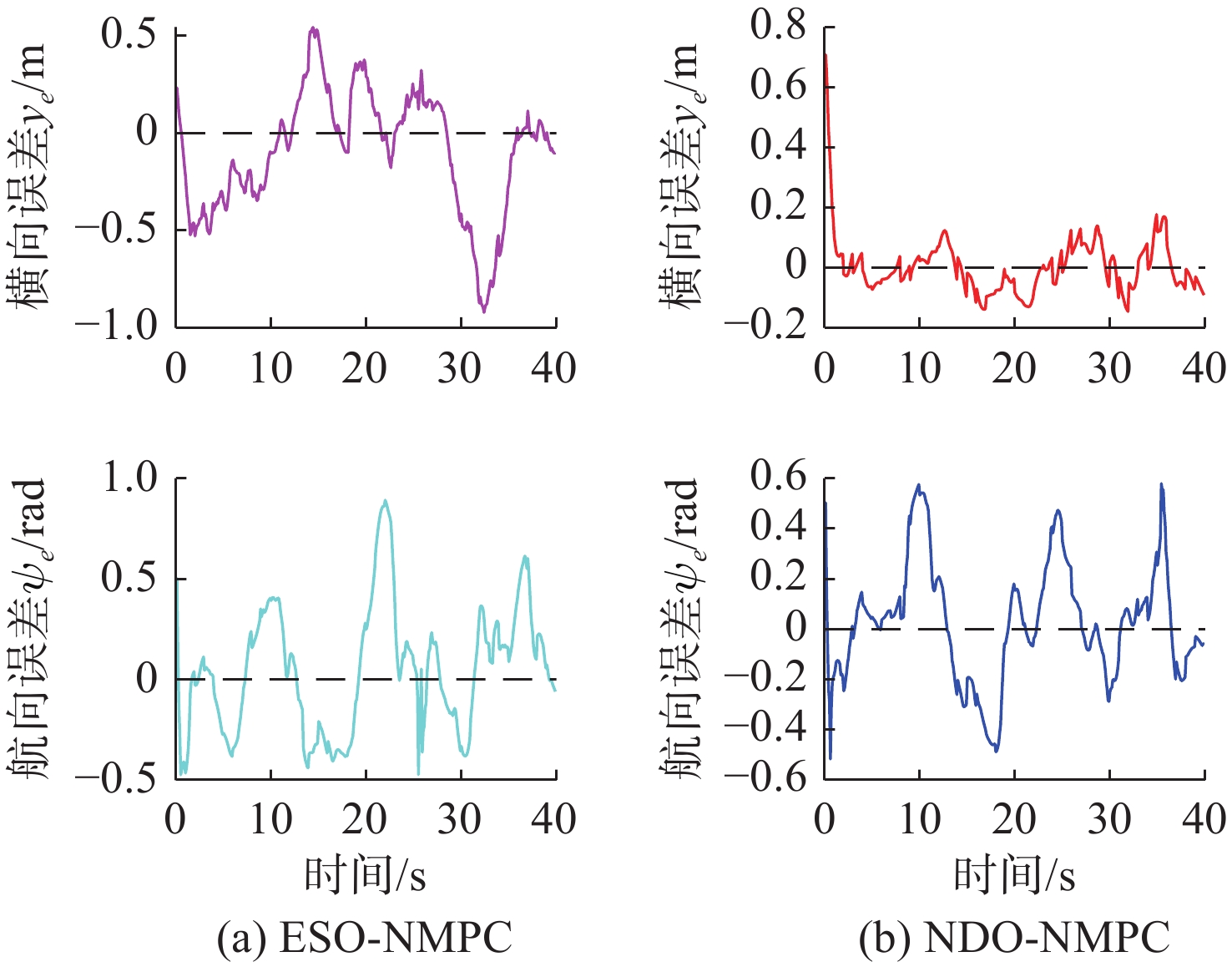
图 3 两种控制方案下的横向误差与航向误差曲线对比
Figure 3. Comparison of cross-track error and heading error curves of the two control schemes
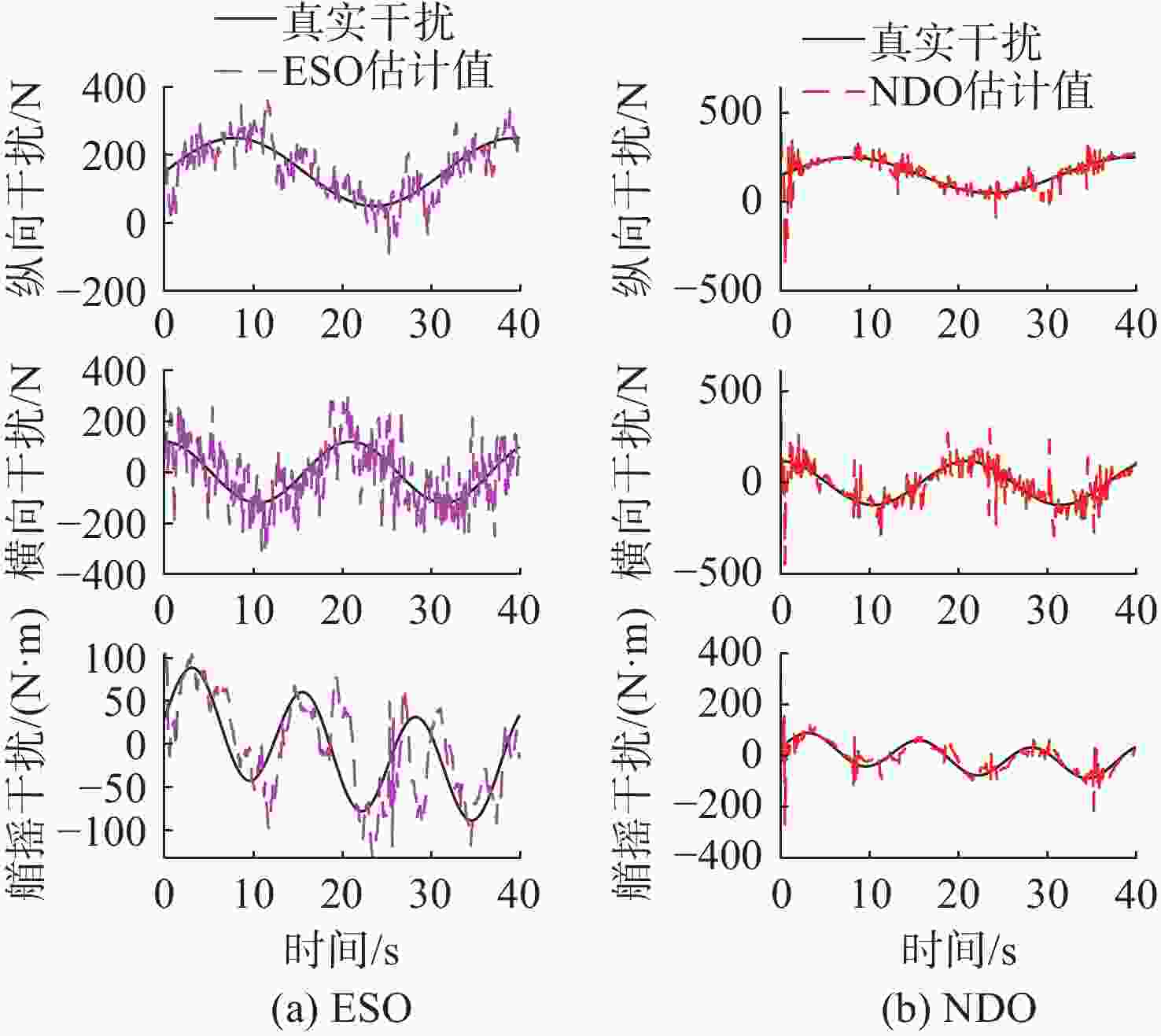
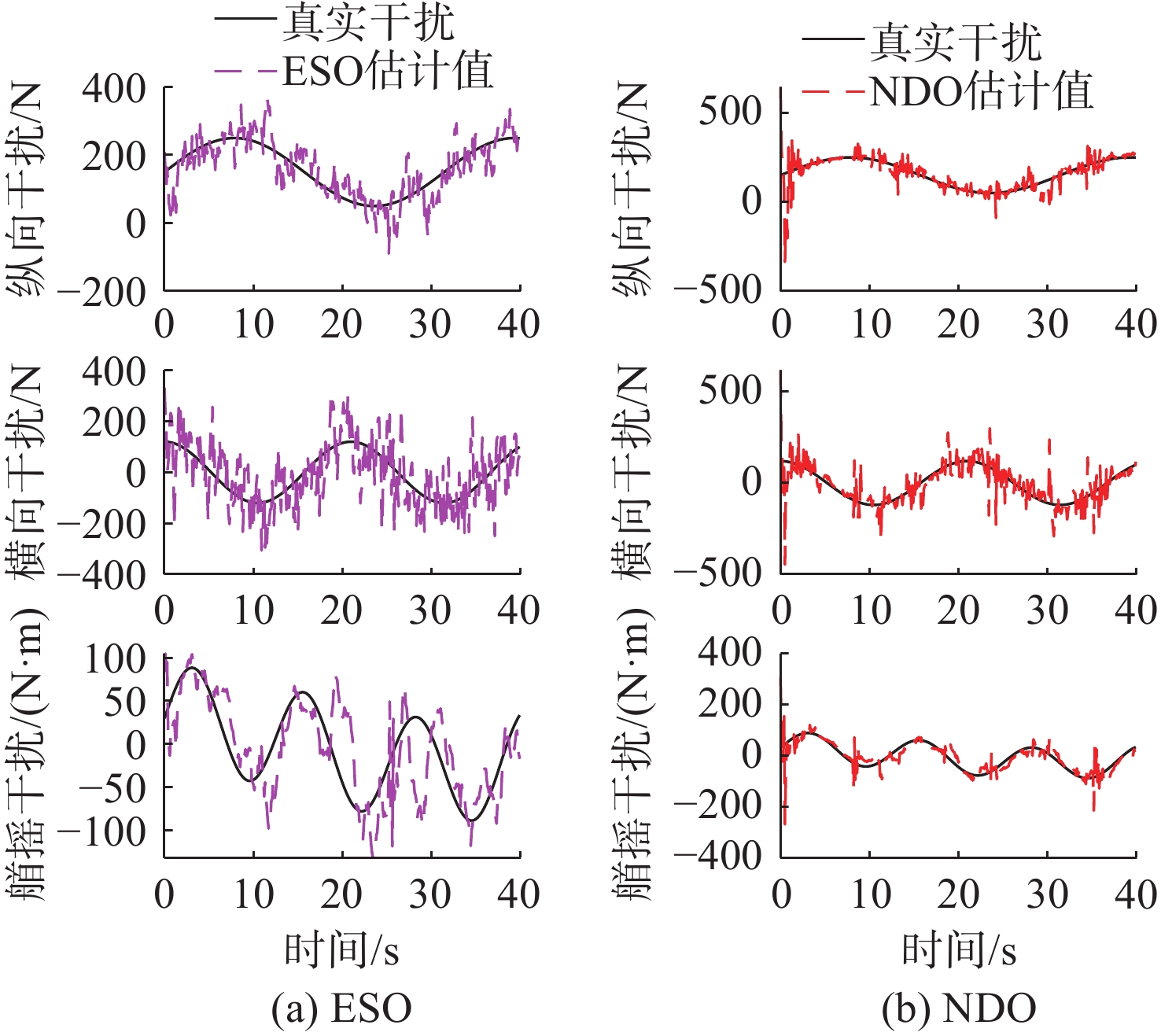
图 4 两种观测器在纵向、横向及艏摇方向的干扰估计性能对比
Figure 4. Comparison of disturbance estimation performance of the two observers in surge, sway and yaw DOFs
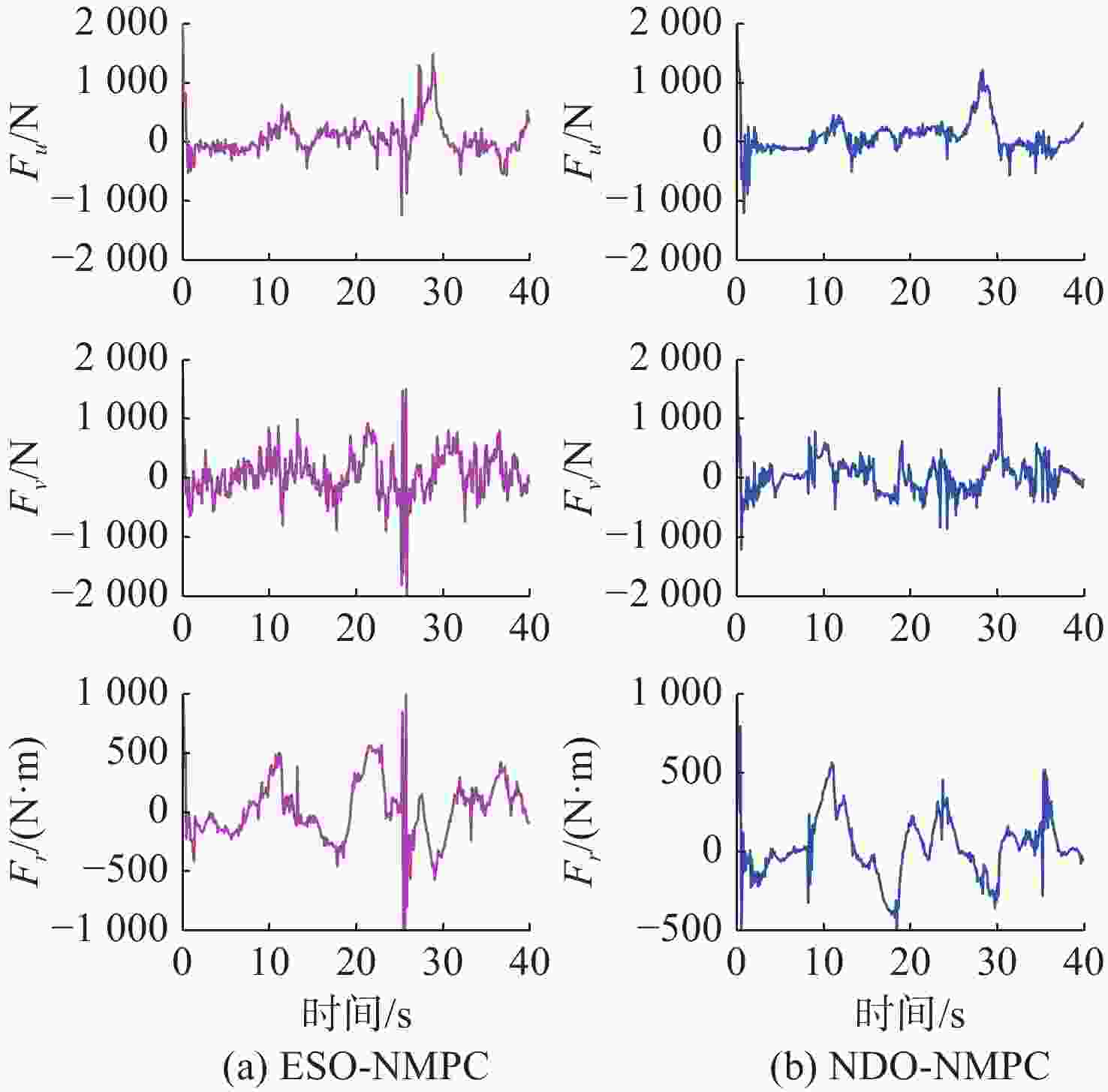
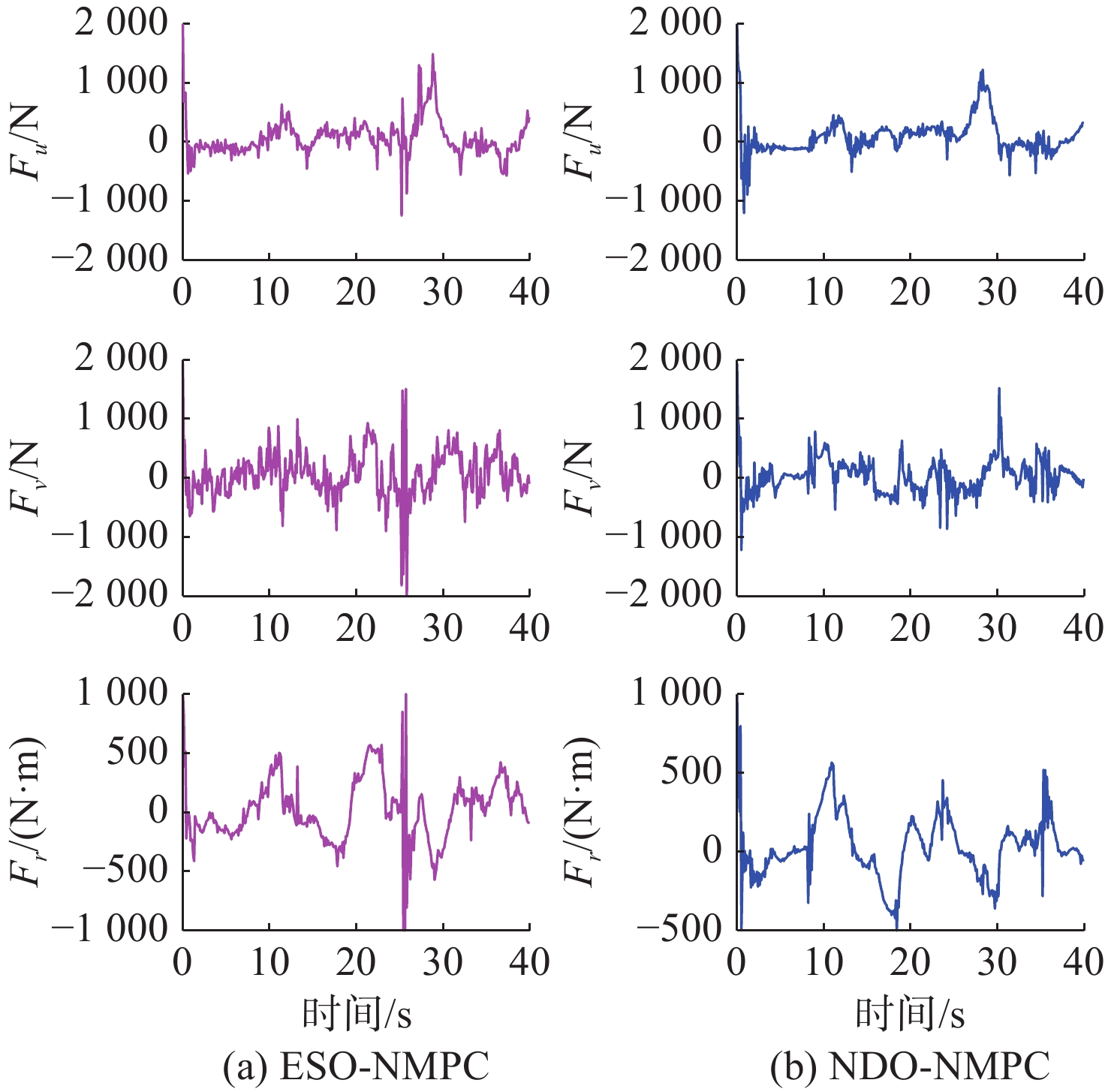
图 5 两种控制方案下的控制输入曲线对比
Figure 5. Comparison of control input curves of the two control schemes
表 1 AUV 动力学模型参数
Table 1. Parameters of the AUV dynamic model
参数名称 符号 数值 质量/kg $ m $ 116 转动惯量 ($ Z $轴)/ $ \mathrm{kg} \cdot \mathrm{m}^{2} $ $ I_{{\textit{z}}} $ 13.1 纵向附加质量/ kg $ X_{\dot u} $ −100.6 横向附加质量/ kg $ {Y}_{\dot{v}} $ −477.2 艏摇附加质量/$ \mathrm{kg} \cdot \mathrm{m}^{2} / \mathrm{rad} $ $ N_{\dot r} $ −15.9 纵向线性阻尼/ kg/s $ {X}_{u} $ 26.9 横向线性阻尼/ kg/s $ {Y}_{v} $ 35.8 艏摇线性阻尼/$ \mathrm{kg} \cdot \mathrm{m}^{2} /(\mathrm{s} \cdot \mathrm{rad}) $ $ {N}_{r} $ 3.5 纵向二次阻尼/kg/m $ {D}_{u} $ 100.3 横向二次阻尼/kg/m $ {D}_{v} $ 503.8 艏摇二次阻尼/$ \mathrm{kg} \cdot \mathrm{m}^{2} / \mathrm{rad}^{2} $ $ D_{r} $ 76.9 最大推力/N $ F_{u, \text {max}}, F_{v\text {max}} $ 2 000 最大力矩/$ {\mathrm{N}} \cdot {\mathrm{m}} $ $ {F}_{r,\max } $ 1 000  下载: 导出CSV
表 2 控制器、观测器与扰动仿真参数设置
Table 2. Simulation parameter settings for controller, observers and disturbances
参数类别 参数名称 符号 数值与设置说明 NMPC 共同参数 采样周期与仿真时长 $ T,{t}_{\text{sim}} $ $ T=0.1\text{ s} $, 总时长 $ {t}_{\text{sim}}=40\text{ s} $ NMPC 共同参数 预测时域步数 $ N $ $ 8 $ NMPC 共同参数 状态误差权重矩阵 $ \boldsymbol{Q} $ $ \text{diag}\left(0.4{,}0.4{,}0.4{,}0.4{,}0.4{,}0.4\right) $ NMPC 共同参数 控制输入权重矩阵 $ \boldsymbol{R} $ $ \text{diag}\left(0.1{,}0.1{,}0.1\right) $ NMPC 共同参数 终端惩罚矩阵 $ \boldsymbol{P} $ $ \text{diag}\left(0.5{,}0.5{,}0.5{,}0.5{,}0.5{,}0.5\right) $ NMPC 共同参数 控制输入饱和约束 $ {\boldsymbol{\tau }}_{\max }=-{\boldsymbol{\tau }}_{\min } $ $ {\left[2\;000\text{ N},2\;000\text{ N},1\;000\text{ N}\cdot \text{m}\right]}^{\text{T}} $ NMPC 共同参数 状态误差安全约束 $ {\mathcal{X}}_{\text{safe}} $
$ {\text{Ω}}_{f} $河道边界约束 $ {c}_{\text{low}}\left(x\right)\leqslant y\leqslant {c}_{\text{upp}}\left(x\right) $ 及
终端误差收缩不等式约束观测器各自参数 方案A: ESO阶次与增益 $ {\boldsymbol{\beta }}_{1},{\boldsymbol{\beta }}_{2} $ $ {\boldsymbol{\beta }}_{1}=\text{diag}\left(6.0{,}6.0{,}6.0\right){\text{ s}}^{-1} $
$ {\boldsymbol{\beta }}_{2}=\text{diag}\left(9.0{,}9.0{,}9.0\right){\text{ s}}^{-2} $观测器各自参数 方案B: NDO阶次与增益 $ \boldsymbol{L} $ $ \boldsymbol{L}\text{=diag}\left(3.0,3.0,3.0\right){\text{ s}}^{-1} $ 扰动与初始设置 内部参数摄动范围与位置 $ \mathit{\Delta }M $
$ \text{Δ}\boldsymbol{D} $+20%(仅施加于被控 AUV 仿真对象,
预测模型与观测器取标称值)扰动与初始设置 速度量测噪声标准差 $ {\boldsymbol{\sigma }}_{v} $ $ {\left[0.15\text{ m/s},0.15\text{ m/s},0.15\text{ rad/s}\right]}^{\text{T}} $ 扰动与初始设置 系统初始状态条件 $ \boldsymbol{\eta }\left(0\right) $
$ \boldsymbol{v}\left(0\right) $$ \boldsymbol{\eta }\left(0\right)={\left[0\text{ m},2.75\text{ m},0\text{ rad}\right]}^{\text{T}} $
$ \boldsymbol{v}\left(0\right)={\left[0\text{ m/s},0\text{ m/s},0\text{ rad/s}\right]}^{\text{T}} $
下载: 导出CSV
表 3 两种方案的干扰估计误差与控制输入平滑性定量指标对比
Table 3. Quantitative comparison of disturbance estimation errors and control input smoothness of the two schemes
自由度
通道对比方案 估计
RMSE估计
MAE最大绝
对误差控制输入平
均变差 TV纵向 ($ u $) ESO-NMPC 46.82 N 37.15 N 142.60 N 38.45 N 纵向 ($ u $) NDO-NMPC 18.34 N 13.80 N 54.20 N 16.20 N 横向 ($ v $) ESO-NMPC 52.16 N 41.30 N 168.40 N 54.12 N 横向 ($ v $) NDO-NMPC 21.05 N 15.92 N 63.50 N 22.85 N 艏摇 ($ r $) ESO-NMPC 24.65 N·m 19.40 N·m 68.90 N·m 29.70 N·m 艏摇 ($ r $) NDO-NMPC 8.92 N·m 6.75 N·m 25.10 N·m 11.40 N·m
下载: 导出CSV
-
[1] Cho G R, Li J H, Park D, et al. Robust trajectory tracking of autonomous underwater vehicles using back-stepping control and time delay estimation[J]. Ocean Engineering, 2020, 201: 107131. doi: 10.1016/j.oceaneng.2020.107131 [2] Wang D, Shen Y, Wan J, et al. Sliding mode heading control for AUV based on continuous hybrid model-free and model-based reinforcement learning[J]. Applied Ocean Research, 2022, 118: 102960. doi: 10.1016/j.apor.2021.102960 [3] Xiong Y, Pan L, Xiao M, et al. Motion control and path optimization of intelligent AUV using fuzzy adaptive PID and improved genetic algorithm[J]. Mathematical Biosciences and Engineering, 2023, 20(5): 9208-9245. doi: 10.3934/mbe.2023404 [4] Cui R, Yang C, Li Y, et al. Adaptive neural network control of AUVs with control input nonlinearities using reinforcement learning[J]. IEEE Transactions on Systems, Man, and Cybernetics: Systems, 2017, 47(6): 1019-1029. doi: 10.1109/TSMC.2016.2645699 [5] Shen C, Shi Y, Buckham B. Integrated path planning and tracking control of an AUV: a unified receding horizon optimization approach[J]. IEEE/ASME Transactions on Mechatronics, 2017, 22(3): 1163-1173. doi: 10.1109/TMECH.2016.2612689 [6] Yan Z, Sun X, Hou D, et al. Trajectory tracking control for underactuated autonomous underwater vehicles using dual close-loop TMPC[C]//2023 42nd Chinese Control Conference (CCC). Piscataway: IEEE, 2023: 4665-4672. [7] Zhang Y, Liu X, Luo M, et al. MPC-based 3-D trajectory tracking for an autonomous underwater vehicle with constraints in complex ocean environments[J]. Ocean Engineering, 2019, 189: 106309. doi: 10.1016/j.oceaneng.2019.106309 [8] Hu Y, Li B, Jiang B, et al. Disturbance observer-based model predictive control for an unmanned underwater vehicle[J]. Journal of Marine Science and Engineering, 2024, 12(1): 94. doi: 10.3390/jmse12010094 [9] Deng S Y, Hao L Y, Shen C. Autonomous underwater vehicle (AUV) motion design: integrated path planning and trajectory tracking based on model predictive control (MPC)[J]. Journal of Marine Science and Engineering, 2024, 12(9): 1655. doi: 10.3390/jmse12091655 [10] Liu T, Zhao J, Huang J. A Gaussian-process-based model predictive control approach for trajectory tracking and obstacle avoidance in autonomous underwater vehicles[J]. Journal of Marine Science and Engineering, 2024, 12(4): 676. doi: 10.3390/jmse12040676 [11] Jimoh I A, Yue L. A velocity form model predictive control of an autonomous underwater vehicle[J]. IEEE Journal of Oceanic Engineering, 2025, 50(2): 1127-1139. doi: 10.1109/JOE.2024.3519680 -

 下载:

 点击查看大图
计量
- 文章访问数: 0
- HTML全文浏览量: 0
- PDF下载量: 0
- 被引次数: 0