

AUV Path Planning Method Based on RRT* and Improved Artificial Potential Field
-
摘要: 针对复杂海流环境显著影响自主水下航行器(AUV)航行效能与能源效率的问题, 文中提出一种融合流场导向采样的双向快速扩展随机树与改进人工势场法的能耗优化路径规划算法(FAPF-Bi-RRT*)。首先, 设计基于流场信息的多策略采样概率修正方法, 通过计算流场与目标方向的一致性度量, 动态调整采样权重, 引导随机树向顺流及低能耗区域扩展, 解决传统 RRT* 盲目搜索的问题; 其次, 建立自适应流场势场模型, 将海流的推阻作用转化为势场梯度, 并在人工势场中引入流场增益自适应调节机制, 实时辅助节点扩展与重连, 避免逆流陷阱; 最后, 构建包含路径长度与能量消耗的复合代价函数进行渐进寻优。在真实地形与流场数据下的仿真结果表明, 该算法在保证概率完备性与避障能力的同时, 在强流场环境中与传统Bi-RRT*算法相比路径长度降低约14%, 路径能耗降低约10%, 实现了复杂海洋环境下的高效、节能路径规划。Abstract: Aiming at the problem that the complex ocean current environment significantly affects the navigation efficiency of autonomous underwater vehicles (AUVs), this paper proposes an energy consumption-optimized path planning algorithm (FAPF-Bi-RRT*) that integrates bidirectional rapidly-exploring random tree with flow field-guided sampling and improved artificial potential field method. Firstly, a multi-strategy sampling probability correction method based on flow field information is designed. By calculating the consistency measure between the flow field and the target direction, the sampling weight is dynamically adjusted to guide the random tree to expand toward downstream and low-energy-consumption areas, thus solving the blind search problem of the traditional RRT*. Secondly, an adaptive flow field potential field model is established, which converts the pushing and resistance effects of ocean currents into potential field gradients. An adaptive adjustment mechanism of flow field gain is introduced into the artificial potential field to assist node expansion and reconnection in real time, thereby avoiding countercurrent traps. Finally, a composite cost function including path length and energy consumption is constructed for progressive optimization. Simulation results under real terrain and flow field data show that while ensuring probabilistic completeness and obstacle avoidance capability, the proposed algorithm reduces the path length by approximately 14% and the path energy consumption by approximately 10% compared with the traditional Bi-RRT* algorithm in strong flow field environments. This realizes efficient and energy-saving path planning in complex marine environments.
-
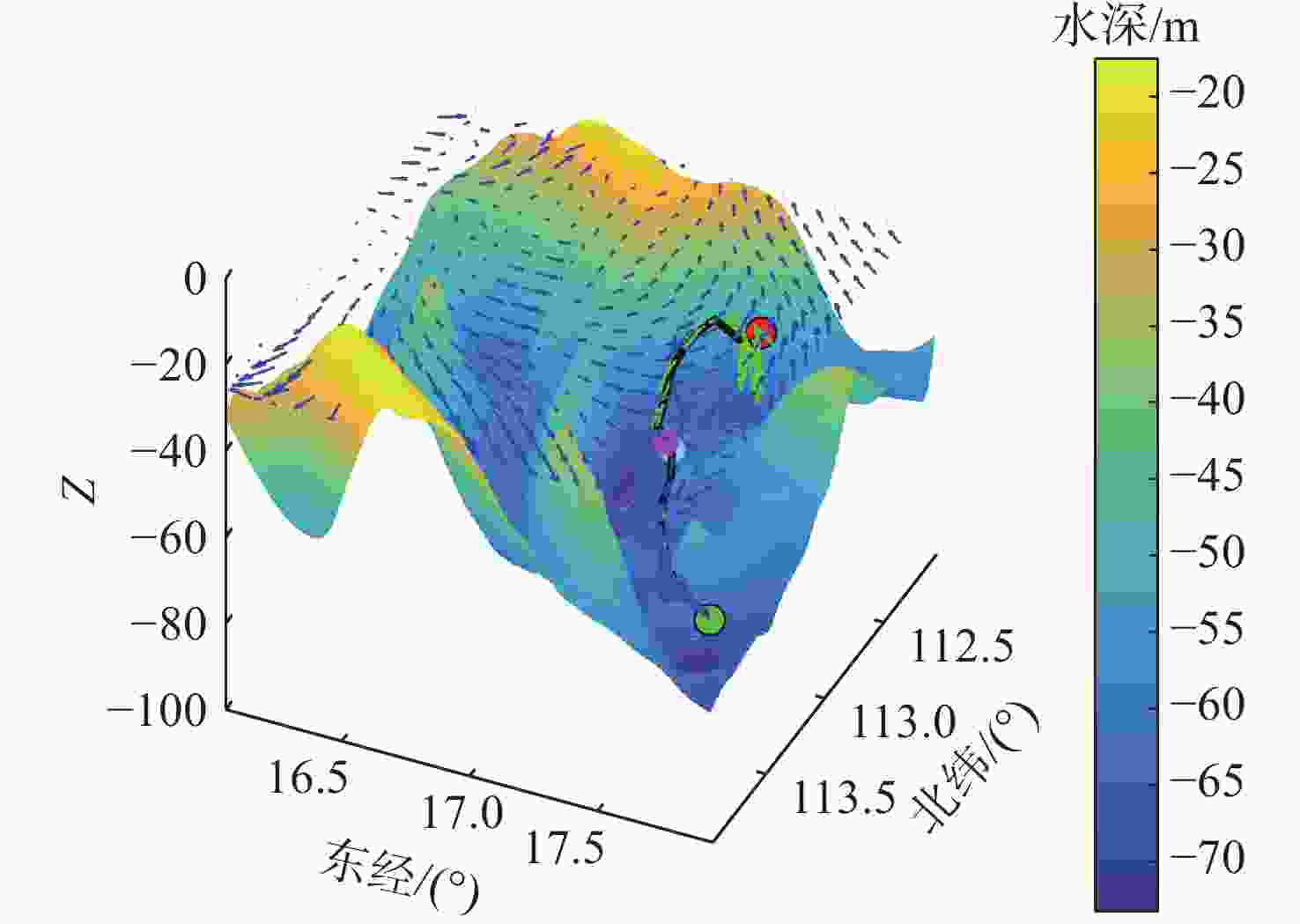
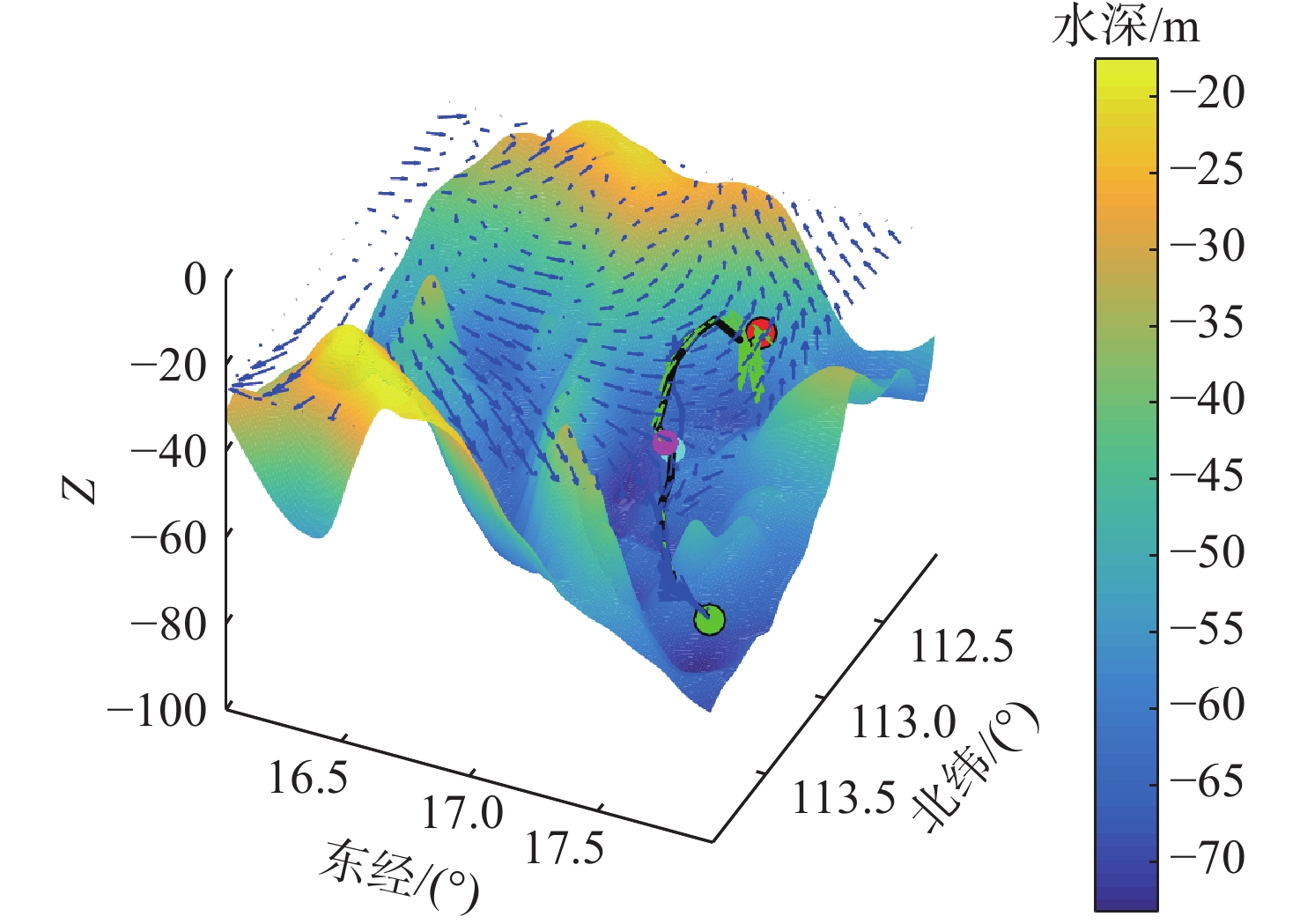
图 6 真实地形流场中的FAPF-Bi-RRT*路径规划
Figure 6. FAPF-Bi-RRT* path planning in real terrain flow fields
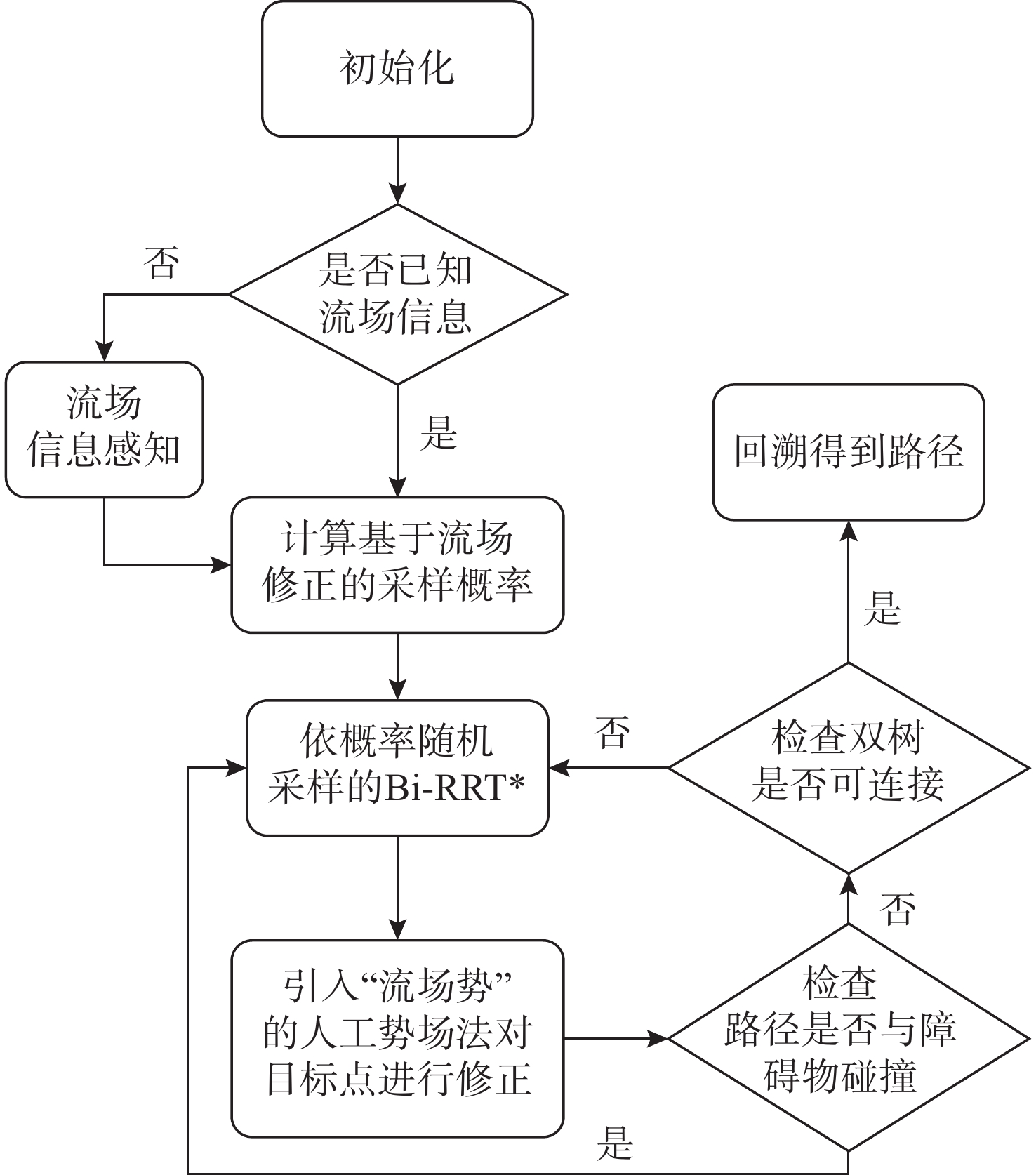
算法: FAPF-Bi-RRT* 1: T_a.Init(q_start); T_b.Init(q_goal);
2: for iter = 1 to N do
3: if isFlowFieldKnown != TRUE then
4: FlowFieldData ← FlowFieldPerception(Env)
5: else
6: FlowFieldData ← GetPredefinedFlowField()
7: end if
8: P_sampling ← CalSamplingProb(FlowFieldData)
9: q_rand ← GetRandSample(P_sampling)
10: q_nearest ← FindNearestNode(T_a, q_rand)
11: q_new ← Steer(q_nearest, q_rand)
12: q_new_opt ← APF_Optimize(q_new, FlowFieldData)
13: if CollisionFree(q_nearest, q_new_opt, Env) then
14: T_a.AddNode(q_new_opt)
15: T_a.Rewire()
16: if TryConnectTrees(T_a, T_b) == TRUE then
17: Path ← ExtractPath(T_a, T_b)
18: return Path
19: end if
20: Swap(T_a, T_b)
21: end if
22: end for
23: return Failure 下载: 导出CSV
表 2 主要超参数
Table 2. Main hyperparameters
符号 参数 数值 $ N $ 最大迭代次数 5000 $ \lambda $ 扩展步长 7 $ {P}_{\text{target}} $ 目标采样概率 0.1 $ {d}_{\text{connect}} $ 双树连接阈值 5 $ {k}_{\text{att}} $ 引力增益系数 1 $ {k}_{\text{rep}} $ 斥力增益系数 100 $ {d}_{\text{safe}} $ 障碍物影响距离 20 $ {\lambda }_{1}, {\lambda }_{2} $ 代价函数权重 0.5, 0.5 $ A $ 水动力阻力系数 1 $ B $ 转向能耗系数 0.5 $ {k}_{\text{flow}} $ 流场势强度系数 1 $ \beta $ 逆流调节因子 1 $ {\alpha }_{\max },{\alpha }_{\min } $ 方向权重上下限 0.8, 0.2
下载: 导出CSV
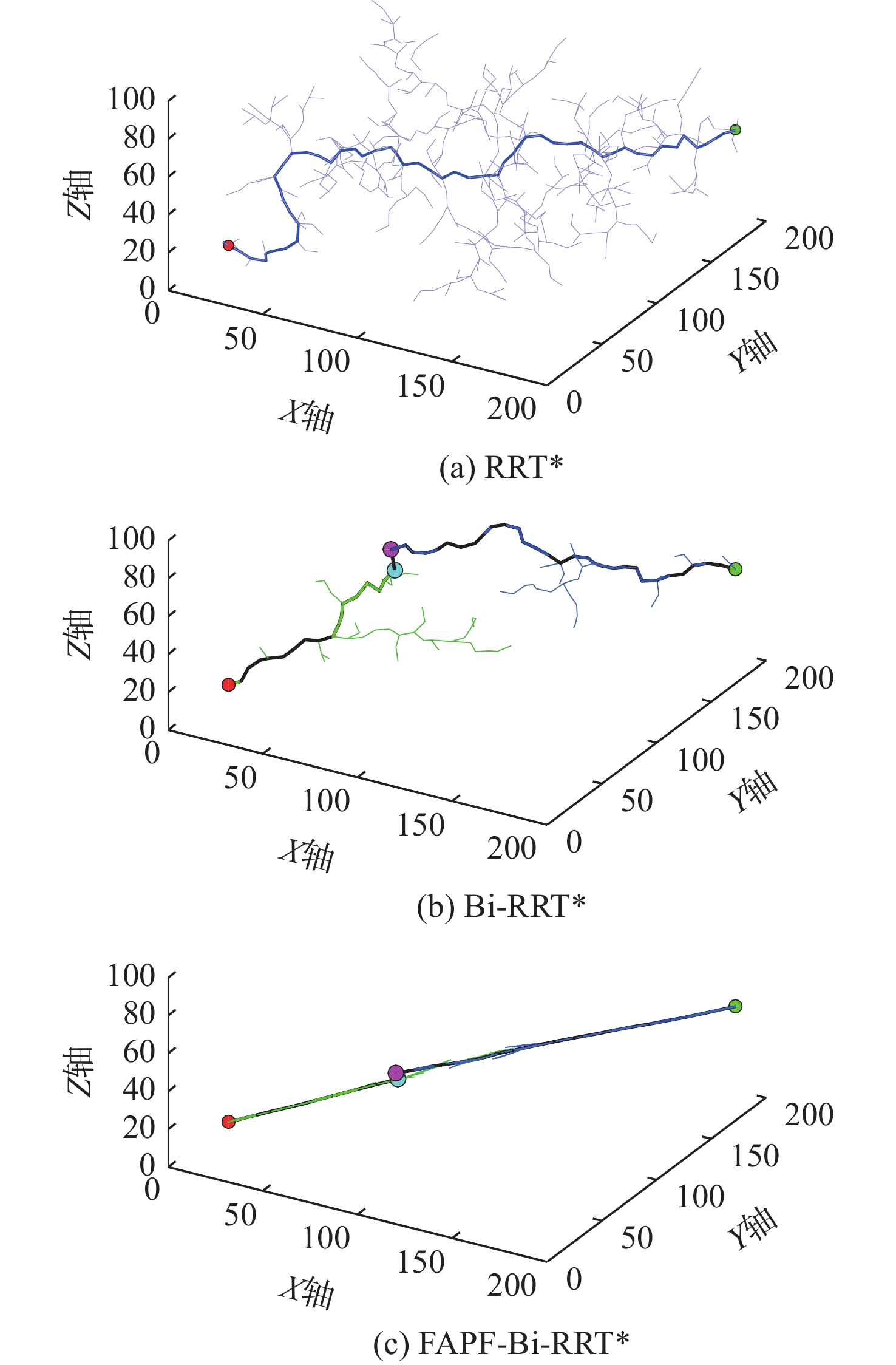
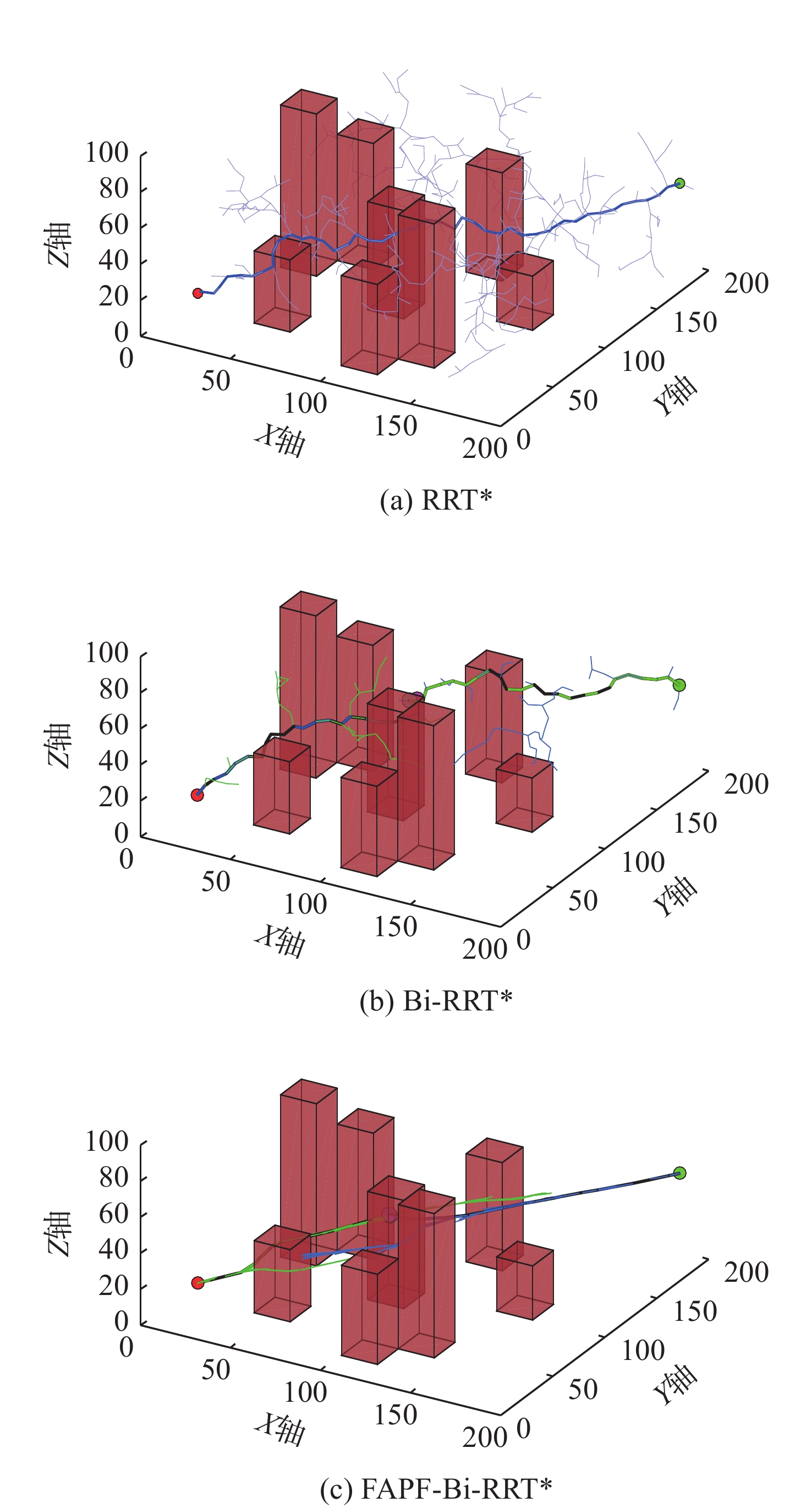
表 3 无障碍物无流场条件路径规划结果对比表
Table 3. Comparison of path planning results without obstacles and flow fields
算法 路径长度/m 计算时间/s 成功率 RRT* 329.92 0.353 0 0.98 Bi-RRT* 372.72 0.002 1 1.00 FAPF-Bi-RRT* 246.22 0.003 5 1.00
下载: 导出CSV
表 4 有障碍物无流场条件路径规划结果对比表
Table 4. Comparison of path planning results without flow field in obstacles environment
算法 路径长度/m 计算时间/s 成功率 RRT* 329.41 0.341 7 0.98 Bi-RRT* 336.29 0.002 9 1.00 FAPF-Bi-RRT* 255.40 0.009 8 1.00
下载: 导出CSV
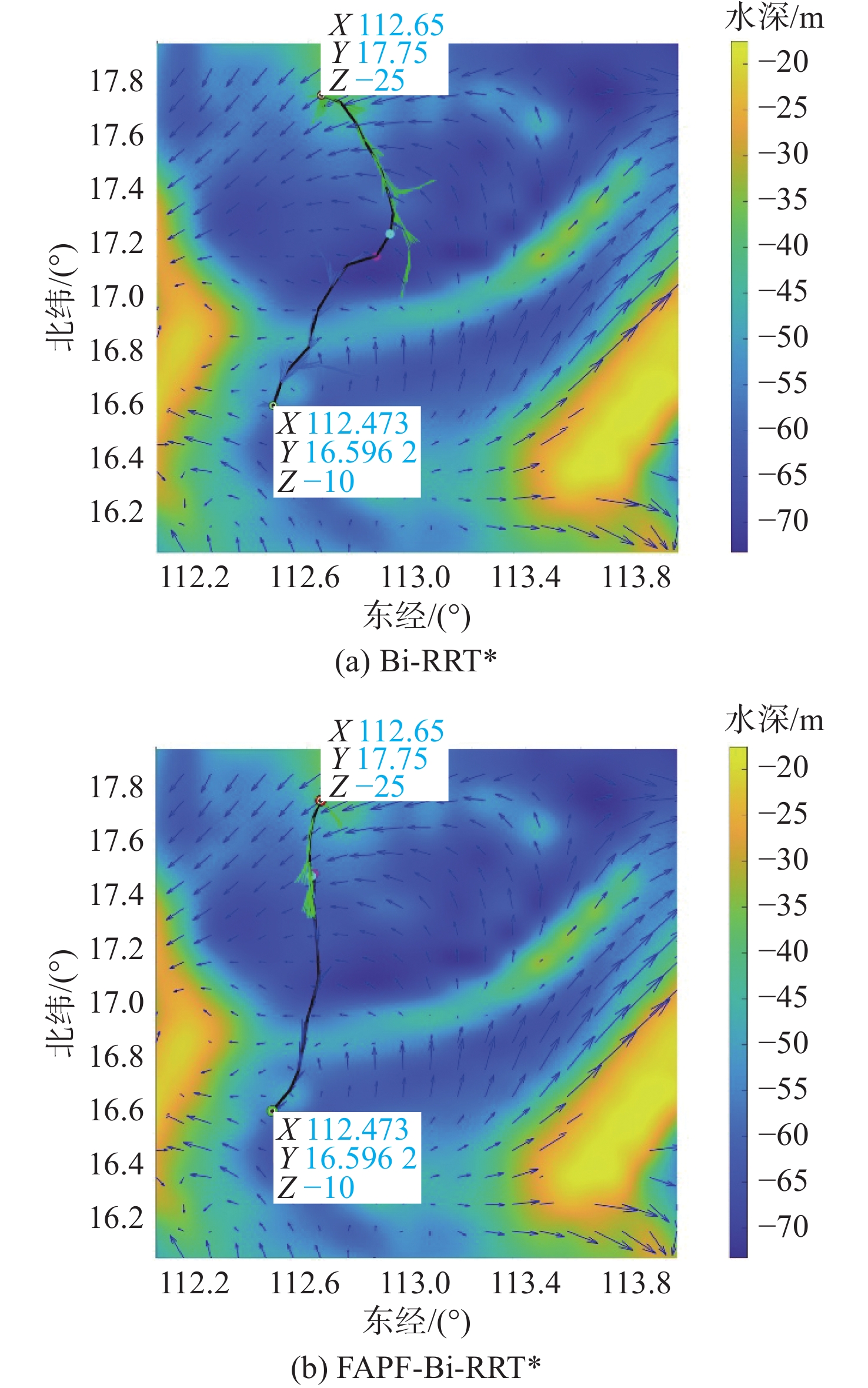
表 5 真实地形流场路径规划结果对比表
Table 5. Comparison of path planning results in real terrain flow fields
算法 路径
能耗(相对得分)路径
长度/km总代价
($ {\lambda }_{1}={\lambda }_{2}=0.5 $)(无量纲)Bi-RRT* 146.46 145.34 145.90 FAPF-Bi-RRT* 130.29 124.50 127.40
下载: 导出CSV
-
[1] 宋保维, 潘光, 张立川, 等. 自主水下航行器发展趋势及关键技术[J]. 中国舰船研究, 2022, 17(5): 27-44. doi: 10.19693/j.issn.1673-3185.02939Song B W, Pan G, Zhang L C, et al. Development trend and key technologies of autonomous underwater vehicles[J]. Chinese Journal of Ship Research, 2022, 17(5): 27-44. doi: 10.19693/j.issn.1673-3185.02939 [2] 黄玉龙, 张勇刚, 赵玉新. 自主水下航行器导航方法综述[J]. 水下无人系统学报, 2019, 27(3): 232-253. doi: 10.11993/j.issn.2096-3920.2019.03.002Huang Y L, Zhang Y G, Zhao Y X. Review of autonomous undersea vehicle navigation methods[J]. Journal of Unmanned Undersea Systems, 2019, 27(3): 232-253. doi: 10.11993/j.issn.2096-3920.2019.03.002 [3] 周帅, 王征, 杨洋, 等. 自主水下航行器路径规划技术综述及展望[J]. 舰船电子工程, 2023, 43(3): 1-6. doi: 10.3969/j.issn.1672-9730.2023.03.001Zhou S, Wang Z, Yang Y, et al. Overview and prospect of path planning technology for autonomous underwater vehicle[J]. Ship Electronic Engineering, 2023, 43(3): 1-6. doi: 10.3969/j.issn.1672-9730.2023.03.001 [4] 王奎民. 主要海洋环境因素对水下航行器航行影响分析[J]. 智能系统学报, 2015, 10(2): 316-323. doi: 10.3969/j.issn.1673-4785.201503006Wang K M. Influence of main ocean environments on the navigation of underwater vehicles[J]. CAAI Transactions on Intelligent Systems, 2015, 10(2): 316-323. doi: 10.3969/j.issn.1673-4785.201503006 [5] 韩雨馨. 考虑海流影响的AUV节能航线规划与避障方法研究[D]. 哈尔滨: 哈尔滨工程大学, 2025. [6] Ru J Y, Yu S J, Wu H, et al. A multi-AUV path planning system based on the omni-directional sensing ability[J]. Journal of Marine Science and Engineering, 2021, 9(8): 806. doi: 10.3390/jmse9080806 [7] 任晔, 王俊雄, 张小卿. 基于多因素改进A*算法的AUV路径规划研究[J]. 舰船科学技术, 2022, 44(11): 58-62. doi: 10.3404/j.issn.1672-7649.2022.11.012Ren Y, Wang J X, Zhang X Q. Research on AUV path planning based on multi-factor improved A* algorithm[J]. Ship Science and Technology, 2022, 44(11): 58-62. doi: 10.3404/j.issn.1672-7649.2022.11.012 [8] Gammell J D, Srinivasa S S, Barfoot T D. Informed RRT*: optimal sampling-based path planning focused via direct sampling of an admissible ellipsoidal heuristic[C]//2014 IEEE/RSJ International Conference on Intelligent Robots and Systems. IEEE, 2014: 2997-3004. [9] 马小轩, 吴韵哲, 吴浩峻, 等. 基于改进人工势场法的水下自主航行器路径规划[J]. 船舶工程, 2021, 43(9): 89-93,100. doi: 10.13788/j.cnki.cbgc.2021.09.16Ma X X, Wu Y Z, Wu H J, et al. Path planning of autonomous underwater vehicle based on improved artificial potential field method[J]. Ship Engineering, 2021, 43(9): 89-93,100. doi: 10.13788/j.cnki.cbgc.2021.09.16 [10] 张强, 刘晓宇, 张南庆, 等. 基于改进人工势场算法的AUV路径规划[J]. 中国航海, 2021, 44(2): 134-141. doi: 10.3969/j.issn.1000-4653.2021.02.022Zhang Q, Liu X Y, Zhang N Q, et al. An improved artificial potential field algorithm for AUV path planning[J]. Navigation of China, 2021, 44(2): 134-141. doi: 10.3969/j.issn.1000-4653.2021.02.022 [11] 张岳星, 王轶群, 李硕, 等. 基于海图和改进粒子群优化算法的AUV全局路径规划[J]. 机器人, 2020, 42(1): 120-128. doi: 10.13973/j.cnki.robot.190100Zhang Y X, Wang Y Q, Li S, et al. Global path planning for AUV based on charts and the improved particle swarm optimization algorithm[J]. Robot, 2020, 42(1): 120-128. doi: 10.13973/j.cnki.robot.190100 [12] 潘昕, 吴旭升, 侯新国, 等. 基于遗传蚂蚁混合算法的AUV全局路径规划[J]. 华中科技大学学报(自然科学版), 2017, 45(5): 45-49, 76. doi: 10.13245/j.hust.170509Pan X, Wu X S, Hou X G, et al. Global path planning based on genetic-ant hybrid algorithm for AUV[J]. Journal of Huazhong University of Science and Technology (Natural Science Edition), 2017, 45(5): 45-49, 76. doi: 10.13245/j.hust.170509 [13] 庞舟岐, 林晓波, 郝程鹏, 等. 基于深度强化学习的矢量推进AUV路径规划方法[J]. 水下无人系统学报, 2025, 33(4): 638-647. doi: 10.11993/j.issn.2096-3920.2025-0005Pang Z Q, Lin X B, Hao C P, et al. Vector propulsion AUV path planning method based on deep reinforcement learning[J]. Journal of Unmanned Undersea Systems, 2025, 33(4): 638-647. doi: 10.11993/j.issn.2096-3920.2025-0005 [14] 陈超洋, 唐于特, 黄毅, 等. 面向动态障碍环境的AUV三维路径规划[J]. 水下无人系统学报, 2025, 33(3): 400-409. doi: 10.11993/j.issn.2096-3920.2025-0008Chen C Y, Tang Y T, Huang Y, et al. Three-dimensional path planning of AUVs in dynamic obstacle environments[J]. Journal of Unmanned Undersea Systems, 2025, 33(3): 400-409. doi: 10.11993/j.issn.2096-3920.2025-0008 [15] He Z C, Dong L, Sun C Y, et al. Asynchronous multithreading reinforcement-learning-based path planning and tracking for unmanned underwater vehicle[J]. IEEE Transactions on Systems, Man, and Cybernetics: Systems, 2022, 52(5): 2757-2769. doi: 10.1109/TSMC.2021.3050960 [16] Han X, Shen C L, Song G L, et al. Energy-efficient path planning for AUVs in ocean current environments[C]//OCEANS 2025 Brest. 2025: 1-6. [17] Han S, Zhao J A, Li X B, et al. Online path planning for AUV in dynamic ocean scenarios: a lightweight neural dynamics network approach[J]. IEEE Transactions on Intelligent Vehicles, 2024, 9(2): 3782-3795. doi: 10.1109/TIV.2024.3356529 [18] Liu S, Wang Z F, Wang T, et al. Energy-optimized path planning for fully actuated AUVs in complex 3D environments[J]. Journal of Marine Science and Engineering, 2025, 13(7): 1269. doi: 10.3390/jmse13071269 [19] Sun B, Zhang W, Li S Q, et al. Energy optimised D* AUV path planning with obstacle avoidance and ocean current environment[J]. Journal of Navigation, 2022, 75(3): 685-703. doi: 10.1017/S0373463322000091 [20] Zhu D J, Yang S X. Path planning method for unmanned underwater vehicles eliminating effect of currents based on artificial potential field[J]. Journal of Navigation, 2021, 74(5): 955-967. doi: 10.1017/S0373463321000345 [21] Zhu D J, ZHAO S L, ZHAO R. Path planning for autonomous underwater vehicle based on artificial potential field and modified RRT[C]//2021 International Conference on Computer, Control and Robotics(ICCCR). 2021: 21-25. [22] Ge L, Phang S K, Sariff N. DPF-Bi-RRT*: an improved path planning algorithm for complex 3D environments with adaptive sampling and dual potential field strategy[J]. IEEE Access, 2025, 13: 35958-35972. doi: 10.1109/ACCESS.2025.3544546 [23] 张兆顺, 崔桂香. 流体力学[M]. 北京: 清华大学出版社, 1999. [24] 齐本胜, 李岩, 苗红霞, 等. 基于改进启发式RRT的AUV路径规划[J]. 系统仿真学报, 2025, 37(1): 245-256. doi: 10.16182/j.issn1004731x.joss.23-1110Qi B S, Li Y, Miao H X, et al. Research on path planning method for autonomous underwater vehicles based on improved informed RRT[J]. Journal of System Simulation, 2025, 37(1): 245-256. doi: 10.16182/j.issn1004731x.joss.23-1110 -

 下载:
下载:

 点击查看大图
计量
- 文章访问数: 212
- HTML全文浏览量: 111
- PDF下载量: 10
- 被引次数: 0