

AUV Terrain-following Method Based on B-Spline Planning and Meta-learning-based LTV-MPC
-
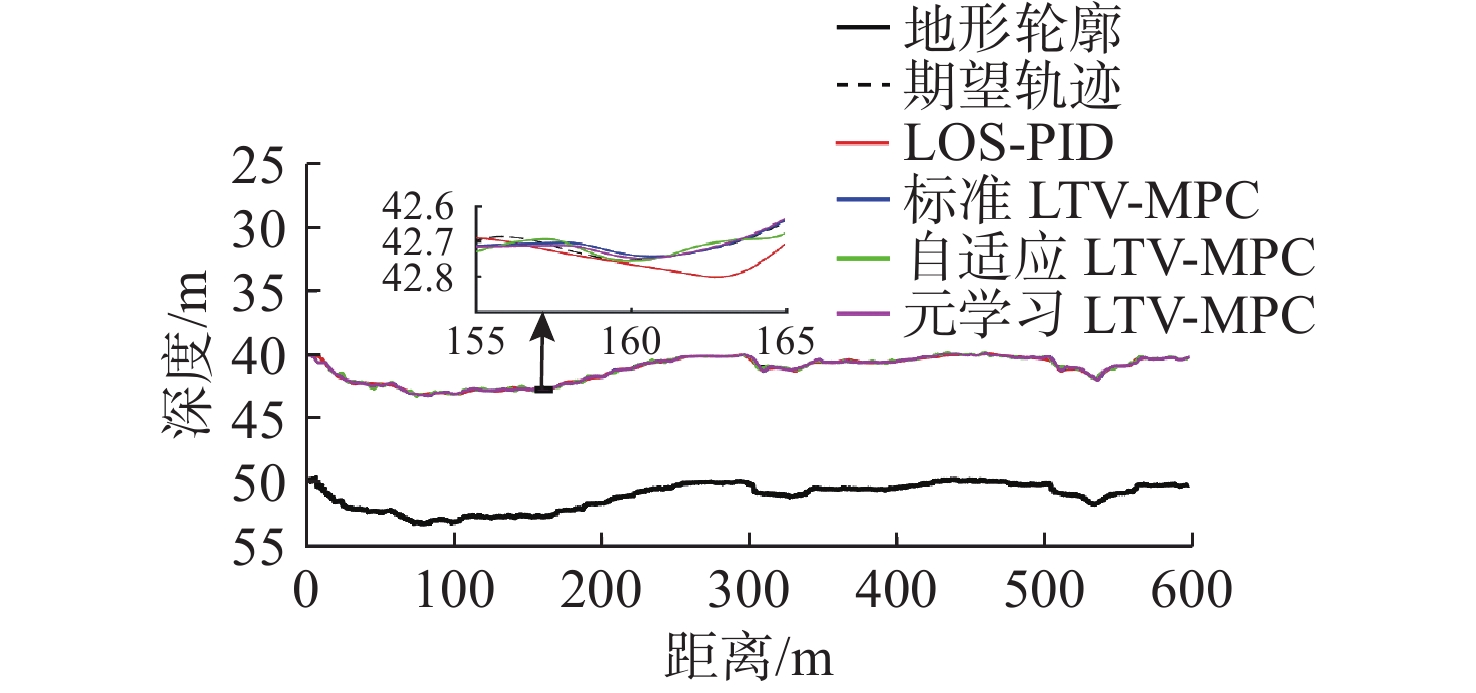
摘要: 针对自主水下航行器(AUV)在复杂海底地形下近底航行时难以同时满足跟踪精度、离底安全和执行器约束的问题, 文中提出一种基于滑动窗口B样条规划的地形跟踪方法, 并在控制层引入基于元学习的权重自适应线性时变模型预测控制(LTV-MPC)策略。规划层采用三次B样条在坡度约束下生成保持定高裕度的参考路径, 结合滑动窗口机制实现局部优化与全局连续性的平衡; 控制层采用 LTV-MPC控制器, 由元学习网络根据地形曲率、深度及姿态误差等特征在线调整代价函数权重, 以适应不同地形条件下的跟踪难度变化。元网络参数通过贝叶斯优化在多组合成地形闭环仿真数据上离线训练, 学习地形特征与最优权重的映射关系, 在线阶段仅需前向推理, 计算效率高。在所设定的仿真场景中, 合成地形与实测地形数据验证表明, 相比视线制导-比例积分微分, 所提方法的均方根(RMS)跟踪误差在2种地形下分别降低42.5%和31.3%, 相比标准LTV-MPC, RMS跟踪误差分别降低4.5%和6.1%, 同时满足俯仰角和舵角约束, 有效解决了复杂地形下跟踪精度与安全性的平衡问题。Abstract: To address the challenge of simultaneously ensuring tracking accuracy, safe bottom clearance, and compliance with actuator constraints for an autonomous undersea vehicle(AUV) operating near complex seabed terrain, this paper proposes a terrain-following method based on sliding-window B-spline planning and a meta-learning-based, weight-adaptive linear time-varying model predictive control(LTV-MPC) strategy. The planning layer employs cubic B-splines subject to slope constraints to generate a reference path that maintains a prescribed altitude margin, while a sliding-window mechanism balances local optimization with global continuity. The control layer implements an LTV-MPC controller equipped with a meta-learning network that adaptively adjusts the cost-function weights online based on features such as terrain curvature, depth error, and attitude error, thus accommodating variations in tracking difficulty across different terrain conditions. The meta-network parameters are trained offline through Bayesian optimization using closed-loop simulation data from multiple synthetic terrains, enabling the network to learn the mapping between terrain features and optimal weights. In the online stage, only forward inference is required, resulting in high computational efficiency. In the specified simulation scenarios, validation using synthetic and measured terrain data demonstrates that the proposed method reduces the root-mean-square(RMS) tracking error by 42.5% and 31.3%, respectively, compared with line-of-sight guidance combined with proportional-integral-derivative control(LOS-PID). Compared with standard LTV-MPC, the RMS tracking error is reduced by 4.5% and 6.1%, respectively. Meanwhile, the pitch-angle and rudder-angle constraints are satisfied, effectively resolving the trade-off between tracking accuracy and safety under complex terrain conditions.
-
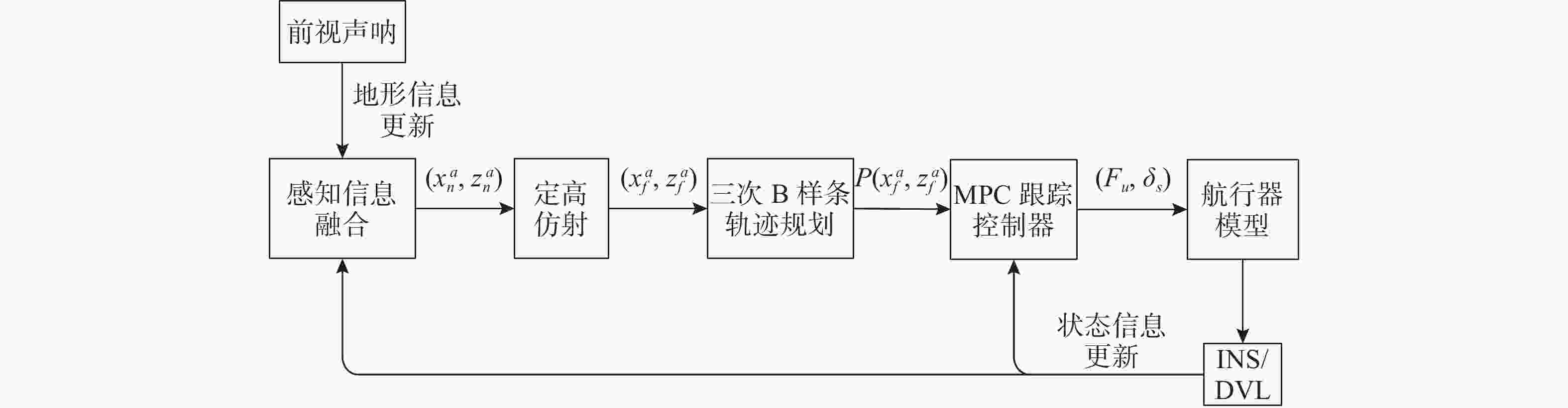
图 2 滑动窗口 B 样条规划与元学习 LTV-MPC 一体化控制框架
Figure 2. Integration framework of sliding-window B-spline planning and meta-learning LTV-MPC control
表 1 滑动窗口在线规划流程
Table 1. Sliding window online planning process
步骤 执行内容 1 初始化窗口参数$ ({L}_{\text{win}},\Delta {x}_{\text{win}}) $及权重$ ({\lambda }_{s},{\lambda }_{t}) $ 2 获取窗口$ W_{\chi} $内地形点数据$ (x_a,\text{z}_a) $ 3 构建局部优化问题(式(12)) 4 求解最优控制点子集$ P_{\chi}^* $ 5 施加相邻窗口间路径连续性约束(式(13)) 6 更新全局B样条参考路径$ S \left(x\right) $ 7 输出路径至底层控制模块, 滑动窗口返回步骤2  下载: 导出CSV
表 2 主要参数取值
Table 2. Values of key parameter
模型参数 取值 算法参数 取值 $ m $/kg 73 $ {\gamma }_{\max } $/(°) ±25 $ L $/m 2.2 $ {\kappa }_{\max } $/m−1 0.08 $ {X}_{\dot{u}} $/kg −6.5 $ {N}_{p} $ 17 $ {Z}_{\dot{w}} $/kg −64.2 $ {N}_{c} $ 9 $ {M}_{\dot{q}} $/(kg·m)2 −14.1 $ \Delta t $/s 0.1 $ {X}_{u} $/(N·s/m) 0.0 $ {u}_{r} $/(m/s) 1.5 $ {X}_{u|u|} $/(N·s2/m2) 2.974 $ \boldsymbol{Q} $ diag(0.15, 350,
150, 120, 8, 3)$ {Z}_{w} $/(N·s/m) 134.051 $ \boldsymbol{R} $ diag(0.05, 0.35) $ {Z}_{w|w|} $/(N·s2/m2) 9.375 $ \begin{aligned}& [\alpha _{{\mu}}^{\min },\alpha _{{\mu}}^{\max }],\\& {\mu}\in \{{\textit{z}}, \theta ,\delta \}\end{aligned} $ [0.8, 2.0] $ {M}_{q} $/(N·m·s) 35.145 $ {M}_{q|q|} $/(N·m·s2) 0.369
下载: 导出CSV
表 3 合成地形场景下控制器性能对比
Table 3. Performance comparison of controllers in synthetic terrain scene
控制器 RMS误差/m 峰值误差/m 滞后时间/s LOS-PID 0.073 0.282 0.00 标准LTV-MPC 0.044 0.310 0.00 自适应LTV-MPC 0.053 0.345 0.00 元学习LTV-MPC 0.042 0.289 0.00
下载: 导出CSV
表 4 真实地形下控制器性能对比
Table 4. Performance comparison of controllers in real terrain
控制器 RMS误差/m 峰值误差/m 滞后时间/s LOS-PID 0.067 0.357 0.00 标准LTV-MPC 0.049 0.349 0.00 自适应LTV-MPC 0.052 0.367 −0.10 元学习LTV-MPC 0.046 0.337 0.00
下载: 导出CSV
表 5 不同时域参数下MPC求解时间
Table 5. MPC solution time under different time domain parameters
预测
时域控制
时域元学习推
理时间/ms元学习MPC
调用时间/ms单步控制
总耗时/ms15 8 0.70±0.19 4.7±1.2 5.0±1.6 17 9 0.74±0.10 4.9±0.7 5.3±0.7 20 10 0.92±0.19 6.2±1.3 6.6±1.3 注: 元学习MPC调用时间中包含元学习推理时间; 单步控制总耗时除元学习MPC调用外还包括状态估计、参考生成及数据记录等开销。
下载: 导出CSV
表 6 不同历史采样点配置下规划层求解时间
Table 6. Planning layer solving time under different historical-sample configurations
历史采样点数 拟合点数 B样条控制点数 求解时间/ms 20 8 4 33.0±6.8 40 18 6 75.9±17.2 60 28 10 125.9±35.6 80 38 14 235.7±55.9
下载: 导出CSV
-
[1] Melo J, Matos A. Bottom estimation and following with the MARES AUV[C]//OCEANS 2012, 2012: 1-8. [2] Bush L A M, Blackmore L, Williams B C. AUV bathymetric mapping depth planning for bottom following via sparse linear programming[C]//OCEANS 2016 MTS/IEEE Monterey, 2016: 1-8. [3] 皮棋棋. 基于动态路径生成的UUV海底地形跟踪方法研究[D]. 哈尔滨: 哈尔滨工程大学, 2020: 26-32. [4] 陈涛, 万首. 利用前视和测高声呐的UUV地形跟踪动态路径生成方法[J]. 水下无人系统学报, 2024, 32(2): 304-310. doi: 10.11993/j.issn.2096-3920.2023-0047Chen T, Wan S. Dynamic path generation method for UUV terrain tracking using forward-looking sonar and altimetry sonar[J]. Journal of Unmanned Undersea Systems, 2024, 32(2): 304-310. doi: 10.11993/j.issn.2096-3920.2023-0047 [5] Silvestre C, Cunha R, Paulino N, et al. A bottom-following preview controller for autonomous underwater vehicles[J]. IEEE Transactions on Control Systems Technology, 2009, 17(2): 257-266. doi: 10.1109/TCST.2008.922560 [6] 边信黔, 程相勤, 贾鹤鸣, 等. 基于迭代滑模增量反馈的欠驱动AUV地形跟踪控制[J]. 控制与决策, 2011, 26(2): 289-292,296. doi: 10.13195/j.cd.2011.02.132.bianxq.024Bian X Q, Cheng X Q, Jia H M, et al. A bottom-following controller for underactuated AUV based on iterative sliding and increment feedback[J]. Control and Decision, 2011, 26(2): 289-292,296. doi: 10.13195/j.cd.2011.02.132.bianxq.024 [7] 贾鹤鸣, 宋文龙, 周佳加. 基于非线性反步法的欠驱动AUV地形跟踪控制[J]. 北京工业大学学报, 2012, 38(12): 1780-1785.Jia H M, Song W L, Zhou J J. Bottom following control for an underactuated AUV based on nonlinear backstepping method[J]. Journal of Beijing University of Technology, 2012, 38(12): 1780-1785. [8] Adhami M A, Yazdanpanah M J, Aguiar A P. Automatic bottom-following for underwater robotic vehicles[J]. Automatica, 2014, 50(8): 2155-2162. doi: 10.1016/j.automatica.2014.06.003 [9] 白继嵩, 庞永杰, 万磊, 等. 基于自适应方法的欠驱动AUV地形跟踪控制[J]. 电机与控制学报, 2017, 21(6): 83-88. doi: 10.15938/j.emc.2017.06.011Bai J S, Pang Y J, Wan L, et al. Underactuated AUV’s bottom-following control based on self-adaptive method[J]. Electric Machines and Control, 2017, 21(6): 83-88. doi: 10.15938/j.emc.2017.06.011 [10] Cai M, Wang Y, Wang S, et al. Prediction-based seabed terrain following control for an underwater vehicle-manipulator system[J]. IEEE Transactions on Systems, Man, and Cybernetics: Systems, 2021, 51(8): 4751-4760. doi: 10.1109/TSMC.2019.2944651 [11] 李锦江, 向先波, 刘传, 等. 基于预设性能制导律的欠驱动AUV海底地形鲁棒时滞跟踪控制[J]. 上海交通大学学报, 2022, 56(7): 944-952. doi: 10.16183/j.cnki.jsjtu.2021.375Li J J, Xiang X B, Liu C, et al. Robust seabed terrain following control of underactuated AUV with prescribed performance guidance law under time delay of actuator[J]. Journal of Shanghai Jiao Tong University, 2022, 56(7): 944-952. doi: 10.16183/j.cnki.jsjtu.2021.375 [12] Wang W R, Su Z H, Ge H L, et al. Obstacle avoidance based on double closed loop control of autonomous underwater vehicle for submarine cable laying[J]. Ocean Engineering, 2023, 279: 114360. doi: 10.1016/j.oceaneng.2023.114360 [13] Yan Z, Hao L, Wang Y, et al. A terrain-following control method for autonomous underwater vehicles with single-beam sensor configuration[J]. Journal of Marine Science and Engineering, 2024, 12(3): 366. doi: 10.3390/jmse12030366 [14] Gautam A. Computationally efficient trajectory tracking control of AUVs with nonlinear model predictive control using neural-based dynamics modeling[J]. Journal of Advanced Marine Engineering and Technology, 2024, 48(4): 207-218. doi: 10.5916/jamet.2024.48.4.207 [15] Zhang Z, Pan X, Chen T, et al. Deep reinforcement learning with model predictive control for path following of autonomous underwater vehicle[C]//2024 43rd Chinese Control Conference(CCC), 2024: 2516-2523. [16] Lapandić D, Xie F, Verginis C K, et al. Meta-learning augmented MPC for disturbance-aware motion planning and control of quadrotors[J]. IEEE Control Systems Letters, 2024, 8: 3045-3050. doi: 10.1109/LCSYS.2024.3520023 [17] Wei M, Zheng L, Wu Y, et al. Meta-learning enhanced model predictive contouring control for agile and precise quadrotor flight[J]. IEEE Transactions on Robotics, 2025, 41: 3590-3608. doi: 10.1109/TRO.2025.3567491 [18] Goff J A, Jordan T H. Stochastic modeling of seafloor morphology: Inversion of Sea Beam data for second-order statistics[J]. Journal of Geophysical Research: Solid Earth, 1988, 93(11): 13589-13608. doi: 10.1029/jb093ib11p13589 -

 下载:
下载:

 点击查看大图
计量
- 文章访问数: 639
- HTML全文浏览量: 357
- PDF下载量: 56
- 被引次数: 0