

Design and Simulation of Biomimetic Fish Caudal FinDriven by EAP Materials
-
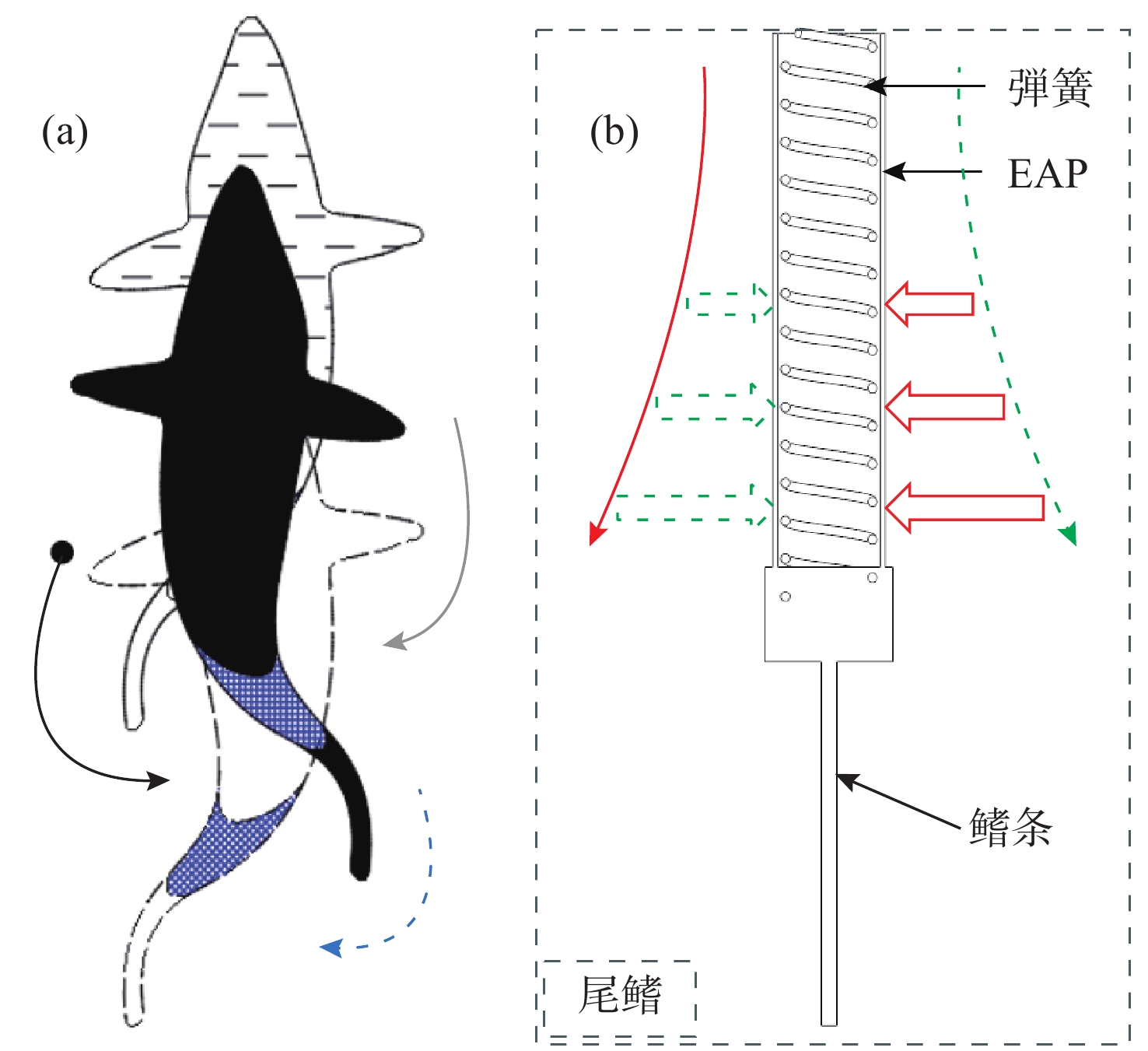
摘要: 在海洋保护与探测领域不断发展的背景下, 传统水下驱动装置存在结构复杂、运动效率偏低等固有缺陷, 柔性材料凭借适配性强、安全性高及灵活性足的优势, 逐渐成为水下仿生驱动领域的研究热点。文中依托电活性聚合物(EAP)能量密度高、机电耦合效率高的材料优势, 结合弹簧挠曲变形与弹性恢复作用, 模拟鱼体-尾鳍(BCF)推进模式的收缩与放松周期性变形过程, 设计了一种圆柱形仿生尾鳍驱动装置, 可实现尾鳍肌肉的连续顺应性变化。基于流体力学理论系统分析尾鳍运动规律与推进力的耦合机理, 构建鳍条摆动瞬时力学模型, 并融入实验数据进行求解。利用Fluent软件建立三维数值仿真模型, 通过动网格计算结果与力学模型预测结果的对比分析, 完成模型有效性验证, 为新型仿生鱼的设计开发提供理论支撑与实验依据。Abstract: With the continuous development of marine conservation and exploration, traditional underwater actuation devices have inherent drawbacks such as complicated structures and low motion efficiency. Flexible materials have gradually become a research focus in the field of underwater biomimetic actuation due to their advantages of strong adaptability, high safety, and sufficient flexibility. Relying on the material advantages of high energy density and high electromechanical coupling efficiency of electroactive polymer(EAP), and combining the flexural deformation and elastic recovery effects of a spring, this paper designed a cylindrical biomimetic caudal fin actuator by simulating the periodic deformation process of contraction and relaxation of the body-caudal fin(BCF) propulsion mode, which could achieve the continuous compliant changes of the caudal fin muscle. Based on hydrodynamic theory, this study systematically analyzed the coupling mechanism between the movement law of the caudal fin and the propulsion force, constructed an instantaneous mechanical model of fin ray oscillation, and integrated experimental data for solution. Furthermore, this study established a three-dimensional numerical simulation model using Fluent software and verified the effectiveness of the model through the comparative analysis between the dynamic mesh calculation results and the mechanical model prediction results. This study provides theoretical support and experimental basis for the design and development of new biomimetic fish.
-
Key words:
- biomimetic fish /
- caudal fin /
- electroactive polymer /
- body-caudal fin propulsion mode
-
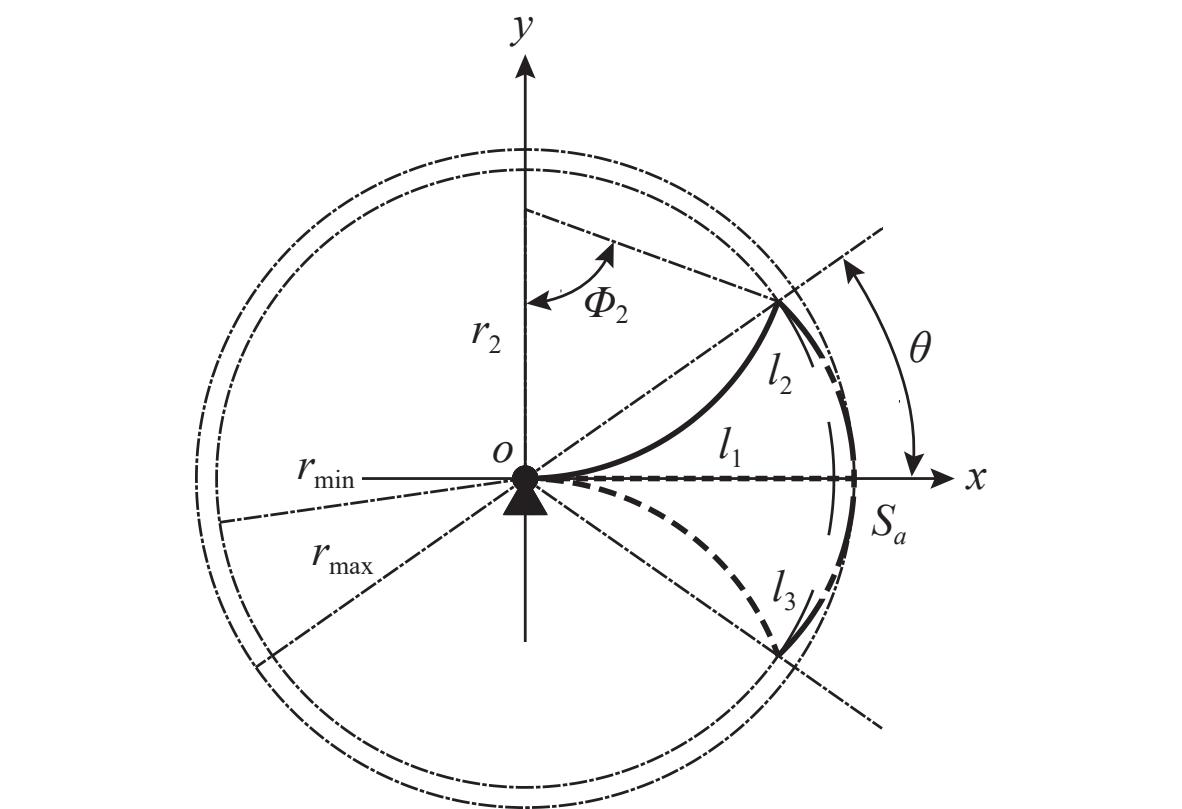
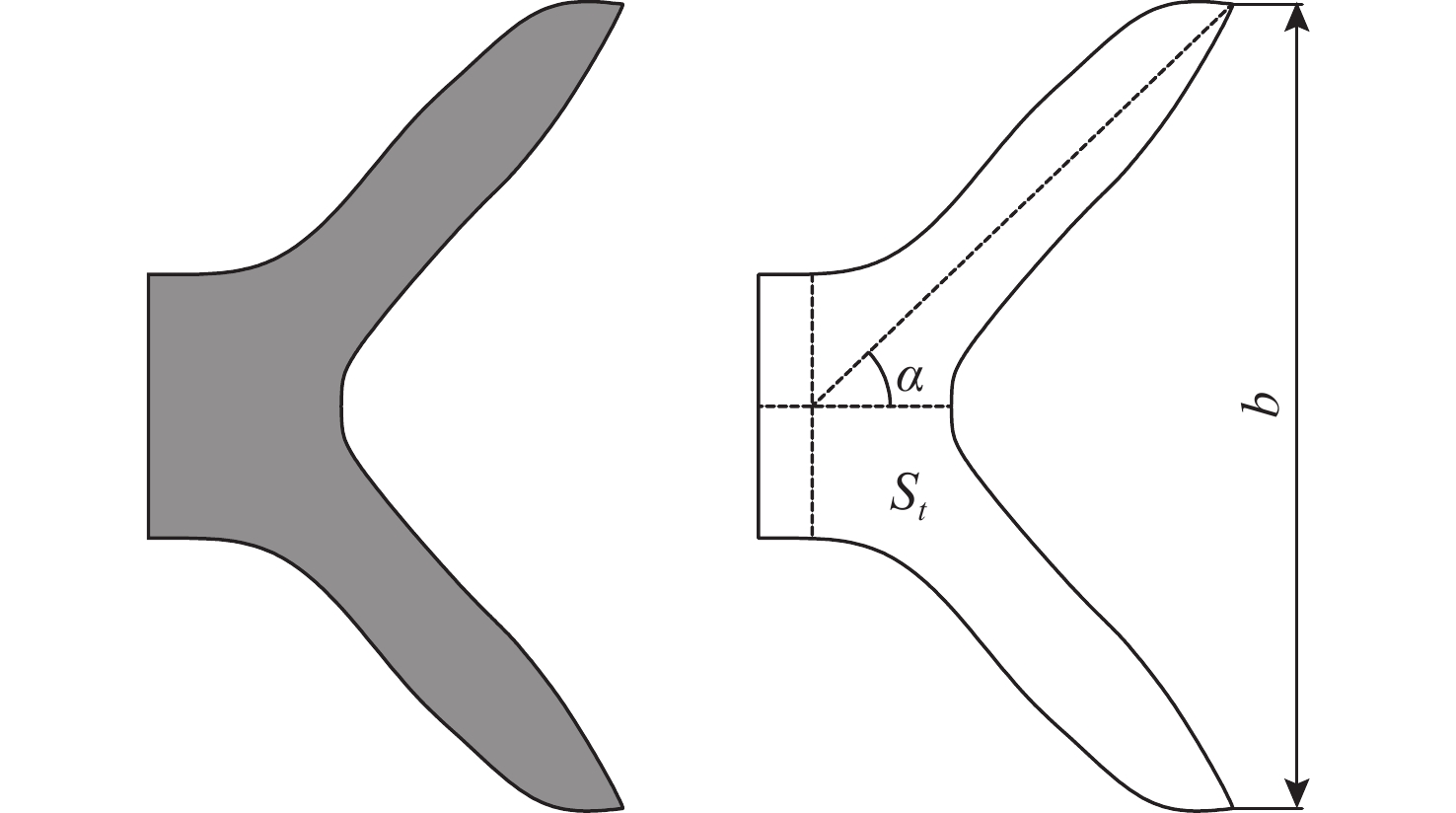
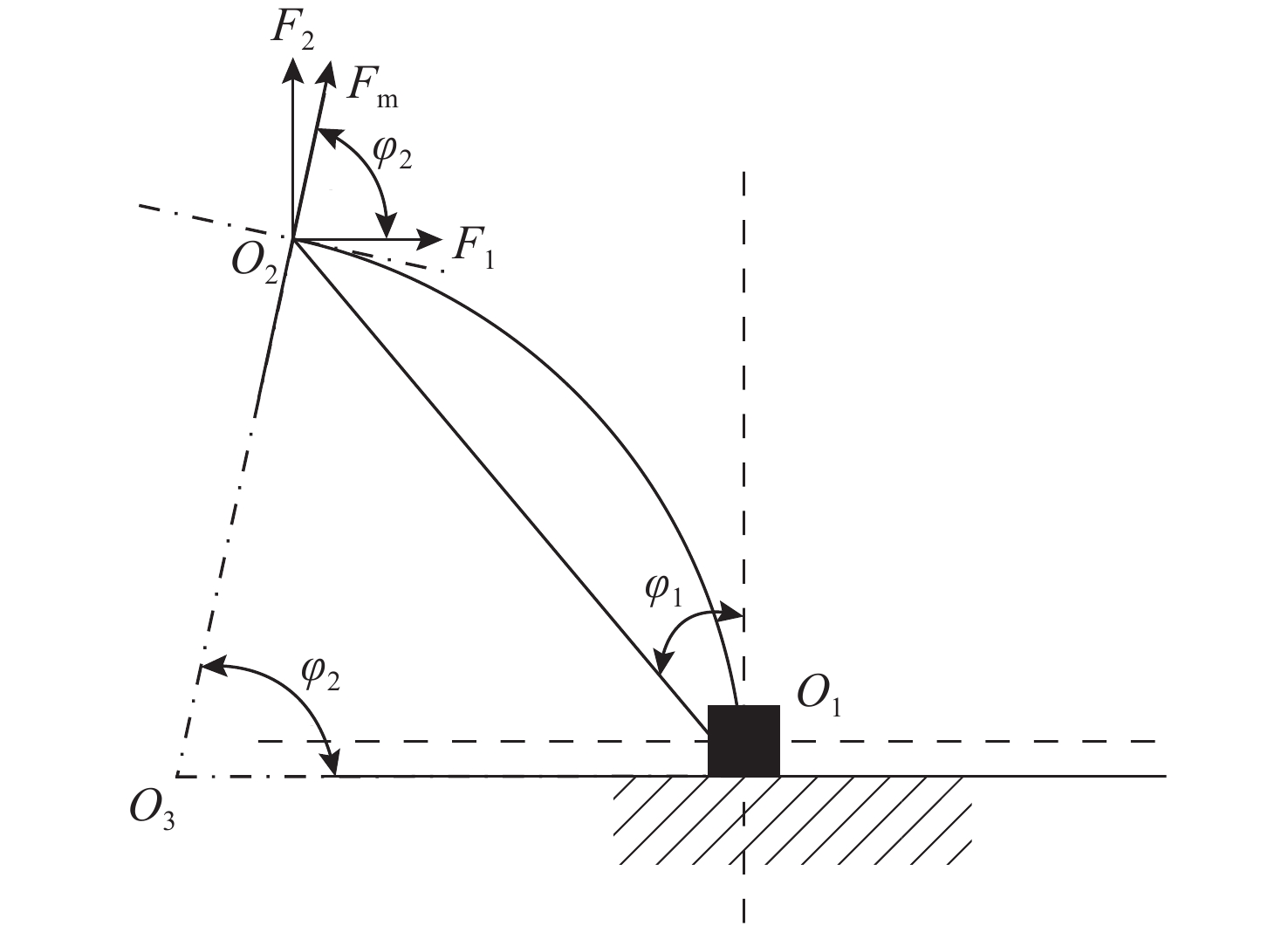
图 9 鱼尾弯曲变形几何结构图
Figure 9. Geometric structure diagram of caudal fin bending deformation
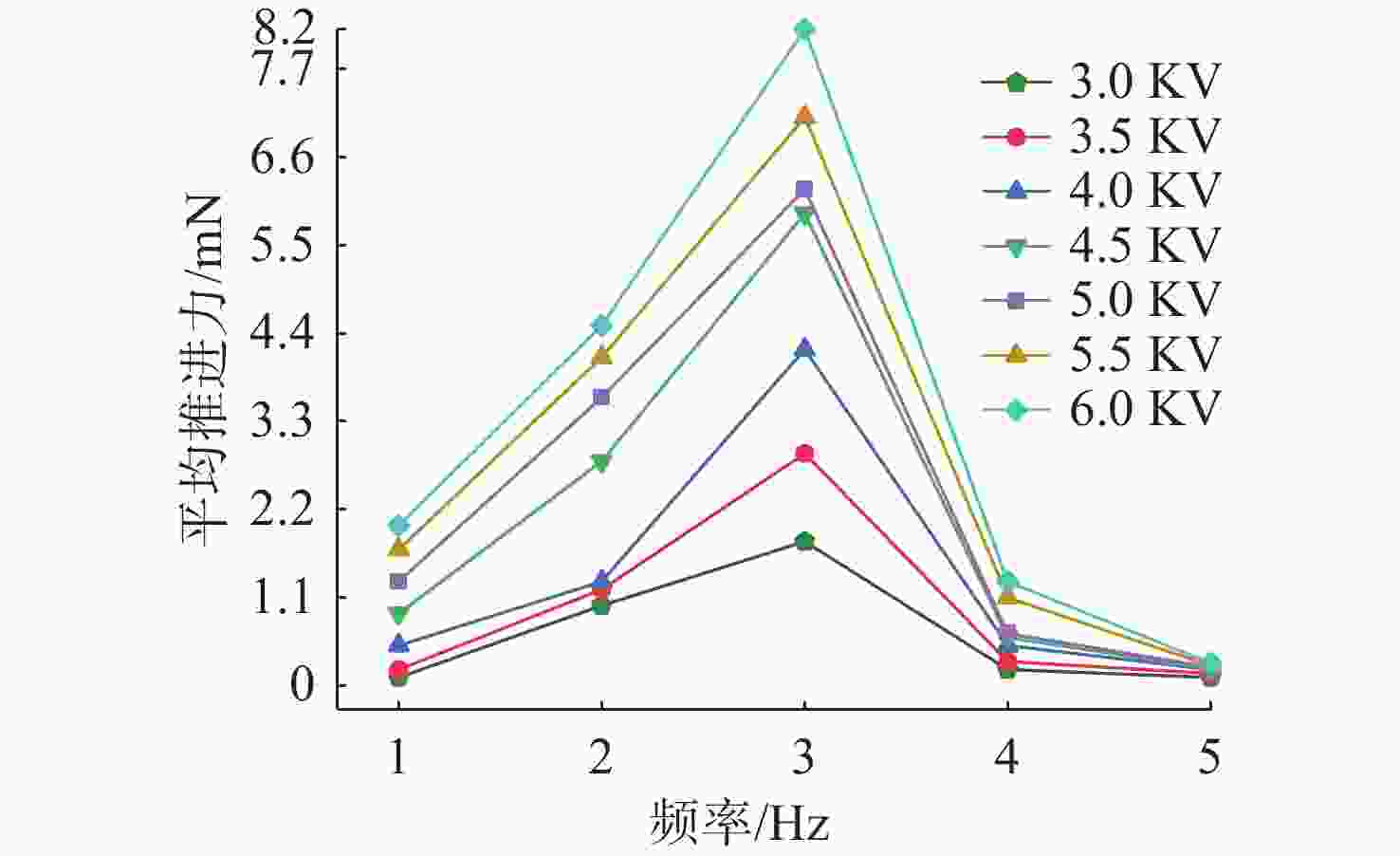
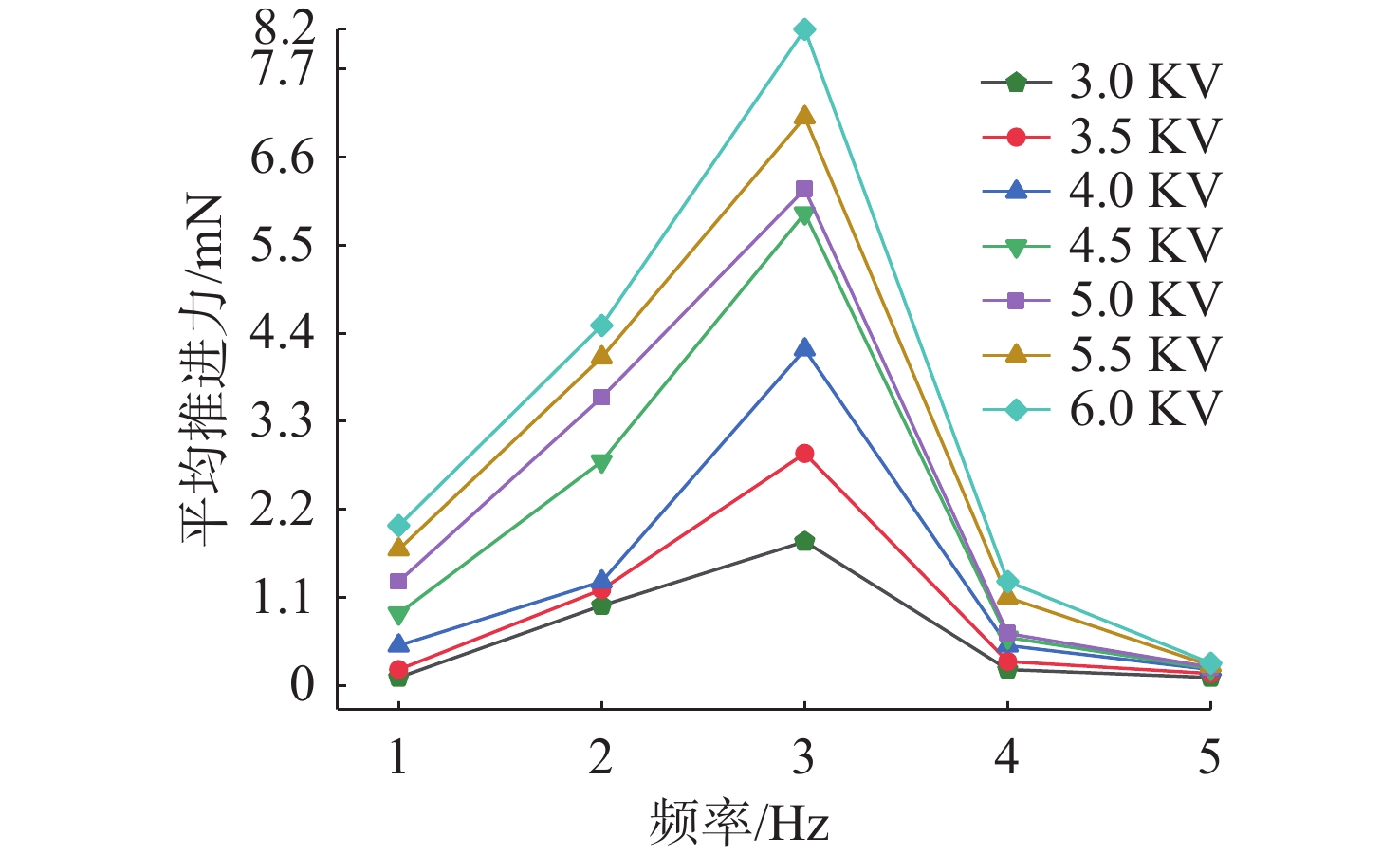
图 11 不同驱动电压和频率下鱼尾平均推进力
Figure 11. Average thrust of caudal fin under different driving voltages and frequencies
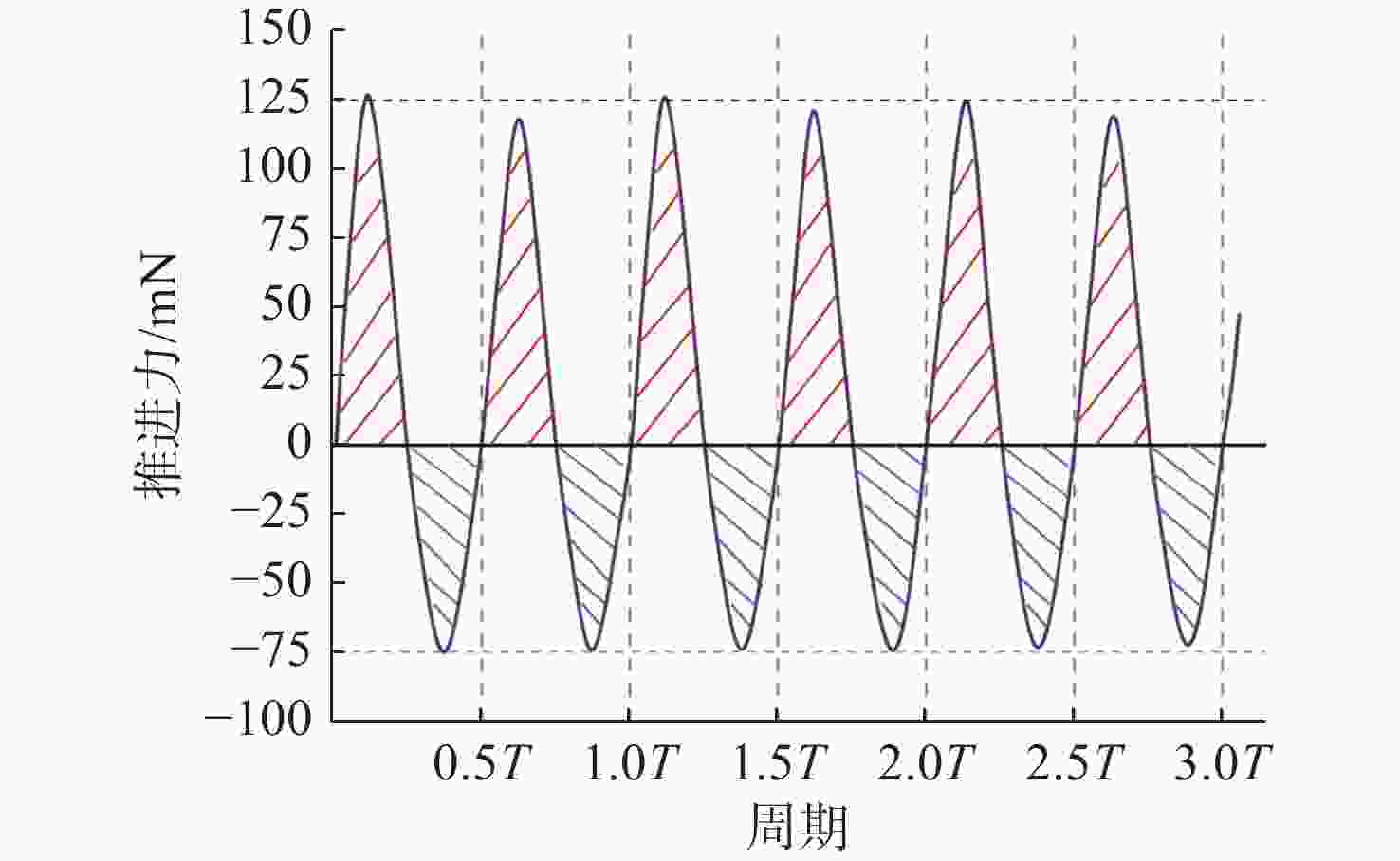
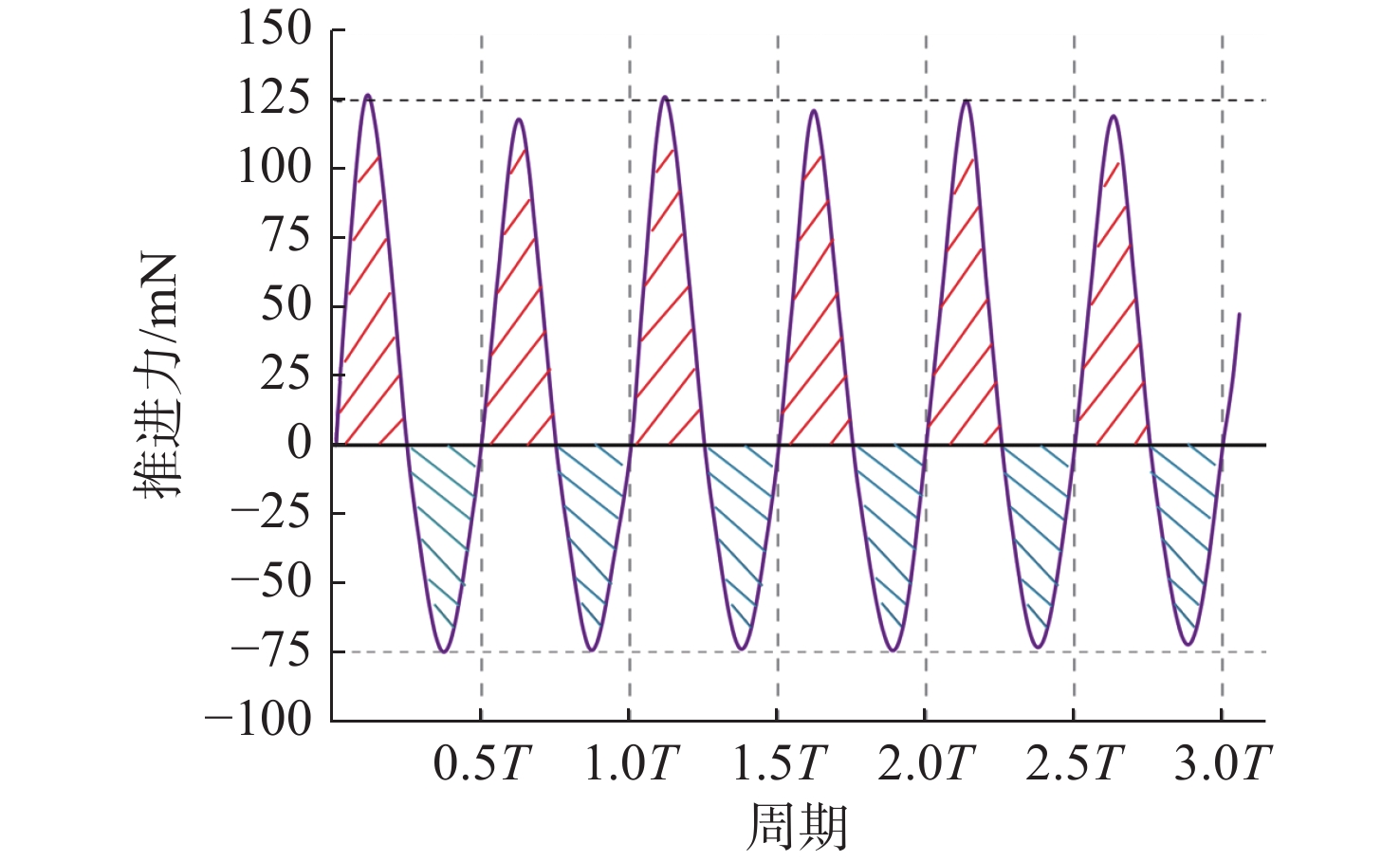
图 12 6 kV、3 Hz电压条件下鱼尾CFD仿真推进力曲线
Figure 12. CFD simulation curve of propulsive force for caudal fin at 6 kV and 3 Hz
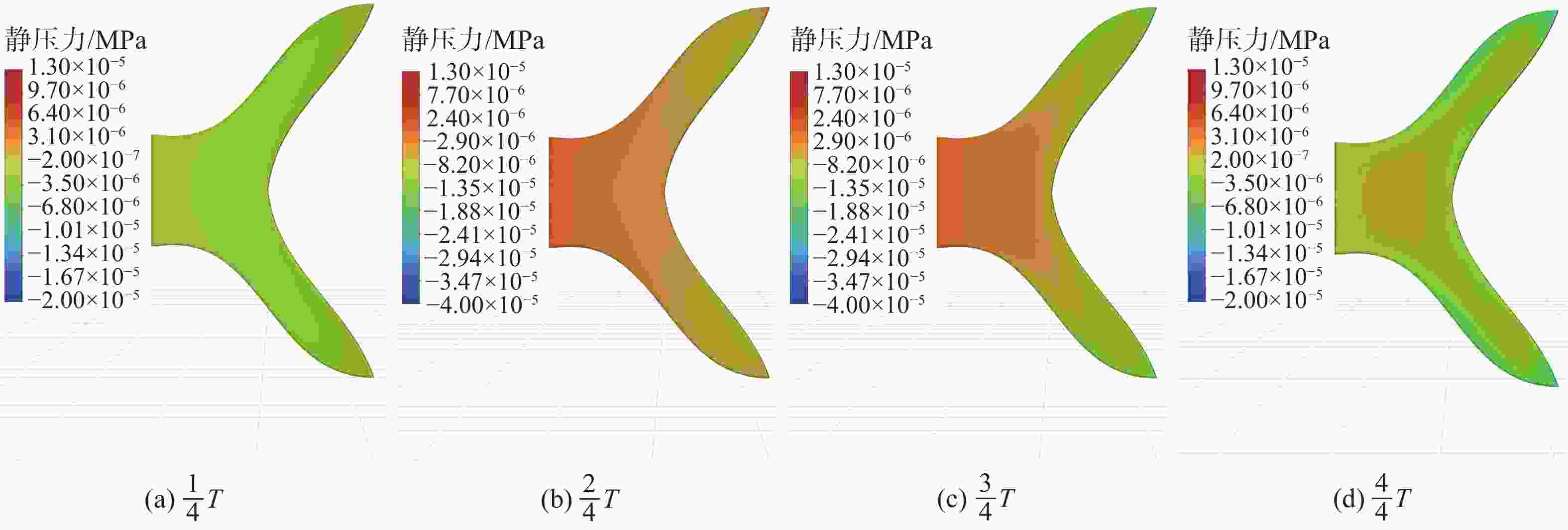
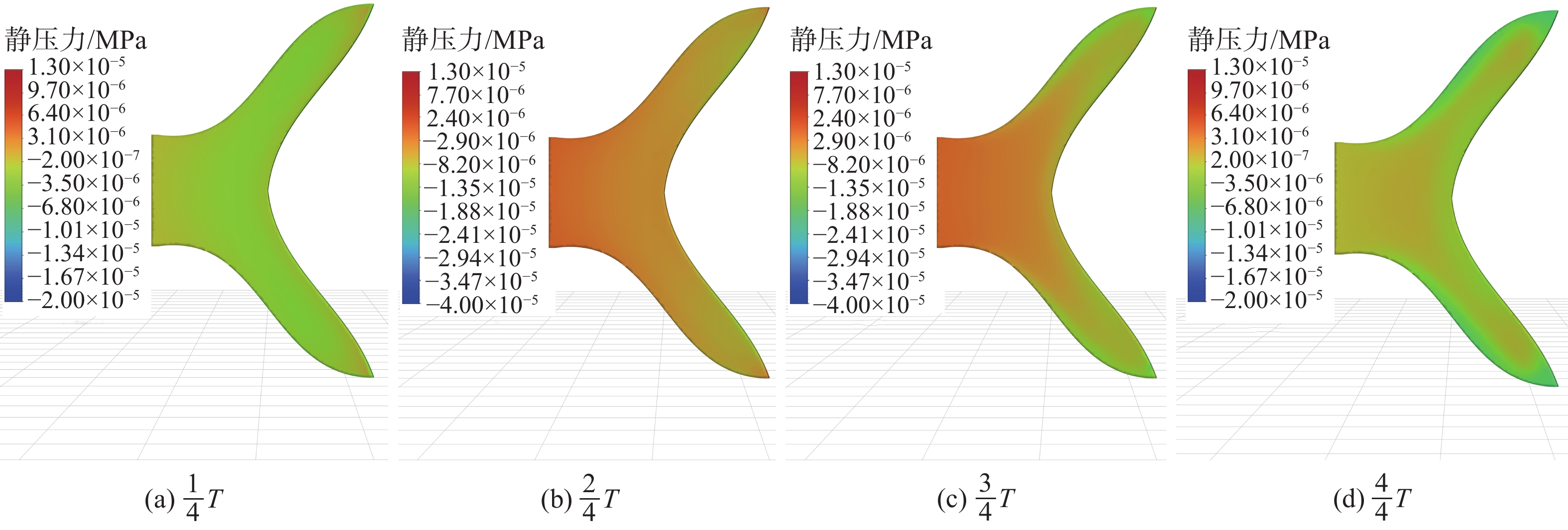
图 13 鱼尾单周期内压强云图
Figure 13. Pressure contour nephogram of bionic caudal fin in one motion cycle
表 1 弹簧规格参数
Table 1. Spring specification parameters
型号 线径/mm 外径/mm 长度/mm 1 1.0 12 120 2 1.2 22 120 3 1.5 22 150 4 1.8 22 180  下载: 导出CSV
表 2 4种不同弹簧型号下平均值
Table 2. Average values of springs under different processes for four models
型号 驱动力/N 弯曲角度/(°) 击穿电压/kV 1 0.38 44 6.5 2 0.44 30 6.5 3 0.66 36 6.5 4 0.76 40 6.0
下载: 导出CSV
表 3 EAP致动器的性能测试及功能检测
Table 3. Performance test and function test of EAP actuator
弯曲方向 左侧通电/kV 右侧通电/kV 弯曲角度/(°) 输出应力/N 左 0 6 42 0.82 右 6 0 43 0.83
下载: 导出CSV
-
[1] Wang R Q, Zhang C, Zhang Y W, et al. Fast-swimming soft robotic fish actuated by bionic muscle[J]. Soft robotics, 2024, 11(5): 845-856. doi: 10.1089/soro.2023.0163 [2] 包海默, 侯舒荣, 宋梅萍, 等. 水下机器人仿生胸鳍设计研究进展[J]. 机械设计, 2023, 40(12): 139-148. doi: 10.13841/j.cnki.jxsj.2023.12.026Bao H M, Hou S R, Song M P, et al. Research progress of bionic pectoral fin design for underwater robots[J]. Mechanical Design, 2023, 40(12): 139-148. doi: 10.13841/j.cnki.jxsj.2023.12.026 [3] 王勇. 介电弹性体柔性仿生机器鱼的设计[D]. 哈尔滨: 哈尔滨工业大学, 2020: 9-34. [4] Coltelli M A, Catterlin J, Scherer A , et al. Simulations of 3D-printable biomimetic artificial muscles based on microfluidic micro-capacitors for exoskeletal actuation and stealthy underwater propulsion[J]. Sensors and Actuators A: Physical, 2021, 325: 112700. [5] Nguyen Q S, Heo S, Park H C, et al. Performance evaluation of an improved fish robot actuated by piezoceramic actuators[J]. Smart Materials and Structures, 2010, 19(3): 1-8. doi: 10.1088/0964-1726/19/3/035030 [6] 刘世琦. 压电双尾鳍式微型机器鱼动力学分析研究[D]. 北京: 北方工业大学, 2021: 17-49. [7] 高飞. SMA驱动仿生机器鱼的尾鳍和喷射推进性能及其实验研究[D]. 哈尔滨: 哈尔滨工业大学, 2015: 19-81. [8] 夏期荣, 董二宝, 杨杰. 基于SMA柔性致动器的机器鱼设计与试验[J]. 新技术新工艺, 2018(8): 17-21.Xia Q R, Dong E B, Yang J. Design and test of robot fish based on SMA flexible actuator[J]. New Technology and New Process, 2018(8): 17-21. [9] Li T F, Li G R, Liang Y M, et al. Fast-moving soft electronic fish [J]. Science Advances, 2017, 3(4): e1602045. [10] Shintake J, Cacucciolo V, Shea H, et al. Soft biomimetic fish robot made of dielectric elastomer actuators[J]. Soft robotics, 2018, 5(4): 466-474. doi: 10.1089/soro.2017.0062 [11] 李梦梦, 李原, 王庆林. EAP柔性智能驱动材料的建模、控制及应用研究进展[J]. 机器人, 2018, 40(5): 660-672. doi: 10.13973/j.cnki.robot.180210Li M M, Li Y, Wang Q L. Research progress on modeling, control and application of EAP flexible intelligent driving materials[J]. Robot, 2018, 40(5): 660-672. doi: 10.13973/j.cnki.robot.180210 [12] 孙伟, 柳素娉, 吴罡, 等. 鱼类游动机理研究进展[J]. 大连海洋大学学报, 2024, 39(4): 1-14.Sun W, Liu S P, Wu G, et al. Research progress of fish swimming mechanism[J]. Journal of Dalian Ocean University, 2024, 39(4): 1-14. [13] 李晓锋, 梁松苗, 李艳芳, 等. 仿生材料电活性聚合物“人工肌肉”的研究进展[J]. 高分子通报, 2008(8): 134-145. doi: 10.14028/j.cnki.1003-3726.2008.08.007Li X F, Liang S M, Li Y F, et al. Progress in biomimetic electroactive polymer artificial muscles[J]. Polymer Bulletin, 2008(8): 134-145. doi: 10.14028/j.cnki.1003-3726.2008.08.007 [14] 胡瑞南, 梅杰, 程正树, 等. 尾鳍摆动驱动仿生机器鱼的水动力性能仿真分析[J]. 武汉科技大学学报, 2020, 43(6): 463-470.Hu R N, Mei J, Cheng Z S, et al. Simulation and analysis of hydrodynamic performance of bionic robotic fish driven by swinging tail fin[J]. Journal of Wuhan University of Science and Technology, 2020, 43(6): 463-470. [15] 冯亿坤. 尾鳍与胸鳍联合推进的仿生鱼自主游动数值模拟研究[D]. 哈尔滨: 哈尔滨工程大学, 2021: 147-161. [16] 包海默, 胡晓惠, 宋梅萍, 等. 尾鳍驱动型水下机器人发展综述[J]. 包装工程, 2023, 44(18): 128-146. doi: 10.19554/j.cnki.1001-3563.2023.18.016Bao H M, Hu X H, Song M P, et al. Review on development of caudal-fin-driven underwater vehicle[J]. Packaging Engineering, 2023, 44(18): 128-146. doi: 10.19554/j.cnki.1001-3563.2023.18.016 [17] 王安忆, 刘贵杰, 王新宝, 等. 身体/尾鳍推进模式仿生机器鱼研究的进展与分析[J]. 机械工程学报, 2016, 52(17): 137-146. doi: 10.3901/JME.2016.17.137Wang A Y, Liu G J, Wang X B, et al. Progress and analysis of bionic robotic fish with body/tail propulsion Model[J]. Chinese Journal of Mechanical Engineering, 2016, 52(17): 137-146. doi: 10.3901/JME.2016.17.137 [18] 崔祚, 姜洪州. 摆动推进鱼类鱼体波复模态分解及其特性分析[J]. 水下无人系统学报, 2020, 28(2): 119-125.Cui Z, Jiang H Z. Complex modal decomposition and characteristics analysis of the midline motions of swimming fish propelled by undulating body and caudal fin[J]. Journal of Unmanned Undersea Systems, 2020, 28(2): 119-125. [19] 李健. 仿生乌贼推进器及其流体动力仿真和实验研究[D]. 哈尔滨: 哈尔滨工业大学, 2011: 71-72. [20] 崔祚, 姜洪洲, 何景峰, 等. BCF仿生鱼游动机理的研究进展及关键技术分析[J]. 机械工程学报, 2015, 51(16): 177-184. doi: 10.3901/JME.2015.16.177Cui Z, Jiang H Z, He J F, et al. Research progress and key technology analysis of BCF bionic fish propulsion mechanism[J]. Journal of Mechanical Engineering, 2015, 51(16): 177-184. doi: 10.3901/JME.2015.16.177 [21] Fang D H, Zhang J S, Huang Z W. Modal analysis on mechanism of bionic fish swimming by dynamic mode decomposition [J]. Ocean Engineering, 2023, 273: 113897. -

 下载:
下载:


 点击查看大图
计量
- 文章访问数: 789
- HTML全文浏览量: 460
- PDF下载量: 180
- 被引次数: 0