

Construction and Validation of a Real-Time Ocean Temperature and Salinity Prediction System Based on Holt-DI-EnKF
-
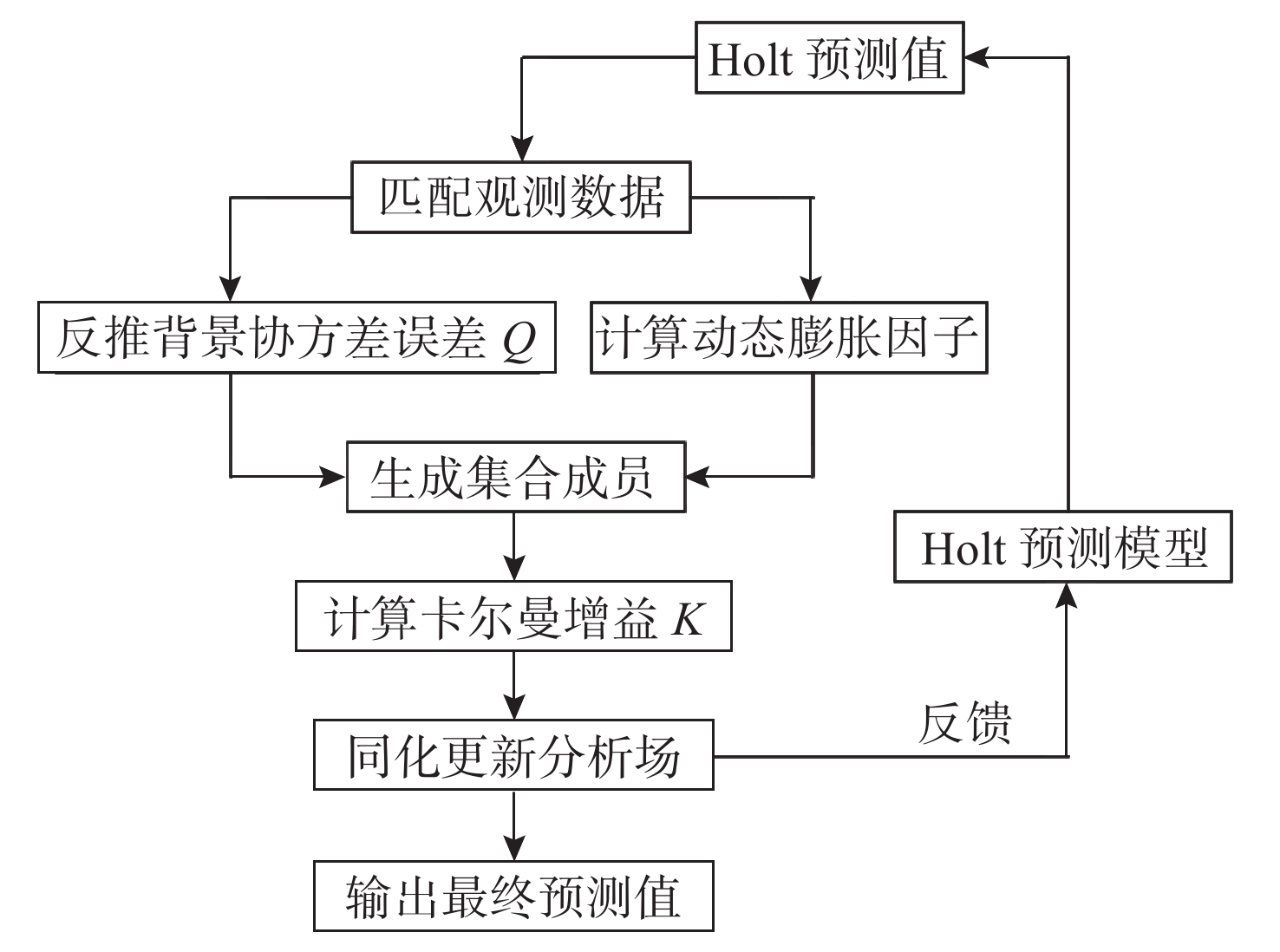
摘要: 针对传统海洋温盐预测方法动态更新能力弱、不确定性量化依赖分布假设、数据同化与预测模型割裂的问题, 聚焦单点月平均温盐时间序列的实时预测任务, 构建兼顾精度、动态适应性与工程实用性的轻量化预测框架。文中集成并改进了经典的时间序列预测、不确定性估计与数据同化方法, 提出融合Holt二次指数平滑、Bootstrap置信区间与动态膨胀集合卡尔曼滤波(DI-EnKF)的预测框架, 即通过Holt模型分解温盐序列并优化参数, 利用Bootstrap量化预测不确定性, 并结合DI-EnKF同化实时观测数据修正误差, 形成“预测-同化”闭环。该框架在全球Argo温盐数据测试中, 温度预测精度显著优于差分自回归移动平均-长短期记忆网络(ARIMA-LSTM)、ARIMA-反向传播(ARIMA-BP)神经网络等混合模型, 盐度预测精度接近最优对比模型。
-
关键词:
- 海洋温盐预测 /
- Holt二次指数平滑 /
- Bootstrap置信区间 /
- DI-EnKF /
- 数据同化
Abstract: To address the limitations of traditional ocean temperature and salinity prediction methods, such as weak dynamic update capability, distribution-dependent uncertainty quantification, and disjointed data assimilation and prediction models, this study focused on real-time prediction of monthly average temperature and salinity time series at a single point to develop a lightweight prediction framework balancing accuracy, dynamic adaptability, and engineering practicality. It integrated and advanced classic time series prediction, uncertainty estimation, and data assimilation methods, proposing a hybrid framework of Holt’s double exponential smoothing, Bootstrap confidence intervals, and dynamically inflated ensemble Kalman filter(DI-EnKF). Specifically, the Holt model decomposed sequences and optimized parameters; Bootstrap quantified prediction uncertainty, and DI-EnKF assimilated real-time observation data to correct errors, forming a “prediction-assimilation” closed loop. Tests on global Argo temperature and salinity data demonstrate that the framework outperforms hybrid models such as autoregressive integrated moving average-long short-term memory(ARIMA-LSTM) network and autoregressive integrated moving average-back propagation(ARIMA-BP) neural network in temperature prediction, with salinity prediction accuracy close to the optimal comparison model. The effectiveness and robustness of the framework are verified. -
表 1 温度预测误差对比
Table 1. Comparison of temperature prediction errors
模型 MAE/℃ RMSE/℃ MAPE/% Holt-DI-EnKF 0.229 0.318 1.05 ARIMA(1,1,0)+LSTM 2.154 2.867 9.87 ARIMA(0,1,1)+LSTM 2.478 3.245 11.34 ARIMA(1,1,1)+LSTM 2.301 3.012 10.54 ARIMA(1,1,0)+BP 1.987 2.645 9.12 ARIMA(0,1,1)+BP 2.112 2.812 9.68 ARIMA(1,1,1)+BP 2.045 2.732 9.38  下载: 导出CSV
表 2 盐度预测误差对比
Table 2. Comparison of salt prediction errors
模型 MAE/‰ RMSE/‰ MAPE/% Holt-DI-EnKF 0.088 0.094 0.25 ARIMA(1,1,0)+LSTM 0.091 0.101 0.26 ARIMA(0,1,1)+LSTM 0.095 0.105 0.27 ARIMA(1,1,1)+LSTM 0.089 0.099 0.25 ARIMA(1,1,0)+BP 0.103 0.112 0.29 ARIMA(0,1,1)+BP 0.107 0.116 0.30
下载: 导出CSV
表 3 温度预测消融实验的误差对比
Table 3. Comparison of errors in temperature prediction ablation experiments
区域 模型 MAE/℃ RMSE/℃ MAPE/% 52°N,163°E Holt 0.2413 0.5577 7.61 Holt+EnKF 0.0349 0.0462 1.02 Holt-DI-EnKF 0.0338 0.0447 0.99 42°S,56°E Holt 1.2946 1.3327 10.99 Holt+EnKF 0.0870 0.1173 0.80 Holt-DI-EnKF 0.0357 0.0443 0.33 52°N,163°W Holt 0.1738 0.4919 2.87 Holt+EnKF 0.0184 0.0252 0.43 Holt-DI-EnKF 0.0184 0.0247 0.43 58°S, 160°W Holt 0.6102 0.6516 25.83 Holt+EnKF 0.1150 0.1234 4.91 Holt-DI-EnKF 0.1118 0.1201 4.79
下载: 导出CSV
表 4 盐度预测消融实验的误差对比
Table 4. Comparison of errors in salt prediction ablation experiments
区域 模型 MAE/‰ RMSE/‰ MAPE/% 52°N,163°E Holt 0.0331 0.0460 0.10 Holt+EnKF 0.0305 0.0408 0.09 Holt-DI-EnKF 0.0303 0.0460 0.09 42°S,56°E Holt 0.6780 0.7285 1.94 Holt+EnKF 0.0338 0.0436 0.11 Holt-DI-EnKF 0.0383 0.0431 0.11 52°N,163°W Holt 0.0399 0.0742 0.12 Holt+EnKF 0.0319 0.0555 0.12 Holt-DI-EnKF 0.0318 0.0552 0.10 58°S,160°W Holt 0.0248 0.0265 0.07 Holt+EnKF 0.0241 0.0261 0.07 Holt-DI-EnKF 0.0243 0.0262 0.07
下载: 导出CSV
表 5 单点温盐预测各模块计算耗时
Table 5. Computation time of each module for single-point temperature/salinity prediction
模块 所需时间/s 温度 Holt 19.12 Holt-DI-EnKF 0.08 其余模块 6.97 总计 26.17 盐度 Holt 19.35 Holt-DI-EnKF 0.09 其余模块 7.10 总计 26.54
下载: 导出CSV
-
[1] 王宁. 面向机器学习的海洋环境数据分析与预测研究[D]. 唐山: 华北理工大学, 2020: 3-4. [2] 张建华. 海温预报知识讲座第一讲海水温度预报概况[J]. 海洋预报, 2003, 20(4): 81-85. [3] Liu H L, Lin P F, Zheng W P, et al. A global eddy-resolving ocean forecast system in China-LICOM Forecast System(LFS)[J]. Journal of Operational Oceanography, 2023, 16(1): 15-27. doi: 10.1080/1755876X.2021.1902680 [4] 金向泽, 张学洪. 温盐环流与全球增暖的数值模拟 (一)纬向平均温盐环流的模拟[J]. 大气科学, 1994, 18(z1): 769-779.Jin X Z, Zhang X H. Simulation of thermohaline circulation and global warming── (I)simulation of zonal mean thermohaline circulation[J]. Chinese Journal of Atmospheric Sciences, 1994, 18(z1): 769-779. [5] 杜扬帆, 伍孝飞, 乔百友. 基于XGBoost-PredRNN++的海表面温度预测[J]. 计算机系统应用, 2022, 31(10): 236-244. [6] 桑燕芳, 王中根, 刘昌明. 水文时间序列分析方法研究进展[J]. 地理科学进展, 2013, 32(1): 20-30.Sang Y F, Wang Z G, Liu C M. Research progress on the time series analysis methods in hydrology[J]. Progress in Geography, 2013, 32(1): 20-30. [7] Evensen G. The ensemble Kalman filter: Theoretical formulation and practical implementation[C]//Conference on Seminar on Recent Developments in Data Assimilation for Atmosphere and Ocean, 2004: 221-264. [8] 沈浙奇, 唐佑民, 高艳秋. 集合资料同化方法的理论框架及其在海洋资料同化的研究展望[J]. 海洋学报, 2016, 38(3): 1-14.Shen Z Q, Tang Y M, Gao Y Q. The theoretical framework of the ensemble-based data assimilation method and its prospect in oceanic data assimilation[J]. Acta Oceanologica Sinica, 2016, 38(3): 1-14. [9] 李亚蒙, 丁军航, 孙宝楠, 等. BP和RBF神经网络应用于海表温盐短期预测效果对比[J]. 海洋科学进展, 2022, 40(2): 220-232. doi: 10.12362/j.issn.1671-6647.2022.02.006Li Y M, Ding J H, Sun B N, et al. Comparison of short-term prediction effects of the sea surface temperature and salinity based on BP and RBF neural network[J]. Advances in Marine Science, 2022, 40(2): 220-232. doi: 10.12362/j.issn.1671-6647.2022.02.006 [10] 高国栋, 张文孝, 慕光宇. RBF网络和BP网络在海水盐度建模中的比较研究[J]. 海洋通报, 2011, 30(1): 12-15. doi: 10.3969/j.issn.1001-6392.2011.01.003Gao G D, Zhang W X, Mu G Y. A comparative study on RBF network and BP network in the model of salinity[J]. Marine Science Bulletin, 2011, 30(1): 12-15. doi: 10.3969/j.issn.1001-6392.2011.01.003 [11] 董世超. 基于ARIMA-BP神经网络模型海流流速预测研究[J]. 中国科技信息, 2014(2): 86-88. [12] 胡泽煜. 基于非平稳时间序列的海面温度预测研究[D]. 上海: 上海海洋大学, 2021: 4, 31. [13] 贺琪, 胡泽煜, 徐慧芳, 等. 基于经验模态分解-门控循环模型的海表温度预测方法[J]. 激光与光电子学进展, 2021, 58(24): 334-342.He Q, Hu Z Y, Xu H F, et al. Sea surface temperature prediction method based on empirical mode decomposition-gated recurrent unit model[J]. Laser & Optoelectronics Progress, 2021, 58(24): 2415005 [14] Yang Y T, Dong J Y, Sun X, et al. A CFCC-LSTM model for sea surface temperature prediction[J]. IEEE Geoscience and Remote Sensing Letters, 2018, 15(2): 207-211. doi: 10.1109/LGRS.2017.2780843 [15] Healy M J R. Smoothing, forecasting and prediction of discrete time series[J]. Journal of the Royal Statistical Society: Series A(Statistics in Society), 1964, 127(2): 292-293. doi: 10.2307/3150192 [16] Holt C C. Forecasting seasonals and trends by exponentially weighted moving averages[J]. International Journal of Forecasting, 2004, 20(1): 5-10. [17] Winters P R. Forecasting sales by exponentially weighted moving averages[J]. Management Science, 1960, 6(3): 324-342. doi: 10.1287/mnsc.6.3.324 [18] Hyndman R J, Koehler A B, Ord J K, et al. Prediction intervals for exponential smoothing using two new classes of state space models[J]. Journal of Forecasting, 2005, 24(1): 17-37. doi: 10.1002/for.938 [19] Bergmeir C, Hyndman R J, Benitez J M. Bagging exponential smoothing methods using STL decomposition and Box-Cox transformation[J]. International Journal of Forecasting, 2016, 32(2): 303-312. doi: 10.1016/j.ijforecast.2015.07.002 [20] 张雅乐, 俞永强, 段晚锁. 四个耦合模式ENSO后报试验的“春季预报障碍”[J]. 气象学报, 2012, 70(3): 506-519. [21] Pauthenet E, Bachelot L, Balem K, et al. Four-dimensional temperature, salinity and mixed-layer depth in the Gulf Stream, reconstructed from remote-sensing and in situ observations with neural networks[J]. Ocean Science, 2022, 18(4): 1221-1244. doi: 10.5194/os-18-1221-2022 [22] Efron B. Bootstrap methods: Another look at the Jackknife[J]. The Annals of Statistics, 1979, 7(1): 1-26. doi: 10.1214/aos/1176344552 [23] Samal U, Kumar A. Improving software reliability: A hybrid ARIMA-LSTM approach for fault prediction[J]. International Journal of System Assurance Engineering and Management, 2025: 1-13. -

 下载:
下载:

 点击查看大图
计量
- 文章访问数: 638
- HTML全文浏览量: 298
- PDF下载量: 129
- 被引次数: 0