


Research Status and Development Trends of Foreign Submarine Detection Technologies
-
摘要: 潜艇的最大威胁源于其隐蔽性。近年来, 随着潜艇降噪技术的持续发展及电子对抗烈度的不断增强, 提升潜艇探测手段与能力的需求日益迫切。文中综述了潜艇噪声、磁场、尾流和重力场等工作特性和典型作战模式, 阐述了不同探潜平台与探测方式的优势和不足, 归纳了声学探测、磁异探测等主流方法的发展现状和国外典型装备型号; 从抗干扰能力、实时数据处理及信息融合、无人系统协同及自主决策等方面分析了潜艇探测领域关键技术。分析表明, 新质探测手段与多源信息融合技术相结合可有效提升探测效能, 而无人系统协同、自主决策等能力的发展有望成为探潜模式转变的突破口, 可为未来潜艇探测领域的发展提供参考。Abstract: The primary threat of submarines stems from their concealment. In recent years, with the advancement of submarine noise reduction technologies and the intensification of electronic countermeasures, enhancing submarine detection methods and capabilities has become increasingly urgent. This paper reviewed the operational characteristics(including noise, magnetic field, wake, and gravitational field) and typical combat modes of submarines, expounded on the advantages and limitations of different anti-submarine platforms and detection approaches, and summarized the development status of mainstream detection methods(such as acoustic detection and magnetic anomaly detection), as well as representative foreign models. It analyzed the key technologies for submarine detection from three aspects: anti-jamming capability, real-time data processing and information fusion, and unmanned system collaboration and autonomous decision-making. The analysis indicates that the integration of new-type detection means with multi-source information fusion can effectively improve detection performance, while the development of capabilities like unmanned system collaboration and autonomous decision-making may serve as a breakthrough for the transformation of anti-submarine modes. This study provides valuable references for future research and development efforts in the field of submarine detection.
-
Key words:
- submarine /
- detection technology /
- sonar /
- magnetic detector /
- unmanned system collaboration
-
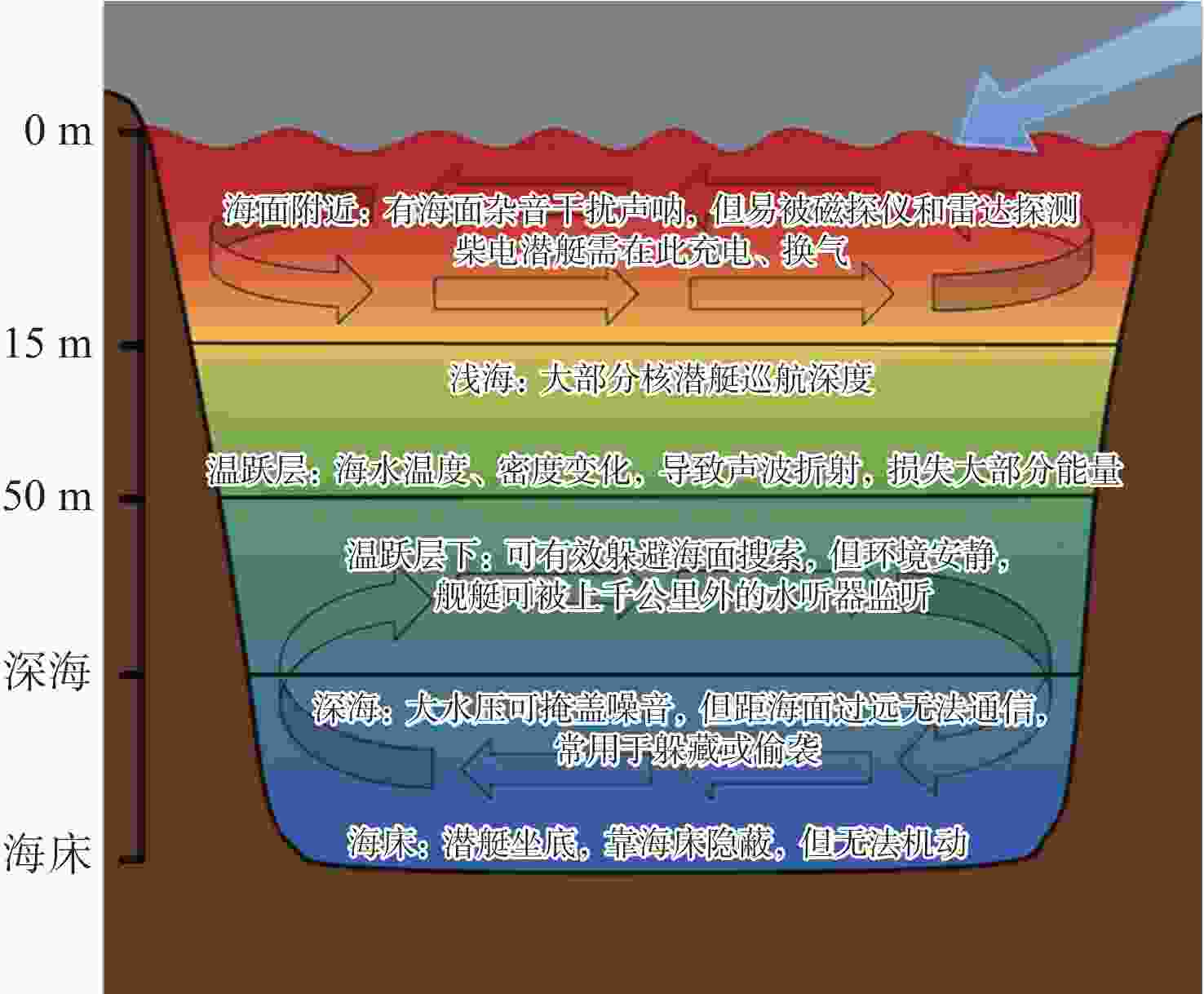
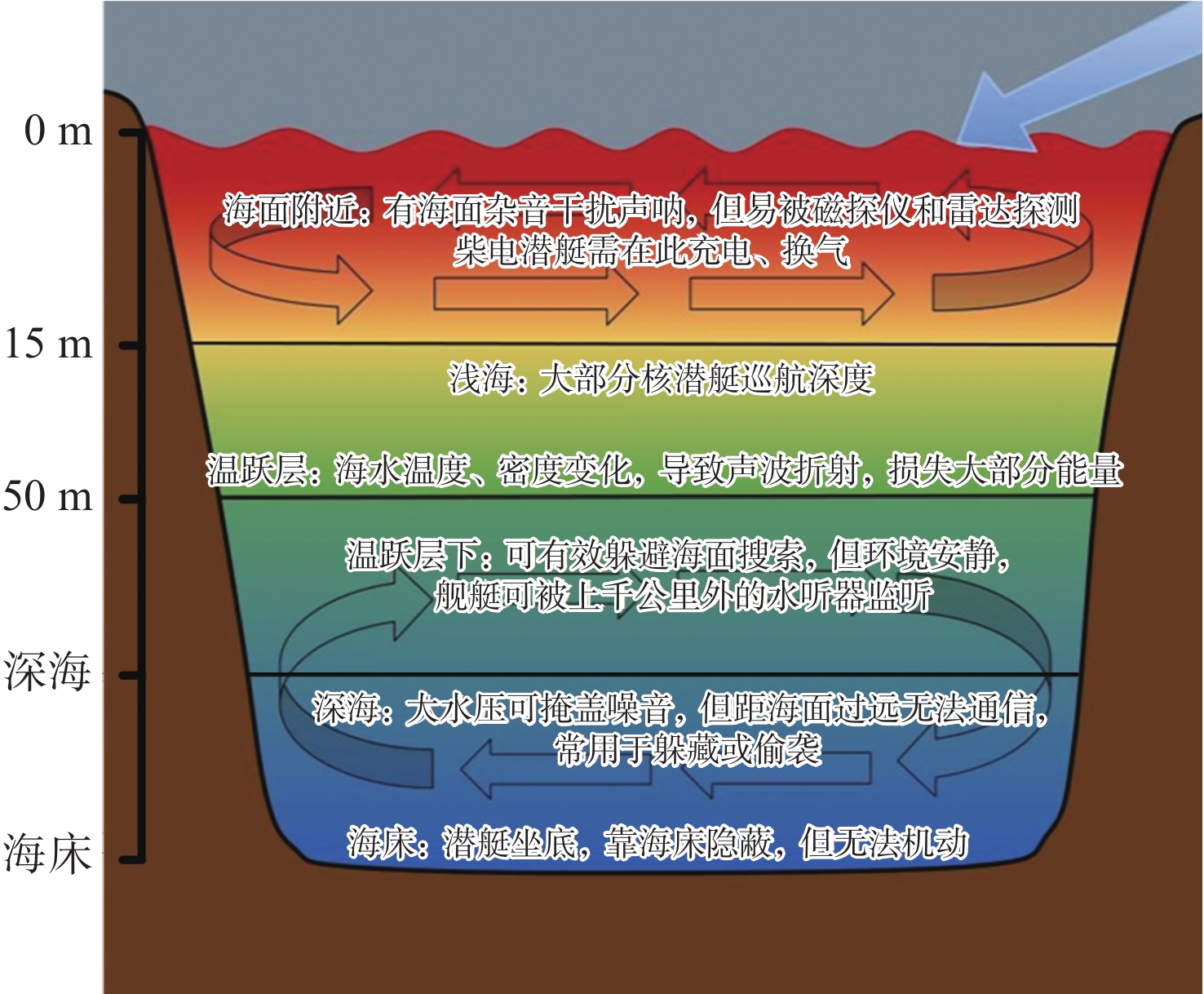
图 1 不同海深环境对应的潜艇工作模式
Figure 1. Submarine operating modes corresponding to different sea depth environments
表 1 潜艇作战模式
Table 1. Operational modes of submarines
作战模式 作战特点 优势 不足 典型应用场景 单艇作战 独立执行任务 灵活性高, 隐蔽性强 资源有限, 无法同时应对多目标 侦察、伏击、突袭 编队作战 多艘潜艇协同作战 包围攻击, 提高作战效率 指挥协调复杂, 隐蔽性降低 对敌方舰队进行全面打击 协同水面舰艇 潜艇-水面舰艇协同作战 火力、隐蔽结合, 形成多层次作战 协同作战复杂, 隐蔽性受影响 对敌方舰队进行联合打击 协同空中平台 潜艇-空中平台协同作战 实现快速侦察与精确攻击 空中平台可能暴露作战位置 快速反应与精确打击 协同岸基平台 潜艇-岸基平台协同作战 可提供长期监视及战略支援 监控范围有限, 通信受限 战略层面的持续监控与支援  下载: 导出CSV
表 2 舰艇探测平台概况
Table 2. Overview of shipborne detection platforms
平台类型 探测
范围探测
精度优势 不足 探测方式 空基平台 广 中等 隐蔽性高, 机动性强, 覆盖范围广, 适合大面积快速搜索。 探测深度有限, 受天气条件(如风浪、云层)影响较大, 维护和运营成本高。 通过雷达、声呐浮标、磁性探测器等传感器探测。 陆基平台 有限 高 隐蔽性高, 探测范围固定, 成本低, 适合防御性作战, 用于特定海域长期监控。 探测范围受限于传感器的布置位置, 易受地理环境(如海底地形、洋流)影响。 通过固定或移动的声呐阵列、雷达等设备探测。 水面舰艇 中等 中等 具备较强的机动性, 能够快速接近目标, 并执行搜攻一体化操作。 隐蔽性低, 适合近距离探测与攻击, 探测深度和精度受限于舰载声呐的性能。 通过舰载声呐、雷达、磁性探测器等设备探测潜艇。 水下平台 中等 高 探测精度高, 适合中近距离作战。能够执行长时间的水下任务。 舰艇水下对水下作战, 攻击后丧失隐蔽性, 机动性较差, 难以快速响应多目标, 维护成本较高。 可采用UUV, 或水中布放声呐、磁探仪, 通过水下传感器探测潜艇。
下载: 导出CSV
-
[1] 王堂屹. 探潜技术发展新方向的研究[J]. 中国科技纵横, 2021(23): 163-165.Wang T Y. Research on the new development direction of submarine exploration technology[J]. China Science & Technology Overview, 2021(23): 163-165. [2] 张石磊, 左平洋, 刘柳, 等. 探潜无人机技术发展概况及关键技术分析[J]. 飞航导弹, 2016(6): 18-21. doi: 10.16338/j.issn.1009-1319.2016.06.04Zhang S L, Zuo P Y, Liu L, et al. Overview of the technological development and analysis of key technologies for underwater exploration UAVs[J]. Aerodynamic Missile Journal, 2016(6): 18-21. doi: 10.16338/j.issn.1009-1319.2016.06.04 [3] 董鹏, 付敏飞, 周野, 等. 美国攻击型核潜艇发展研究[J]. 舰船科学技术, 2023, 45(21): 217-221.Dong P, Fu M F, Zhou Y, et al. American nuclear-powered attack submarine[J]. Ship Science and Technology, 2023, 45(21): 217-221. [4] 刘辉. 基于感应磁场的潜艇磁异常计算模型[J]. 水下无人系统学报, 2018, 26(2): 152-156. doi: 10.11993/j.issn.2096-3920.2018.02.009Liu H. Magnetic anomaly calculation model of submarine based on induced magnetic field[J]. Journal of Unmanned Undersea Systems, 2018, 26(2): 152-156. doi: 10.11993/j.issn.2096-3920.2018.02.009 [5] 伍浩松, 杨鹏. 美海军即将测试新型超静音核潜艇推进装置[J]. 国外核新闻, 2024(5): 10-10.Wu H S, Yang P. U. S. Navy to test new ultra-quiet nuclear submarine propulsion[J]. Foreign Nuclear News, 2024(5): 10-10. [6] 尤岳, 周涛, 陈科, 等. 水下无人航行器探潜能力建模与仿真分析[J]. 舰船科学技术, 2021, 43(19): 66-71.You Y, Zhou T, Chen K, et al. Submarine detection modeling and simulation of unmanned underwater vehicle[J]. Ship Science and Technology, 2021, 43(19): 66-71. [7] 成建波, 孙心毅. 航空磁异常探潜技术发展综述[J]. 声学与电子工程, 2018(3): 46-49.Cheng J B, Sun X Y. Review of the development of aerial magnetic anomaly technology for underwater target detection[J]. Acoustics and Electronics Engineering, 2018(3): 46-49. [8] 国妍, 王江安. 光电探测在探潜方面的发展分析[J]. 舰船科学技术, 2002, 24(4): 42-45.Guo Y, Wang J A. Development analysis of optoelectronic detection in underwater target detection[J]. Ship Science and Technology, 2002, 24(4): 42-45. [9] 于龙. 红外成像仪用于探潜技术的研究[J]. 红外, 2004(4): 31-35. doi: 10.3969/j.issn.1672-8785.2004.04.006Yu L. Research on infrared imagers applied to underwater target detection technology[J]. Infrared, 2004(4): 31-35. doi: 10.3969/j.issn.1672-8785.2004.04.006 [10] 王建华, 赵浩淞. 机载红外探潜系统综述[J]. 激光与红外, 2013, 43(6): 599-603. doi: 10.3969/j.issn.1001-5078.2013.06.001Wang J H, Zhao H S. Survey of airborned infrared system for submarine detection[J]. Laser & Infrared, 2013, 43(6): 599-603. doi: 10.3969/j.issn.1001-5078.2013.06.001 [11] 康乐, 孙宝三, 张维利, 等. 潜艇水声对抗航空声呐作战效能仿真研究[J]. 指挥控制与仿真, 2023, 45(3): 17-24.Kang L, Sun B S, Zhang W L, et al. Research on submarine underwater acoustic effectiveness against airborne sonar[J]. Command Control & Simulation, 2023, 45(3): 17-24. [12] 丛红日, 郭晏宗, 杨斌, 等. 反潜直升机使用吊放声呐持续跟踪潜艇作战使用方法及其效能仿真[J]. 海军航空工程学院学报, 2020, 35(3): 253-260.Cong H R, Guo Y Z, Yang B, et al. Incessant scouting submarine method and effectiveness evaluation of anti-submarine helicopter with dipping sonar[J]. Journal of Naval Aeronautical and Astronautical University, 2020, 35(3): 253-260. [13] 张飞飞, 赵申东, 李瑞红, 等. 基于潜艇规避的吊放声呐应召搜潜兵力需求研究与分析[J]. 指挥控制与仿真, 2024, 46(6): 27-31.Zhang F F, Zhao S H, Li R H, et al. Research and analysis on military strength demand of dipping sonar on-call submarine searching based on submarine evasion[J]. Command Control & Simulation, 2024, 46(6): 27-31. [14] 曹涛. 国外主动声呐装备发展及关键技术研究[J]. 声学与电子工程, 2023(4): 50-54.Cao T. Research on the development and key technologies of foreign active sonar equipment[J]. Acoustics and Electronics Engineering, 2023(4): 50-54. [15] 鲜勇, 鲁宏捷, 李佳庆, 等. 国外航空声呐浮标发展综述[J]. 电光与控制, 2019, 26(8): 67-70. doi: 10.3969/j.issn.1671-637X.2019.08.013Xian Y, Lu H J, Li J Q, et al. A review on development of foreign aviation sonobuoys[J]. Electronics Optics & Control, 2019, 26(8): 67-70. doi: 10.3969/j.issn.1671-637X.2019.08.013 [16] Taylor C M, Maskell S, Ralph J F. Using hybrid multiobjective machine learning to optimise sono-buoy placement patterns[J]. IET Radar, Sonar & Navigation, 2023, 17(3): 374-387. [17] 刘东涛, 黄赓. 新型舰用共形阵声呐性能分析[J]. 声学与电子工程, 2017(2): 13-16.Liu D T, Huang G. Performance analysis of a new type of shipborne conformal array sonar[J]. Acoustics and Electronics Engineering, 2017(2): 13-16. [18] 唐百胜, 韩雪建. 被动拖曳线列阵声呐探测性能影响因素分析[J]. 电声技术, 2024, 48(6): 1-7, 11.Tang B S, Han X J. Analysis on performance influencing factors of passive towed linear array sonar[J]. Audio Engineering, 2024, 48(6): 1-7, 11. [19] 赵培聪. 国外声呐技术研究现状与发展趋势[J]. 现代雷达, 2016, 38(8): 20-24, 69.Zhao P C. Research status and development trends of foreign sonar technology[J]. Modern Radar, 2016, 38(8): 20-24, 69. [20] Shepherd A. Ultra maritime partners with anduril for new XLUUV sensing capability[J]. Inside the Navy, 2025(15): 38. [21] 刘莎. 装载于美国P-8A反潜机平台的无人机磁探能力分析[J]. 舰船电子工程, 2022, 42(7): 166-168.Liu S. Analysis of the UAV magnetic exploration capability loaded on the U. S. P-8A anti-submarine aircraft platform[J]. Ship Electronic Engineering, 2022, 42(7): 166-168. [22] 董鹏, 孙哲, 邹念洋, 等. 国外磁探潜装备现状及发展趋势[J]. 舰船科学技术, 2018, 40(11): 166-169.Dong P, Sun Z, Zou N Y, et al. The situation and development trend of foreign magnetic exploration submarine equipment[J]. Ship Science and Technology, 2018, 40(11): 166-169. [23] 张朝阳, 刘济民, 杨林, 等. 磁探潜关键技术现状及发展趋势[J]. 科学技术与工程, 2022, 22(1): 18-27.Zhang Z Y, Liu J M, Yang L, et al. Situation and development trend of the key technology of magnetic submarine exploration[J]. Science Technology and Engineering, 2022, 22(1): 18-27. [24] 寇军, 康海霞, 杨然, 等. 原子磁力仪的空间应用及发展趋势[J]. 导航与控制, 2018, 17(6): 23-27.Kou J, Kang H X, Yang R, et al. Space application and development of atomic magnetometer[J]. Navigation and Control, 2018, 17(6): 23-27. [25] Boto E, Tierney T M, Holmes N, et al. Wearable brain-magnetometer mapping of human brain function[J]. Nature, 2022, 604(7906): 656-661. [26] Kominis I K, Kornack T W, Allred J C, et al. A subfemtotesla multichannel atomic magnetometer[J]. Nature, 2003, 422(6932): 596-599. doi: 10.1038/nature01484 [27] Seltzer S J, Romalis M V. Unshielded three-axis vector operation of a spin-exchange-relaxation-free atomic magnetometer[J]. Applied Physics Letters, 2004, 85(20): 4804-4806. [28] 刘腾蛟, 王丹, 刘金国, 等. 潜艇非声探测技术综述[J]. 水下无人系统学报, 2023, 31(4): 521-526.Liu T J, Wang D, Liu J G, et al. Review of non-acoustic detection technologies of submarines[J]. Journal of Unmanned Undersea Systems, 2023, 31(4): 521-526. [29] Zhang Z Q, Shi J, Zhang Y, et al. Feasibility analysis of submarine detection method based on the airborne gravity gradient[C]//2018 37th Chinese Control Conference: CCC 2018, 2018: 4587-4591. [30] 吕斯琪. 潜艇尾流及海面映波的探测方法研究[D]. 哈尔滨: 哈尔滨工业大学, 2022: 2. [31] Jia Y, Liu S Y, Liu Y Q, et al. Echo-level SAR imaging simulation of wakes excited by a submerged body[J]. Sensors, 2024, 24(4): 19. [32] 衣志航. 广域海面潜艇目标探测识别与融合跟踪方法的研究[D]. 哈尔滨: 哈尔滨工业大学, 2020: 13. [33] 王伟, 于福建, 张峻铭, 等. 基于云计算的探潜信息综合处理系统建设研究[J]. 数字海洋与水下攻防, 2022, 5(1): 80-85.Wang W, Yu F J, Zhang J M, et al. Construction research on integrated processing system of anti-submarine detection information based on cloud[J]. Digital Ocean & Underwater Warfare, 2022, 5(1): 80-85. [34] 赵绪明, 葛先军, 刘倩, 等. 舰艇编队功能反潜体系的构建与评估[J]. 海军航空工程学院学报, 2012(4): 464-468.Zhao X M, Ge X J, Liu Q, et al. Construction and evaluation of a functional anti-submarine system for warship formations[J]. Journal of Naval Aeronautical and Astronautical University, 2012(4): 464-468. [35] 王宁, 梁晓龙, 张佳强, 等. 跨域无人集群协同反潜搜索方法研究[J]. 系统仿真学报, 2024, 36(4): 817-824.Wang N, Liang X L, Zhang J Q, et al. Research on cross-domain unmanned swarm cooperative anti-submarine search method[J]. Journal of System Simulation, 2024, 36(4): 817-824. [36] 张延厚, 王超, 张奇, 等. 水声目标探测和识别融合技术发展综述[J]. 信号处理, 2023, 39(10): 1711-1727.Zhang Y H, Wang C, Zhang Q, et al. A review of underwater acoustic target detection and recognition technology based on information fusion[J]. Journal of Signal Processing, 2023, 39(10): 1711-1727. [37] Wang B, Wu C X, Zhu Y N, et al. Ship radiated noise recognition technology based on ML-DS decision fusion[J]. Computational Intelligence and Neuroscience, 2021, 2021: 8901565. doi: 10.1155/2021/8901565 [38] 郭庆昌, 王小康, 李晓东, 等. 无人航行器对抗敌反潜装备作战使用技术研究[J]. 数字海洋与水下攻防, 2022, 5(2): 127-132.Guo Q C, Wang X K, Li X D, et al. Research on operational use of UUVs against adversarial anti-submarine equipment[J]. Digital Ocean & Underwater Warfare, 2022, 5(2): 127-132. [39] 郝宇, 邱龙皓, 邹男, 等. 无人平台自主探测声呐的发展现状和展望[J]. 哈尔滨工程大学学报, 2021, 42(9): 1347-1354.Hao Y, Qiu L H, Zou N, et al. Development status and the prospect of autonomous detection sonar on unmanned platforms[J]. Journal of Harbin Engineering University, 2021, 42(9): 1347-1354. [40] 白卓, 张邦楚, 朱威禹, 等. 反潜作战制胜机理分析及对抗模式研究[J]. 现代防御技术, 2024, 52(3): 36-47.Bai Z, Zhang B C, Zhu W Y, et al. Analysis on winning mechanism and countermeasure mode of anti-submarine warfare[J]. Modern Defense Technology, 2024, 52(3): 36-47. -

 下载:
下载:

 点击查看大图
计量
- 文章访问数: 1721
- HTML全文浏览量: 638
- PDF下载量: 367
- 被引次数: 0
图(5) / 表(2)